YIN Lang, LI Shuchuan, YU Huamin, et al. Flexible electronic skin enabling SensorCraft[J]. Aeronautical Manufacturing Technology, 2026, 69(5): 25010109.
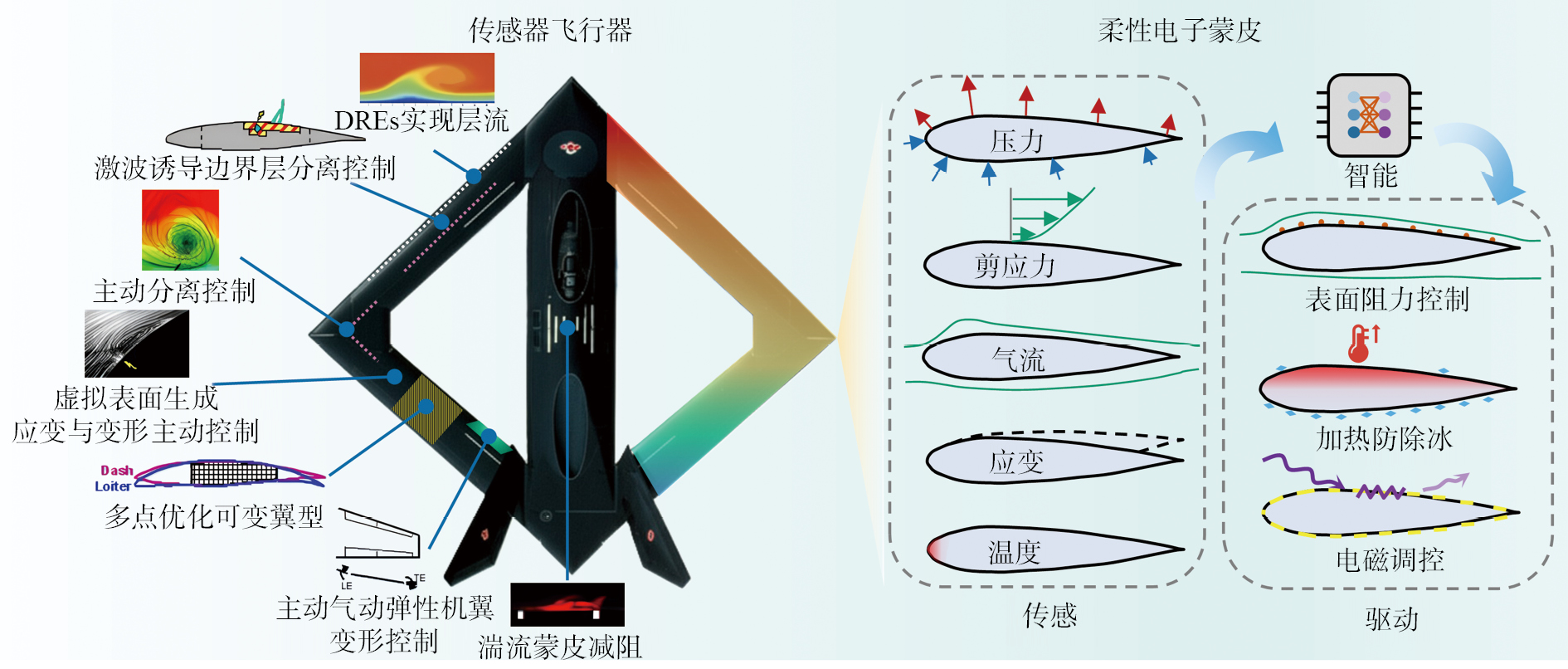
图1 传感器飞行器的技术需求及柔性电子蒙皮在其中的应用
图2 基于柔性电子蒙皮的传感器飞行器的重要进展[ XIONG W N, ZHU C, GUO D L, et al. Bio-inspired, intelligent flexible sensing skin for multifunctional flying perception[J]. Nano Energy, 2021, 90: 106550. 17, SUN B Y, MA B H, WANG P B, et al. High sensitive flexible hot-film sensor for measurement of unsteady boundary layer flow[J]. Smart Materials and Structures, 2020, 29(3): 035023. WANG Y, QIU L, LUO Y J, et al. A stretchable and large-scale guided wave sensor network for aircraft smart skin of structural health monitoring[J]. Structural Health Monitoring, 2021, 20(3): 861-876. SHIN H S, OTT Z, BEUKEN L G, et al. Bio-inspired large-area soft sensing skins to measure UAV wing deformation in flight[J]. Advanced Functional Materials, 2021, 31(23): 2100679. XU Z J, CAO L N Y, LI C Y, et al. Digital mapping of surface turbulence status and aerodynamic stall on wings of a flying aircraft[J]. Nature Communications, 2023, 14: 2792. ZHU C, XU Z Y, HOU C, et al. Flexible, monolithic piezoelectric sensors for large-area structural impact monitoring via MUSIC-assisted machine learning[J]. Structural Health Monitoring, 2024, 23(1): 121-136. ZHAO Q Y, HUANG J, GUO Y X, et al. Machine learning-assisted sparse observation assimilation for real-time aerodynamic field perception[J]. Science China Technological Sciences, 2024, 67(5): 1458-1469. TOPAC T, GRAY C, CHANG F K. Fly-by-feel: Learning aerodynamics from multimodal wing mechanics[C]//AIAA SCITECH 2024 Forum. Orlando: AIAA, 2024. GONG Z, DI W C, JIANG Y G, et al. Flexible calorimetric flow sensor with unprecedented sensitivity and directional resolution for multiple flight parameter detection[J]. Nature Communications, 2024, 15: 3091. WANG J X, WEI X Y, SHI J L, et al. High-resolution flexible iontronic skins for both negative and positive pressure measurement in room temperature wind tunnel applications[J]. Nature Communications, 2024, 15: 7094. 23-31]
图3 柔性壁面压力传感器原理及机翼集成
图4 柔性表面摩擦力传感器原理及机翼集成
图5 柔性气流传感器的原理和应用
图6 柔性应变传感器原理及集成
图7 柔性温度传感器及航空航天领域应用
图8 柔性电子蒙皮减阻技术
图9 柔性薄膜电加热技术
图10 柔性电子蒙皮电磁调控技术
图11 多物理量分布式传感柔性电子蒙皮
图12 多模态共位集成的柔性电子蒙皮
图13 使用神经网络/机器学习的方式对稀疏数据进行重构
图14 多物理量融合感知实现多参数估计
图15 基于柔性电子蒙皮的智能感知算法
图16 “感-控”闭环反馈系统架构
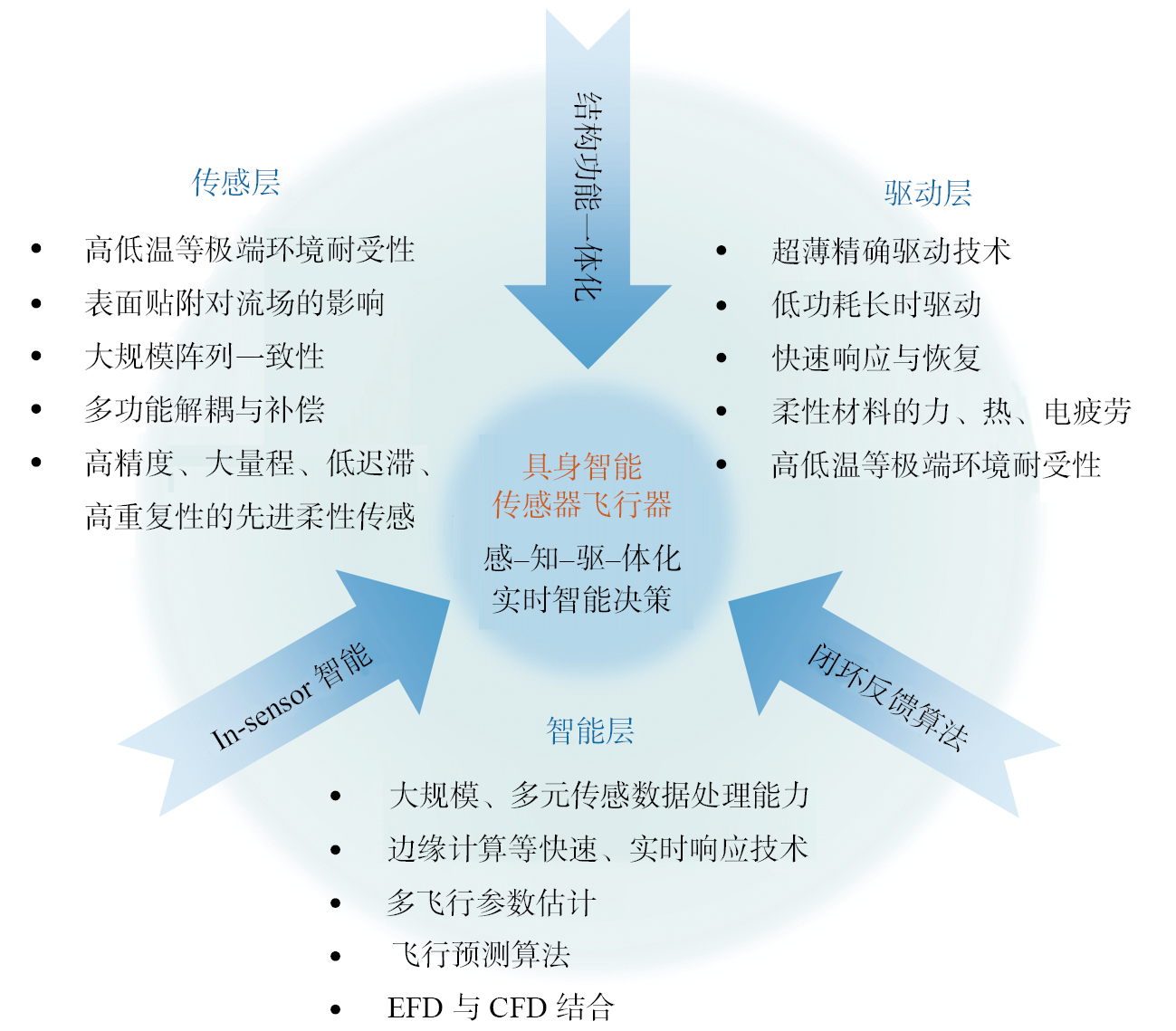
图17 具身智能传感器飞行器挑战与展望
表1 多功能集成方式对比[ XIONG W N, ZHU C, GUO D L, et al. Bio-inspired, intelligent flexible sensing skin for multifunctional flying perception[J]. Nano Energy, 2021, 90: 106550. 17, HUA Q L, SUN J L, LIU H T, et al. Skin-inspired highly stretchable and conformable matrix networks for multifunctional sensing[J]. Nature Communications, 2018, 9: 244. 145]
1.State Key Laboratory of Intelligent Manufacturing Equipment and Technology, Huazhong University of Science and Technology, Wuhan430074, China
2.Center for Advanced Electronic Manufacturing, School of Mechanical Science and Engineering, Huazhong University of Science and Technology, Wuhan430074, China
3.Flexible Electronics Research Center, Huazhong University of Science and Technology, Wuhan430074, China
Citations
YIN Lang, LI Shuchuan, YU Huamin, et al. Flexible electronic skin enabling SensorCraft[J]. Aeronautical Manufacturing Technology, 2026, 69(5): 25010109.
Abstract
Aerospace technology demands ever-higher standards for aircraft performance, safety, and intelligence. Traditional rigid sensors struggle to achieve real-time, in-situ measurement of multifunctional and large-scale sensory signals, and the extensive deployment of discrete rigid sensors has a non-negligible impact on the aircraft’s structure and its surface flow field. The advent of flexible electronics offers a new opportunity to overcome the bottlenecks of conventional sensing technology. Its inherent characteristics—such as being flexible and conformable—have fostered the development of new concepts like the “SensorCraft”. The core principle involves deploying large-scale, distributed sensor networks across the aircraft’s surface and within its structure for real-time, multi-modal perception of both the aircraft’s state and the external environment. This review systematically covers the key principles and representative device/system designs of flexible electronics for sensing surface flow characteristics (e.g., pressure, shear stress, airflow) and for perceiving aerodynamic forces and thermal conditions (e.g., strain, temperature). It also discusses the applications of flexible electronic skin in active actuation domains, including drag reduction, anti-/de-icing, and electromagnetic control. Combined with the burgeoning field of artificial intelligence, the functionality and intelligence of flexible electronic skins can be further expanded. Finally, the paper provides an outlook on the main challenges and future directions in this field, aiming to promote the development of embodied intelligence for SensorCraft.
航空航天领域的快速发展对飞行器的性能、安全性、经济性和智能化水平提出了越来越高的要求。传统飞行器主要依赖离散分布的、刚性的传感器(如皮托管、应变片、陀螺仪等)获取飞行姿态、速度、载荷等信息,并基于这些有限信息进行飞行控制和状态监测[ HARUN Z, AMER ABBAS A. Wind tunnel measurement techniques[M]//HARUN Z, APROVITOLA A, PEZZELLA G. Boundary Layer Flows-Advances in Experimentation, Modelling and Simulation. Rijeka: IntechOpen, 2024. 陈迎春, 郭传亮, 李晓勇. 大型商用飞机风洞试验需求及技术展望[J]. 气动研究与试验, 2023(4): 25-30.CHEN Yingchun, GUO Chuanliang, LI Xiaoyong. Wind tunnel testing requirements and technology prospects for large commercial aircraft[J]. Aerodynamic Research & Experiment, 2023(4): 25-30. 1-2]。然而,随着飞行器设计向着更高机动性、更轻量化结构、更复杂气动外形(如变体机翼[ ZHU L Q. Intelligent and flexible morphing wing technology: A review[J]. Journal of Mechanical Engineering, 2018, 54(1): 28. BARBARINO S, BILGEN O, AJAJ R M, et al. A review of morphing aircraft[J]. Journal of Intelligent Material Systems and Structures, 2011, 22(9): 823-877. JHA A K, KUDVA J N. Morphing aircraft concepts, classifications, and challenges[J]. Smart Structures and Materials 2004: Industrial and Commercial Applications of Smart Structures Technologies, 2004: 213. 3-5])等方向发展,使得传统传感方式在获取精细、多参量、实时飞行状态信息方面遇到挑战。陈迎春等[ 陈迎春, 郭传亮, 李晓勇. 大型商用飞机风洞试验需求及技术展望[J]. 气动研究与试验, 2023(4): 25-30.CHEN Yingchun, GUO Chuanliang, LI Xiaoyong. Wind tunnel testing requirements and technology prospects for large commercial aircraft[J]. Aerodynamic Research & Experiment, 2023(4): 25-30. 2]对风洞试验技术提出了“稳、准、快、多、和”的要求,特别强调了完善高精度测量技术、多类气动力同时,测量技术以及非定常测量技术的重要性。
柔性电子技术的兴起为突破传统传感技术瓶颈带来了革命性的机遇[ KIM D H, LU N S, MA R, et al. Epidermal electronics[J]. Science, 2011, 333(6044): 838-843. SOMEYA T, BAO Z N, MALLIARAS G G. The rise of plastic bioelectronics[J]. Nature, 2016, 540(7633): 379-385. ROGERS J A, SOMEYA T, HUANG Y G. Materials and mechanics for stretchable electronics[J]. Science, 2010, 327(5973): 1603-1607. 6-8]。柔性电子器件基于柔性或可拉伸基底材料,结合先进的微纳加工技术,可以制造出轻质、超薄、可弯曲、可拉伸电子器件和传感器。独特的力学特性使其能够共形贴附于各种复杂曲面,如飞机机翼、机身等,而不会显著改变曲面原有外形或引入应力集中。此外,柔性电子技术易于实现大面积[ TIAN L M, ZIMMERMAN B, AKHTAR A, et al. Large-area MRI-compatible epidermal electronic interfaces for prosthetic control and cognitive monitoring[J]. Nature Biomedical Engineering, 2019, 3(3): 194-205. SHI X, ZUO Y, ZHAI P, et al. Large-area display textiles integrated with functional systems[J]. Nature, 2021, 591(7849): 240-245. YIN L, WANG Y H, ZHAN J, et al. Chest-scale self-compensated epidermal electronics for standard 6-precordial-lead ECG[J]. NPJ Flexible Electronics, 2022, 6: 29. 9-11]、高密度[ SHIN H, JEONG S, LEE J H, et al. 3D high-density microelectrode array with optical stimulation and drug delivery for investigating neural circuit dynamics[J]. Nature Communications, 2021, 12: 492. ZHENG Y Q, LIU Y X, ZHONG D L, et al. Monolithic optical microlithography of high-density elastic circuits[J]. Science, 2021, 373(6550): 88-94. 12-13]的传感器阵列集成,为获取分布式、高分辨率的物理场信息提供了可能。
这些优势使得柔性电子技术在航空航天领域展现出巨大的应用潜力,推动了“传感器飞行器”等新概念的发展。传感器飞行器[ CORD T J, NEWBERN S. Unmanned air vehicles: new challenges in design[C]//2001 IEEE Aerospace Conference Proceedings. Big Sky: IEEE, 2001: 2699-2704. 14]是美国空军实验室在20世纪末提出的一种高空长航时预警监视和信息综合飞行器,采用平台载荷一体化技术理念,兼具飞行器和传感器的双重特征[ 郝帅, 马铁林, 王一, 等. 传感器飞机核心关键技术进展与应用[J]. 航空学报, 2023, 44(6): 027034.HAO Shuai, MA Tielin, WANG Yi, et al. Progress and application of key technologies of SensorCraft[J]. Acta Aeronautica et Astronautica Sinica, 2023, 44(6): 027034. 15]。如图1所示,传感器飞行器的主要技术需求包括通过自适应结构变形进行飞行中形态改变、先进的主动气弹性机翼设计理念、横向后掠翼层流控制,以及使用主动流体控制或进行减阻或分离控制等[ An overview of SensorCraft capabilities and key enabling technologies[C]//26th AIAA Applied Aerodynamics Conference. Honolulu: AIAA, 2008: 7185. 16]。其核心思想是通过在飞机表面和结构内部署大规模的分布式传感网络,从而实时、全面地感知飞行器自身状态和外部环境。柔性电子蒙皮是实现传感器飞行器的关键使能技术,该技术旨在将传感器、数据处理单元甚至执行器集成到飞机的蒙皮结构或覆盖其表面的柔性薄膜上,形成一个多功能的、仿生的人造“皮肤”[ XIONG W N, ZHU C, GUO D L, et al. Bio-inspired, intelligent flexible sensing skin for multifunctional flying perception[J]. Nano Energy, 2021, 90: 106550. 17]。其中,柔性电子蒙皮的传感层主要应用于飞行器表面流动特性传感(如气流分离等)和气动力与热感知(如压力、剪应力、应变、温度等)。基于该柔性传感网络提供的丰富、实时的分布式信息,使“Fly-by-Feel”的飞行控制理念应运而生[ MANGALAM A S, BRENNER M J. Fly-by-feel sensing and control: Aeroservoelasticity[C]//AIAA Atmospheric Flight Mechanics Conference. Atlanta: AIAA, 2014. HUANG Z, ZHAO H Y, LIU C, et al. High accuracy flight state identification of a self-sensing wing via machine learning approaches[C]//Structural Health Monitoring. Stanford: DEStech Publications, 2019. SURYAKUMAR V S, BABBAR Y, STRGANAC T W, et al. Control of a nonlinear wing section using fly-by-feel sensing[C]//AIAA Atmospheric Flight Mechanics Conference. Dallas: AIAA, 2015: 2239. 18-20]。鸟类飞行之所以高效、灵巧,是因为它们拥有高度发达的分布式神经系统(感知)和强大的大脑(信息处理与控制决策)。柔性电子蒙皮模拟了生物皮肤的感知功能,能够产生海量、多模态的实时数据流。然而,这些原始数据本身并不能直接用于飞行控制,它们需要被有效地处理和解读。人工智能技术在此扮演了关键的“大脑”角色,它们能够从高维、复杂的传感器数据中提取有用特征,识别飞行状态(如失速[ SANIAT T S, GONI T, GALIB S M. LSTM recurrent neural network assisted aircraft stall prediction for enhanced situational awareness[EB/OL]. [2025-06-03]. https://arxiv.org/abs/2012.04876. 21]),估计关键参数(如攻角(Angle of attack,AOA)、升力[ ARAUJO-ESTRADA S A, WINDSOR S P. Aerodynamic state and loads estimation using bioinspired distributed sensing[J]. Journal of Aircraft, 2020, 58(4): 704-716. 22]),甚至预测未来趋势。最终,这些经过处理的、具有明确物理意义的信息被反馈给驱动层,并决策是否需要进行飞行状态的调整或通过柔性电子蒙皮的驱动层进行表面力-热-电磁的调控。从而,构成一个完整的感知-认知-决策-执行闭环的具身智能体。
图1 传感器飞行器的技术需求及柔性电子蒙皮在其中的应用
Fig.1 Technical requirements for SensorCraft and the application of flexible electronic skin
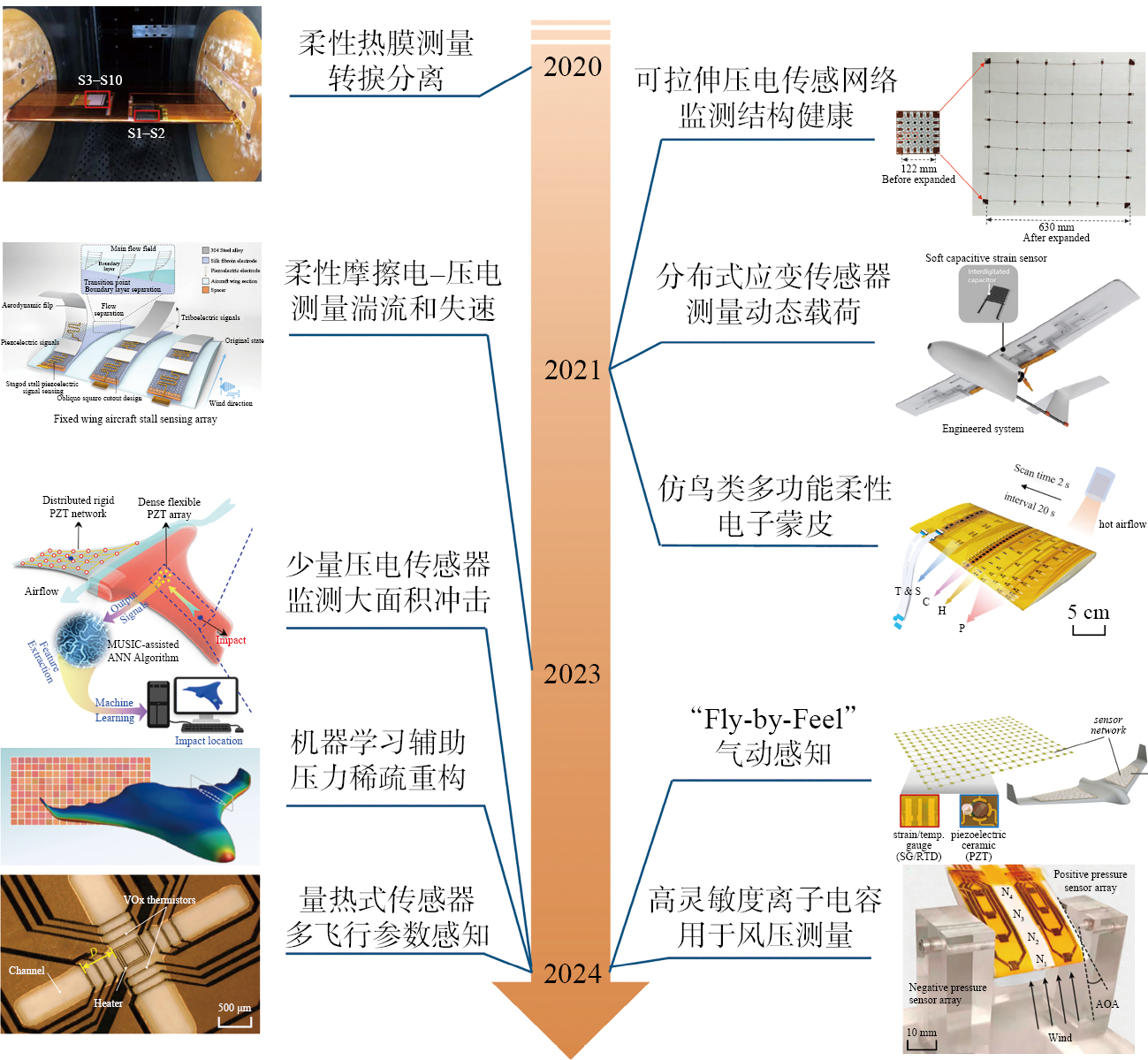
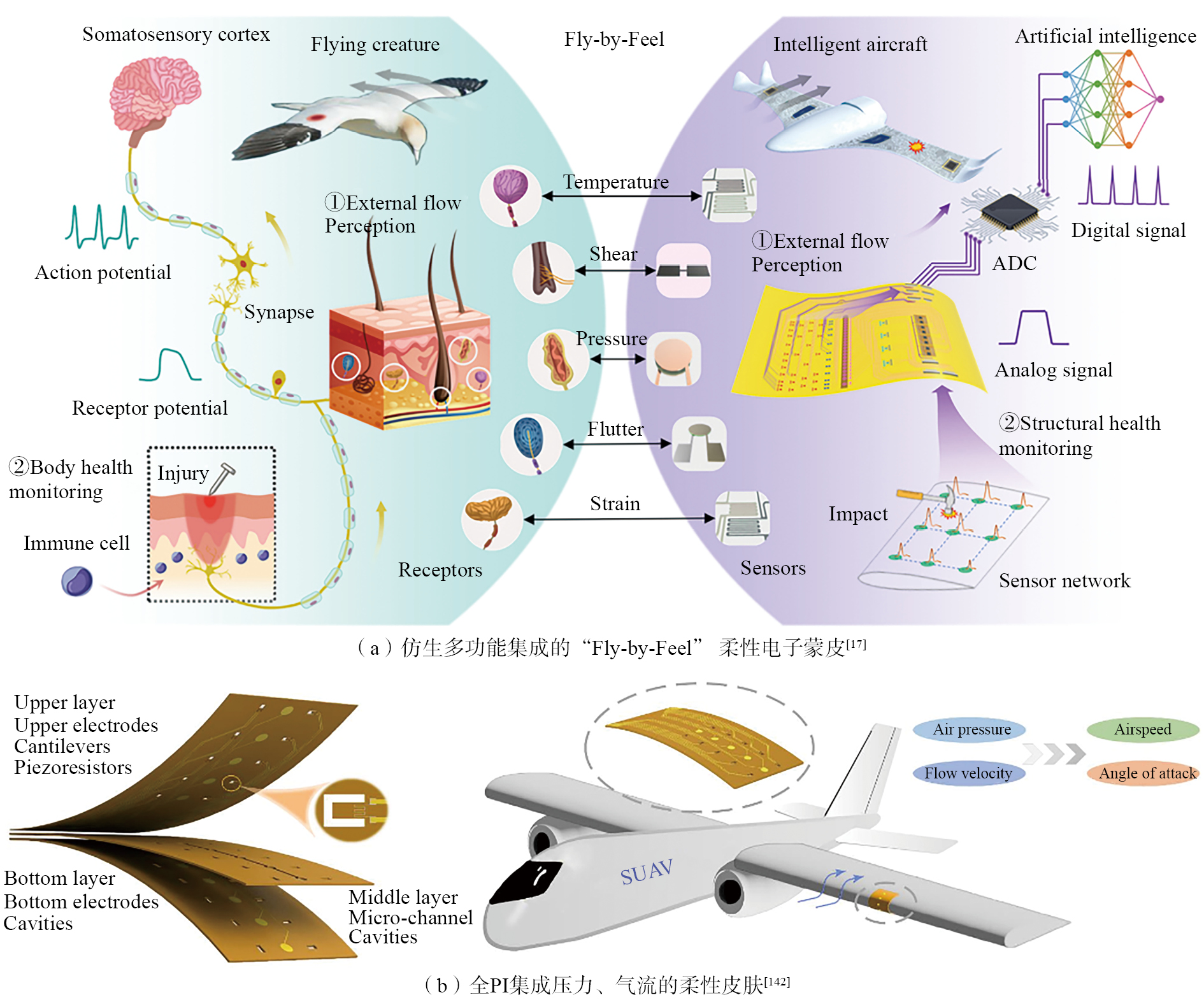
近年来,柔性电子蒙皮技术在航空航天领域的应用取得了显著进展,为传感器飞行器带来了革命性的突破。如图2所示[ XIONG W N, ZHU C, GUO D L, et al. Bio-inspired, intelligent flexible sensing skin for multifunctional flying perception[J]. Nano Energy, 2021, 90: 106550. 17, SUN B Y, MA B H, WANG P B, et al. High sensitive flexible hot-film sensor for measurement of unsteady boundary layer flow[J]. Smart Materials and Structures, 2020, 29(3): 035023. WANG Y, QIU L, LUO Y J, et al. A stretchable and large-scale guided wave sensor network for aircraft smart skin of structural health monitoring[J]. Structural Health Monitoring, 2021, 20(3): 861-876. SHIN H S, OTT Z, BEUKEN L G, et al. Bio-inspired large-area soft sensing skins to measure UAV wing deformation in flight[J]. Advanced Functional Materials, 2021, 31(23): 2100679. XU Z J, CAO L N Y, LI C Y, et al. Digital mapping of surface turbulence status and aerodynamic stall on wings of a flying aircraft[J]. Nature Communications, 2023, 14: 2792. ZHU C, XU Z Y, HOU C, et al. Flexible, monolithic piezoelectric sensors for large-area structural impact monitoring via MUSIC-assisted machine learning[J]. Structural Health Monitoring, 2024, 23(1): 121-136. ZHAO Q Y, HUANG J, GUO Y X, et al. Machine learning-assisted sparse observation assimilation for real-time aerodynamic field perception[J]. Science China Technological Sciences, 2024, 67(5): 1458-1469. TOPAC T, GRAY C, CHANG F K. Fly-by-feel: Learning aerodynamics from multimodal wing mechanics[C]//AIAA SCITECH 2024 Forum. Orlando: AIAA, 2024. GONG Z, DI W C, JIANG Y G, et al. Flexible calorimetric flow sensor with unprecedented sensitivity and directional resolution for multiple flight parameter detection[J]. Nature Communications, 2024, 15: 3091. WANG J X, WEI X Y, SHI J L, et al. High-resolution flexible iontronic skins for both negative and positive pressure measurement in room temperature wind tunnel applications[J]. Nature Communications, 2024, 15: 7094. 23-31],该领域的发展呈现出从单一功能、单点测量向多功能集成化、分布式网络化感知的演进路径。初期研究主要集中于利用单一传感器对气动状态进行监测,如通过热膜实现对流动转捩与分离的精确判断。随着传感功能的逐渐多样化,柔性电子蒙皮极大地丰富了飞行器可感知的参数维度。与此同时,传感系统的规模与性能也得到了显著提升。一方面,传感器从单个或少量阵列发展为可覆盖机翼等关键部件的大面积、高密度传感网络,为实现“Fly-by-Feel”的气动感知理念奠定了硬件基础;另一方面,传感器的灵敏度与精度持续优化,为精细化流场测量提供了新的可能。更为重要的是柔性传感技术与人工智能算法的深度融合,催生了全新的感知范式。“稀疏传感-智能重构”的模式,有效解决了大规模传感器布设带来的数据冗余、布线复杂和功耗过高等工程难题,实现了对复杂飞行参数的全面、高效感知。目前这些研究大多用于实验室原型机或小型无人机,在飞行器真实工况的适用性仍待进一步探索。
图2 基于柔性电子蒙皮的传感器飞行器的重要进展[ XIONG W N, ZHU C, GUO D L, et al. Bio-inspired, intelligent flexible sensing skin for multifunctional flying perception[J]. Nano Energy, 2021, 90: 106550. 17, SUN B Y, MA B H, WANG P B, et al. High sensitive flexible hot-film sensor for measurement of unsteady boundary layer flow[J]. Smart Materials and Structures, 2020, 29(3): 035023. WANG Y, QIU L, LUO Y J, et al. A stretchable and large-scale guided wave sensor network for aircraft smart skin of structural health monitoring[J]. Structural Health Monitoring, 2021, 20(3): 861-876. SHIN H S, OTT Z, BEUKEN L G, et al. Bio-inspired large-area soft sensing skins to measure UAV wing deformation in flight[J]. Advanced Functional Materials, 2021, 31(23): 2100679. XU Z J, CAO L N Y, LI C Y, et al. Digital mapping of surface turbulence status and aerodynamic stall on wings of a flying aircraft[J]. Nature Communications, 2023, 14: 2792. ZHU C, XU Z Y, HOU C, et al. Flexible, monolithic piezoelectric sensors for large-area structural impact monitoring via MUSIC-assisted machine learning[J]. Structural Health Monitoring, 2024, 23(1): 121-136. ZHAO Q Y, HUANG J, GUO Y X, et al. Machine learning-assisted sparse observation assimilation for real-time aerodynamic field perception[J]. Science China Technological Sciences, 2024, 67(5): 1458-1469. TOPAC T, GRAY C, CHANG F K. Fly-by-feel: Learning aerodynamics from multimodal wing mechanics[C]//AIAA SCITECH 2024 Forum. Orlando: AIAA, 2024. GONG Z, DI W C, JIANG Y G, et al. Flexible calorimetric flow sensor with unprecedented sensitivity and directional resolution for multiple flight parameter detection[J]. Nature Communications, 2024, 15: 3091. WANG J X, WEI X Y, SHI J L, et al. High-resolution flexible iontronic skins for both negative and positive pressure measurement in room temperature wind tunnel applications[J]. Nature Communications, 2024, 15: 7094. 23-31]
Fig.2 Progress in SensorCraft based on flexible electronic skin[ XIONG W N, ZHU C, GUO D L, et al. Bio-inspired, intelligent flexible sensing skin for multifunctional flying perception[J]. Nano Energy, 2021, 90: 106550. 17, SUN B Y, MA B H, WANG P B, et al. High sensitive flexible hot-film sensor for measurement of unsteady boundary layer flow[J]. Smart Materials and Structures, 2020, 29(3): 035023. WANG Y, QIU L, LUO Y J, et al. A stretchable and large-scale guided wave sensor network for aircraft smart skin of structural health monitoring[J]. Structural Health Monitoring, 2021, 20(3): 861-876. SHIN H S, OTT Z, BEUKEN L G, et al. Bio-inspired large-area soft sensing skins to measure UAV wing deformation in flight[J]. Advanced Functional Materials, 2021, 31(23): 2100679. XU Z J, CAO L N Y, LI C Y, et al. Digital mapping of surface turbulence status and aerodynamic stall on wings of a flying aircraft[J]. Nature Communications, 2023, 14: 2792. ZHU C, XU Z Y, HOU C, et al. Flexible, monolithic piezoelectric sensors for large-area structural impact monitoring via MUSIC-assisted machine learning[J]. Structural Health Monitoring, 2024, 23(1): 121-136. ZHAO Q Y, HUANG J, GUO Y X, et al. Machine learning-assisted sparse observation assimilation for real-time aerodynamic field perception[J]. Science China Technological Sciences, 2024, 67(5): 1458-1469. TOPAC T, GRAY C, CHANG F K. Fly-by-feel: Learning aerodynamics from multimodal wing mechanics[C]//AIAA SCITECH 2024 Forum. Orlando: AIAA, 2024. GONG Z, DI W C, JIANG Y G, et al. Flexible calorimetric flow sensor with unprecedented sensitivity and directional resolution for multiple flight parameter detection[J]. Nature Communications, 2024, 15: 3091. WANG J X, WEI X Y, SHI J L, et al. High-resolution flexible iontronic skins for both negative and positive pressure measurement in room temperature wind tunnel applications[J]. Nature Communications, 2024, 15: 7094. 23-31]
(1)压阻式。利用材料在外力作用下电阻率或几何形状发生变化,使其电阻值改变的原理[ FAN X H, HU H L, LIAO B, et al. Optimization of microstructure design for enhanced sensing performance in flexible piezoresistive sensors[J]. Journal of Advanced Ceramics, 2024, 13(6): 711-728. 32]。柔性压阻传感器通常将导电填料(如碳纳米管、石墨烯、金属纳米线/颗粒)分散在弹性聚合物基体(如聚二甲基硅氧烷(Polydimethylsiloxane,PDMS)、聚氨酯(Polyurethane,PU)中,形成导电复合材料[ XUAN Y, UCHIYAMA T, URA H, et al. Flexible integrated air pressure sensors for monitoring positive and negative pressure distribution[J]. ACS Applied Materials & Interfaces, 2024, 16(40): 54215-54223. PARK J, LEE Y, HONG J, et al. Giant tunneling piezoresistance of composite elastomers with interlocked microdome arrays for ultrasensitive and multimodal electronic skins[J]. ACS Nano, 2014, 8(5): 4689-4697. PAN L J, CHORTOS A, YU G H, et al. An ultra-sensitive resistive pressure sensor based on hollow-sphere microstructure induced elasticity in conducting polymer film[J]. Nature Communications, 2014, 5: 3002. 33-35]。当受到压力时,填料间的距离或接触状态改变,引起整体电阻变化。另一种策略是利用微结构[ CUI X H, HUANG F L, ZHANG X C, et al. Flexible pressure sensors via engineering microstructures for wearable human-machine interaction and health monitoring applications[J]. iScience, 2022, 25(4): 104148. 36]设计(如金字塔[ CHEN Z H, QU C M, YAO J J, et al. Two-stage micropyramids enhanced flexible piezoresistive sensor for health monitoring and human-computer interaction[J]. ACS Applied Materials & Interfaces, 2024, 16(6): 7640-7649. KIM S, YU D E, KIM S, et al. Enhanced sensitivity of a resistive pressure sensor based on a PEDOT: PSS thin film on PDMS with a random-height micropyramid structure[J]. Micromachines, 2024, 15(9): mi15091110. 37-38]、微柱[ CHENG L X, WANG R X, HAO X J, et al. Design of flexible pressure sensor based on conical microstructure PDMS-bilayer graphene[J]. Sensors, 2021, 21(1): s21010289. 39]、多孔海绵[ XIA H, WANG L, ZHANG H, et al. MXene/PPy@PDMS sponge-based flexible pressure sensor for human posture recognition with the assistance of a convolutional neural network in deep learning[J]. Microsystems & Nanoengineering, 2023, 9: 155. LI L X, DENG J Q, KONG P, et al. Highly sensitive porous PDMS-based piezoresistive sensors prepared by assembling CNTs in HIPE template[J]. Composites Science and Technology, 2024, 248: 110459. 40-41]结构)放大压力引起的形变。其优点是结构相对简单、读出电路直接,但可能存在非线性、迟滞和温度漂移问题。
(2)压电式。基于压电效应,即压电材料(如压电陶瓷(Lead zirconate titanate,PZT)[ ZHU C, GUO D L, YE D, et al. Flexible PZT-integrated, bilateral sensors via transfer-free laser lift-off for multimodal measurements[J]. ACS Applied Materials & Interfaces, 2020, 12(33): 37354-37362. DAGDEVIREN C, SU Y W, JOE P, et al. Conformable amplified lead zirconate titanate sensors with enhanced piezoelectric response for cutaneous pressure monitoring[J]. Nature Communications, 2014, 5: 4496. 42-43]、压电聚合物[ GUPTA V, BABU A, GHOSH S K, et al. Revisiting δ-PVDF based piezoelectric nanogenerator for self-powered pressure mapping sensor[J]. Applied Physics Letters, 2021, 119(25): 252902. 44]、ZnO纳米线[ YANG T, PAN H, TIAN G, et al. Hierarchically structured PVDF/ZnO core-shell nanofibers for self-powered physiological monitoring electronics[J]. Nano Energy, 2020, 72: 104706. 45]等)在受到机械应力时,其内部会产生电偶极矩,表面出现电荷积累,从而产生电压信号。柔性压电传感器常采用压电聚合物薄膜或将压电陶瓷粉末/纤维与聚合物复合[ YOUSUF M, BEIGH N T, ARYA D S, et al. A sensitive and flexible poroelastic barium titanate matrix for pressure sensing applications[J]. IEEE Sensors Letters, 2023, 7(2): 1-4. 46]。压电传感器是自源器件,无需外部电源,响应速度快,适用于动态压力测量,但通常难以测量静态或缓慢变化的压力。
(3)电容式。其基本结构是平行板电容器,由上下两个柔性电极和中间的柔性介电层构成。当施加压力时,介电层被压缩,导致电极间距 d减小或介电常数 εr变化,从而引起电容C=ε0εrA/d,(A为电极面积;ε0为真空介电常数)的变化[ XIONG W N, GUO D L, YANG Z X, et al. Conformable, programmable and step-linear sensor array for large-range wind pressure measurement on curved surface[J]. Science China Technological Sciences, 2020, 63(10): 2073-2081. 47]。通过引入微结构(如多孔、金字塔、微柱)可以显著提高介电层的可压缩性,从而大幅提升灵敏度[ WAN Y B, QIU Z G, HONG Y, et al. A highly sensitive flexible capacitive tactile sensor with sparse and high-aspect-ratio microstructures[J]. Advanced Electronic Materials, 2018, 4(4): 1700586. XIONG W N, ZHANG F, QU S Y, et al. Marangoni-driven deterministic formation of softer, hollow microstructures for sensitivity-enhanced tactile system[J]. Nature Communications, 2024, 15: 5596. LUO Y S, SHAO J Y, CHEN S R, et al. Flexible capacitive pressure sensor enhanced by tilted micropillar arrays[J]. ACS Applied Materials & Interfaces, 2019, 11(19): 17796-17803. 48-50]。电容传感器功耗低、灵敏度较高、温度漂移相对较小,但易受寄生电容和电磁干扰影响;另一种典型的电容式压力传感器是利用离子导体(如离子凝胶、离子液体、含水电解质)与电子导体(电极)界面处形成的双电层(Electric double layer,EDL)电容进行传感[ BAI N N, WANG L, WANG Q, et al. Graded intrafillable architecture-based iontronic pressure sensor with ultra-broad-range high sensitivity[J]. Nature Communications, 2020, 11: 209. HE Y F, CHENG Y, YANG C H, et al. Creep-free polyelectrolyte elastomer for drift-free iontronic sensing[J]. Nature Materials, 2024, 23(8): 1107-1114. 51-52]。EDL的等效厚度极薄(纳米尺度),因此其单位面积电容(比电容)比传统电容高几个数量级。当压力作用于离子传感器时,引起离子导体/电极接触面积或界面距离的微小变化,就能产生巨大的电容变化,从而获得极高的灵敏度。离子传感器通常结构简单,但其性能可能受温度、湿度影响,且响应速度相对电容或压电传感器较慢。
(4)光学式。主要利用光纤传感技术,如光纤布拉格光栅(Fiber Bragg grating,FBG)[ XU S Y, LI X Z, WANG T Y, et al. Fiber Bragg grating pressure sensors: A review[J]. Optical Engineering, 2023, 62(1): 010902. 53]或法布里-珀罗干涉仪(Fabry-Pérot interferometer,FPI)[ ZHU X P, JIANG C, CHEN H L, et al. Ultrasensitive gas pressure sensor based on two parallel Fabry-Perot interferometers and enhanced Vernier effect[J]. Optics & Laser Technology, 2023, 158: 108755. 54]。压力作用于传感结构上引起应变或形变,导致FBG的布拉格波长漂移或FPI的腔长变化,通过解调光谱信号来测量压力。光学传感器具有抗电磁干扰、耐腐蚀、易于复用等优点,适合恶劣环境和分布式测量。但通常需要专门的光源和解调设备,且柔性化封装和连接是挑战。
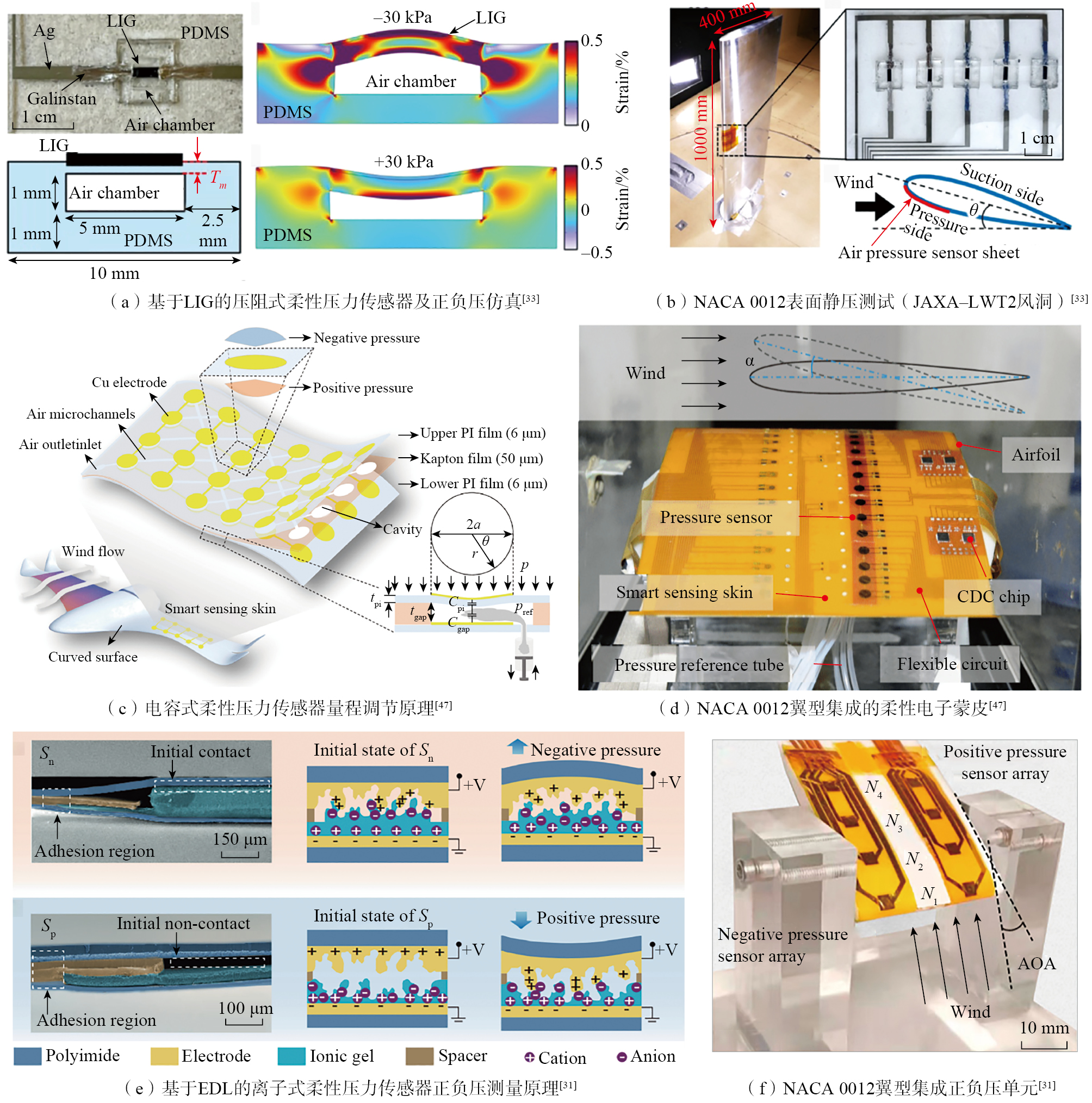
目前,大多数柔性压力传感器仅能用于接触式压力测量,而航空航天领域的壁面压力需要同时具备正负压测量能力(从近真空的负压到高动压区的正压区),这对柔性壁面压力传感器提出了新的挑战,需要具备复杂的多层膜结构和严格密封参考压力腔。Xuan等[ XUAN Y, UCHIYAMA T, URA H, et al. Flexible integrated air pressure sensors for monitoring positive and negative pressure distribution[J]. ACS Applied Materials & Interfaces, 2024, 16(40): 54215-54223. 33]利用激光诱导石墨烯(Laser-induced graphene,LIG)和PDMS薄膜空腔结构,如图3(a)所示,成功开发了一种基于应变电阻变化原理的柔性气压传感器,实现了正压和负压分布的实时监测。测试正负压(-30~30 kPa)下电阻变化,灵敏度分别为负压10.2%/kPa,正压-0.55%/kPa。分别通过日本新千岁机场到羽田机场的飞行气压测试,以及NACA 0012机翼集成在日本JAXA-LWT2低速风洞试验(图3(b)[ XUAN Y, UCHIYAMA T, URA H, et al. Flexible integrated air pressure sensors for monitoring positive and negative pressure distribution[J]. ACS Applied Materials & Interfaces, 2024, 16(40): 54215-54223. 33])验证了传感器压力测量的准确性。对于此类密封的参考压力腔,Xiong等[ XIONG W N, GUO D L, YANG Z X, et al. Conformable, programmable and step-linear sensor array for large-range wind pressure measurement on curved surface[J]. Science China Technological Sciences, 2020, 63(10): 2073-2081. 47]提出了可通过调节参考压力实现了量程的可编程性,解决了单一传感器难以兼顾宽量程和高灵敏度的矛盾,并在NACA 0012翼型上的风洞测试验证了柔性传感器阵列在复杂曲面压力测量中的可行性,如图3(c)和(d)所示。
图3 柔性壁面压力传感器原理及机翼集成
Fig.3 Principle of flexible wall pressure sensors and wing integration
通过在这类空腔结构中引入微结构设计和离子导体,柔性压力传感器的灵敏度可以得到极大提升。Wang等[ WANG J X, WEI X Y, SHI J L, et al. High-resolution flexible iontronic skins for both negative and positive pressure measurement in room temperature wind tunnel applications[J]. Nature Communications, 2024, 15: 7094. 31]通过预压法巧妙设计出了可进行正负压测量的离子电容压力传感器,如图3(e)所示,实现了宽范围(-100~600 kPa)和高分辨率(-20 Pa/100 Pa)的正负压测量,并具备数百Hz的动态响应能力,在室温低速风洞中通过NACA 0012翼型进行了试验(图3(f))。对于湍流脉动、抖振等动态现象,传感器的响应速度至关重要。为进一步提高传感器的动态响应,Zhang等[ ZHANG Y, ZHOU X M, ZHANG N, et al. Ultrafast piezocapacitive soft pressure sensors with over 10 kHz bandwidth via bonded microstructured interfaces[J]. Nature Communications, 2024, 15: 3048. 55]通过键合微结构界面将响应时间缩短至亚ms级(~0.04 ms),带宽超过10 kHz。这使得柔性传感器有望应用于高频脉动压力测量,甚至声学探测等传统柔性传感器难以胜任的领域。
尽管壁面剪应力测量意义重大,但长期以来,精确、可靠地测量动态变化曲面和复杂几何形状表面上的壁面剪应力分布,一直是一项极具挑战性的任务。壁面剪应力测量方法主要分为以浮动元件天平为代表的直接测量法和以热膜为代表的间接测量法[ WINTER K G. An outline of the techniques available for the measurement of skin friction in turbulent boundary layers[J]. Progress in Aerospace Sciences, 1979, 18: 1-57. 56]。
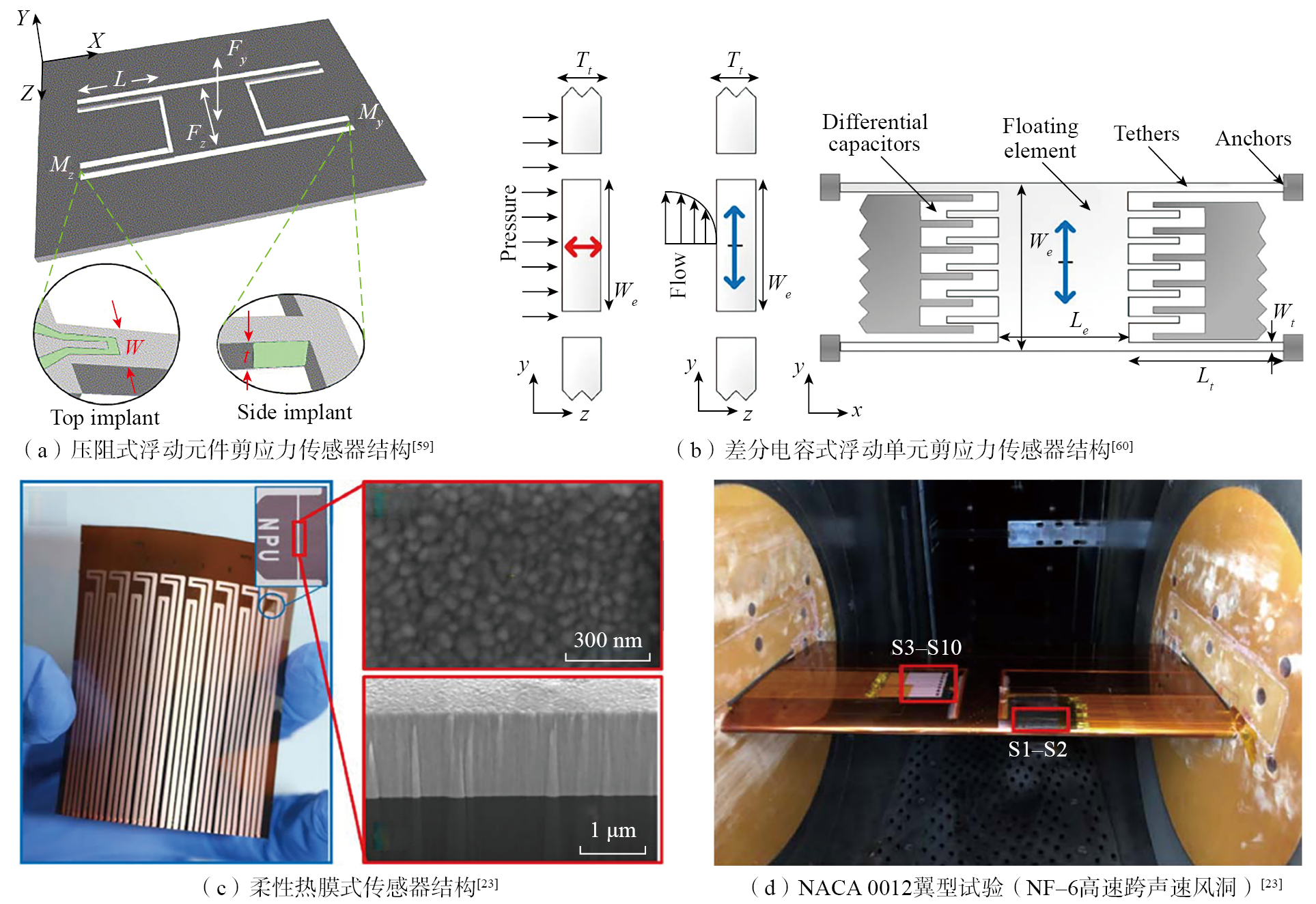
浮动元件法的核心思想是利用一个与周围壁面齐平安装的可移动微小平台,直接感受流体施加在其表面上的切向力(剪应力)。这个浮动元件通过柔性梁、悬臂或系链悬挂在固定的基底上。当流体流过传感器表面时,作用在浮动元件上的总剪切力会导致元件发生微小的位移[ SCHMIDT M A, HOWE R T, SENTURIA S D, et al. Design and calibration of a microfabricated floating-element shear-stress sensor[J]. IEEE Transactions on Electron Devices, 1988, 35(6): 750-757. SHAJII J, NG K Y, SCHMIDT M A. A microfabricated floating-element shear stress sensor using wafer-bonding technology[J]. Journal of Microelectromechanical Systems, 1992, 1(2): 89-94. 57-58]。典型的浮动元件由悬臂梁和应变片构成,如图4(a)所示[ BARLIAN A A, PARK S J, MUKUNDAN V, et al. Design and characterization of microfabricated piezoresistive floating element-based shear stress sensors[J]. Sensors and Actuators A: Physical, 2007, 134(1): 77-87. 59],通过侧壁和顶部植入的压阻元件分别测量平面内剪切力和平面外法向力[ BARLIAN A A, PARK S J, MUKUNDAN V, et al. Design and characterization of microfabricated piezoresistive floating element-based shear stress sensors[J]. Sensors and Actuators A: Physical, 2007, 134(1): 77-87. 59]。此外,流动中的压力梯度也会造成一定的误差,通过差分电容可有效抑制压力的干扰。如图4(b)所示[ CHANDRASEKHARAN V, SELLS J, MELOY J, et al. A microscale differential capacitive direct wall-shear-stress sensor[J]. Journal of Microelectromechanical Systems, 2011, 20(3): 622-635. 60],通过两个叉指电容差分,可以放大剪应力信号而抑制共模的压力信号,压力抑制比达64 dB,从而显著降低了噪声(约)。
图4 柔性表面摩擦力传感器原理及机翼集成
Fig.4 Principle of flexible wall stress sensors and wing integration
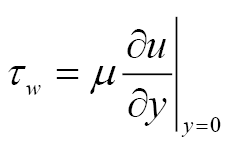
与浮动元件法不同,热膜法是一种基于热流与表面摩擦力之间雷诺比拟的间接测量方法。热膜的基本原理是利用置于壁面或非常靠近壁面的加热元件与流经其上流体之间产生对流换热[ PANG P, ZHAO K L, ZHONG S Y, et al. Flexible skin for measurement of boundary layer state and flight attitude identification on UAV[J]. Smart Materials and Structures, 2023, 32(4): 045008. LI G Z, LIU S Q, WANG L Q, et al. Skin-inspired quadruple tactile sensors integrated on a robot hand enable object recognition[J]. Science Robotics, 2020, 5(49): eabc8134. 61-62]。工作时,通过给加热元件(热敏电阻)通入电流使其温度高于周围流体。产生的热量主要通过3个途径散失:与流体间的对流换热、通过基底材料的传导散热以及热辐射(在大多数应用中,热辐射可以忽略不计)。对流换热的速率取决于近壁区的速度梯度,即与壁面剪应力τw成正比。通过测量加热元件电阻、电压或维持其恒定温度所需的功率变化,就可以间接推算出τw。二者的关系常通过King公式及其变种进行描述[ LÖFDAHL L, CHERNORAY V, HAASL S, et al. Characteristics of a hot-wire microsensor for time-dependent wall shear stress measurements[J]. Experiments in Fluids, 2003, 35(3): 240-251. HANRATTY T J, CAMPBELL J A. Fluid Mechanics measurements: measurement of wall shear stress[M]. 2nd ed. London: Routledge, 1996. 63-64]。
(2)
式中,P为加热元件的输入功率;ΔT为加热元件与流体之间的温差;A和B分布为与传感器几何形状、流体性质和传热特性相关的标定常数;m通常取1/3左右,需要通过试验标定来确定[ SUN B Y, MA B H, WANG P B, et al. High sensitive flexible hot-film sensor for measurement of unsteady boundary layer flow[J]. Smart Materials and Structures, 2020, 29(3): 035023. 23, SUN B Y, WANG P B, LUO J, et al. A flexible hot-film sensor array for underwater shear stress and transition measurement[J]. Sensors, 2018, 18(10): s18103469. 65]。
柔性热膜传感器通常在柔性基底(如聚酰亚胺(Polyimide,PI))上沉积金属(如镍、铂、金等)作为加热和传感单元[ SUN B Y, MA B H, WANG P B, et al. High sensitive flexible hot-film sensor for measurement of unsteady boundary layer flow[J]. Smart Materials and Structures, 2020, 29(3): 035023. 23, SUN B Y, WANG P B, LUO J, et al. A flexible hot-film sensor array for underwater shear stress and transition measurement[J]. Sensors, 2018, 18(10): s18103469. PANG P, ZHANG T, ZHANG X X, et al. Constant temperature hot-film sensor for the measurement of near-wall turbulence and flow direction[J]. IEEE Sensors Journal, 2024, 24(5): 5895-5903. 65-66]。Sun等[ SUN B Y, MA B H, WANG P B, et al. High sensitive flexible hot-film sensor for measurement of unsteady boundary layer flow[J]. Smart Materials and Structures, 2020, 29(3): 035023. 23]开发了基于真空退火的高灵敏度的柔性热膜传感器(图4(c)),用于测量边界层中的湍流特性,成功捕捉了NACA 0012翼型上边界层的流动转变位置,转变区域随雷诺数和AOA增加而向前缘移动(图4(d)[ SUN B Y, MA B H, WANG P B, et al. High sensitive flexible hot-film sensor for measurement of unsteady boundary layer flow[J]. Smart Materials and Structures, 2020, 29(3): 035023. 23])。通常退火是增加柔性热膜传感器灵敏度的有效方法,但柔性基底耐温性能有限。Guo等[ GUO D L, LING J H, HUANG Y Z, et al. Recrystallization-induced laser lift-off strategy for flexible thermal sensors with near-limit sensitivity[J]. Advanced Materials Technologies, 2024, 9(2): 2301444. 67]通过再结晶诱导的激光剥离策略,调和了柔性基底与高温退火(~800℃)之间的矛盾,实现了6.2‰℃−1 的温度系数,使柔性薄膜传感器可接近块体材料的极限。
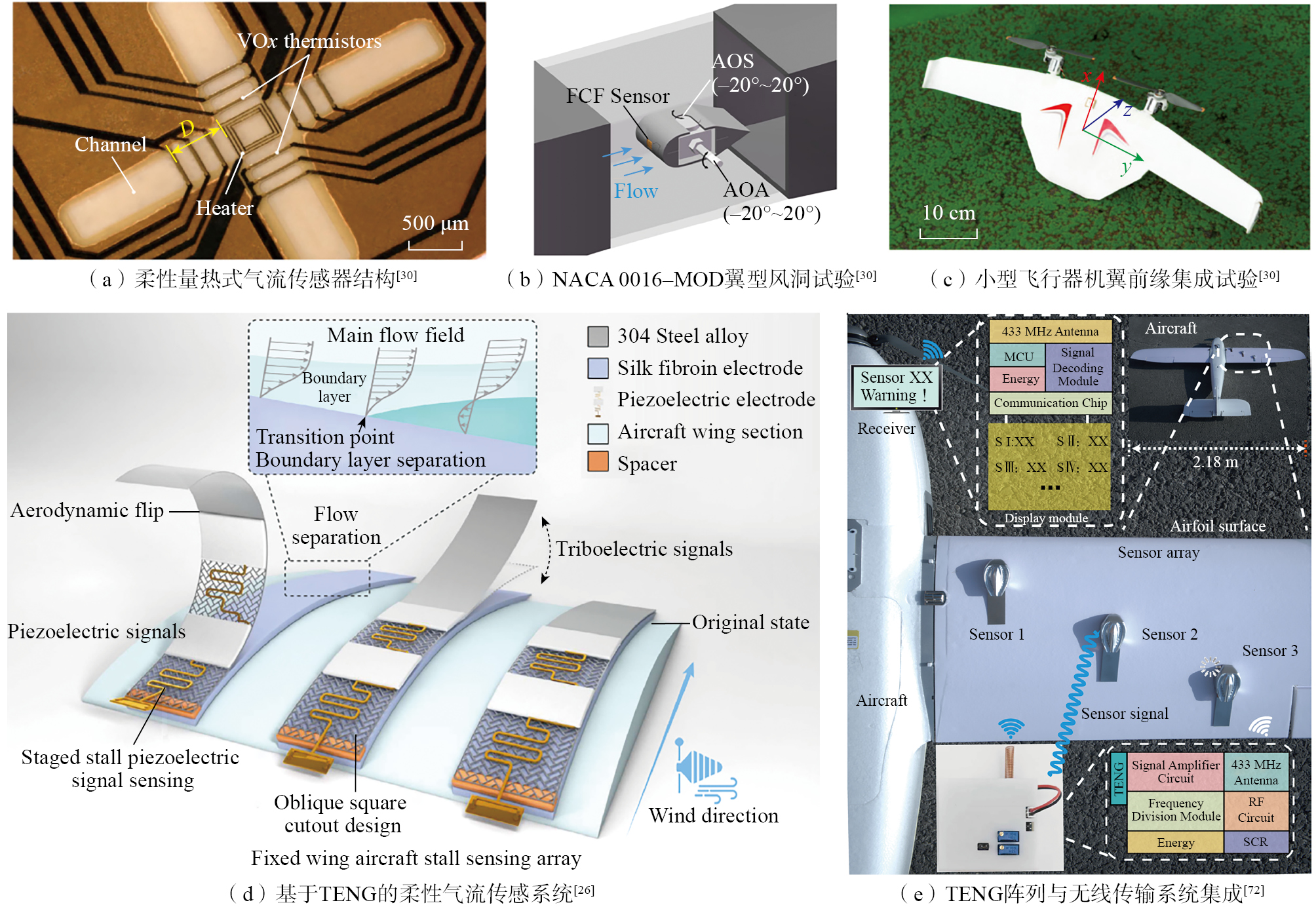
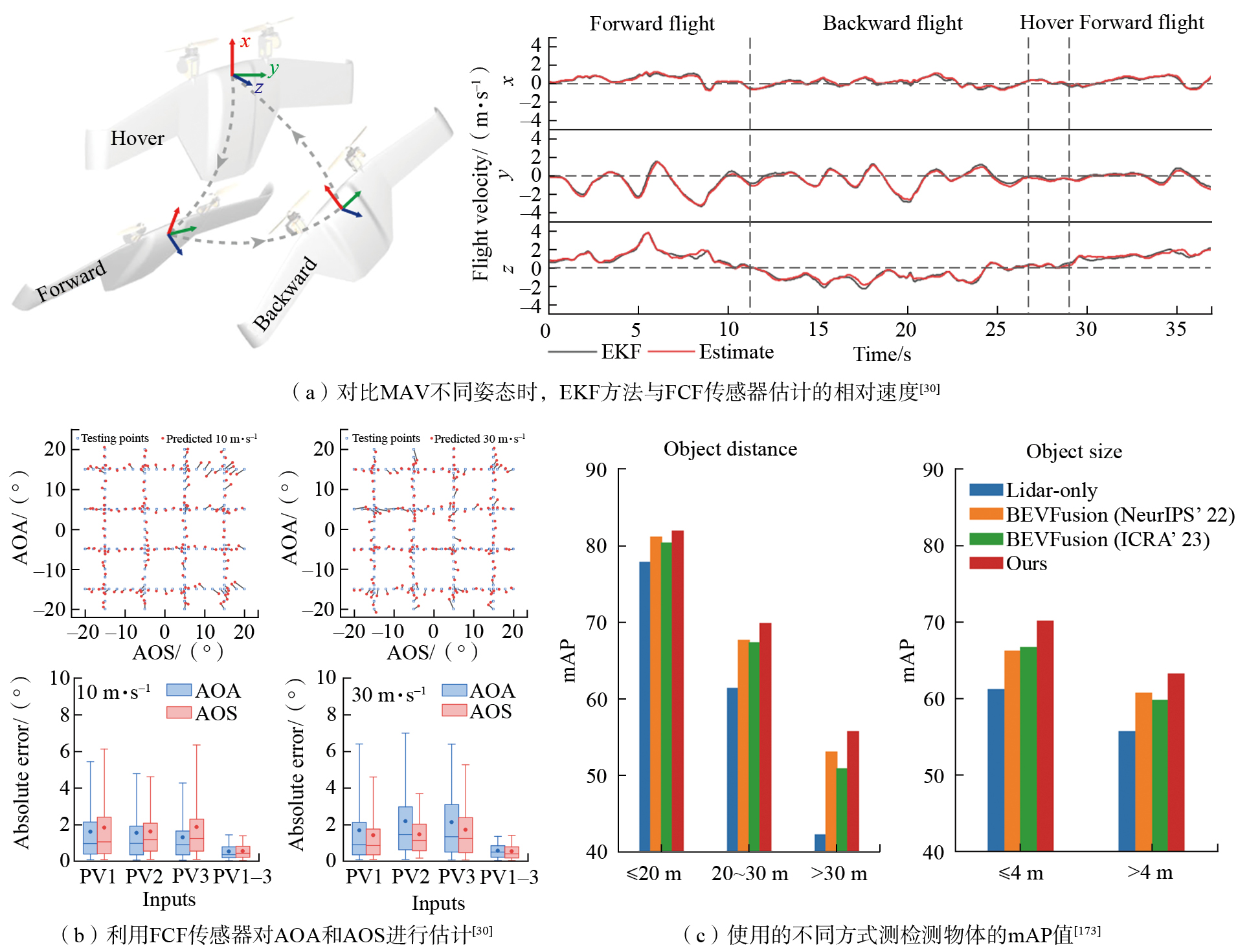
与剪应力测量类似,热膜/热线传感器也可以用于风速测量[ CHEN J, FAN Z F, ZOU J, et al. Two-dimensional micromachined flow sensor array for fluid mechanics studies[J]. Journal of Aerospace Engineering, 2003, 16(2): 85-97. 68],通常需要将传感器放置在边界层外缘或自由来流中,或者通过标定建立表面热膜信号与局部流速或来流速度的关系;另一种基于热对流的量热式气流传感器[ GHOUILA-HOURI C, TALBI A, VIARD R, et al. Unsteady flows measurements using a calorimetric wall shear stress micro-sensor[J]. Experiments in Fluids, 2019, 60(4): 67. WEISS J, JONDEAU E, GIANI A, et al. Static and dynamic calibration of a MEMS calorimetric shear-stress sensor[J]. Sensors and Actuators A: Physical, 2017, 265: 211-216. 69-70],可以通过测量其与气流间的强制对流换热来推算流速。通常包含一个加热元件和至少两个温度传感元件,一个位于加热元件的上游(或参考点),另一个位于下游。流体流动时会将加热元件产生的热量向下游传递。传感器测量的是加热元件下游和上游(或参考点)之间的温差。Gong等[ GONG Z, DI W C, JIANG Y G, et al. Flexible calorimetric flow sensor with unprecedented sensitivity and directional resolution for multiple flight parameter detection[J]. Nature Communications, 2024, 15: 3091. 30]基于该原理,利用悬浮式氧化钒(VOx)热敏电阻,开发了一种基于量热式的高灵敏度柔性气流传感器,如图5(a)所示,并进行风洞测试,验证了该传感器极高的速度分辨率(0.11 mm·s-1)和角度分辨率(0.1°)。通过传感器和机器学习结合能够同时精准估算小型飞行器的多项飞行参数,如AOA、侧滑角(Angle of Sideslip,AOS)和相对气流速度,为飞行控制和弱气流感知提供了创新解决方案,如图5(b)[ GONG Z, DI W C, JIANG Y G, et al. Flexible calorimetric flow sensor with unprecedented sensitivity and directional resolution for multiple flight parameter detection[J]. Nature Communications, 2024, 15: 3091. 30] 和(c)[ GONG Z, DI W C, JIANG Y G, et al. Flexible calorimetric flow sensor with unprecedented sensitivity and directional resolution for multiple flight parameter detection[J]. Nature Communications, 2024, 15: 3091. 30] 所示。
图5 柔性气流传感器的原理和应用
Fig.5 Principle and application of flexible airflow sensing
另一种极具潜力的柔性气流传感技术起源于传统的丝线法[ TAO J L, YU X. Hair flow sensors: From bio-inspiration to bio-mimicking—A review[J]. Smart Materials and Structures, 2012, 21(11): 113001. 71],将传统的丝线法(用于流动显示)与摩擦纳米发电机(Triboelectric nanogenerator,TENG)相结合[ XU Z J, CAO L N Y, LI C Y, et al. Digital mapping of surface turbulence status and aerodynamic stall on wings of a flying aircraft[J]. Nature Communications, 2023, 14: 2792. 26, SHENG H R, CAO L N Y, SHANG Y R, et al. Conformal self-powered high signal-to-noise ratio biomimetic in situ aircraft surface turbulence mapping system[J]. Nano Energy, 2025, 136: 110694. 72]。TENG利用摩擦起电和静电感应效应将机械能(如气流引起的振动或摩擦)转化为电能[ WANG Z L. Triboelectric nanogenerator (TENG)—Sparking an energy and sensor revolution[J]. Advanced Energy Materials, 2020, 10(17): 2000137. CHEN J, WANG Z L. Reviving vibration energy harvesting and self-powered sensing by a triboelectric nanogenerator[J]. Joule, 2017, 1(3): 480-521. FAN F R, TIAN Z Q, WANG Z L. Flexible triboelectric generator[J]. Nano Energy, 2012, 1(2): 328-334. 73-75]。在气流传感方面,TENG可以设计成风车式[ LI Y, DENG H C, WU H Y, et al. Rotary wind-driven triboelectric nanogenerator for self-powered airflow temperature monitoring of industrial equipment[J]. Advanced Science, 2024, 11(13): 2307382. WANG P H, PAN L, WANG J Y, et al. An ultra-low-friction triboelectric-electromagnetic hybrid nanogenerator for rotation energy harvesting and self-powered wind speed sensor[J]. ACS Nano, 2018, 12(9): 9433-9440. 76-77]、薄膜拍打式[ ZHANG H L, YANG Y, ZHONG X D, et al. Single-electrode-based rotating triboelectric nanogenerator for harvesting energy from tires[J]. ACS Nano, 2014, 8(1): 680-689. 78]。将微小的覆盖有摩擦电材料的丝线固定在飞机表面,丝线在气流作用下会摆动或振动。丝线与下方电极或其他摩擦层之间的接触-分离或相对滑动会产生摩擦电信号。通过分析TENG信号的特征(如信号幅值、频率、波形等),可以判断局部气流状态,如层流(信号平稳或无信号)、湍流(信号波动剧烈)、分离流(丝线剧烈拍打或指向异常)甚至失速状态。图5(d)展示了Xu等[ XU Z J, CAO L N Y, LI C Y, et al. Digital mapping of surface turbulence status and aerodynamic stall on wings of a flying aircraft[J]. Nature Communications, 2023, 14: 2792. 26]的固定翼失速传感阵列,该研究开创性地将TENG阵列首次应用于真实飞行工况,在Prandtl-500回流风洞中使用NACA0012翼型模型进行风洞试验,并在Cessna 182模型飞机和真实Cessna C172S载人飞机上进行实地测试,成功实现了机翼表面湍流演化过程的数字化可视化,并基于湍流信号特征准确预测了失速。在此基础上,Sheng等[ SHENG H R, CAO L N Y, SHANG Y R, et al. Conformal self-powered high signal-to-noise ratio biomimetic in situ aircraft surface turbulence mapping system[J]. Nano Energy, 2025, 136: 110694. 72]进一步优化了该系统,结合仿生设计(涡流发生器)和优化的丝素蛋白材料,不仅能实时检测失速状态,还能通过控制气流延缓失速发生。通过433 MHz无线传输设备进一步提升了系统的实用性,确保信号实时传输至驾驶舱,展示了其作为仿生柔性电子蒙皮用于原位湍流映射的应用前景(图5(e))。
1.4 柔性应变传感器
应变是衡量物体在外力作用下相对变形程度的物理量。通过在关键飞机结构(如尾翼、主起落架、机身和主翼翼梁等)表面或内部布置应变传感器,可以监测在气动载荷、惯性力、热应力作用下的结构应变分布。结合相应模型可将应变转换为变形从而重建结构的三维形状[ LIU Y H, HUANG Y, YAO H J, et al. A modeling and calibrating method of FBG sensors for wing deformation displacement measurement[J]. Heliyon, 2023, 9(5): e15932. 79],通过建立应变与载荷的传递关系,可对冲击、气动变化、阵风载荷做出响应,并对机身结构损伤或材料退化进行实时评估和风险预警[ LIU Y H, HUANG Y, YAO H J, et al. A modeling and calibrating method of FBG sensors for wing deformation displacement measurement[J]. Heliyon, 2023, 9(5): e15932. Distributed sensing of a cantilever beam and plate using a fiber optic sensing system[C]//2018 Applied Aerodynamics Conference. Atlanta: AIAA, 2018: 3482. 79-80]。根据测量原理不同,柔性应变传感器可分为电阻式、电容式、光学式、频率选择表面式等。
(1)电阻式。电阻型应变传感器通常由导电传感薄膜和柔性基板组成。当复合结构被拉伸时,传感膜的微观结构变化会导致导电通路变化,通过设计裂纹扩展/重连[ BAI Y Z, ZHOU Y L, WU X Y, et al. Flexible strain sensors with ultra-high sensitivity and wide range enabled by crack-modulated electrical pathways[J]. Nano-Micro Letters, 2024, 17(1): 64. 81]或通过多种导电材料的复合(如碳纳米管[ VERTUCCIO L, GUADAGNO L, SPINELLI G, et al. Piezoresistive properties of resin reinforced with carbon nanotubes for health-monitoring of aircraft primary structures[J]. Composites Part B: Engineering, 2016, 107: 192-202. 82]、石墨烯[ SUN B C, XU G B, JI X, et al. A strain-resistant flexible thermistor sensor array based on CNT/MXene hybrid materials for lithium-ion battery and human temperature monitoring[J]. Sensors and Actuators A: Physical, 2024, 368: 115059. 83]、金属纳米线/颗粒[ LIM C, LEE S, KANG H, et al. Highly conductive and stretchable hydrogel nanocomposite using whiskered gold nanosheets for soft bioelectronics[J]. Advanced Materials, 2024, 36(39): 2407931. 84]等),可实现远超常规应变片的灵敏度,并且可以通过结构设计来实现较大的拉伸量程[ AMJADI M, KYUNG K U, PARK I, et al. Stretchable, skin-mountable, and wearable strain sensors and their potential applications: A review[J]. Advanced Functional Materials, 2016, 26(11): 1678-1698. 85]。用于飞行器应变监测领域,温度交叉敏感性以及长期稳定性是其面临的主要挑战。
(2)电容式。电容式应变传感器通常由可拉伸电介质和极板组成。在拉伸下主要受电介质和柔性基板的泊松比的影响,应变引起电容器几何参数(如极板间距、交叠面积等)变化,从而导致电容变化来感知应变[ QIN J, YIN L J, HAO Y N, et al. Flexible and stretchable capacitive sensors with different microstructures[J]. Advanced Materials, 2021, 33(34): 2008267. 86]。通过微结构设计能显著提高其可拉伸性与可重复性[ FASSLER A, MAJIDI C. Soft-matter capacitors and inductors for hyperelastic strain sensing and stretchable electronics[J]. Smart Materials and Structures, 2013, 22(5): 055023. ARAB HASSANI F, JIN H, YOKOTA T, et al. Soft sensors for a sensing-actuation system with high bladder voiding efficiency[J]. Science Advances, 2020, 6(18): eaba0412. 87-88],其优点在于功耗低、线性度相对较好、对温度不敏感,但易受寄生电容和外部电磁场干扰,需要精密的测量电路。
(3)光学式。FBG传感器通过检测刻写在光纤纤芯内的周期性折射率调制光栅的布拉格波长的变化来测量应变[ MA Z, CHEN X Y, MA Z, et al. Analysis of distributed measurement method for array antenna position[J]. Applied Sciences, 2020, 10(10): 3480. 89]。通过将FBG光纤粘贴在柔性基板上或直接嵌入复合材料结构中,可以实现柔性化[ ZHU L Q, SUN G K, BAO W M, et al. Structural deformation monitoring of flight vehicles based on optical fiber sensing technology: A review and future perspectives[J]. Engineering, 2022, 16: 39-55. 90]。FBG应变传感器需要专门的光学解调设备与温度解耦方法。
(4)频率选择表面式(Frequency selective surface,FSS)。FSS是一种二维周期性结构的电磁材料,对特定频率的电磁波具有滤波(反射或透射)特性,其谐振频率对结构的几何尺寸和介电环境非常敏感。近年来,基于柔性材料的柔性FSS取得了显著进步[ SOLTANI S, TAYLOR P S, PARKER E A, et al. Popup tunable frequency selective surfaces for strain sensing[J]. IEEE Sensors Letters, 2020, 4(4): 1-4. CHOI J H, AHN J, KIM J B, et al. An electroactive, tunable, and frequency selective surface utilizing highly stretchable dielectric elastomer actuators based on functionally antagonistic aperture control[J]. Small, 2016, 12(14): 1840-1846. 91-92],集成于柔性基底上的FSS结构随附着物体发生应变时,其单元几何形状(如周期、缝隙宽度)会发生改变,使谐振频率发生漂移。通过无线方式探测FSS的反射或透射频谱,即可反演出应变信息。FSS传感器具有无线、无源、可嵌入、对恶劣环境不敏感等潜在优势。其挑战在于设计和制备三维FSS相对复杂,且空间分辨率受限于单元尺寸。
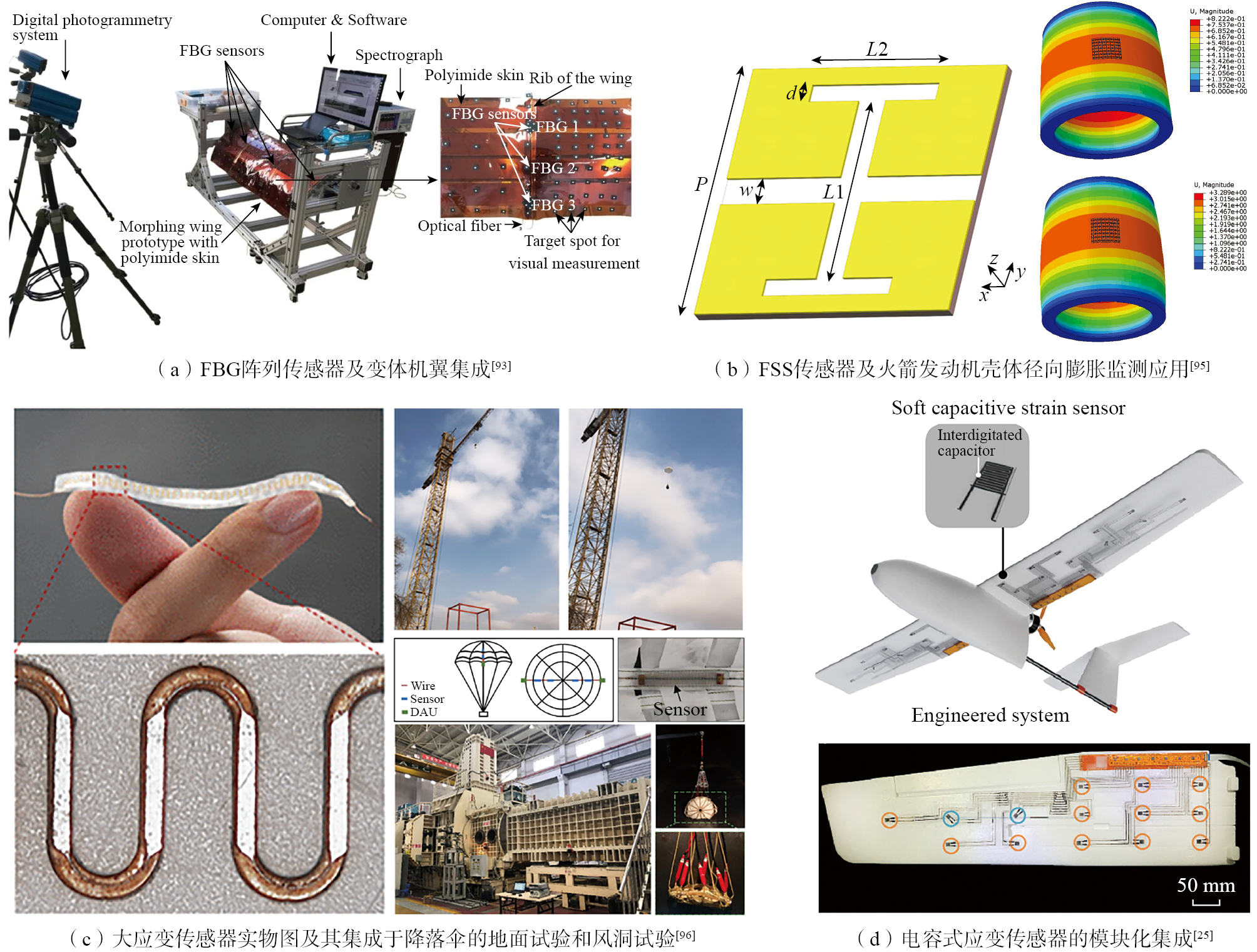
由于FBG传感器具有抗电磁干扰、体积小、重量轻、精度高、易于多路复用实现准分布式测量等优点,在航空航天领域的应用中得到了广泛发展。对于变体机翼的实时形变感知需求,Sun等[ SUN G K, WU Y P, LI H, et al. 3D shape sensing of flexible morphing wing using fiber Bragg grating sensing method[J]. Optik, 2018, 156: 83-92. 93]使用48个FBG传感器嵌入到PI蒙皮中,重建了变形翼的3D表面形状,并与视觉测量结果进行了对比,最大误差小于 5%,验证了方法的有效性(图6(a))。在SmartX项目中,Nazeer等[ NAZEER N, WANG X R, GROVES R M, et al. Sensing, actuation, and control of the SmartX prototype morphing wing in the wind tunnel[J]. Actuators, 2021, 10(6): 107. 94]的变体机翼也利用FBG和干涉测量相结合的方法监测了分段式变形翼模块的挠度。
图6 柔性应变传感器原理及集成
Fig.6 Principle of flexible strain sensors and integration
此外,针对无线无源的FSS,Wang等[ WANG X, SHI K X, WANG J L, et al. Flexible strain sensor based on a frequency selective surface[J]. Optics Express, 2023, 31(5): 8884-8896. 95]设计了一种可共形贴附的柔性FSS应变传感器(图6(b)),该FSS工作在Ka波段(31.4 GHz)且其品质因数Q达到16.2。通过静力学和电磁仿真,分析了该传感器应用于火箭发动机壳体径向膨胀监测的可行性,结果显示1.64%的膨胀产生约200 MHz的频率偏移,且频率偏移与变形量呈良好的线性关系,其灵敏度通过单轴拉伸试验测得约为1.28 GHz/mm。
考虑到FBG需要专门的光学解调设备、FSS的空间分辨率和精度问题,柔性电阻、电容式应变传感器的发展为飞行器变形监测提供了新可能。如Li等[ LI S, LIU G D, LI R, et al. Contact-resistance-free stretchable strain sensors with high repeatability and linearity[J]. ACS Nano, 2022, 16(1): 541-553. 96]研制出一种由离轴蛇形夹层结构和封装层组成的电阻式柔性大应变传感器,基于力学结构设计实现其高重复性和高线性度,并被应用于“天问一号”降落伞地面试验(图6(c))。在超薄柔性应变传感器方面,Yu等[ YU H Y, BIAN J, CHEN F R, et al. Ultrathin, graphene-in-polyimide strain sensor via laser-induced interfacial ablation of polyimide[J]. Advanced Electronic Materials, 2023, 9(9): 2201086. 97]利用热传导为主的新界面烧蚀方式,制备出超薄(8 μm)石墨烯-PI应变传感器,并在变体机翼的变形(弯曲、扭转、冲击)监测中证明了其高灵敏度及高稳定性。针对电容式应变传感器在航空航天领域的发展,图6(d)展示了Shin等[ SHIN H S, OTT Z, BEUKEN L G, et al. Bio-inspired large-area soft sensing skins to measure UAV wing deformation in flight[J]. Advanced Functional Materials, 2021, 31(23): 2100679. 25]研究的μm级电容应变传感器模块化集成,该大面积柔性电子蒙皮在无人机飞行机应用中表现出高灵敏度和可重复性,实现了小型无人机的气动载荷捕获。
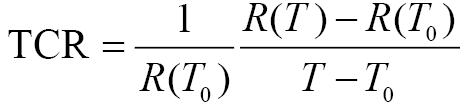
主流的柔性温度传感器有热电阻和热电偶两种,前者基于导体或半导体材料的电阻值随温度变化的原理。柔性电阻温度传感器(Resistance temperature sensor,RTD)通常在柔性基底上沉积金属[ WEBB R C, BONIFAS A P, BEHNAZ A, et al. Ultrathin conformal devices for precise and continuous thermal characterization of human skin[J]. Nature Materials, 2013, 12(10): 938-944. 98]或印刷油墨[ DAN L, ELIAS A L. Flexible and stretchable temperature sensors fabricated using solution-processable conductive polymer composites[J]. Advanced Healthcare Materials, 2020, 9(16): 2000380. 99],形成薄膜形电阻。RTD的线性度和稳定性较高,但电阻温度系数(Temperature coefficient of resistance,TCR)相对较低。
(3)
式中,R(T)为温度T时的电阻;R(T0)为测试样品在温度T0时的初始电阻,高TCR值表示高精度。利用半导体材料电阻随温度发生剧烈(通常是非线性)变化的特性,可以制备灵敏度更高的热敏电阻温度传感器[ HAO S W, FU Q J, MENG L, et al. A biomimetic laminated strategy enabled strain-interference free and durable flexible thermistor electronics[J]. Nature Communications, 2022, 13: 6472. SAHOO S, PARASHAR S K S, ALI S M. CaTiO3 nano ceramic for NTCR thermistor based sensor application[J]. Journal of Advanced Ceramics, 2014, 3(2): 117-124. 100-101]。热敏电阻的优点是灵敏度非常高,响应快;缺点是测温范围相对较窄,线性度差,稳定性不如RTD。
不同于热电阻,热电偶为基于塞贝克效应,即两种不同导电材料构成的回路中,当两个结点处于不同温度时,回路中会产生温差电动势。柔性热电偶可以使用不同薄膜金属/合金或半导体材料在柔性基底上形成[ DAN L, ELIAS A L. Flexible and stretchable temperature sensors fabricated using solution-processable conductive polymer composites[J]. Advanced Healthcare Materials, 2020, 9(16): 2000380. 99, ASSUMPCAO D, KUMAR S, NARASIMHAN V, et al. High-performance flexible metal-on-silicon thermocouple[J]. Scientific Reports, 2018, 8: 13725. ZHANG Z K, LIU Z J, LEI J M, et al. Flexible thin film thermocouples: From structure, material, fabrication to application[J]. iScience, 2023, 26(8): 107303. 102-103]。热电偶是自源器件,无需外部电源,结构简单,测量范围宽,但需要高精度放大器和冷端补偿。将多个热电偶单元串联可形成热电堆,可以增大输出电压,提高灵敏度[ BEN MBAREK S, ALCHEIKH N, YOUNIS M I. Recent advances on MEMS based infrared thermopile detectors[J]. Microsystem Technologies, 2022, 28(8): 1751-1764. 104]。基于热电偶或热电堆的冷热端温差原理,通过添加热阻层,在其两侧产生一个微小的温差,该温差可以通过嵌入的热电偶或热电堆来测量,形成热流传感器[ DONG H L, LU M M, WANG W F, et al. High temperature heat flux sensor with ITO/In2O3 thermopile for extreme environment sensing[J]. Microsystems & Nanoengineering, 2024, 10: 105. LI X, SUN D H, LIU B L, et al. High-sensitive thin film heat flux gauge with ITO/In2O3 thermopile on nickel alloys for turbine blade applications[J]. IEEE Sensors Journal, 2022, 22(5): 3911-3919. 105-106]。热流传感器用于测量通过一个表面单位面积的热量传递速率,即热流密度。
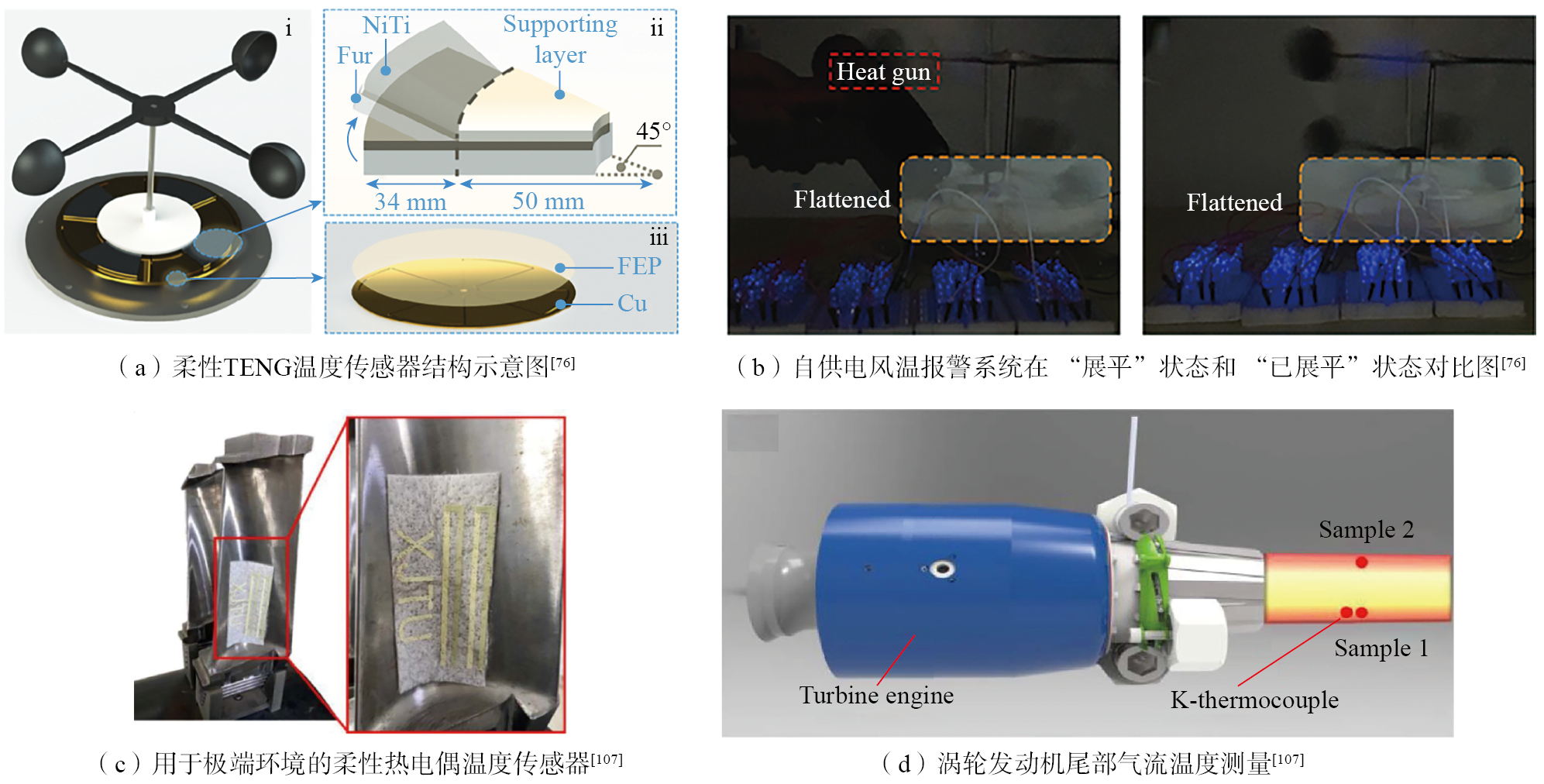
除了上述常见的柔性温度测量方案,TENG在测温方面也颇具潜力。Li等[ LI Y, DENG H C, WU H Y, et al. Rotary wind-driven triboelectric nanogenerator for self-powered airflow temperature monitoring of industrial equipment[J]. Advanced Science, 2024, 11(13): 2307382. 76]通过TENG集成NiTi形状记忆合金(Shape memory alloy,SMA)实现了对气流温度的自供电监测(图7(a))。当气流温度达到SMA的相变温度(约40 ℃)时,SMA变平,增大摩擦接触面积,使得TENG输出电流显著增加(响应比达到219%)。利用这一特性,可以构建无需外部电源的温度报警系统。该研究在油浸变压器冷却系统故障模拟试验中实现了对高温气流的无线监测和报警(图7(b)[ LI Y, DENG H C, WU H Y, et al. Rotary wind-driven triboelectric nanogenerator for self-powered airflow temperature monitoring of industrial equipment[J]. Advanced Science, 2024, 11(13): 2307382. 76]),特别适用于航空器某些难以布线的区域。
图7 柔性温度传感器及航空航天领域应用
Fig.7 Flexible temperature sensor and application in aerospace
传统柔性电子材料(如PI、聚对苯二甲酸乙二醇酯(Polyethylene terephthalate,PET)、PDMS)的耐温性通常有限(一般低于300~400 ℃),这限制了柔性温度传感器在航空极端温度环境的应用。Liu等[ LIU Z J, TIAN B, JIANG Z D, et al. Flexible temperature sensor with high sensitivity ranging from liquid nitrogen temperature to 1200 ℃[J]. International Journal of Extreme Manufacturing, 2023, 5(1): 015601. 107]提出了一种创新的解决方案,采用具有优异隔热性能和宽温域稳定性的气凝胶毡作为柔性基底,并通过丝网印刷技术在其上制备无机金属氧化物(如氧化铟、氧化铟锡(Indium tin oxide,ITO)等)薄膜构成热电偶结(图7(c))。这种设计巧妙地结合了柔性基底的变形能力和无机敏感材料的耐高温特性。试验证明,该柔性热电偶传感器能够在极宽的温度范围内(从液氮温度-196 ℃到1200 ℃高温)稳定工作,并保持了良好的灵敏度(226.7 μV/℃)。图7(d)[ LIU Z J, TIAN B, JIANG Z D, et al. Flexible temperature sensor with high sensitivity ranging from liquid nitrogen temperature to 1200 ℃[J]. International Journal of Extreme Manufacturing, 2023, 5(1): 015601. 107] 展示了该传感器成功应用于监测小型涡轮发动机尾喷口火焰温度、水蒸气物理爆炸瞬态温度等高温场景,说明了其在航空航天领域的巨大应用潜力。通过对传感材料的优化,Li等[ LI W W, KONG L Y, XU M Z, et al. Microsecond-scale transient thermal sensing enabled by flexible Mo(1-x)W(x)S(2) alloys[J]. Research, 2024, 7: 0452. 108]基于喷墨打印和退火策略构建了Mo1-xWxS2合金薄膜,进一步将此类柔性极端温度传感器的响应时间提高到了30 μs,为恶劣工况下的瞬态温度传感奠定了基础。
飞行器柔性温度传感器在低温段主要应用于结冰探测,利用温度传感器阵列监测飞机关键表面的温度分布和变化速率,当表面温度接近或低于冰点且存在过冷水滴时,结冰风险增加可通过系统加热元件监测加热和冷却过程中的温度响应曲线来判断是否结冰[ FARINA D, MAZIO M, MACHRAFI H, et al. Environmental chamber characterization of an ice detection sensor for aviation using graphene and PEDOT: PSS[J]. Micromachines, 2024, 15(4): 504. 109]。
在柔性电子传感器的实际应用场景中,流体环境是极为常见的工作条件,无论是海洋监测时传感器在海水中的运行,还是可穿戴设备与人体体表汗液、空气的接触,流体作用力都会对传感器性能产生显著影响。阻力控制作为提升柔性电子传感器在流体环境中性能的关键驱动技术,通过增减阻策略和微流道等多种方式[ RAJ A, SUTHANTHIRARAJ P P A, SEN A K. Pressure-driven flow through PDMS-based flexible microchannels and their applications in microfluidics[J]. Microfluidics and Nanofluidics, 2018, 22(11): 128. 110],能够构建起了一套完整且精细的流体力学特性调节体系,实现对传感器周围流体环境的精准干预,从而有效保障传感器在复杂流体条件下的稳定运行与精确测量[ IBRAHIM M D, AMRAN S N A, YUNOS Y S, et al. The study of drag reduction on ships inspired by simplified shark skin imitation[J]. Applied Bionics and Biomechanics, 2018, 2018(1): 7854321. 111]。
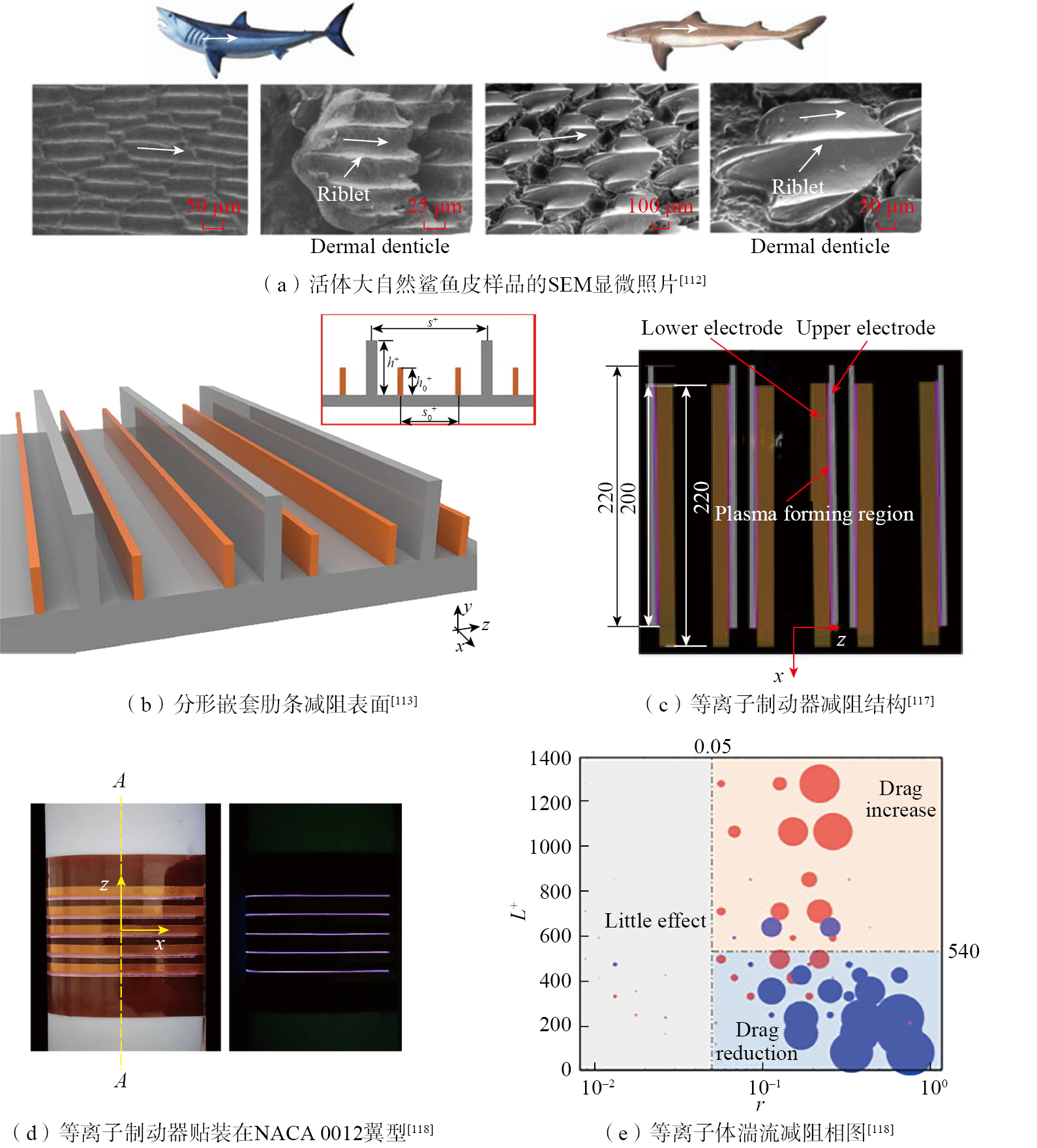
减阻方面,可通过对材料表面进行特殊处理或结构设计来实现。例如,通过采用仿生学原理,模仿鲨鱼皮表面的微观结构,如图8(a)所示[ BHUSHAN B. Shark skin surface for fluid-drag reduction in turbulent flow[M]//Biomimetics. Cham: Springer International Publishing, 2018: 491-562. 112]。在柔性传感器表面构建微小的肋条结构。这种结构能够有效降低流体在其表面流动时的阻力[ IBRAHIM M D, AMRAN S N A, YUNOS Y S, et al. The study of drag reduction on ships inspired by simplified shark skin imitation[J]. Applied Bionics and Biomechanics, 2018, 2018(1): 7854321. 111],减少能量损耗,提升传感器在流体环境中的工作效率。在此基础上,Ou等[ OU Z Y, ZHOU Z D, ZHOU W Y, et al. Hierarchical nested riblet surface for higher drag reduction in turbulent boundary layer[J]. Physics of Fluids, 2024, 36(10): 105166. 113]提出并验证了一种分形嵌套肋条的拓扑形式(图8(b)),该表面的减阻性能比受鲨鱼皮启发的均匀肋表面提高了约70%。类似的,Cui等[ CUI X X, CHEN D K, CHEN H W. Multistage gradient bioinspired riblets for synergistic drag reduction and efficient antifouling[J]. ACS Omega, 2023, 8(9): 8569-8581. 114]构建了柔性多级梯度沟槽,在流速0.5 m/s时最大减阻16.8%,说明了这种低表面能的结构可以产生稳定的高速和低速条纹从而改变表面流体的流动状态。除了结构调控方式,还可以通过壁面上的微孔或狭缝[ GLUZDOV D S, GATAPOVA E Y. Microchannel surface structures for drag reduction[J]. Journal of Engineering Thermophysics, 2023, 32(2): 214-241. 115]向外喷射流体,实现整体结构的主动减阻的功能。Zhao等[ ZHAO P F, LI X, LUO Z J, et al. A bio-inspired drag reduction method of bionic fish skin mucus structure[J]. Micromachines, 2024, 15(3): 364. 116]提出了一种新型黏液释放结构,其灵感来自鱼类皮肤上的黏液细胞分泌物,在拉伸和压缩等不同姿态下,阻力减少效果各不相同。这种黏液释放结构通过直接黏液注入过程实现了可重复使用性。
图8 柔性电子蒙皮减阻技术
Fig.8 Drag reduction technology via flexible electronic skin
另一种电学的等离子体减阻结构由两个电极组成,中间由一层介电材料隔开。一个电极暴露在空气中;另一个则被封装。当在两电极间施加高频、高压的交流电时,暴露电极上方的空气会被电离,形成一层非热力学平衡的低温等离子体。在不均匀的电场作用下,等离子体中的带电粒子受到加速作用,并通过与中性气体分子的频繁碰撞,将动量传递给周围的空气,从而在宏观上产生一股沿壁面切向的力。Cheng等[ CHENG X Q, WONG C W, HUSSAIN F, et al. Flat plate drag reduction using plasma-generated streamwise vortices[J]. Journal of Fluid Mechanics, 2021, 918: A24. 117]对等离子体致动器在平板上控制湍流边界层进行了试验研究,如图8(c)所示,减阻效果达36%。Su等[ SU Z, ZONG H H, LIANG H, et al. Minimizing airfoil drag at low angles of attack with DBD-based turbulent drag reduction methods[J]. Chinese Journal of Aeronautics, 2023, 36(4): 104-119. 118]在NACA 0012翼型进行了试验(图8(d)),在5 m/s的自由流速度下可实现高达64%的最大相对减阻,并给出了阻力调控效果的无量纲相图,如图8(e)所示。
2.2 面向飞行安全的主动热管理与防除冰技术
在特定的气候条件下,高空飞行的飞机迎风表面通常会伴随3种不同形式的结冰现象,即“水滴积冰”,“干结冰”和“升华结冰”。冰在飞机表面持续积累,最终因厚度和质量不断增大,使得冰以较高的速度向外甩出,飞出的冰块可能导致飞机本身或设备的损坏。传统的刚性除冰装置存在重量大、与机翼贴合性差等问题,而柔性加热器件则展现出显著优势。柔性加热蒙皮[ WANG Z, ZHU Y T, LIU X L, et al. Temperature self-regulating electrothermal pseudo-slippery surface for anti-icing[J]. Chemical Engineering Journal, 2021, 422: 130110. ZHAO Z H, CHEN H W, LIU X L, et al. The development of electric heating coating with temperature controlling capability for anti-icing/de-icing[J]. Cold Regions Science and Technology, 2021, 184: 103234. 119-120]可以紧密贴合在机翼的柔性蒙皮表面,实现均匀加热,其质量密度低、导热系数高,能与超疏水表面等结构防除冰策略复合,实现更有效的防除冰效果。
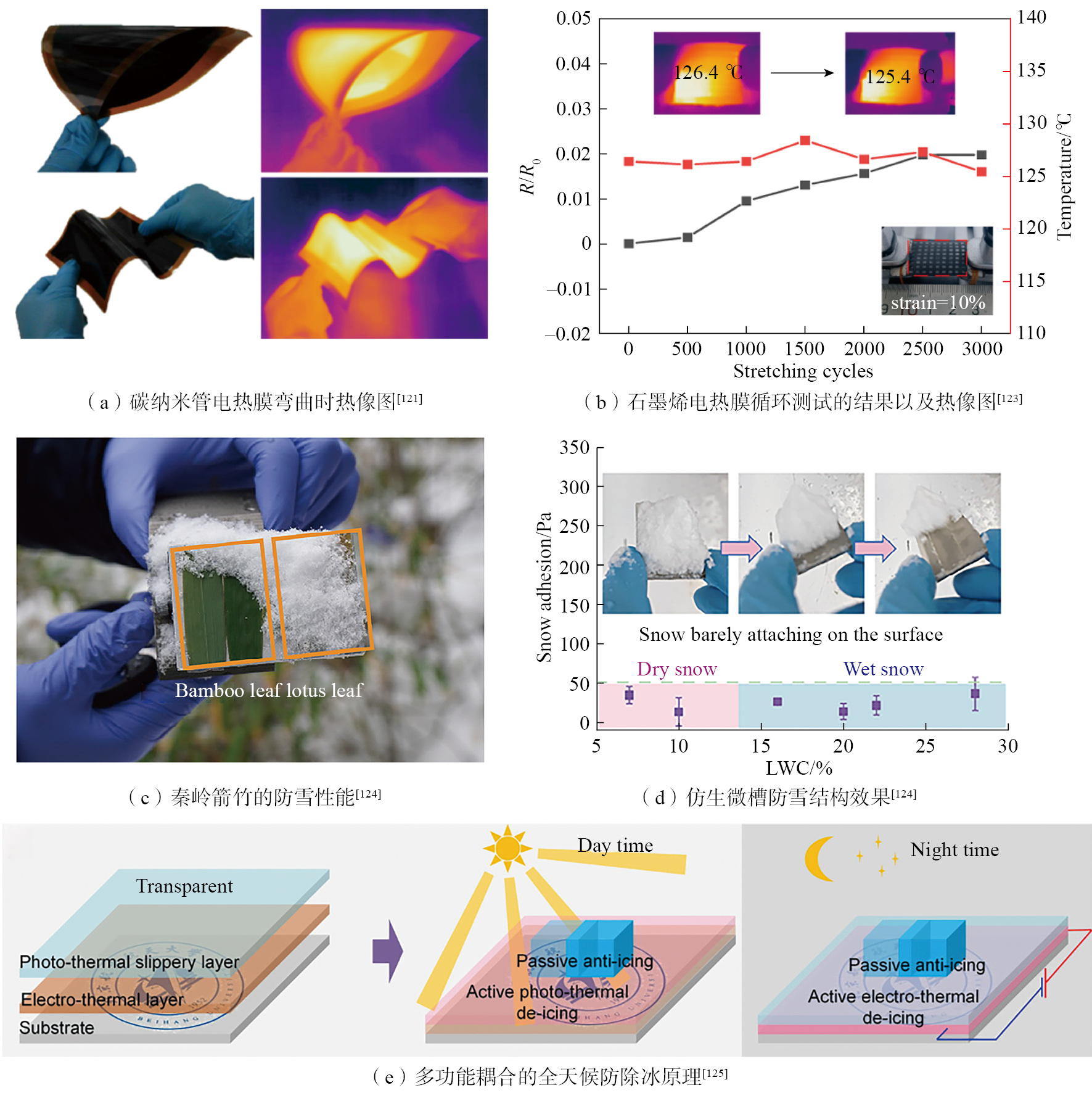
Zheng等[ ZHENG B J, WANG H T, WU X L, et al. Flexible nanocomposite electrothermal films based on carbon nanotubes and waterborne polyurethane with high reliability, stretchability and low-temperature performance for wind turbine blade deicing[J]. Composites Part A: Applied Science and Manufacturing, 2022, 158: 106979. 121]研发了一种基于碳纳米管与水性聚氨酯的纳米复合电热膜。该电热膜具有高导电性和快速响应特性,在-35 ℃低温环境下仍可正常启动,升温速率高达60 ℃/min,如图9(a)所示,该材料具有可弯曲/拉伸发热、发热均匀、发热迅速、发热面积大的特点,与传统方式相比,可靠性更高、能源利用效率更高、除冰更迅速。类似的,Liu等[ LIU Y H, MA X H, ZHANG H Z, et al. Large-scale production of electrothermal films with GNSs/CNTs/CB three-dimensional structure ink by screen printing[J]. ACS Applied Electronic Materials, 2022, 4(2): 814-822. 122]采用分散研磨法制备了低成本的水性碳系列电热油墨,通过丝网印刷可以大规模制备具有各种面积的电热薄膜。在此基础上,通过球磨分散工艺构建石墨烯纳米片/多壁碳纳米管/炭黑的三维导电网络。输入电压为10 V时可达到饱和温度(165 ℃),并且具有极低的功耗(444.75 cm2/W)。电热膜在115000次循环的弯曲测试中保持了相对稳定的电性能。Song等[ SONG H Q, NIE B B, ZHU Y H, et al. Flexible grid graphene electrothermal films for real-time monitoring applications[J]. Langmuir, 2024, 40(13): 6940-6948. 123]通过将激光诱导法和转移印刷工艺相结合,制造了一种基于石墨烯图案结构的柔性电热膜(图9(b))。网格结构设计为电热膜的应用提供了准确的实时监测,并在解决管道中除冰和清除冰堵塞相关的问题方面显示出潜力。柔性电热膜在15 V下可达到165 ℃的高加热温度,并表现出足够的加热稳定性。
图9 柔性薄膜电加热技术
Fig.9 Flexible film electric heating technology
通过柔性结构化表面防除冰是另一条有效的技术路径,如图9(c)所示,Yan等[ YAN Z X, KONG Z Y, TANG Y L, et al. A bioinspired micro-grooved structure for low snow adhesion and effective snow-shedding[J]. Advanced Materials, 2025, 37(21): 2500839. 124]受秦岭箭竹启发,提出一种仿生微槽防雪结构,该结构通过减少接触面积来最小化范德华力,并通过V形设计来减轻毛细效应,从而促进界面处液态水的分离(图9(d)[ YAN Z X, KONG Z Y, TANG Y L, et al. A bioinspired micro-grooved structure for low snow adhesion and effective snow-shedding[J]. Advanced Materials, 2025, 37(21): 2500839. 124])。结构防除冰与加热防除冰可进一步结合,Wang等[ WANG Y M, ZHANG K T, CUI X X, et al. A transparent photo/electrothermal composite coating with liquid-like slippery property for all-day anti-/de-icing[J]. ACS Applied Materials & Interfaces, 2024, 16(31): 41400-41408. 125]报告了一种双层透明光电/电热涂层,可用于全天防/除冰(图9(e))。制备的涂层具有超滑性、低附着力,可见光透射率高达77%,由于添加了紫外线和红外线吸收剂,可有效吸收紫外线和近红外光,通过底部ITO层可提供电热性能,使其能够实现全天候除冰。
2.3 面向天线-隐身一体化的柔性电磁特征调控
飞行器外形普遍采用复杂的非可展曲面以优化气动性能,同时,通信、导航和探测等功能高度依赖于与机体共形的天线系统。柔性电磁调控蒙皮旨在将具备电磁波吸收、透射或散射调控能力的超材料与柔性电子技术相结合,形成一种能够完美贴合于飞行器复杂曲面、兼具隐身、通信,甚至光学透明[ ZHANG C, YANG J, CAO W K, et al. Transparently curved metamaterial with broadband millimeter wave absorption[J]. Photonics Research, 2019, 7(4): 478-485. 126]的“智能”蒙皮。这种技术旨在消除传统隐身涂料厚重、易腐蚀且无法兼容天线工作的固有缺陷。
柔性电磁调控蒙皮的核心在于解决功能材料在复杂曲面上的共形难题,尤其是在非可展曲面(如球面、马鞍面)上,如何避免传统平面设计映射所导致的结构失真与性能恶化是研究的焦点。例如,Bisht等[ BISHT M S, SHARMA A, SRIVASTAVA K V. Radar cross section (RCS) analysis of finite metamaterial based absorber for planar and curved configurations[C]//2019 IEEE Indian Conference on Antennas and Propogation (InCAP). Ahmedabad: IEEE, 2019. 127]的研究表明,将平面设计的吸波超材料直接弯曲共形于曲面时,其吸收性能会随着弯曲角度的增大而显著下降,这凸显了为曲面专门设计的必要性。虽然针对曲面功能结构已有研究,如Bai等[ BAI L, WANG Z R, YE D, et al. High efficient near-infrared sintering for electrohydrodynamic printed frequency selective surface[J]. Materials & Design, 2025, 252: 113774. 128]提出的近红外烧结电流体动力喷印技术可直接在曲面制造功能结构,但这类方法往往受限于特定工艺与平台。近年来,以柔性基底和特种结构设计为代表的柔性电子技术,为非可展曲面共形超材料的制备提供了全新的解决方案。其中,仿生设计与剪纸/折纸策略展现出巨大的应用潜力。
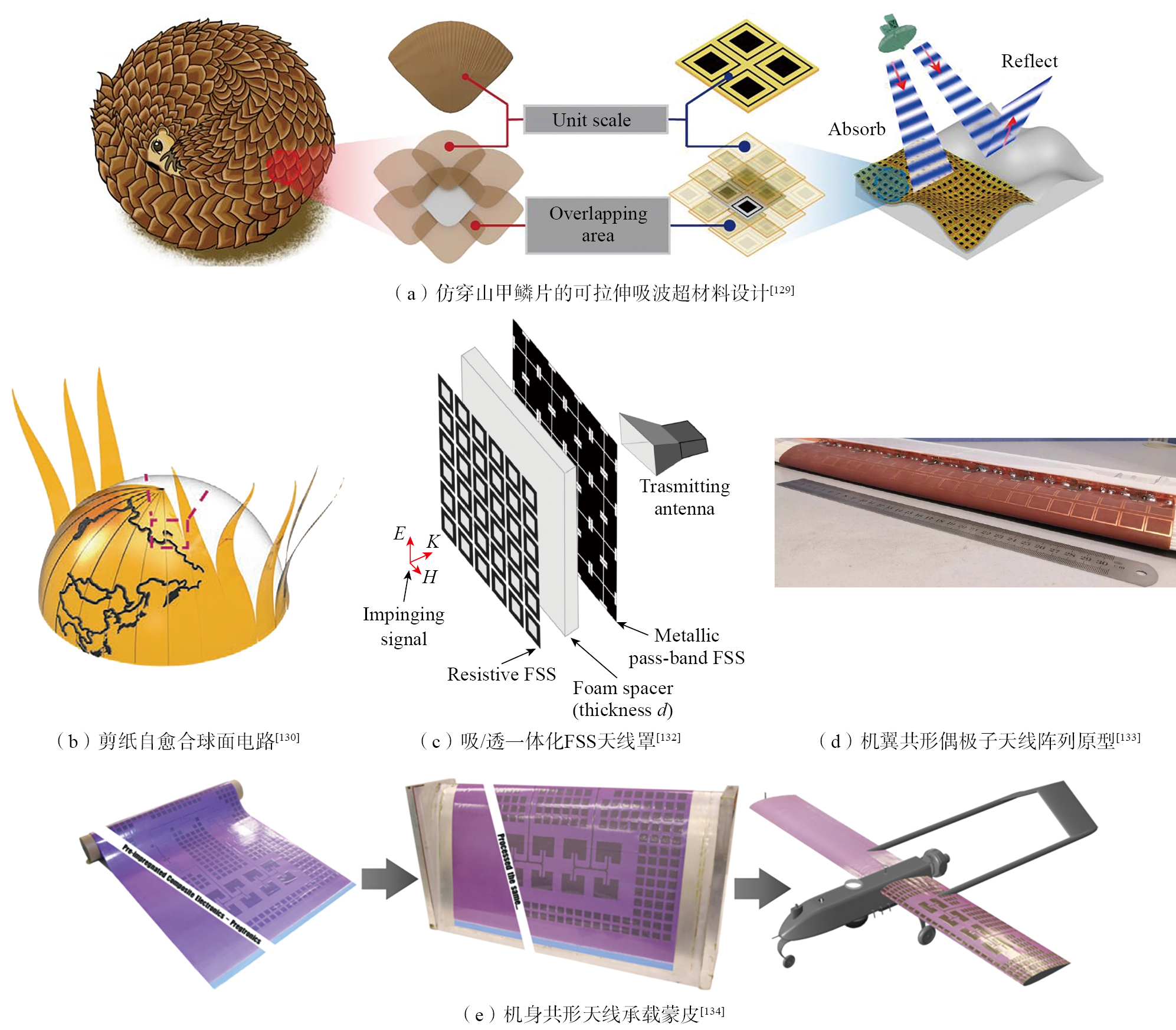
Wang等[ WANG C X, LV Z S, MOHAN M P, et al. Pangolin-inspired stretchable, microwave-invisible metascale[J]. Advanced Materials, 2021, 33(41): 2102131. 129]受穿山甲鳞片的启发,提出了一种创新的软硬结合可拉伸超材料蒙皮策略,如图10(a)所示,该设计将刚性的电磁耗散单元(硬质“鳞片”)周期性地集成于高弹性的基板上。当基板拉伸时,相邻的刚性单元可以相对滑动和重叠,类似于穿山甲的鳞片结构,从而在宏观上实现优异的拉伸性和对非可展曲面的保形覆盖能力。该研究通过在球面和鞍面等典型非可展曲面上的测试,验证了这种仿生鳞片结构在复杂变形下仍能保持稳定的吸波性能,为解决大曲率、大变形表面下的电磁隐身问题提供了极具前景的力学-电磁协同设计思路。
图10 柔性电子蒙皮电磁调控技术
Fig.10 Flexible electronic skin electromagnetic control technology
剪纸技术是实现二维平面材料向三维复杂曲面共形转换的另一条有效途径。通过在二维柔性薄膜上引入精密的剪切线,可以有效释放材料在共形贴合过程中产生的面内应力,避免褶皱和气泡的产生。Liu等[ LIU J P, JIANG S, XIONG W N, et al. Self-healing kirigami assembly strategy for conformal electronics[J]. Advanced Functional Materials, 2022, 32(12): 2109214. 130]开发出一种新型的自愈合剪纸组装策略,如图10(b)所示,该方法能够将传统的二维电路设计与制造工艺直接应用于三维曲面的共形覆盖,通过精确设计的剪纸图案,实现了二维功能片材对球面的完美包裹。这种策略不仅解决了共形难题,还为连接因裁切而断开的电路提供了可能。Wang等[ WANG S H, WANG Y C, CHEN Z J, et al. Kirigami design of flexible and conformal tactile sensor on sphere-shaped surface for contact force sensing[J]. Advanced Materials Technologies, 2023, 8(3): 2200993. 131]也将类似思想用于构建球面柔性触觉传感器,共同展示了柔性电子蒙皮在构建曲面功能方面的巨大潜力。
柔性电磁调控蒙皮的另一项关键任务是实现天线与隐身功能的“一体化”集成。共形天线虽能满足气动外形需求,但其自身也成为一个显著的雷达散射源。传统的吸波涂料会严重干扰天线收发信号,因此必须发展带内透波、带外吸波的“吸/透”一体化超材料技术。Costa等[ COSTA F, MONORCHIO A. A frequency selective radome with wideband absorbing properties[J]. IEEE Transactions on Antennas and Propagation, 2012, 60(6): 2740-2747. 132]提出了一种频率选择性天线罩,如图10(c)所示,通过设计由十字与方环FSS构成的双层结构,实现了低频段的高效透波与高频段的宽带吸收。该结构在保证天线工作频段内低插入损耗(0.3 dB)的同时,在10~18 GHz的宽广频带内实现了优异的吸波性能,从而有效降低了天线系统的雷达散射截面,为解决共形天线的隐身问题提供了重要的设计思路。
将上述理念推向实际应用,需要在真实的飞行器平台上进行验证。Peng等[ PENG J J, QU S W, XIA M Y, et al. Conformal phased array antenna for unmanned aerial vehicle with ±70° scanning range[J]. IEEE Transactions on Antennas and Propagation, 2021, 69(8): 4580-4587. 133]围绕无人机平台共形天线开展了深入研究,设计并制作了一个1×8线性的共形偶极子天线阵列原型,并将其共形安装于模拟无人机机翼前缘的曲面泡沫结构上,如图10(d)所示。通过将柔性天线阵列与曲面载体紧密贴合,实现了天线功能与气动外形的统一。这项工作与Healey等[ HEALEY R, NICHOLSON K J, WANG J, et al. Conformal load-bearing antenna structures—Mechanical loading considerations[J]. Sensors, 2021, 22(1): S22010048. 134]对共形承载天线结构在机械载荷下的性能研究(图10(e))共同表明柔性共形天线技术正逐步走向成熟,为发展集成了隐身功能的柔性电磁调控蒙皮奠定了坚实的基础。
当前的研究已经从基础的柔性材料制备,发展到精巧的仿生与剪纸力学结构设计,并初步探索了天线-隐身一体化的集成方法。然而,研究仍面临诸多挑战:如何在非可展曲面上实现超材料单元的精确、无失真排布,正如Zhang[ ZHANG K P, LIAO Y F, QIU B, et al. 3D printed embedded metamaterials[J]. Small, 2021, 17(50): 2103262. 135]和Shin[ SHIN D, CHOI S, KIM J, et al. Direct-printing of functional nanofibers on 3D surfaces using self-aligning nanojet in near-field electrospinning[J]. Advanced Materials Technologies, 2020, 5(6): 2000232. 136]等在小尺度上所展示的那样,仍是大规模应用的技术瓶颈;如何解决柔性剪纸策略中切割线对超材料电磁完整性的破坏问题[ LIU J P, JIANG S, XIONG W N, et al. Self-healing kirigami assembly strategy for conformal electronics[J]. Advanced Functional Materials, 2022, 32(12): 2109214. 130];以及如何将吸/透一体化超材料与天线在曲面环境下进行一体化共形集成,并系统评估其耦合效应对辐射与散射特性的综合影响[ COSTA F, MONORCHIO A. A frequency selective radome with wideband absorbing properties[J]. IEEE Transactions on Antennas and Propagation, 2012, 60(6): 2740-2747. PENG J J, QU S W, XIA M Y, et al. Conformal phased array antenna for unmanned aerial vehicle with ±70° scanning range[J]. IEEE Transactions on Antennas and Propagation, 2021, 69(8): 4580-4587. 132-133],这些都有待进一步发展。
3 多物理量融合与重构
柔性电子蒙皮作为先进感知载体,需要将多种不同物理量传感技术进行集成与融合,实时采集海量、高维度、多模态数据[ LEE J H, CHO K, KIM J K. Age of flexible electronics: Emerging trends in soft multifunctional sensors[J]. Advanced Materials, 2024, 36(16): 2310505. 137]。然而,这些原始数据往往裹挟着噪声与冗余信息,其离散化的空间分布特性也使得直接用于复杂系统的决策控制面临天然挑战。人工智能技术,特别是机器学习与深度学习的突破性进展[ BURNELL R, SCHELLAERT W, BURDEN J, et al. Rethink reporting of evaluation results in AI[J]. Science, 2023, 380(6641): 136-138. WANG Y J, ADAM M L, ZHAO Y L, et al. Machine learning-enhanced flexible mechanical sensing[J]. Nano-Micro Letters, 2023, 15(1): 55. NIU H S, YIN F F, KIM E S, et al. Advances in flexible sensors for intelligent perception system enhanced by artificial intelligence[J]. InfoMat, 2023, 5(5): e12412. 138-140],为破解数据处理难题、释放柔性电子传感器的智能潜力提供了系统性解决方案。通过数据重构[ XU Z J, CAO L N Y, LI C Y, et al. Digital mapping of surface turbulence status and aerodynamic stall on wings of a flying aircraft[J]. Nature Communications, 2023, 14: 2792. 26, HUANG Y A, ZHU C, XIONG W N, et al. Flexible smart sensing skin for “fly-by-feel” morphing aircraft[J]. Science China Technological Sciences, 2022, 65(1): 1-29. DONG Z H, GONG Z, CHEN B Q, et al. Ultrathin flexible skin with all-polyimide pressure and airflow sensor array for estimation of flight parameters[J]. IEEE Sensors Journal, 2023, 23(23): 29494-29501. 141-142]、多物理量融合[ TOPAC T, GRAY C, CHANG F K. Fly-by-feel: Learning aerodynamics from multimodal wing mechanics[C]//AIAA SCITECH 2024 Forum. Orlando: AIAA, 2024. GONG Z, DI W C, JIANG Y G, et al. Flexible calorimetric flow sensor with unprecedented sensitivity and directional resolution for multiple flight parameter detection[J]. Nature Communications, 2024, 15: 3091. 29-30]等算法,正推动柔性电子蒙皮从离散、单一的传感器件向具备多物理量、复杂流场感知能力的智能终端演进[ DONG B W, SHI Q F, YANG Y Q, et al. Technology evolution from self-powered sensors to AIoT enabled smart homes[J]. Nano Energy, 2021, 79: 105414. SUN T M, FENG B, HUO J P, et al. Artificial intelligence meets flexible sensors: Emerging smart flexible sensing systems driven by machine learning and artificial synapses[J]. Nano-Micro Letters, 2023, 16(1): 14. 143-144]。
3.1 多物理量协同感知的集成策略
为了获取更全面的飞机状态信息,提升感知系统的效率和集成度,将多种传感功能集成到单一的柔性电子蒙皮是必然趋势。这种集成不仅可以减少传感器的数量、重量、功耗和布线复杂性,还能实现多物理量之间的协同感知和信息融合,从而更深入地理解复杂的航空物理过程。传感阵列多功能集成主要有两种策略:一是在柔性基板上协同分布多个单功能传感器单元;二是将多种传感模态集成到单个传感器单元内部。两种多功能集成方式的特点如表1所示[ XIONG W N, ZHU C, GUO D L, et al. Bio-inspired, intelligent flexible sensing skin for multifunctional flying perception[J]. Nano Energy, 2021, 90: 106550. 17, HUA Q L, SUN J L, LIU H T, et al. Skin-inspired highly stretchable and conformable matrix networks for multifunctional sensing[J]. Nature Communications, 2018, 9: 244. 145]。
表1 多功能集成方式对比[ XIONG W N, ZHU C, GUO D L, et al. Bio-inspired, intelligent flexible sensing skin for multifunctional flying perception[J]. Nano Energy, 2021, 90: 106550. 17, HUA Q L, SUN J L, LIU H T, et al. Skin-inspired highly stretchable and conformable matrix networks for multifunctional sensing[J]. Nature Communications, 2018, 9: 244. 145]
Table 1 Comparison of multifunctional integration methods[ XIONG W N, ZHU C, GUO D L, et al. Bio-inspired, intelligent flexible sensing skin for multifunctional flying perception[J]. Nano Energy, 2021, 90: 106550. 17, HUA Q L, SUN J L, LIU H T, et al. Skin-inspired highly stretchable and conformable matrix networks for multifunctional sensing[J]. Nature Communications, 2018, 9: 244. 145]
集成方式
典型实现技术
优点
缺点
封装、可靠性
代表文献
分布式传感
混合传感器阵列,模块化+柔性互联
设计/制造相对简单,单传感器性能易优化
布线复杂,功耗/重量大,空间分辨率受限,可能存在热/机械串扰
需考虑大规模布线和连接器的可靠性
[ XIONG W N, ZHU C, GUO D L, et al. Bio-inspired, intelligent flexible sensing skin for multifunctional flying perception[J]. Nano Energy, 2021, 90: 106550. 17]
共位集成
多层堆叠,多功能复合材料,结构功能一体化
集成度高,空间分辨率高,系统小型化
信号串扰/解耦是核心问题,制造工艺复杂,标定困难
需保护内部复杂结构和多材料界面
[ HUA Q L, SUN J L, LIU H T, et al. Skin-inspired highly stretchable and conformable matrix networks for multifunctional sensing[J]. Nature Communications, 2018, 9: 244. 145]
多物理量分布式传感侧重于在一个柔性基板或蒙皮的不同空间位置上,集成用于测量不同物理量的传感器单元。例如,可以在某区域布置压力传感器阵列,在相邻区域布置剪应力传感器阵列或温度传感器[ 郭栋梁, 侯超, 朱臣, 等. 飞行器表面气动载荷的柔性智能蒙皮多参量测量[J]. 实验流体力学, 2022, 36(2): 146-154.GUO Dongliang, HOU Chao, ZHU Chen, et al. Multi-parameter measurement of aerodynamic load via flexible sensing skin[J]. Journal of Experiments in Fluid Mechanics, 2022, 36(2): 146-154. PANG P, ZHANG J N, LUO C H, et al. Flexible sensing skin for simultaneous measurement of wall shear stress, flow direction and dynamic pressure[C]//2024 IEEE SENSORS. Kobe: IEEE, 2024. 146-147]。这些传感器单元本身只具备单一或有限的传感功能,但通过整个阵列的协同工作和数据采集,可以实现对目标区域内多个物理量(如压力场、剪应力场、温度场)的同步、分布式测量。这种方法的重点在于多物理量测量的“协同性”以及后续的数据融合分析,而非追求单个传感节点的“多功能性”。
分布式集成的实现方式主要分为两种:一种是混合传感器阵列集成。即在同一柔性基底(如PI、PET、PDMS)上,利用微纳加工、印刷电子等技术,集成不同工作原理的传感器。这些传感器共享同一个柔性基底,便于共形贴附与流场解码[ HU X H, GUO S, CHEN Y Q, et al. Functional materials-enabled flexible electronic skin for flow field decoding[J]. Frontiers in Electronics, 2025, 6: 1528802. 148]。另一种是模块化与柔性互联,即将不同功能的传感器制作成独立的柔性模块,然后通过FPC或其他柔性互联技术将这些模块连接起来,形成一个大规模、可扩展的传感网络[ LEGER T J, JOHNSTON D A, WOLFF J M. Flex circuit sensor array for surface unsteady pressure measurements[J]. Journal of Propulsion and Power, 2004, 20(4): 754-758. 149],这种方式的设计灵活性和可维护性更佳。
Xiong等[ XIONG W N, ZHU C, GUO D L, et al. Bio-inspired, intelligent flexible sensing skin for multifunctional flying perception[J]. Nano Energy, 2021, 90: 106550. 17]提出了一种受生物启发的智能柔性传感皮肤,通过模仿飞行生物的多重感知能力(如皮肤、神经通路、免疫系统和大脑功能),实现了多功能飞行感知的突破性进展。如图11(a)所示,该工作通过模块化集成成功实现了多物理量协同测量,包括用于风压测量的电容传感器、用于壁面剪应力的热膜传感器、用于表面温度和结构应变的电阻传感器,以及用于耦合气流-结构动力学和冲击定位的压电传感器,它们均展现出卓越的多功能集成能力。在风洞试验中,该系统不仅精确测量了表面压力、温度、壁面剪应力和颤振等关键参数,还结合智能算法进行数据处理和决策,成功定位了突发冲击并预测了气流分离和失速等飞行状态,为未来智能飞行器“Fly-by-Feel”技术的应用提供了重要潜力。Dong等[ DONG Z H, GONG Z, CHEN B Q, et al. Ultrathin flexible skin with all-polyimide pressure and airflow sensor array for estimation of flight parameters[J]. IEEE Sensors Journal, 2023, 23(23): 29494-29501. 142]也报道了一种完全基于PI的超薄(<70 μm)柔性蒙皮,该蒙皮上集成了电容式压力传感器阵列和电阻式气流传感器阵列,可在同一平台上同时获取压力分布和近壁面气流信息,并通过这些数据成功估算关键的飞行参数,如空速和AOA等(图11(b))[ DONG Z H, GONG Z, CHEN B Q, et al. Ultrathin flexible skin with all-polyimide pressure and airflow sensor array for estimation of flight parameters[J]. IEEE Sensors Journal, 2023, 23(23): 29494-29501. 142]。
与分布式传感策略不同,共位集成旨在将多种传感功能集成到同一个微小的、独立的传感器单元中[ GUO F W, LI Y, MA G M, et al. Overview of 3D printing multimodal flexible sensors[J]. ACS Applied Materials & Interfaces, 2024, 16(48): 65779-65795. 150],实现在空间上“同一点”获取多个参数。这对于理解传感器所在位置的局域物理环境,或者在空间分辨率要求极高的场景(如湍流微结构研究)中具有优势。
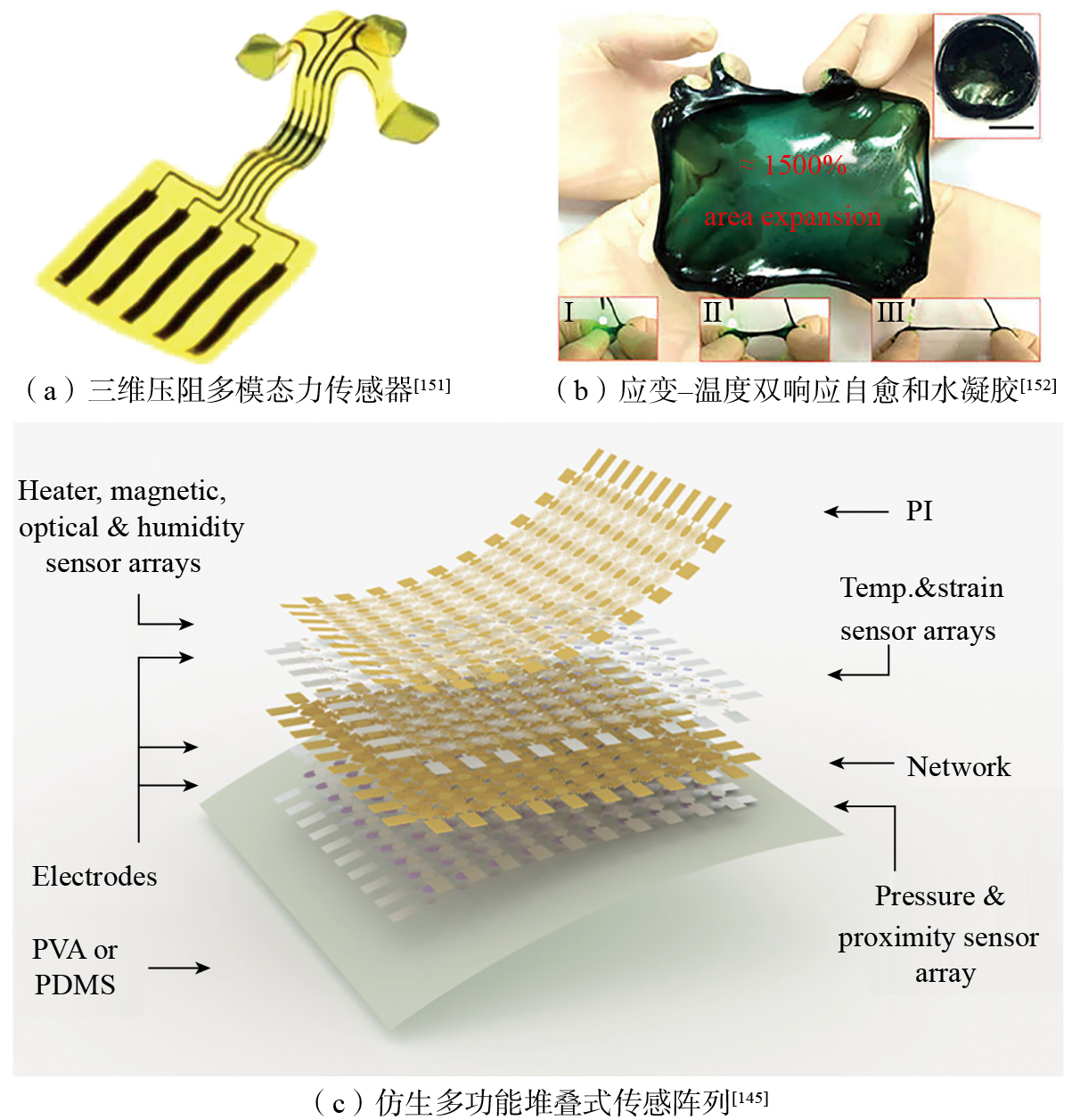
研究人员采用了多种策略来实现多功能共位集成,例如通过结构设计可实现单一传感器二维测量到三维测量的扩展。如图12(a)所示,Won等[ WON S M, WANG H L, KIM B H, et al. Multimodal sensing with a three-dimensional piezoresistive structure[J]. ACS Nano, 2019, 13(10): 10972-10979. 151]提出了一种基于单晶硅纳米膜压阻元件的三维“桌状”结构。该结构通过在4个支撑腿上集成压阻元件,能够同时、独立地测量法向力(压力)、剪切力、弯曲以及温度。通过分析4个传感元件的电阻变化,可以有效分离面内和面外机械变形产生的信号,实现多模态解耦传感,展示了利用特定三维几何结构实现多功能解耦传感的潜力。
单一材料的多物理量响应也是共位集成的重要技术路径。Ge等[ GE G, LU Y, QU X Y, et al. Muscle-inspired self-healing hydrogels for strain and temperature sensor[J]. ACS Nano, 2020, 14(1): 218-228. 152]受肌肉结构的启发,开发了一种基于聚苯胺纳米纤维/聚丙烯酸水凝胶的传感器(图12(b))。这种水凝胶本身同时具有压阻效应和热敏效应,聚苯胺纳米纤维网络在拉伸应变下电阻发生变化,同时对温度变化也表现出高敏感性,从而实现了应变和温度的双重传感功能,这种方法依赖于单一功能材料本身的多重物理响应特性来实现多功能集成。
对于更多功能的集成,需要考虑有限空间的堆叠和结构复用。如图12(c)所示,Hua等[ HUA Q L, SUN J L, LIU H T, et al. Skin-inspired highly stretchable and conformable matrix networks for multifunctional sensing[J]. Nature Communications, 2018, 9: 244. 145]将不同类型的传感器单元(温度、应变、湿度、光、磁场、压力、接近)作为节点集成到一个结构化的柔性PI网络中,并提出了通过堆叠实现三维集成的可能性,以提高集成密度。这种方法侧重于将多个分立但微型化的单功能传感器集成到一个柔性可拉伸的平台上。利用纺织物的纵横交错结构,也可以设计不同的传感路径。通过在织物中整合不同功能的纱线(如电容式压力传感纱线和电阻式应变传感纱线),并在织物结构层面设计传感路径,该纺织品能够在同一材料体系内同时检测压力和拉伸应变[ PENG Y Y, SUN F X, PAN R R. Multiplexed sensing textiles enabled by reconfigurable weaving meso-structures for intricate kinematic posture recognition and thermal therapy healthcare[J]. ACS Sensors, 2025, 10(4): 3051-3060. 153]。
随着对集成密度和功能数需求的提高,引线数量与交叠问题更加突出,柔性三维集成技术[ HUANG Z L, HAO Y F, LI Y, et al. Three-dimensional integrated stretchable electronics[J]. Nature Electronics, 2018, 1(8): 473-480. ZHUANG Q N, YAO K M, ZHANG C, et al. Permeable, three-dimensional integrated electronic skins with stretchable hybrid liquid metal solders[J]. Nature Electronics, 2024, 7(7): 598-609. 154-155]可以突破平面集成密度的极限,但不影响整理的柔性。三维集成的柔性电子概念由Huang等[ HUANG Z L, HAO Y F, LI Y, et al. Three-dimensional integrated stretchable electronics[J]. Nature Electronics, 2018, 1(8): 473-480. 154]率先提出,通过逐层构建电路和激光烧蚀形成的垂直互连通道,显著提高了设备的集成密度和功能复杂性,在柔性电子的多功能共位集成中极具潜力。
多功能集成的核心优势在于能够同时获取多种信息,但这通常伴随着信号串扰和耦合的挑战。准确地从混合的传感器响应中提取每种刺激的独立信息(即信号解耦)是实现多功能传感器实用化的关键环节。一种重要的解耦策略是从传感器本身的物理设计入手,通过优化结构和选择材料,尽可能地减少或消除不同刺激响应之间的耦合。通过引入特定的微结构(如微金字塔、微柱阵列、多孔结构等)可以调控传感器对不同刺激的敏感性。例如,Su等[ SU Q, ZOU Q, LI Y, et al. A stretchable and strain-unperturbed pressure sensor for motion interference-free tactile monitoring on skins[J]. Science Advances, 2021, 7(48): eabi4563. 156]通过设计刚性微金字塔结构,可以最大化压力敏感性和最小化应变敏感性,从而实现压力和应变的初步解耦。除此之外,通过封装层可以将传感器与某些干扰源隔离开。例如,Yang等[ YANG L, YAN J Y, MENG C Z, et al. Vanadium oxide-doped laser-induced graphene multi-parameter sensor to decouple soil nitrogen loss and temperature[J]. Advanced Materials, 2023, 35(14): 2210322. 157]使用软膜封装VOx-LIG传感器,使得封装后的器件可以准确测量温度而不受氮氧化物气体的影响,从而实现了气体和温度传感的解耦。
3.2 离散传感信息的连续物理场智能重构
柔性传感器阵列的空间离散测量特性,与气动分析、流动控制等工程应用所需的连续物理场表征之间存在天然鸿沟。数据重构技术旨在通过算法建模,实现从稀疏测量数据到高分辨率物理场的精准映射,其核心是在有限传感器布局下完成对压力云图、剪应力分布、温度场等关键参数的连续化表征[ BUZZICOTTI M. Data reconstruction for complex flows using AI: Recent progress, obstacles, and perspectives[J]. Europhysics Letters, 2023, 142(2): 23001. 158]。
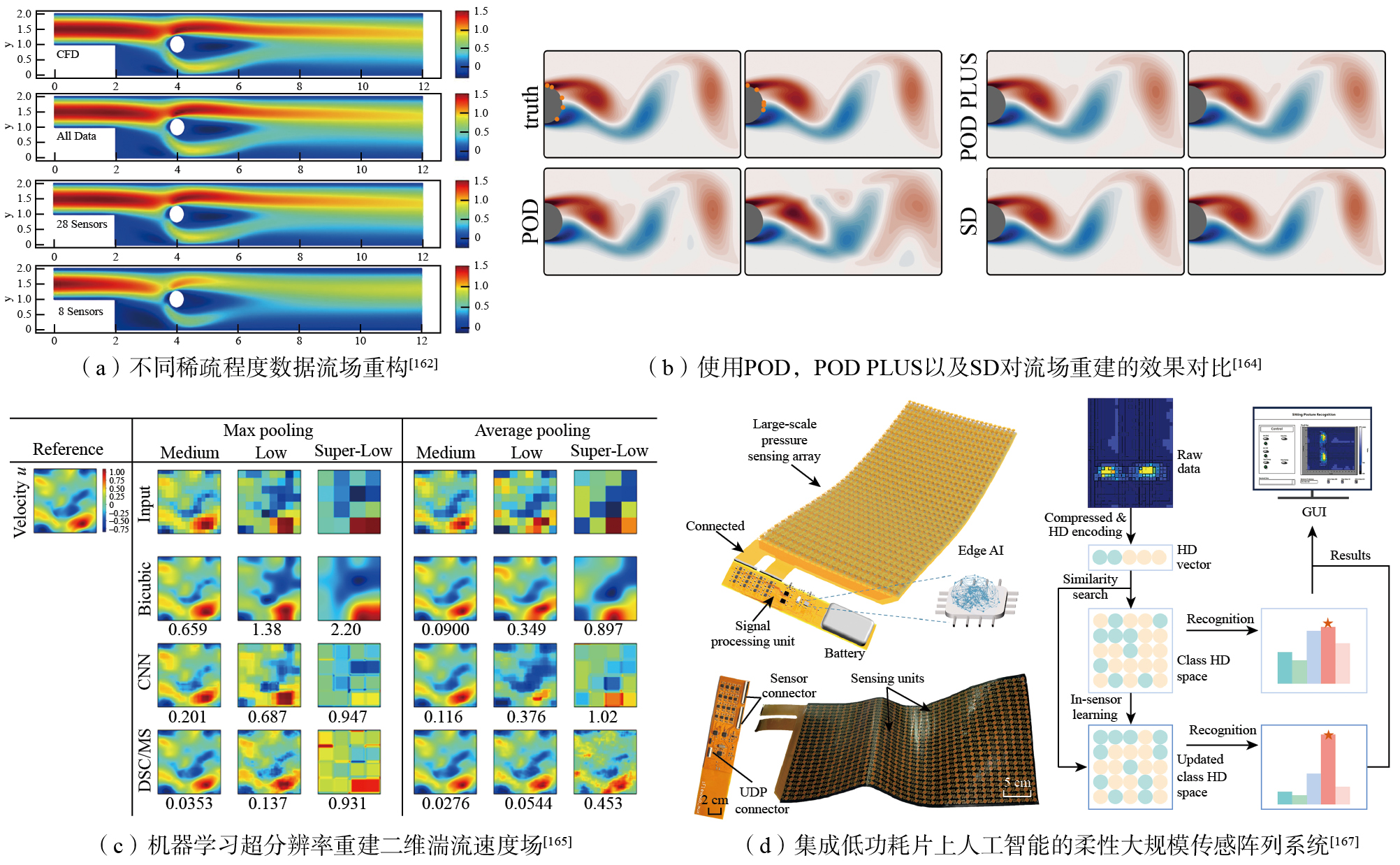
传统插值拟合方法,如克里金插值、薄板样条函数,依托几何邻近性假设实现数据填充,原理简明、计算高效。但在含激波、分离涡的非线性流场等复杂环境的重构中,这种方式难以捕捉多尺度流动特征,从而精度受限;基于物理模型的方法则将纳维-斯托克斯方程、能量守恒定律等先验知识嵌入算法框架,典型代表是物理信息神经网络(Physics-informed neural network,PINN)[ RAISSI M, PERDIKARIS P, KARNIADAKIS G E. Physics-informed neural networks: A deep learning framework for solving forward and inverse problems involving nonlinear partial differential equations[J]. Journal of Computational Physics, 2019, 378: 686-707. 159],通过在损失函数中引入微分方程约束,PINN可以实现稀疏数据驱动下符合物理规律的流场重建,有效解决了纯数据方法可能出现的物理非合理性问题[ XU S F, SUN Z X, HUANG R F, et al. A practical approach to flow field reconstruction with sparse or incomplete data through physics informed neural network[J]. Acta Mechanica Sinica, 2022, 39(3): 322302. YANG K C, LIU X, FENG W H, et al. A super resolution flow field reconstruction method using PINN[C]//First Aerospace Frontiers Conference (AFC 2024). Xi’an: SPIE, 2024: 114. 160-161]。如图13(a)所示,Hosseini等[ HOSSEINI M Y, SHIRI Y. Flow field reconstruction from sparse sensor measurements with physics-informed neural networks[J]. Physics of Fluids, 2024, 36(7): 073606. 162]采用逆物理信息神经网络将可用的稀疏数据与物理定律合并。该方法以圆柱体周围的流动为案例进行研究,具有3个不同的训练集。一个是来自域的稀疏速度数据;另外两个数据集是从域边界和圆柱体壁周围的传感器获得的有限速度数据。已确定所有模型的速度分量的决定系数(R2)系数和均方误差(RMSE)指标,用于指示模型性能。结果表明,该方法可以在圆柱体周围有超过 28个传感器的情况下以相当高的精度成功重建实际速度场,突出了PINN 作为试验流体力学有效数据同化技术的潜力。
图13 使用神经网络/机器学习的方式对稀疏数据进行重构
Fig.13 Reconstructing sparse data using neural networks
数据驱动的深度模型也是数据重构常用的方式[ LING J L, KURZAWSKI A, TEMPLETON J. Reynolds averaged turbulence modelling using deep neural networks with embedded invariance[J]. Journal of Fluid Mechanics, 2016, 807: 155-166. 163]。既可以简单地借助模态分解将高维流场降维表示为模态系数的线性组合,进而构建稀疏传感器读数到模态系数的端到端映射[ ERICHSON N B, MATHELIN L, YAO Z W, et al. Shallow neural networks for fluid flow reconstruction with limited sensors[J]. Proceedings Mathematical, Physical, and Engineering Sciences, 2020, 476(2238): 20200097. 164];也可以通过超分辨率重建技术[ FUKAMI K, FUKAGATA K, TAIRA K. Super-resolution reconstruction of turbulent flows with machine learning[J]. Journal of Fluid Mechanics, 2019, 870: 106-120. 165],如生成对抗网络[ YOUSIF M Z, ZHOU D, YU L Q, et al. Flow field recovery in restricted domains using a generative adversarial network framework[J]. Physics of Fluids, 2024, 36(12): 125113. 166]实现流场细节的精细化。如图13(b)所示,Erichson等[ ERICHSON N B, MATHELIN L, YAO Z W, et al. Shallow neural networks for fluid flow reconstruction with limited sensors[J]. Proceedings Mathematical, Physical, and Engineering Sciences, 2020, 476(2238): 20200097. 164]提出了一种基于浅层神经网络的学习方法,从有限的测量和有限的数据中重建流体流动。这种方式可以学习传感器测量值和高维流体流场之间的端到端映射,而无需对原始数据进行任何繁重的预处理。其使用的浅层解码器(Shallow decoder,SD)相比传统的本征正交分解(Proper orthogonal decomposition,POD)及其改良算法POD PLUS能够更好地对数据进行重构。
如图13(c)所示,Fukami等[ FUKAMI K, FUKAGATA K, TAIRA K. Super-resolution reconstruction of turbulent flows with machine learning[J]. Journal of Fluid Mechanics, 2019, 870: 106-120. 165]提出了一种采用机器学习方法对严重欠分辨的湍流流场数据进行超分辨率分析的方法,能够重构高分辨率流场。为此开发了两种机器学习模型,即卷积神经网络(Convolutional neural network,CNN)和混合下采样跳跃连接多尺度(Downsampled skip-connection multi-scale,DSC/MS)模型。将这些模型应用于二维圆柱尾流作为初步测试,结果表明,它能从低分辨率流场数据中重构层流,展现出卓越能力。进一步评估这些模型在二维均匀湍流中的性能发现,CNN与DSC/MS模型能够从极度粗糙的流场图像中重构湍流,且精度显著。针对湍流问题,基于机器学习的超分辨率分析可大幅提升空间分辨率——仅需少至50个训练快照数据即可实现,表明这种揭示复杂湍流的亚网格尺度物理机制具有巨大潜力。
在面向大规模柔性传感系统的数据重构与实时处理方面,传统基于原始数据传输的智能监测方案常因高维信号传输导致带宽瓶颈与计算延迟。如图13(d)所示,Xu等[ XU Z Y, ZHANG F, XIE E X, et al. A flexible, large-scale sensing array with low-power in-sensor intelligence[J]. Research, 2024, 7: 0497. 167]提出基于压缩超向量编码器的数据重构策略,通过多级信号压缩与编码优化实现高效信息提取。系统将32×32压阻阵列采集的1024维原始信号通过8×8网格平均压缩至16维特征(4×4网格),并采用层级量化编码生成低维超向量,使数据量缩减至原始信号的1/64。这种数据重构方法结合动态HV列表和基向量映射,在保留关键空间分布特征的同时,将传感器至处理器的通信带宽需求从122 kbps降至80 bps,显著缓解了边缘计算中的数据传输压力。试验表明,该编码器在微控制器单元(Microcontroller unit,MCU)端仅需55.4 ms即可完成全流程数据重构与分类推理,较传统支持向量机(Support vector machine,SVM)提速50倍,且重构后数据通过超维计算仍能维持99%的识别准确率,实现了实时快速地端侧数据重构。
3.3 异构多模态数据的融合感知
柔性电子蒙皮集成的压力、温度、应变、气流等多类型传感器,形成了时空多模态数据采集体系。多物理量融合技术通过对异构数据的协同处理,突破单一传感器的信息孤岛,实现对系统状态的全面认知,其核心是解决数据对齐、特征融合与冲突消解等关键问题[ WANG C Y, XIA K L, WANG H M, et al. Advanced carbon for flexible and wearable electronics[J]. Advanced Materials, 2019, 31(9): 1801072. XU F L, LI X Y, SHI Y, et al. Recent developments for flexible pressure sensors: A review[J]. Micromachines, 2018, 9(11): 580. 168-169]。在技术实现层面,传统方法以扩展卡尔曼滤波(Extended Kalman filter,EKF)、粒子滤波(Particle filter,PF)为代表[ PAU L F. Sensor data fusion[J]. Journal of Intelligent and Robotic Systems, 1988, 1(2): 103-116. 170],通过状态空间建模实现对噪声数据的最优估计,但在高维非线性场景中存在计算复杂度激增的缺陷[ WANG B H, THUKRAL A, XIE Z Q, et al. Flexible and stretchable metal oxide nanofiber networks for multimodal and monolithically integrated wearable electronics[J]. Nature Communications, 2020, 11: 2405. 171]。
深度学习的引入带来了范式革新,基于特征级融合的神经网络架构,可以实现从输入到输出的高度非线性映射,能够更好地对多个物理量进行构建,实现多物理量的融合感知[ SUN T, TASNIM F, MCINTOSH R T, et al. Decoding of facial strains via conformable piezoelectric interfaces[J]. Nature Biomedical Engineering, 2020, 4(10): 954-972. 172]。如图14(a)所示,Gong等[ GONG Z, DI W C, JIANG Y G, et al. Flexible calorimetric flow sensor with unprecedented sensitivity and directional resolution for multiple flight parameter detection[J]. Nature Communications, 2024, 15: 3091. 30]设计了一种柔性量热流量传感器,并使用基于多层感知机的人工神经网络模型实现对多个飞行参数的估计,传感器实现了前所未有的0.11 mm·s−1的速度分辨率和0.1°的角度分辨率。通过将传感器连接到机翼模型,可以同时估计AOA和AOS。由于其高灵敏度和快速响应,三轴飞行速度和机翼振动也可以通过感应相对气流速度来估计(图14(b)[ GONG Z, DI W C, JIANG Y G, et al. Flexible calorimetric flow sensor with unprecedented sensitivity and directional resolution for multiple flight parameter detection[J]. Nature Communications, 2024, 15: 3091. 30])。
图14 多物理量融合感知实现多参数估计
Fig.14 Multi-physical quantity fusion perception for multi-parameter estimation
Transformer架构凭借其强大的序列建模能力,在处理多传感器时空异步数据时展现出独特优势,通过自注意力机制动态分配各传感器权重,有效捕捉长程依赖关系。如图14(c)所示,Gunn等[ GUNN J, LENYK Z, SHARMA A, et al. Lift-Attend-Splat: bird’s-eye-view camera-lidar fusion using transformers[C]//2024 IEEE/CVF Conference on Computer Vision and Pattern Recognition Workshops (CVPRW). Seattle: IEEE, 2024: 4526-4536. 173]提出了Lift-attend-splat方法,基于Transformer架构实现多传感器的多物理场融合:通过“Lift”将激光雷达鸟瞰图(Bird’s-eye-view,BEV)特征提升至相机投影平面,建立几何对应;“Attend”阶段利用 Transformer 编码器-解码器,使激光雷达特征作为查询关注相机特征列,以注意力机制动态选择跨模态互补信息;借助Transformer的全局关联能力,允许相机语义特征灵活贡献于BEV多位置,避免传统方法的深度归一化限制,且参数更少(0.9 M vs. 1.6 M)。试验表明,其在nuScenes数据集上显著提升3D目标检测性能,尤其在远距离(>30 m)和小物体检测中优势突出,证明Transformer架构能有效实现图像语义与点云深度的跨物理场高效融合,为多模态感知提供了摆脱深度依赖的轻量化新思路。
4 感知-决策-控制一体化的闭环智能系统
人工智能赋能柔性电子的终极目标是构建具备生物感知的智能系统——能够从多维感知数据中理解环境态势、识别关键事件、预测发展趋势,并据此生成决策指令,实现“感知-决策-控制”的闭环智能系统。这一过程通过机器学习模型的分类、回归、预测等功能,将传感器数据转化为可操作的知识,在飞行器状态监测、控制优化与维护管理中展现出巨大应用潜力[ WOOD K T, ARAUJO-ESTRADA S, RICHARDSON T, et al. Distributed pressure sensing-based flight control for small fixed-wing unmanned aerial systems[J]. Journal of Aircraft, 2019, 56(5): 1951-1960. XU Y, JIANG F K, NEWBERN S, et al. Flexible shear-stress sensor skin and its application to unmanned aerial vehicles[J]. Sensors and Actuators A: Physical, 2003, 105(3): 321-329. 174-175]。
4.1 基于机器学习的状态识别与结构健康诊断
针对飞行状态智能识别,通过SVM、决策树等传统模型或深度神经网络,对压力、剪应力等时序数据进行特征提取,实现失速前兆检测、流动转捩识别等关键事件判别。例如,Saniat等[ SANIAT T S, GONI T, GALIB S M. LSTM recurrent neural network assisted aircraft stall prediction for enhanced situational awareness[EB/OL]. [2025-06-03]. https://arxiv.org/abs/2012.04876. 21]构建了3个长短期记忆网络(Long short-term memory,LSTM)模型,基于飞行模拟器数据实现了提前10 s的失速预测,准确率达95%,为主动防失速控制提供了关键时间窗口。
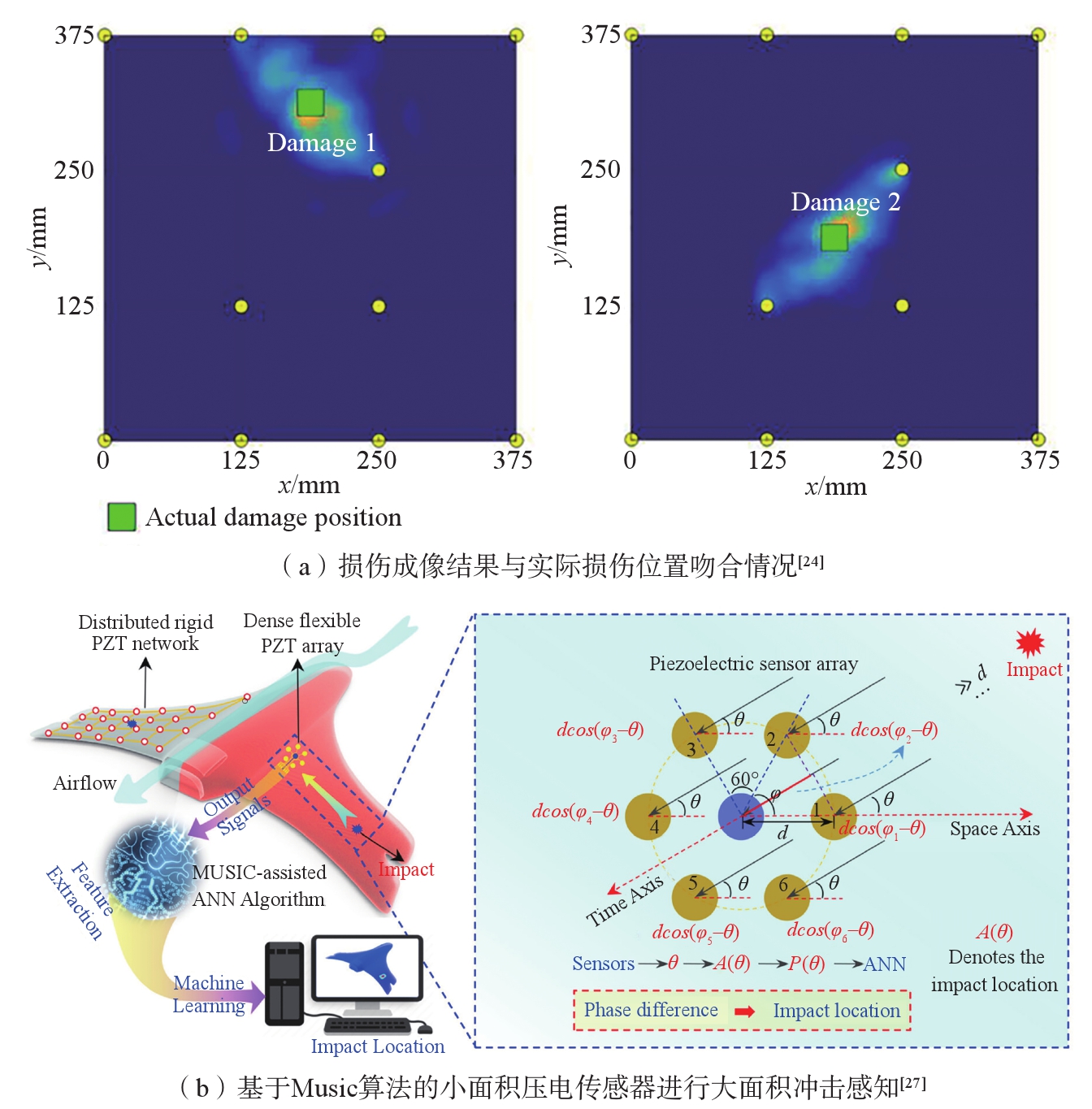
在结构健康管理领域,通过分析应变、声发射信号的异常波动,结合CNN的局部特征提取能力,可精确识别结构损伤类型(如裂纹、脱粘)并定位损伤位置,为飞行器的视情维护提供数据支撑[ 袁梅, 鲍鹏宇, 付重, 等. 飞机结构健康监测技术及传感器网络[J]. 航空制造技术, 2008, 51(22): 44-48.YUAN Mei, BAO Pengyu, FU Zhong, et al. Aircraft structural health monitoring technology and sensor network[J]. Aeronautical Manufacturing Technology, 2008, 51(22): 44-48. WANG Y, HU S G, XIONG T, et al. Recent progress in aircraft smart skin for structural health monitoring[J]. Structural Health Monitoring, 2022, 21(5): 2453-2480. 176-177]。如图15(a)所示,Wang等[ WANG Y, QIU L, LUO Y J, et al. A stretchable and large-scale guided wave sensor network for aircraft smart skin of structural health monitoring[J]. Structural Health Monitoring, 2021, 20(3): 861-876. 24]提出了一种可拉伸且大规模导波传感器网络的设计制造方法,该方法旨在实现飞机蒙皮的结构健康监测,解决了大规模、低成本、可靠且简单地直接制造此类传感器网络的难题。导波传感器网络在单轴拉伸至原始尺寸的500%时仍能正常工作,完全展开后可覆盖原始面积的2500%,且测试结果表明,网络上的PZT可以正常激发和接收导波信号。同时,该网络可应用于带有肋条的碳纤维复合层板表面,在主动和被动导波基础的复合结构健康监测(包括损伤成像和冲击成像)方面具有良好的适用性。
图15 基于柔性电子蒙皮的智能感知算法
Fig.15 Intelligent sensing and autonomous decision-making algorithm based on flexible electronic skin
Zhu等[ ZHU C, XU Z Y, HOU C, et al. Flexible, monolithic piezoelectric sensors for large-area structural impact monitoring via MUSIC-assisted machine learning[J]. Structural Health Monitoring, 2024, 23(1): 121-136. 27]针对大型结构体提出基于单片式小微传感器的冲击监测定位技术(图15(b)),其核心原理在于融合柔性压电传感器阵列与多重信号分类(Multiple signal classification,MUSIC)辅助的人工神经网络算法——通过MUSIC算法从输出信号中捕获关键特征分类矩阵输入人工神经网络,实现冲击空间定位。试验表明,该柔性压电传感器可精准监测超过其自身面积7500%的广域冲击;其次,传感器因超薄特性与复杂曲面完美贴合,几乎不影响表面流场。MUSIC算法的融入显著提升了机器学习冲击定位的识别精度与鲁棒性,且不受结构形状、材料、厚度或开孔设计的制约。除冲击定位外,该系统还可监测冲击能量、频率、硬度等结构健康参数,为飞行器结构状态与环境参数一体化监测开辟广阔前景。
4.2 数据驱动的“感-控”闭环反馈与自主执行
前文中所描述的从物理模型向数据驱动模型的演进,是实现复杂条件下可靠状态感知的必然选择。理论的提出和状态的估计,最终都需要通过闭环控制的实际验证来证明其价值。利用海量传感信息,可进行飞行状态的精准估计,将结果用于飞行器的姿态稳定[ VOSS A. Open and closed loop gust loads analyses for a flying wing configuration with variable longitudinal stability[J]. Aerospace Science and Technology, 2019, 89: 1-10. 178]、容错控制[ LU B W, MA J J, ZHENG Z Q. Adaptive closed-loop control allocation-based fault tolerant flight control for an overactuated aircraft[J]. IEEE Access, 2019, 7: 179505-179516. 179]和气动外形调整[ BLOWER C J, LEE W, WICKENHEISER A M. The development of a closed-loop flight controller with panel method integration for gust alleviation using biomimetic feathers on aircraft wings[J]. Bioinspiration, Biomimetics, and Bioreplication 2012, 2012, 8339: 83390I. 180]。结合最新的强化学习等人工智能技术,可进一步提高反馈控制的瞬态响应性能和在不同飞行器及飞行条件下的适应性[ YUKSEK B, INALHAN G. Reinforcement learning based closed-loop reference model adaptive flight control system design[J]. International Journal of Adaptive Control and Signal Processing, 2021, 35(3): 420-440. 181]。
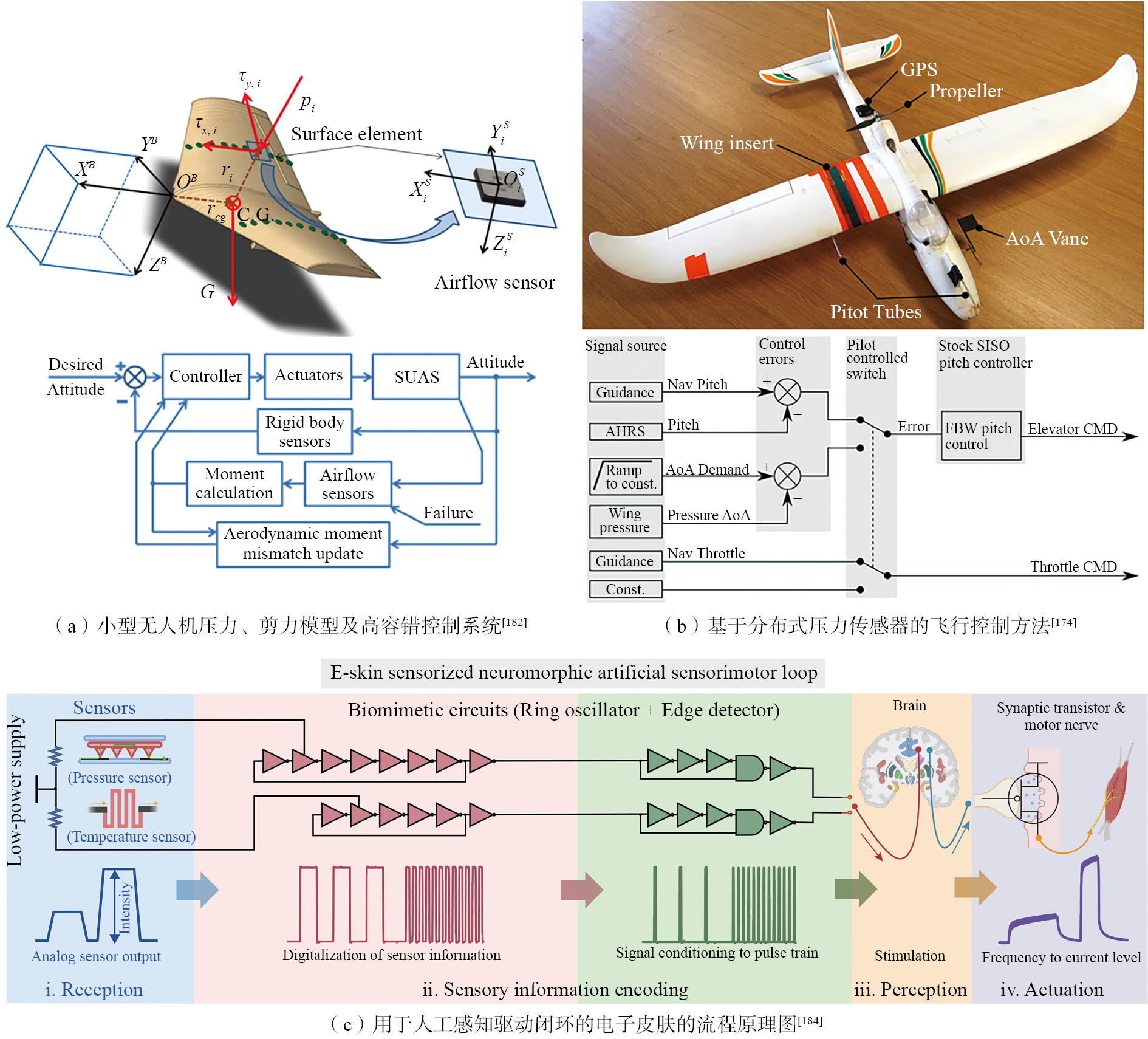
现有的飞行器闭环控制方法一般是基于传统的刚性传感阵列。如图16(a)所示,Shen等[ SHEN H, XU Y, DICKINSON B T. Fault tolerant attitude control for small unmanned aircraft systems equipped with an airflow sensor array[J]. Bioinspiration & Biomimetics, 2014, 9(4): 046015. 182]通过在小型无人机表面布置压力和剪应力传感阵列,开发了一套具有高容错的自适应控制系统。根据45个气流传感器的数据,证明在50%的传感器发生故障的工况下,飞机仍然能保持稳定并跟踪姿态指令。Wood等[ WOOD K T, ARAUJO-ESTRADA S, RICHARDSON T, et al. Distributed pressure sensing-based flight control for small fixed-wing unmanned aerial systems[J]. Journal of Aircraft, 2019, 56(5): 1951-1960. 174]在一架改装的Bixler-2无人机右翼上,沿弦向集成了一个包含7个压力测点的阵列(图16(b))。利用人工神经网络,输出对AOA和空速的估计值,并将误差信号直接用于驱动升降舵,从而控制飞机的纵向姿态,使其精确地跟踪并保持目标攻角。
图16 “感-控”闭环反馈系统架构
Fig.16 “Sense-Control” closed-loop feedback system architecture
这种方法对于传统构型的飞机是可行的,但对于未来追求更高气动效率和任务适应性的柔性或变构飞行器而言,由于传感单元的刚性限制及分立测点的几何变化等原因,柔性电子蒙皮在这一领域具有更大的适用性。现有的柔性电子闭环反馈的研究,大多是针对生物电子和人机交互等应用。Bao Zhenan团队开创了全柔性化感-知-驱链路的先河,用于蟑螂腿的驱动[ KIM Y, CHORTOS A, XU W T, et al. A bioinspired flexible organic artificial afferent nerve[J]. Science, 2018, 360(6392): 998-1003. 183]。随后,通过对材料特性、器件结构和系统架构的优化,开发出了具有多模式感知、神经形态脉冲串信号生成和闭环驱动功能的低压全柔性电子皮肤[ WANG W C, JIANG Y W, ZHONG D L, et al. Neuromorphic sensorimotor loop embodied by monolithically integrated, low-voltage, soft e-skin[J]. Science, 2023, 380(6646): 735-742. 184](图16(c))。Mao等[ MAO Q, LIAO Z J, YUAN J F, et al. Multimodal tactile sensing fused with vision for dexterous robotic housekeeping[J]. Nature Communications, 2024, 15: 6871. 185]在单一的传感反馈控制基础上增加了视觉融合策略,可实现机器人灵巧抓取和准确识别日常物体,处理其他具有挑战性的任务。
HARUNZ, AMER ABBASA. Wind tunnel measurement techniques[M]//HARUNZ, APROVITOLAA, PEZZELLAG. Boundary Layer Flows-Advances in Experimentation, Modelling and Simulation. Rijeka: IntechOpen, 2024.
[2]
陈迎春, 郭传亮, 李晓勇. 大型商用飞机风洞试验需求及技术展望[J]. 气动研究与试验, 2023(4): 25-30. CHENYingchun, GUOChuanliang, LIXiaoyong. Wind tunnel testing requirements and technology prospects for large commercial aircraft[J]. Aerodynamic Research & Experiment, 2023(4): 25-30.
[3]
ZHUL Q. Intelligent and flexible morphing wing technology: A review[J]. Journal of Mechanical Engineering, 2018, 54(1): 28.
[4]
BARBARINOS, BILGENO, AJAJR M, et al. A review of morphing aircraft[J]. Journal of Intelligent Material Systems and Structures, 2011, 22(9): 823-877.
[5]
JHAA K, KUDVAJ N. Morphing aircraft concepts, classifications, and challenges[J]. Smart Structures and Materials 2004: Industrial and Commercial Applications of Smart Structures Technologies, 2004: 213.
[6]
KIMD H, LUN S, MAR, et al. Epidermal electronics[J]. Science, 2011, 333(6044): 838-843.
[7]
SOMEYAT, BAOZ N, MALLIARASG G. The rise of plastic bioelectronics[J]. Nature, 2016, 540(7633): 379-385.
[8]
ROGERSJ A, SOMEYAT, HUANGY G. Materials and mechanics for stretchable electronics[J]. Science, 2010, 327(5973): 1603-1607.
[9]
TIANL M, ZIMMERMANB, AKHTARA, et al. Large-area MRI-compatible epidermal electronic interfaces for prosthetic control and cognitive monitoring[J]. Nature Biomedical Engineering, 2019, 3(3): 194-205.
[10]
SHIX, ZUOY, ZHAIP, et al. Large-area display textiles integrated with functional systems[J]. Nature, 2021, 591(7849): 240-245.
[11]
YINL, WANGY H, ZHANJ, et al. Chest-scale self-compensated epidermal electronics for standard 6-precordial-lead ECG[J]. NPJ Flexible Electronics, 2022, 6: 29.
[12]
SHINH, JEONGS, LEEJ H, et al. 3D high-density microelectrode array with optical stimulation and drug delivery for investigating neural circuit dynamics[J]. Nature Communications, 2021, 12: 492.
[13]
ZHENGY Q, LIUY X, ZHONGD L, et al. Monolithic optical microlithography of high-density elastic circuits[J]. Science, 2021, 373(6550): 88-94.
[14]
CORDT J, NEWBERNS. Unmanned air vehicles: new challenges in design[C]//2001 IEEE Aerospace Conference Proceedings. Big Sky: IEEE, 2001: 2699-2704.
[15]
郝帅, 马铁林, 王一, 等. 传感器飞机核心关键技术进展与应用[J]. 航空学报, 2023, 44(6): 027034. HAOShuai, MATielin, WANGYi, et al. Progress and application of key technologies of SensorCraft[J]. Acta Aeronautica et Astronautica Sinica, 2023, 44(6): 027034.
[16]
An overview of SensorCraft capabilities and key enabling technologies[C]//26th AIAA Applied Aerodynamics Conference. Honolulu: AIAA, 2008: 7185.
[17]
XIONGW N, ZHUC, GUOD L, et al. Bio-inspired, intelligent flexible sensing skin for multifunctional flying perception[J]. Nano Energy, 2021, 90: 106550.
[18]
MANGALAMA S, BRENNERM J. Fly-by-feel sensing and control: Aeroservoelasticity[C]//AIAA Atmospheric Flight Mechanics Conference. Atlanta: AIAA, 2014.
[19]
HUANGZ, ZHAOH Y, LIUC, et al. High accuracy flight state identification of a self-sensing wing via machine learning approaches[C]//Structural Health Monitoring. Stanford: DEStech Publications, 2019.
[20]
SURYAKUMARV S, BABBARY, STRGANACT W, et al. Control of a nonlinear wing section using fly-by-feel sensing[C]//AIAA Atmospheric Flight Mechanics Conference. Dallas: AIAA, 2015: 2239.
[21]
SANIATT S, GONIT, GALIBS M. LSTM recurrent neural network assisted aircraft stall prediction for enhanced situational awareness[EB/OL]. [2025-06-03]. https://arxiv.org/abs/2012.04876.
[22]
ARAUJO-ESTRADAS A, WINDSORS P. Aerodynamic state and loads estimation using bioinspired distributed sensing[J]. Journal of Aircraft, 2020, 58(4): 704-716.
[23]
SUNB Y, MAB H, WANGP B, et al. High sensitive flexible hot-film sensor for measurement of unsteady boundary layer flow[J]. Smart Materials and Structures, 2020, 29(3): 035023.
[24]
WANGY, QIUL, LUOY J, et al. A stretchable and large-scale guided wave sensor network for aircraft smart skin of structural health monitoring[J]. Structural Health Monitoring, 2021, 20(3): 861-876.
[25]
SHINH S, OTTZ, BEUKENL G, et al. Bio-inspired large-area soft sensing skins to measure UAV wing deformation in flight[J]. Advanced Functional Materials, 2021, 31(23): 2100679.
[26]
XUZ J, CAOL N Y, LIC Y, et al. Digital mapping of surface turbulence status and aerodynamic stall on wings of a flying aircraft[J]. Nature Communications, 2023, 14: 2792.
[27]
ZHUC, XUZ Y, HOUC, et al. Flexible, monolithic piezoelectric sensors for large-area structural impact monitoring via MUSIC-assisted machine learning[J]. Structural Health Monitoring, 2024, 23(1): 121-136.
[28]
ZHAOQ Y, HUANGJ, GUOY X, et al. Machine learning-assisted sparse observation assimilation for real-time aerodynamic field perception[J]. Science China Technological Sciences, 2024, 67(5): 1458-1469.
[29]
TOPACT, GRAYC, CHANGF K. Fly-by-feel: Learning aerodynamics from multimodal wing mechanics[C]//AIAA SCITECH 2024 Forum. Orlando: AIAA, 2024.
[30]
GONGZ, DIW C, JIANGY G, et al. Flexible calorimetric flow sensor with unprecedented sensitivity and directional resolution for multiple flight parameter detection[J]. Nature Communications, 2024, 15: 3091.
[31]
WANGJ X, WEIX Y, SHIJ L, et al. High-resolution flexible iontronic skins for both negative and positive pressure measurement in room temperature wind tunnel applications[J]. Nature Communications, 2024, 15: 7094.
[32]
FANX H, HUH L, LIAOB, et al. Optimization of microstructure design for enhanced sensing performance in flexible piezoresistive sensors[J]. Journal of Advanced Ceramics, 2024, 13(6): 711-728.
[33]
XUANY, UCHIYAMAT, URAH, et al. Flexible integrated air pressure sensors for monitoring positive and negative pressure distribution[J]. ACS Applied Materials & Interfaces, 2024, 16(40): 54215-54223.
[34]
PARKJ, LEEY, HONGJ, et al. Giant tunneling piezoresistance of composite elastomers with interlocked microdome arrays for ultrasensitive and multimodal electronic skins[J]. ACS Nano, 2014, 8(5): 4689-4697.
[35]
PANL J, CHORTOSA, YUG H, et al. An ultra-sensitive resistive pressure sensor based on hollow-sphere microstructure induced elasticity in conducting polymer film[J]. Nature Communications, 2014, 5: 3002.
[36]
CUIX H, HUANGF L, ZHANGX C, et al. Flexible pressure sensors via engineering microstructures for wearable human-machine interaction and health monitoring applications[J]. iScience, 2022, 25(4): 104148.
[37]
CHENZ H, QUC M, YAOJ J, et al. Two-stage micropyramids enhanced flexible piezoresistive sensor for health monitoring and human-computer interaction[J]. ACS Applied Materials & Interfaces, 2024, 16(6): 7640-7649.
[38]
KIMS, YUD E, KIMS, et al. Enhanced sensitivity of a resistive pressure sensor based on a PEDOT: PSS thin film on PDMS with a random-height micropyramid structure[J]. Micromachines, 2024, 15(9): mi15091110.
[39]
CHENGL X, WANGR X, HAOX J, et al. Design of flexible pressure sensor based on conical microstructure PDMS-bilayer graphene[J]. Sensors, 2021, 21(1): s21010289.
[40]
XIAH, WANGL, ZHANGH, et al. MXene/PPy@PDMS sponge-based flexible pressure sensor for human posture recognition with the assistance of a convolutional neural network in deep learning[J]. Microsystems & Nanoengineering, 2023, 9: 155.
[41]
LIL X, DENGJ Q, KONGP, et al. Highly sensitive porous PDMS-based piezoresistive sensors prepared by assembling CNTs in HIPE template[J]. Composites Science and Technology, 2024, 248: 110459.
[42]
ZHUC, GUOD L, YED, et al. Flexible PZT-integrated, bilateral sensors via transfer-free laser lift-off for multimodal measurements[J]. ACS Applied Materials & Interfaces, 2020, 12(33): 37354-37362.
[43]
DAGDEVIRENC, SUY W, JOEP, et al. Conformable amplified lead zirconate titanate sensors with enhanced piezoelectric response for cutaneous pressure monitoring[J]. Nature Communications, 2014, 5: 4496.
[44]
GUPTAV, BABUA, GHOSHS K, et al. Revisiting δ-PVDF based piezoelectric nanogenerator for self-powered pressure mapping sensor[J]. Applied Physics Letters, 2021, 119(25): 252902.
[45]
YANGT, PANH, TIANG, et al. Hierarchically structured PVDF/ZnO core-shell nanofibers for self-powered physiological monitoring electronics[J]. Nano Energy, 2020, 72: 104706.
[46]
YOUSUFM, BEIGHN T, ARYAD S, et al. A sensitive and flexible poroelastic barium titanate matrix for pressure sensing applications[J]. IEEE Sensors Letters, 2023, 7(2): 1-4.
[47]
XIONGW N, GUOD L, YANGZ X, et al. Conformable, programmable and step-linear sensor array for large-range wind pressure measurement on curved surface[J]. Science China Technological Sciences, 2020, 63(10): 2073-2081.
[48]
WANY B, QIUZ G, HONGY, et al. A highly sensitive flexible capacitive tactile sensor with sparse and high-aspect-ratio microstructures[J]. Advanced Electronic Materials, 2018, 4(4): 1700586.
[49]
XIONGW N, ZHANGF, QUS Y, et al. Marangoni-driven deterministic formation of softer, hollow microstructures for sensitivity-enhanced tactile system[J]. Nature Communications, 2024, 15: 5596.
[50]
LUOY S, SHAOJ Y, CHENS R, et al. Flexible capacitive pressure sensor enhanced by tilted micropillar arrays[J]. ACS Applied Materials & Interfaces, 2019, 11(19): 17796-17803.
[51]
BAIN N, WANGL, WANGQ, et al. Graded intrafillable architecture-based iontronic pressure sensor with ultra-broad-range high sensitivity[J]. Nature Communications, 2020, 11: 209.
[52]
HEY F, CHENGY, YANGC H, et al. Creep-free polyelectrolyte elastomer for drift-free iontronic sensing[J]. Nature Materials, 2024, 23(8): 1107-1114.
[53]
XUS Y, LIX Z, WANGT Y, et al. Fiber Bragg grating pressure sensors: A review[J]. Optical Engineering, 2023, 62(1): 010902.
[54]
ZHUX P, JIANGC, CHENH L, et al. Ultrasensitive gas pressure sensor based on two parallel Fabry-Perot interferometers and enhanced Vernier effect[J]. Optics & Laser Technology, 2023, 158: 108755.
[55]
ZHANGY, ZHOUX M, ZHANGN, et al. Ultrafast piezocapacitive soft pressure sensors with over 10 kHz bandwidth via bonded microstructured interfaces[J]. Nature Communications, 2024, 15: 3048.
[56]
WINTERK G. An outline of the techniques available for the measurement of skin friction in turbulent boundary layers[J]. Progress in Aerospace Sciences, 1979, 18: 1-57.
[57]
SCHMIDTM A, HOWER T, SENTURIAS D, et al. Design and calibration of a microfabricated floating-element shear-stress sensor[J]. IEEE Transactions on Electron Devices, 1988, 35(6): 750-757.
[58]
SHAJIIJ, NGK Y, SCHMIDTM A. A microfabricated floating-element shear stress sensor using wafer-bonding technology[J]. Journal of Microelectromechanical Systems, 1992, 1(2): 89-94.
[59]
BARLIANA A, PARKS J, MUKUNDANV, et al. Design and characterization of microfabricated piezoresistive floating element-based shear stress sensors[J]. Sensors and Actuators A: Physical, 2007, 134(1): 77-87.
[60]
CHANDRASEKHARANV, SELLSJ, MELOYJ, et al. A microscale differential capacitive direct wall-shear-stress sensor[J]. Journal of Microelectromechanical Systems, 2011, 20(3): 622-635.
[61]
PANGP, ZHAOK L, ZHONGS Y, et al. Flexible skin for measurement of boundary layer state and flight attitude identification on UAV[J]. Smart Materials and Structures, 2023, 32(4): 045008.
[62]
LIG Z, LIUS Q, WANGL Q, et al. Skin-inspired quadruple tactile sensors integrated on a robot hand enable object recognition[J]. Science Robotics, 2020, 5(49): eabc8134.
[63]
LÖFDAHLL, CHERNORAYV, HAASLS, et al. Characteristics of a hot-wire microsensor for time-dependent wall shear stress measurements[J]. Experiments in Fluids, 2003, 35(3): 240-251.
[64]
HANRATTYT J, CAMPBELLJ A. Fluid Mechanics measurements: measurement of wall shear stress[M]. 2nd ed. London: Routledge, 1996.
[65]
SUNB Y, WANGP B, LUOJ, et al. A flexible hot-film sensor array for underwater shear stress and transition measurement[J]. Sensors, 2018, 18(10): s18103469.
[66]
PANGP, ZHANGT, ZHANGX X, et al. Constant temperature hot-film sensor for the measurement of near-wall turbulence and flow direction[J]. IEEE Sensors Journal, 2024, 24(5): 5895-5903.
[67]
GUOD L, LINGJ H, HUANGY Z, et al. Recrystallization-induced laser lift-off strategy for flexible thermal sensors with near-limit sensitivity[J]. Advanced Materials Technologies, 2024, 9(2): 2301444.
[68]
CHENJ, FANZ F, ZOUJ, et al. Two-dimensional micromachined flow sensor array for fluid mechanics studies[J]. Journal of Aerospace Engineering, 2003, 16(2): 85-97.
[69]
GHOUILA-HOURIC, TALBIA, VIARDR, et al. Unsteady flows measurements using a calorimetric wall shear stress micro-sensor[J]. Experiments in Fluids, 2019, 60(4): 67.
[70]
WEISSJ, JONDEAUE, GIANIA, et al. Static and dynamic calibration of a MEMS calorimetric shear-stress sensor[J]. Sensors and Actuators A: Physical, 2017, 265: 211-216.
[71]
TAOJ L, YUX. Hair flow sensors: From bio-inspiration to bio-mimicking—A review[J]. Smart Materials and Structures, 2012, 21(11): 113001.
[72]
SHENGH R, CAOL N Y, SHANGY R, et al. Conformal self-powered high signal-to-noise ratio biomimetic in situ aircraft surface turbulence mapping system[J]. Nano Energy, 2025, 136: 110694.
[73]
WANGZ L. Triboelectric nanogenerator (TENG)—Sparking an energy and sensor revolution[J]. Advanced Energy Materials, 2020, 10(17): 2000137.
[74]
CHENJ, WANGZ L. Reviving vibration energy harvesting and self-powered sensing by a triboelectric nanogenerator[J]. Joule, 2017, 1(3): 480-521.
[75]
FANF R, TIANZ Q, WANGZ L. Flexible triboelectric generator[J]. Nano Energy, 2012, 1(2): 328-334.
[76]
LIY, DENGH C, WUH Y, et al. Rotary wind-driven triboelectric nanogenerator for self-powered airflow temperature monitoring of industrial equipment[J]. Advanced Science, 2024, 11(13): 2307382.
[77]
WANGP H, PANL, WANGJ Y, et al. An ultra-low-friction triboelectric-electromagnetic hybrid nanogenerator for rotation energy harvesting and self-powered wind speed sensor[J]. ACS Nano, 2018, 12(9): 9433-9440.
[78]
ZHANGH L, YANGY, ZHONGX D, et al. Single-electrode-based rotating triboelectric nanogenerator for harvesting energy from tires[J]. ACS Nano, 2014, 8(1): 680-689.
[79]
LIUY H, HUANGY, YAOH J, et al. A modeling and calibrating method of FBG sensors for wing deformation displacement measurement[J]. Heliyon, 2023, 9(5): e15932.
[80]
Distributed sensing of a cantilever beam and plate using a fiber optic sensing system[C]//2018 Applied Aerodynamics Conference. Atlanta: AIAA, 2018: 3482.
[81]
BAIY Z, ZHOUY L, WUX Y, et al. Flexible strain sensors with ultra-high sensitivity and wide range enabled by crack-modulated electrical pathways[J]. Nano-Micro Letters, 2024, 17(1): 64.
[82]
VERTUCCIOL, GUADAGNOL, SPINELLIG, et al. Piezoresistive properties of resin reinforced with carbon nanotubes for health-monitoring of aircraft primary structures[J]. Composites Part B: Engineering, 2016, 107: 192-202.
[83]
SUNB C, XUG B, JIX, et al. A strain-resistant flexible thermistor sensor array based on CNT/MXene hybrid materials for lithium-ion battery and human temperature monitoring[J]. Sensors and Actuators A: Physical, 2024, 368: 115059.
[84]
LIMC, LEES, KANGH, et al. Highly conductive and stretchable hydrogel nanocomposite using whiskered gold nanosheets for soft bioelectronics[J]. Advanced Materials, 2024, 36(39): 2407931.
[85]
AMJADIM, KYUNGK U, PARKI, et al. Stretchable, skin-mountable, and wearable strain sensors and their potential applications: A review[J]. Advanced Functional Materials, 2016, 26(11): 1678-1698.
[86]
QINJ, YINL J, HAOY N, et al. Flexible and stretchable capacitive sensors with different microstructures[J]. Advanced Materials, 2021, 33(34): 2008267.
[87]
FASSLERA, MAJIDIC. Soft-matter capacitors and inductors for hyperelastic strain sensing and stretchable electronics[J]. Smart Materials and Structures, 2013, 22(5): 055023.
[88]
ARAB HASSANIF, JINH, YOKOTAT, et al. Soft sensors for a sensing-actuation system with high bladder voiding efficiency[J]. Science Advances, 2020, 6(18): eaba0412.
[89]
MAZ, CHENX Y, MAZ, et al. Analysis of distributed measurement method for array antenna position[J]. Applied Sciences, 2020, 10(10): 3480.
[90]
ZHUL Q, SUNG K, BAOW M, et al. Structural deformation monitoring of flight vehicles based on optical fiber sensing technology: A review and future perspectives[J]. Engineering, 2022, 16: 39-55.
[91]
SOLTANIS, TAYLORP S, PARKERE A, et al. Popup tunable frequency selective surfaces for strain sensing[J]. IEEE Sensors Letters, 2020, 4(4): 1-4.
[92]
CHOIJ H, AHNJ, KIMJ B, et al. An electroactive, tunable, and frequency selective surface utilizing highly stretchable dielectric elastomer actuators based on functionally antagonistic aperture control[J]. Small, 2016, 12(14): 1840-1846.
[93]
SUNG K, WUY P, LIH, et al. 3D shape sensing of flexible morphing wing using fiber Bragg grating sensing method[J]. Optik, 2018, 156: 83-92.
[94]
NAZEERN, WANGX R, GROVESR M, et al. Sensing, actuation, and control of the SmartX prototype morphing wing in the wind tunnel[J]. Actuators, 2021, 10(6): 107.
[95]
WANGX, SHIK X, WANGJ L, et al. Flexible strain sensor based on a frequency selective surface[J]. Optics Express, 2023, 31(5): 8884-8896.
[96]
LIS, LIUG D, LIR, et al. Contact-resistance-free stretchable strain sensors with high repeatability and linearity[J]. ACS Nano, 2022, 16(1): 541-553.
[97]
YUH Y, BIANJ, CHENF R, et al. Ultrathin, graphene-in-polyimide strain sensor via laser-induced interfacial ablation of polyimide[J]. Advanced Electronic Materials, 2023, 9(9): 2201086.
[98]
WEBBR C, BONIFASA P, BEHNAZA, et al. Ultrathin conformal devices for precise and continuous thermal characterization of human skin[J]. Nature Materials, 2013, 12(10): 938-944.
[99]
DANL, ELIASA L. Flexible and stretchable temperature sensors fabricated using solution-processable conductive polymer composites[J]. Advanced Healthcare Materials, 2020, 9(16): 2000380.
[100]
HAOS W, FUQ J, MENGL, et al. A biomimetic laminated strategy enabled strain-interference free and durable flexible thermistor electronics[J]. Nature Communications, 2022, 13: 6472.
[101]
SAHOOS, PARASHARS K S, ALIS M. CaTiO3 nano ceramic for NTCR thermistor based sensor application[J]. Journal of Advanced Ceramics, 2014, 3(2): 117-124.
ZHANGZ K, LIUZ J, LEIJ M, et al. Flexible thin film thermocouples: From structure, material, fabrication to application[J]. iScience, 2023, 26(8): 107303.
[104]
BEN MBAREKS, ALCHEIKHN, YOUNISM I. Recent advances on MEMS based infrared thermopile detectors[J]. Microsystem Technologies, 2022, 28(8): 1751-1764.
[105]
DONGH L, LUM M, WANGW F, et al. High temperature heat flux sensor with ITO/In2O3 thermopile for extreme environment sensing[J]. Microsystems & Nanoengineering, 2024, 10: 105.
[106]
LIX, SUND H, LIUB L, et al. High-sensitive thin film heat flux gauge with ITO/In2O3 thermopile on nickel alloys for turbine blade applications[J]. IEEE Sensors Journal, 2022, 22(5): 3911-3919.
[107]
LIUZ J, TIANB, JIANGZ D, et al. Flexible temperature sensor with high sensitivity ranging from liquid nitrogen temperature to 1200 ℃[J]. International Journal of Extreme Manufacturing, 2023, 5(1): 015601.
[108]
LIW W, KONGL Y, XUM Z, et al. Microsecond-scale transient thermal sensing enabled by flexible Mo(1-x)W(x)S(2) alloys[J]. Research, 2024, 7: 0452.
[109]
FARINAD, MAZIOM, MACHRAFIH, et al. Environmental chamber characterization of an ice detection sensor for aviation using graphene and PEDOT: PSS[J]. Micromachines, 2024, 15(4): 504.
[110]
RAJA, SUTHANTHIRARAJP P A, SENA K. Pressure-driven flow through PDMS-based flexible microchannels and their applications in microfluidics[J]. Microfluidics and Nanofluidics, 2018, 22(11): 128.
[111]
IBRAHIMM D, AMRANS N A, YUNOSY S, et al. The study of drag reduction on ships inspired by simplified shark skin imitation[J]. Applied Bionics and Biomechanics, 2018, 2018(1): 7854321.
[112]
BHUSHANB. Shark skin surface for fluid-drag reduction in turbulent flow[M]//Biomimetics. Cham: Springer International Publishing, 2018: 491-562.
[113]
OUZ Y, ZHOUZ D, ZHOUW Y, et al. Hierarchical nested riblet surface for higher drag reduction in turbulent boundary layer[J]. Physics of Fluids, 2024, 36(10): 105166.
[114]
CUIX X, CHEND K, CHENH W. Multistage gradient bioinspired riblets for synergistic drag reduction and efficient antifouling[J]. ACS Omega, 2023, 8(9): 8569-8581.
[115]
GLUZDOVD S, GATAPOVAE Y. Microchannel surface structures for drag reduction[J]. Journal of Engineering Thermophysics, 2023, 32(2): 214-241.
[116]
ZHAOP F, LIX, LUOZ J, et al. A bio-inspired drag reduction method of bionic fish skin mucus structure[J]. Micromachines, 2024, 15(3): 364.
[117]
CHENGX Q, WONGC W, HUSSAINF, et al. Flat plate drag reduction using plasma-generated streamwise vortices[J]. Journal of Fluid Mechanics, 2021, 918: A24.
[118]
SUZ, ZONGH H, LIANGH, et al. Minimizing airfoil drag at low angles of attack with DBD-based turbulent drag reduction methods[J]. Chinese Journal of Aeronautics, 2023, 36(4): 104-119.
[119]
WANGZ, ZHUY T, LIUX L, et al. Temperature self-regulating electrothermal pseudo-slippery surface for anti-icing[J]. Chemical Engineering Journal, 2021, 422: 130110.
[120]
ZHAOZ H, CHENH W, LIUX L, et al. The development of electric heating coating with temperature controlling capability for anti-icing/de-icing[J]. Cold Regions Science and Technology, 2021, 184: 103234.
[121]
ZHENGB J, WANGH T, WUX L, et al. Flexible nanocomposite electrothermal films based on carbon nanotubes and waterborne polyurethane with high reliability, stretchability and low-temperature performance for wind turbine blade deicing[J]. Composites Part A: Applied Science and Manufacturing, 2022, 158: 106979.
[122]
LIUY H, MAX H, ZHANGH Z, et al. Large-scale production of electrothermal films with GNSs/CNTs/CB three-dimensional structure ink by screen printing[J]. ACS Applied Electronic Materials, 2022, 4(2): 814-822.
[123]
SONGH Q, NIEB B, ZHUY H, et al. Flexible grid graphene electrothermal films for real-time monitoring applications[J]. Langmuir, 2024, 40(13): 6940-6948.
[124]
YANZ X, KONGZ Y, TANGY L, et al. A bioinspired micro-grooved structure for low snow adhesion and effective snow-shedding[J]. Advanced Materials, 2025, 37(21): 2500839.
[125]
WANGY M, ZHANGK T, CUIX X, et al. A transparent photo/electrothermal composite coating with liquid-like slippery property for all-day anti-/de-icing[J]. ACS Applied Materials & Interfaces, 2024, 16(31): 41400-41408.
[126]
ZHANGC, YANGJ, CAOW K, et al. Transparently curved metamaterial with broadband millimeter wave absorption[J]. Photonics Research, 2019, 7(4): 478-485.
[127]
BISHTM S, SHARMAA, SRIVASTAVAK V. Radar cross section (RCS) analysis of finite metamaterial based absorber for planar and curved configurations[C]//2019 IEEE Indian Conference on Antennas and Propogation (InCAP). Ahmedabad: IEEE, 2019.
[128]
BAIL, WANGZ R, YED, et al. High efficient near-infrared sintering for electrohydrodynamic printed frequency selective surface[J]. Materials & Design, 2025, 252: 113774.
LIUJ P, JIANGS, XIONGW N, et al. Self-healing kirigami assembly strategy for conformal electronics[J]. Advanced Functional Materials, 2022, 32(12): 2109214.
[131]
WANGS H, WANGY C, CHENZ J, et al. Kirigami design of flexible and conformal tactile sensor on sphere-shaped surface for contact force sensing[J]. Advanced Materials Technologies, 2023, 8(3): 2200993.
[132]
COSTAF, MONORCHIOA. A frequency selective radome with wideband absorbing properties[J]. IEEE Transactions on Antennas and Propagation, 2012, 60(6): 2740-2747.
[133]
PENGJ J, QUS W, XIAM Y, et al. Conformal phased array antenna for unmanned aerial vehicle with ±70° scanning range[J]. IEEE Transactions on Antennas and Propagation, 2021, 69(8): 4580-4587.
ZHANGK P, LIAOY F, QIUB, et al. 3D printed embedded metamaterials[J]. Small, 2021, 17(50): 2103262.
[136]
SHIND, CHOIS, KIMJ, et al. Direct-printing of functional nanofibers on 3D surfaces using self-aligning nanojet in near-field electrospinning[J]. Advanced Materials Technologies, 2020, 5(6): 2000232.
[137]
LEEJ H, CHOK, KIMJ K. Age of flexible electronics: Emerging trends in soft multifunctional sensors[J]. Advanced Materials, 2024, 36(16): 2310505.
[138]
BURNELLR, SCHELLAERTW, BURDENJ, et al. Rethink reporting of evaluation results in AI[J]. Science, 2023, 380(6641): 136-138.
NIUH S, YINF F, KIME S, et al. Advances in flexible sensors for intelligent perception system enhanced by artificial intelligence[J]. InfoMat, 2023, 5(5): e12412.
[141]
HUANGY A, ZHUC, XIONGW N, et al. Flexible smart sensing skin for “fly-by-feel” morphing aircraft[J]. Science China Technological Sciences, 2022, 65(1): 1-29.
[142]
DONGZ H, GONGZ, CHENB Q, et al. Ultrathin flexible skin with all-polyimide pressure and airflow sensor array for estimation of flight parameters[J]. IEEE Sensors Journal, 2023, 23(23): 29494-29501.
[143]
DONGB W, SHIQ F, YANGY Q, et al. Technology evolution from self-powered sensors to AIoT enabled smart homes[J]. Nano Energy, 2021, 79: 105414.
[144]
SUNT M, FENGB, HUOJ P, et al. Artificial intelligence meets flexible sensors: Emerging smart flexible sensing systems driven by machine learning and artificial synapses[J]. Nano-Micro Letters, 2023, 16(1): 14.
[145]
HUAQ L, SUNJ L, LIUH T, et al. Skin-inspired highly stretchable and conformable matrix networks for multifunctional sensing[J]. Nature Communications, 2018, 9: 244.
[146]
郭栋梁, 侯超, 朱臣, 等. 飞行器表面气动载荷的柔性智能蒙皮多参量测量[J]. 实验流体力学, 2022, 36(2): 146-154. GUODongliang, HOUChao, ZHUChen, et al. Multi-parameter measurement of aerodynamic load via flexible sensing skin[J]. Journal of Experiments in Fluid Mechanics, 2022, 36(2): 146-154.
[147]
PANGP, ZHANGJ N, LUOC H, et al. Flexible sensing skin for simultaneous measurement of wall shear stress, flow direction and dynamic pressure[C]//2024 IEEE SENSORS. Kobe: IEEE, 2024.
[148]
HUX H, GUOS, CHENY Q, et al. Functional materials-enabled flexible electronic skin for flow field decoding[J]. Frontiers in Electronics, 2025, 6: 1528802.
[149]
LEGERT J, JOHNSTOND A, WOLFFJ M. Flex circuit sensor array for surface unsteady pressure measurements[J]. Journal of Propulsion and Power, 2004, 20(4): 754-758.
[150]
GUOF W, LIY, MAG M, et al. Overview of 3D printing multimodal flexible sensors[J]. ACS Applied Materials & Interfaces, 2024, 16(48): 65779-65795.
[151]
WONS M, WANGH L, KIMB H, et al. Multimodal sensing with a three-dimensional piezoresistive structure[J]. ACS Nano, 2019, 13(10): 10972-10979.
[152]
GEG, LUY, QUX Y, et al. Muscle-inspired self-healing hydrogels for strain and temperature sensor[J]. ACS Nano, 2020, 14(1): 218-228.
[153]
PENGY Y, SUNF X, PANR R. Multiplexed sensing textiles enabled by reconfigurable weaving meso-structures for intricate kinematic posture recognition and thermal therapy healthcare[J]. ACS Sensors, 2025, 10(4): 3051-3060.
ZHUANGQ N, YAOK M, ZHANGC, et al. Permeable, three-dimensional integrated electronic skins with stretchable hybrid liquid metal solders[J]. Nature Electronics, 2024, 7(7): 598-609.
[156]
SUQ, ZOUQ, LIY, et al. A stretchable and strain-unperturbed pressure sensor for motion interference-free tactile monitoring on skins[J]. Science Advances, 2021, 7(48): eabi4563.
[157]
YANGL, YANJ Y, MENGC Z, et al. Vanadium oxide-doped laser-induced graphene multi-parameter sensor to decouple soil nitrogen loss and temperature[J]. Advanced Materials, 2023, 35(14): 2210322.
[158]
BUZZICOTTIM. Data reconstruction for complex flows using AI: Recent progress, obstacles, and perspectives[J]. Europhysics Letters, 2023, 142(2): 23001.
[159]
RAISSIM, PERDIKARISP, KARNIADAKISG E. Physics-informed neural networks: A deep learning framework for solving forward and inverse problems involving nonlinear partial differential equations[J]. Journal of Computational Physics, 2019, 378: 686-707.
[160]
XUS F, SUNZ X, HUANGR F, et al. A practical approach to flow field reconstruction with sparse or incomplete data through physics informed neural network[J]. Acta Mechanica Sinica, 2022, 39(3): 322302.
[161]
YANGK C, LIUX, FENGW H, et al. A super resolution flow field reconstruction method using PINN[C]//First Aerospace Frontiers Conference (AFC 2024). Xi’an: SPIE, 2024: 114.
[162]
HOSSEINIM Y, SHIRIY. Flow field reconstruction from sparse sensor measurements with physics-informed neural networks[J]. Physics of Fluids, 2024, 36(7): 073606.
[163]
LINGJ L, KURZAWSKIA, TEMPLETONJ. Reynolds averaged turbulence modelling using deep neural networks with embedded invariance[J]. Journal of Fluid Mechanics, 2016, 807: 155-166.
[164]
ERICHSONN B, MATHELINL, YAOZ W, et al. Shallow neural networks for fluid flow reconstruction with limited sensors[J]. Proceedings Mathematical, Physical, and Engineering Sciences, 2020, 476(2238): 20200097.
[165]
FUKAMIK, FUKAGATAK, TAIRAK. Super-resolution reconstruction of turbulent flows with machine learning[J]. Journal of Fluid Mechanics, 2019, 870: 106-120.
[166]
YOUSIFM Z, ZHOUD, YUL Q, et al. Flow field recovery in restricted domains using a generative adversarial network framework[J]. Physics of Fluids, 2024, 36(12): 125113.
[167]
XUZ Y, ZHANGF, XIEE X, et al. A flexible, large-scale sensing array with low-power in-sensor intelligence[J]. Research, 2024, 7: 0497.
[168]
WANGC Y, XIAK L, WANGH M, et al. Advanced carbon for flexible and wearable electronics[J]. Advanced Materials, 2019, 31(9): 1801072.
[169]
XUF L, LIX Y, SHIY, et al. Recent developments for flexible pressure sensors: A review[J]. Micromachines, 2018, 9(11): 580.
[170]
PAUL F. Sensor data fusion[J]. Journal of Intelligent and Robotic Systems, 1988, 1(2): 103-116.
[171]
WANGB H, THUKRALA, XIEZ Q, et al. Flexible and stretchable metal oxide nanofiber networks for multimodal and monolithically integrated wearable electronics[J]. Nature Communications, 2020, 11: 2405.
[172]
SUNT, TASNIMF, MCINTOSHR T, et al. Decoding of facial strains via conformable piezoelectric interfaces[J]. Nature Biomedical Engineering, 2020, 4(10): 954-972.
[173]
GUNNJ, LENYKZ, SHARMAA, et al. Lift-Attend-Splat: bird’s-eye-view camera-lidar fusion using transformers[C]//2024 IEEE/CVF Conference on Computer Vision and Pattern Recognition Workshops (CVPRW). Seattle: IEEE, 2024: 4526-4536.
[174]
WOODK T, ARAUJO-ESTRADAS, RICHARDSONT, et al. Distributed pressure sensing-based flight control for small fixed-wing unmanned aerial systems[J]. Journal of Aircraft, 2019, 56(5): 1951-1960.
[175]
XUY, JIANGF K, NEWBERNS, et al. Flexible shear-stress sensor skin and its application to unmanned aerial vehicles[J]. Sensors and Actuators A: Physical, 2003, 105(3): 321-329.
[176]
袁梅, 鲍鹏宇, 付重, 等. 飞机结构健康监测技术及传感器网络[J]. 航空制造技术, 2008, 51(22): 44-48. YUANMei, BAOPengyu, FUZhong, et al. Aircraft structural health monitoring technology and sensor network[J]. Aeronautical Manufacturing Technology, 2008, 51(22): 44-48.
[177]
WANGY, HUS G, XIONGT, et al. Recent progress in aircraft smart skin for structural health monitoring[J]. Structural Health Monitoring, 2022, 21(5): 2453-2480.
[178]
VOSSA. Open and closed loop gust loads analyses for a flying wing configuration with variable longitudinal stability[J]. Aerospace Science and Technology, 2019, 89: 1-10.
[179]
LUB W, MAJ J, ZHENGZ Q. Adaptive closed-loop control allocation-based fault tolerant flight control for an overactuated aircraft[J]. IEEE Access, 2019, 7: 179505-179516.
[180]
BLOWERC J, LEEW, WICKENHEISERA M. The development of a closed-loop flight controller with panel method integration for gust alleviation using biomimetic feathers on aircraft wings[J]. Bioinspiration, Biomimetics, and Bioreplication 2012, 2012, 8339: 83390I.
[181]
YUKSEKB, INALHANG. Reinforcement learning based closed-loop reference model adaptive flight control system design[J]. International Journal of Adaptive Control and Signal Processing, 2021, 35(3): 420-440.
[182]
SHENH, XUY, DICKINSONB T. Fault tolerant attitude control for small unmanned aircraft systems equipped with an airflow sensor array[J]. Bioinspiration & Biomimetics, 2014, 9(4): 046015.
[183]
KIMY, CHORTOSA, XUW T, et al. A bioinspired flexible organic artificial afferent nerve[J]. Science, 2018, 360(6392): 998-1003.