Numerical Simulation Study on Aerothermal-Structural Coupling Characteristics of Hypersonic Morphing Vehicles
Citations
LUO Shibin, YUE Hang, LIU Jun, et al. Numerical simulation study on aerothermal-structural coupling characteristics of hypersonic morphing vehicles[J]. Aeronautical Manufacturing Technology, 2026, 69(5): 25010169.
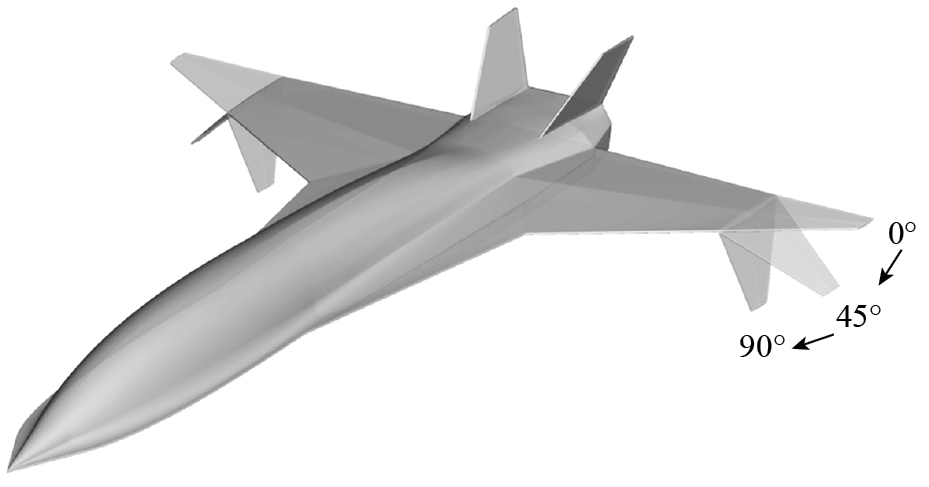
图1 飞行器机翼折叠示意图
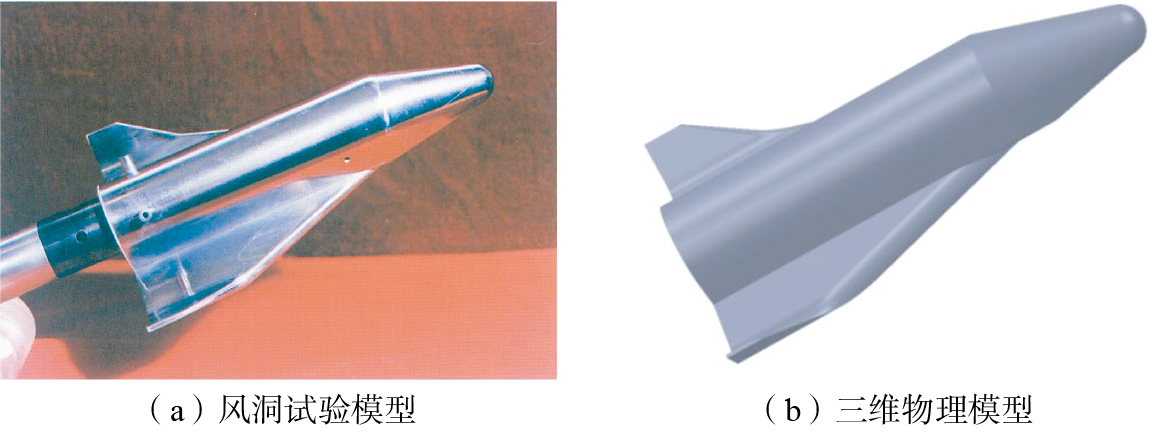
图2 空天飞机风洞试验模型及三维物理模型[ 李素循. 典型外形高超声速流动特性[M]. 北京: 国防工业出版社, 2007.LI Suxun. Typical shape hypersonic flow characteristics[M]. Beijing: National Defense Industry Press, 2007. 14]
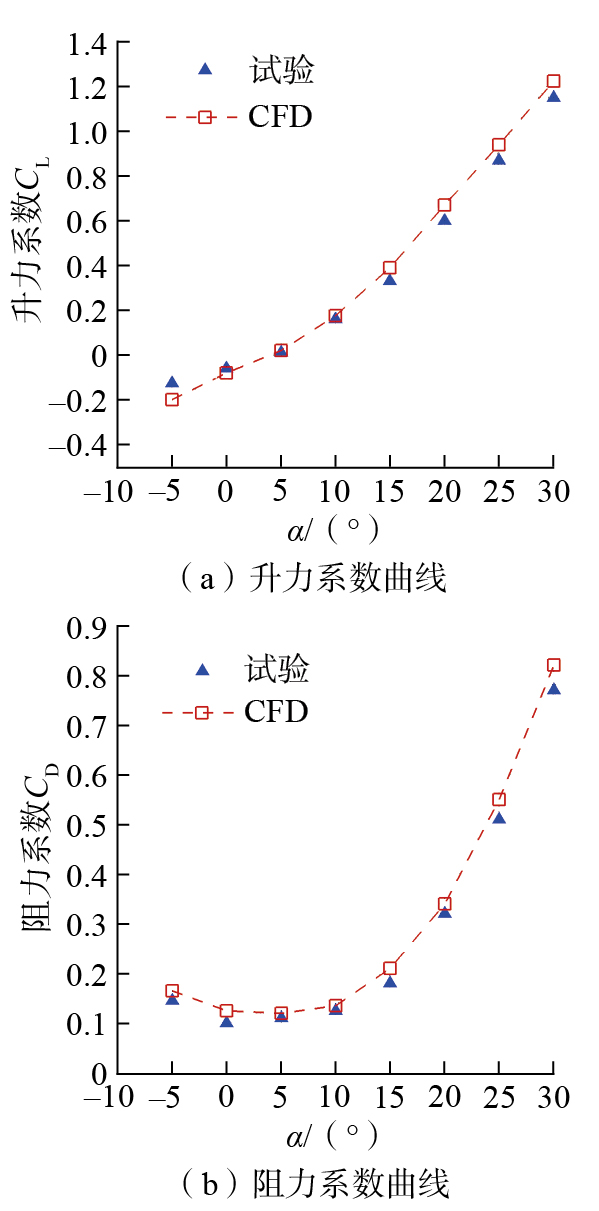
图3 气动力系数随攻角α的变化曲线
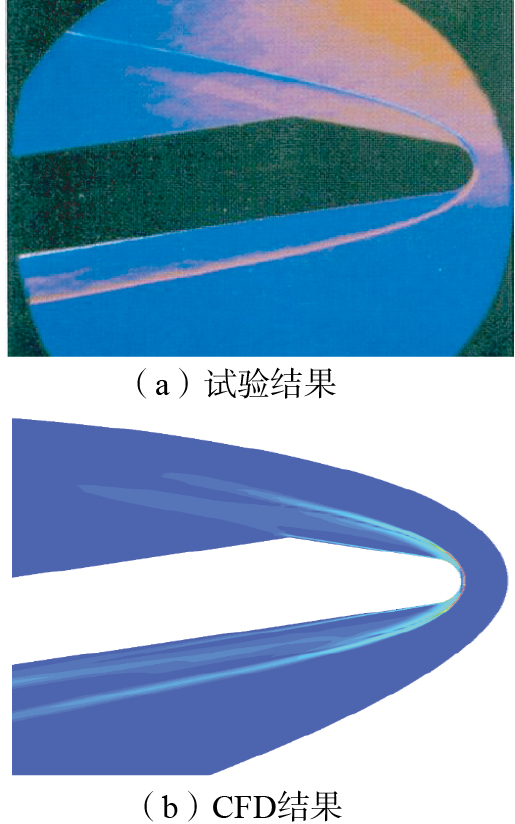
图4 密度梯度云图与试验纹影图对比[ 李素循. 典型外形高超声速流动特性[M]. 北京: 国防工业出版社, 2007.LI Suxun. Typical shape hypersonic flow characteristics[M]. Beijing: National Defense Industry Press, 2007. 14]
Research Institute of Aerospace Technology, Central South University, Changsha410083, China
Citations
LUO Shibin, YUE Hang, LIU Jun, et al. Numerical simulation study on aerothermal-structural coupling characteristics of hypersonic morphing vehicles[J]. Aeronautical Manufacturing Technology, 2026, 69(5): 25010169.
Abstract
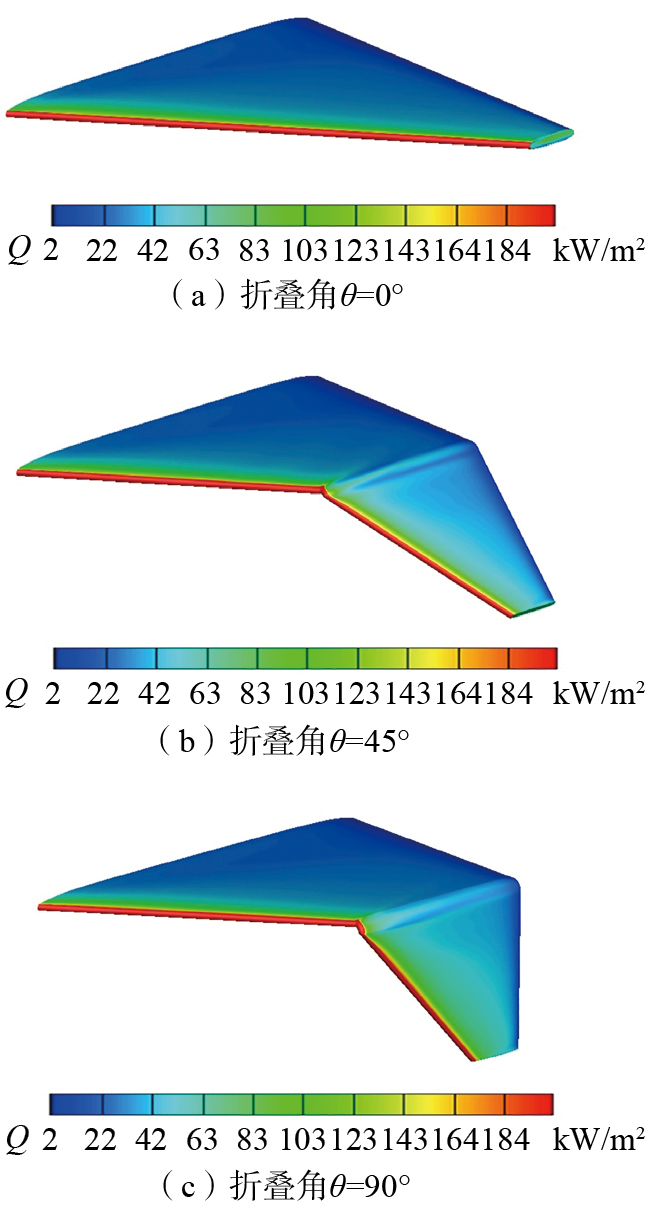
This study investigates the coupled aerothermal and structural response of a hypersonic morphing vehicle undergoing configuration changes across a wide speed regime. Numerical simulations were conducted at Ma 5 and an altitude of 24 km to evaluate surface heat flux and pressure loads under varying wing folding angles (0°-90°) and angles of attack, using computational fluid dynamics (CFD). Based on the transient heat conduction equation—governed by the principle of energy conservation and Fourier’s law of heat conduction—the aerodynamic loads obtained from CFD were applied as boundary conditions in a finite element analysis to perform thermo-structural coupling simulations of the wing structure under representative morphing states. Results show that wing folding significantly intensifies localized aerodynamic heating and stress concentration: At a 90° folding angle, the peak heat flux at the wingtip reaches 1309.9 kW/m2, and the equivalent structural stress increases to 506 MPa. Nevertheless, with appropriate thermal protection design, both thermal and mechanical safety requirements can still be satisfied. This work provides preliminary engineering analysis for evaluating the multi-state coupled characteristics of hypersonic morphing vehicles.
高超声速飞行器技术具有显著的战略引领性,已成为全球航空航天强国竞相布局的前沿方向。随着任务剖面日益复杂,实现宽速域(Ma 0~8+)、大空域(0~50 km)飞行能力成为新一代高超声速平台的核心设计目标。在此背景下,传统固定构型飞行器面临根本性矛盾:其气动外形需在宽马赫数范围内折衷设计,导致各飞行阶段性能均处于次优状态[ 董芃呈, 韩玉琪, 刘金超. 宽适应性高超声速空天动力技术发展分析[J]. 航空动力, 2020(6): 25-30.DONG Pengcheng, HAN Yuqi, LIU Jinchao. Analysis of the development of wide adaptability hypersonic aerospace power technology[J]. Aerospace Power, 2020(6): 25-30. CHU L L, LI Q, GU F, et al. Design, modeling, and control of morphing aircraft: A review[J]. Chinese Journal of Aeronautics, 2022, 35(5): 220-246. LIU Z, LIU J, DING F, et al. Novel methodology for wide-ranged multistage morphing waverider based on conical theory[J]. Acta Astronautica, 2017, 140: 362-369. 1-3]。
为突破这一瓶颈,变体布局作为一种变革性解决方案被提出——通过主动调整机翼后掠角、展弦比或局部几何形态,使飞行器在不同速域/空域下始终接近最优气动效率。典型案例如美国XB-70、苏联图-160等[ LEVY D, WAHLS R, ZICKUHR T, et al. Summary of data from the first AIAA CFD drag prediction workshop[C]//Proceedings of 40th AIAA Aerospace Sciences Meeting & Exhibit. Reston: AIAA, 2002. 4]可变后掠翼超声速飞机,通过翼尖下折抑制高压溢流、利用鸭翼增升与配平、借助机身前体压缩来流等方式,显著提升了跨速域飞行性能与稳定性[ RODRÍGUEZ-SEGADE M, HERNÁNDEZ S, DÍAZ J. Multi-level and multi-objective structural optimization for hypersonic vehicle design[J]. Aerospace Science and Technology, 2024, 152: 109346. 5]。然而,变体构型在带来气动收益的同时,也引入了全新的多物理场耦合挑战。
在固定构型高超声速飞行器研究中,气动力/热/结构耦合分析已形成较为成熟的技术路径。例如,李欣等[ 李欣, 张剑飞, 何雅玲, 等. 二维流场、热结构松耦合模拟研究[J]. 工程热物理学报, 2012, 33(1): 87-90.LI Xin, ZHANG Jianfei, HE Yaling, et al. Research on two dimensional flow field and thermal structure loose coupling simulation[J]. Journal of Engineering Thermophysics, 2012, 33(1): 87-90. 6]基于FLUENT与结构求解器构建松耦合框架,研究时间步长对结果的影响;张兵等[ 张兵, 韩景龙. 多场耦合计算平台与高超声速热防护结构传热问题研究[J]. 航空学报, 2011, 32(3): 400-409.ZHANG Bing, HAN Jinglong. Research on heat transfer problems of multi field coupled computing platform and high ultrasonic thermal protection structure[J]. Acta Aeronautica et Astronautica Sinica, 2011, 32(3): 400-409. 7]开发的多场耦合接口平台,采用守恒插值处理热流传递;苑凯华等[ 苑凯华, 程萌. 高超声速气动力/热/结构多场耦合分析[J]. 战术导弹技术, 2017(5): 41-45.YUAN Kaihua, CHENG Meng. Multi field coupling analysis of hypersonic aerodynamics/heat/structure[J]. Tactical Missile Technology, 2017(5): 41-45. 8]则根据物理场特征时间尺度优化耦合策略,建立了工程适用的热弹性流场模拟方法。这些工作主要面向几何不变、载荷连续变化的场景,通常假设流场处于准稳态或缓慢演化过程。
然而,变体飞行器在模态转换过程中,几何构型发生突变,导致流场结构、热流分布及结构载荷出现非定常的变化特征。现有耦合方法虽然难以直接揭示变形过程中热-力响应的演化规律,但可迁移用于单个变形状态的分析,尤其在变形区域,易形成局部高热流区与应力集中,且热防护系统须兼顾多种构型下的极端工况,安全裕度要求更高,显著增加结构质量负担[ 王梓伊, 张伟伟, 刘磊. 高超声速飞行器热气动弹性仿真计算方法综述[J]. 气体物理, 2020, 5(6): 15-33.WANG Ziyi, ZHANG Weiwei, LIU Lei. Overview of thermal aeroelastic simulation calculation methods for hypersonic aircraft[J]. Physics of Gases, 2020, 5(6): 15-33. VIRGIL PETRESCU R V, AVERSA R, APICELLA A, et al. Modern propulsions for the aerospace industry[J]. American Journal of Engineering and Applied Sciences, 2018, 11(2): 715-755. SASTRY Y, KIROS B G, HAILU F, et al. Impact analysis of compressor rotor blades of an aircraft engine[J]. Frontiers of Structural and Civil Engineering, 2019, 13(3): 505-514. 9-11]。目前,针对高超声速变体飞行器在多离散构型下的气动力-热-结构耦合特性系统性研究仍较少,缺乏对不同变形状态间性能表现与失效风险的对比评估。
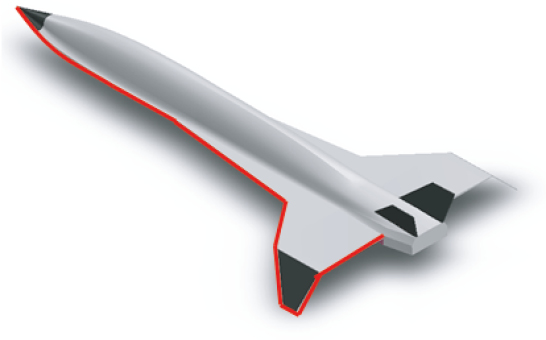
结合现有的高超声速飞行器气动布局方案,飞行器外形方案初步构建过程中,优先考虑了飞行器宽速域飞行的应用背景,通过机翼折叠的方式将不同飞行环境条件下各自具备性能优势的外形进行结合,使之同时具备高、低速飞行器的外形特点[ GONG C, MA B F. Aerodynamic evaluation of an unmanned aerial vehicle with variable sweep and span[J]. Proceedings of the Institution of Mechanical Engineers, Part G: Journal of Aerospace Engineering, 2019, 233(13): 4980-4997. 12],能够通过机翼折叠调节气动性能。在机体方面,飞行器采用大后掠三角翼、无平尾加双垂尾布局,机身、边条翼、大后掠三角翼高度融合;机翼部分采用了可折叠外翼设计,向下弯折的机翼能够抑制下表面高压溢流,同时减小气动阻力,对飞行器展弦比的调节能够影响飞行器横航向稳定性。外翼可以根据外部环境及任务需求调节折叠角度θ,机翼折叠影响的主要外形参数为翼展、机翼投影面积、展弦比等[ FITZMAURICE R. Boeing’s hypersonic passenger plane concept could one day get you from London to New York in 2 hours[EB/OL]. [2025-09-15]. http://www.businessinsider.com/boeing-hypersonic-passenger-plane-concept-london-to-new-york-in-two-hours-2018-6. 13]。折叠翼飞行器不同机翼折叠角状态的气动布局如图1所示。飞行器具体外形参数见表1。
图1 飞行器机翼折叠示意图
Fig.1 Schematic diagram of aircraft wing folding
表1 高超声速变体飞行器外形参数
Table 1 Geometric parameters of the hypersonic morphing vehicle
机身长度/m
翼展范围/m
机高/m
机翼投影面积范围/m2
边条翼后掠角/(°)
主翼后掠角/(°)
展弦比变化范围
前缘钝化半径/mm
11.8
4.9~6.9
0.88
4.31~5.06
83
41
0.7~1.5
10
1.2 高超声速流动数值模拟方法
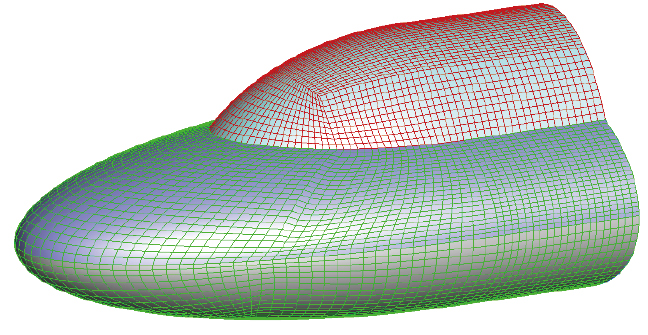
本文在对飞行器进行CFD数值模拟时,采用一套基于GPU的高效CFD数值模拟程序,该程序求解雷诺平均NS方程,有限体积空间离散、k-ω SST湍流模型,AUSMPW+迎风格式。选取公开文献中的空天飞机模型作为计算模型,通过数值模拟结果与风洞试验数据对比分析,验证本文高超声速外流场数值计算方法的有效性和准确性。空天飞机的风洞试验模型如图2所示[ 李素循. 典型外形高超声速流动特性[M]. 北京: 国防工业出版社, 2007.LI Suxun. Typical shape hypersonic flow characteristics[M]. Beijing: National Defense Industry Press, 2007. 14],试验条件及换算的数值模拟条件见表2。
图2 空天飞机风洞试验模型及三维物理模型[ 李素循. 典型外形高超声速流动特性[M]. 北京: 国防工业出版社, 2007.LI Suxun. Typical shape hypersonic flow characteristics[M]. Beijing: National Defense Industry Press, 2007. 14]
Fig.2 Wind tunnel test model and three-dimensional physical model of space plane[ 李素循. 典型外形高超声速流动特性[M]. 北京: 国防工业出版社, 2007.LI Suxun. Typical shape hypersonic flow characteristics[M]. Beijing: National Defense Industry Press, 2007. 14]
表2 风洞试验及数值模拟条件
Table 2 Wind tunnel test and numerical simulation conditions
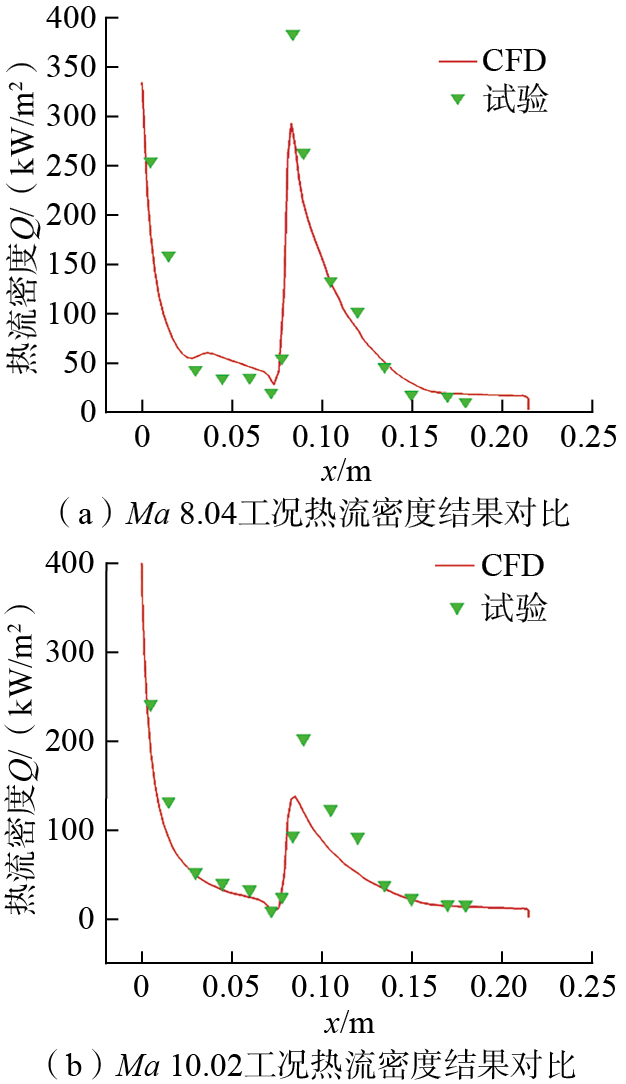
Fig.6 Comparison chart of CFD calculated heat flux density and experimental data
表4Ma 8.04与Ma 10.02工况双椭球模型表面热流试验值与计算值的误差
Table 4 Error of Ma 8.04 and Ma 10.02 operating condition double ellipsoid model surface heat flux test and calculation results
位置(x/m)
Ma 8.04工况误差/%
Ma 10.02工况误差/%
0.005
10.63
2.14
0.015
12.35
4.68
0.030
13.36
1.87
0.045
14.54
8.12
0.060
6.03
16.07
0.078
2.81
9.68
0.085
23.03
22.51
0.105
5.62
3.29
0.120
4.92
7.10
0.135
4.02
4.72
0.150
9.84
7.96
0.170
9.16
8.90
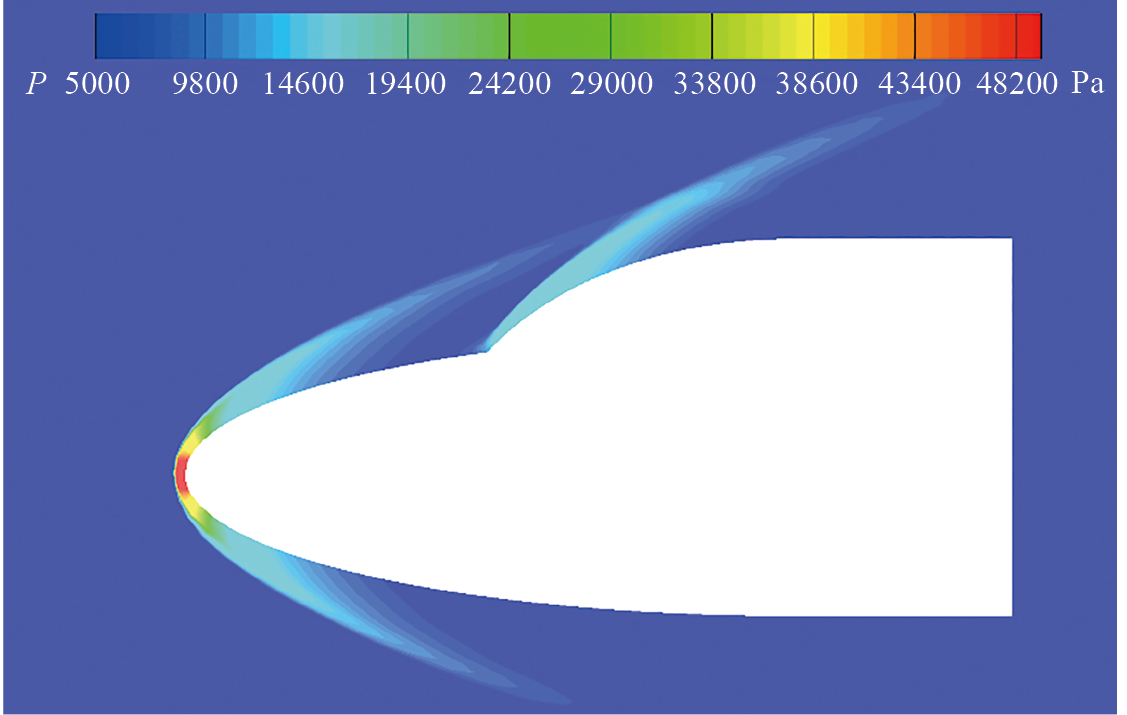
图7Ma 10.02工况流场压力分布图
Fig.7 Pressure distribution diagram of flow field under Ma 10.02 condition
1.3 气动力-热-结构耦合分析方法
本文以机翼折叠变形的高超声速飞行器为研究对象,聚焦构型变化引发的气动力-热-结构耦合效应。基于CFD计算获得不同折叠角(0°~90°)的表面气动力与热流分布,并将之作为多物理场载荷施加于初步构建的机翼结构模型,开展热-结构响应分析。比较不同机翼折叠角度状态之间的差异,并探究差异产生的原因[ WANG Y G, LUO Y J, KANG Z. Integrated design optimization of structural topology and heat source layout[J]. International Journal of Heat and Mass Transfer, 2021, 169: 120943. 16]。
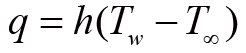
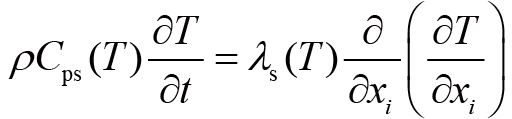
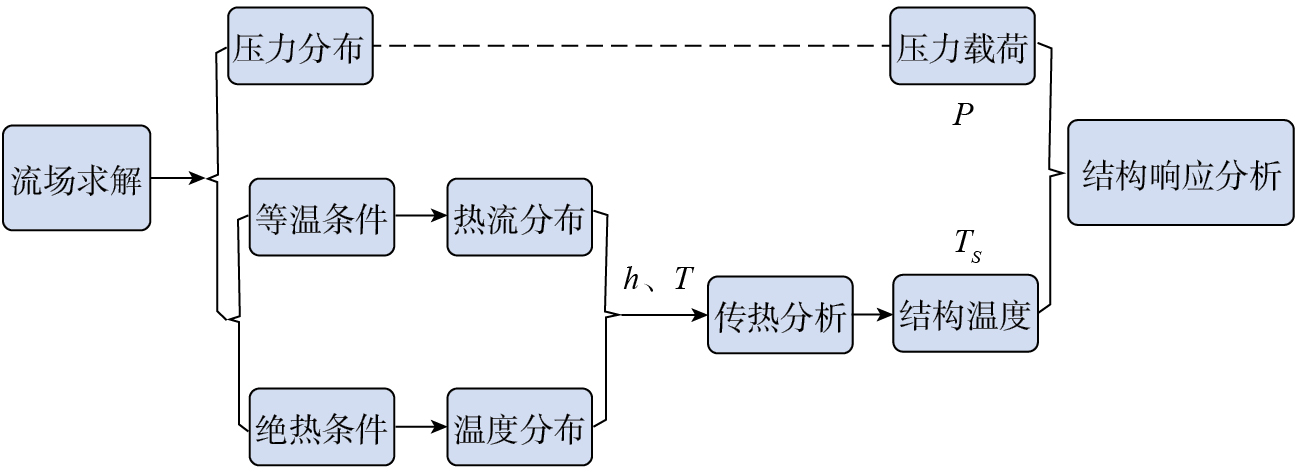
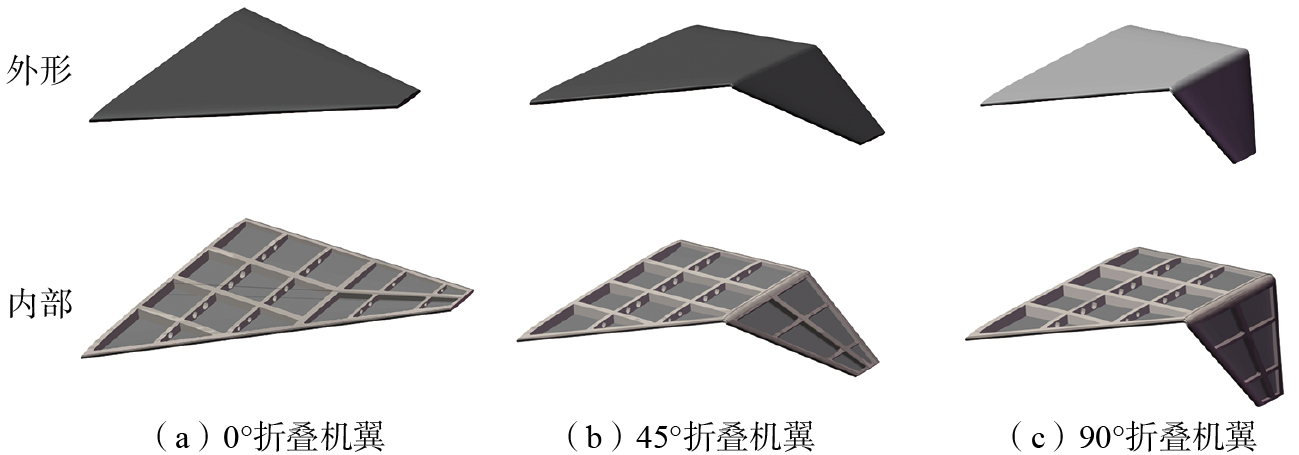
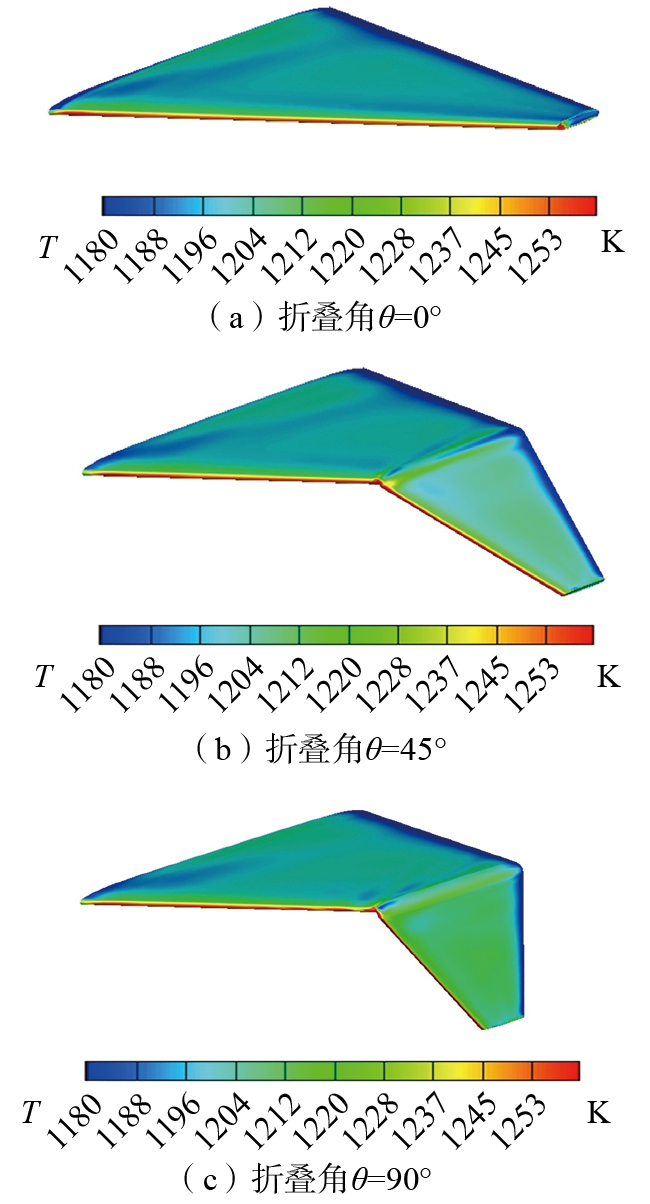
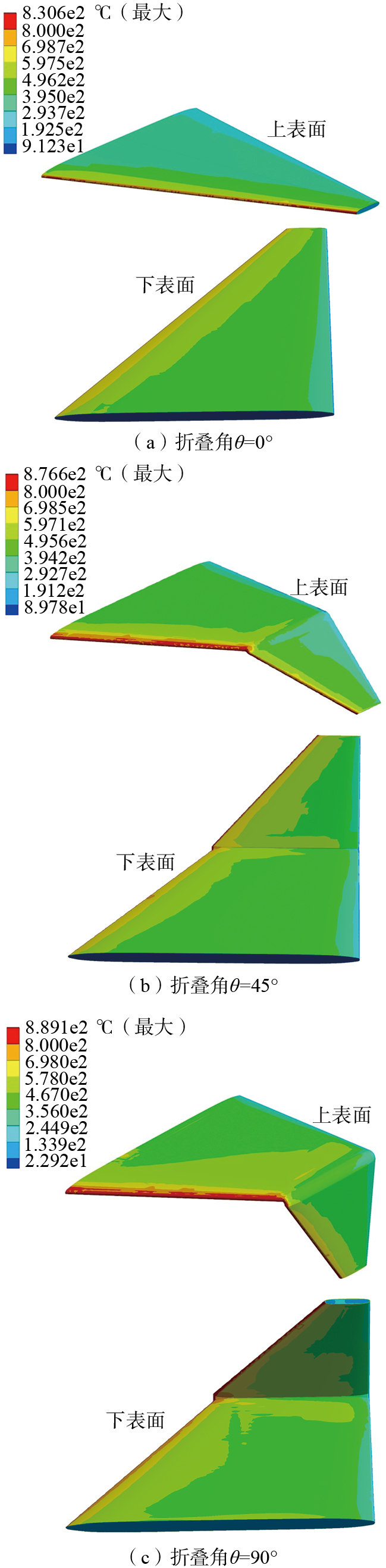
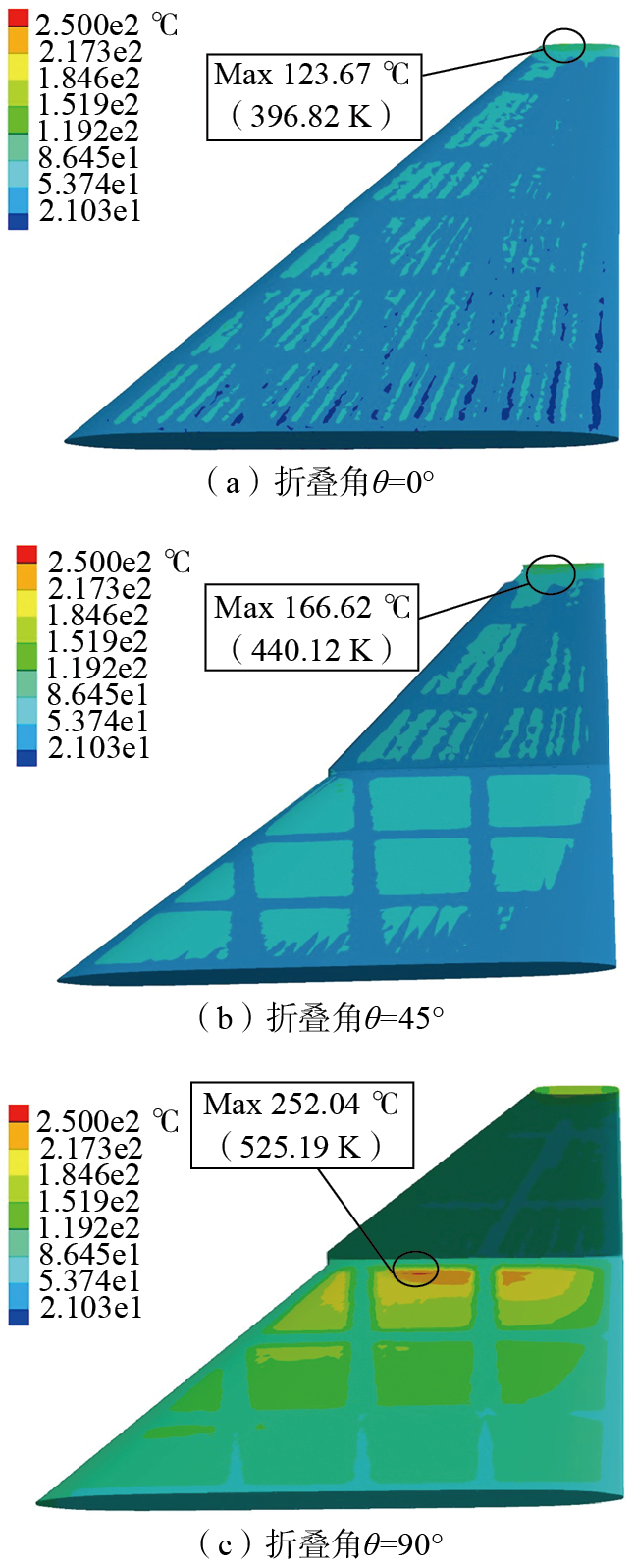
本文气动力-热-结构耦合计算主要研究流程如图8所示[ WANG J R, XIE W H, YU D, et al. Study on the multi-field coupling behavior of C/SiC composites under the combined action of the local extreme heat source and hypersonic airflow[J]. International Journal of Thermal Sciences, 2024, 200: 108952. MA N, MENG J H, LUO J Q, et al. Optimization of thermal-fluid-structure coupling for variable-span inflatable wings considering case correlation[J]. Aerospace Science and Technology, 2024, 153: 109448. 17-18]。首先,分别通过等温/绝热两种不同壁面边界条件的流场求解获取机翼表面的热流分布与表面温度分布;其次,计算得出飞行器表面的对流换热系数,绝热条件下获得的机翼壁面温度视为机翼表面流体的温度,可以用于换算各网格节点对流换热系数。将对流换热系数和温度分布作为外部载荷加载到机翼结构表面进行结构传热分析。最后,结构温度分布与表面压力分布,两者共同作为结构外部载荷进行结构响应分析。图9是不同折叠角度的机翼整体结构外形图与结构内部图。
图8 气动力-热-结构耦合计算流程图
Fig.8 Flowchart of aerodynamic-thermal-structural coupling calculation
图9 机翼0°/45°/90°折叠角度结构模型图
Fig.9 Structural model diagram of wing folding angles at 0°, 45° and 90°
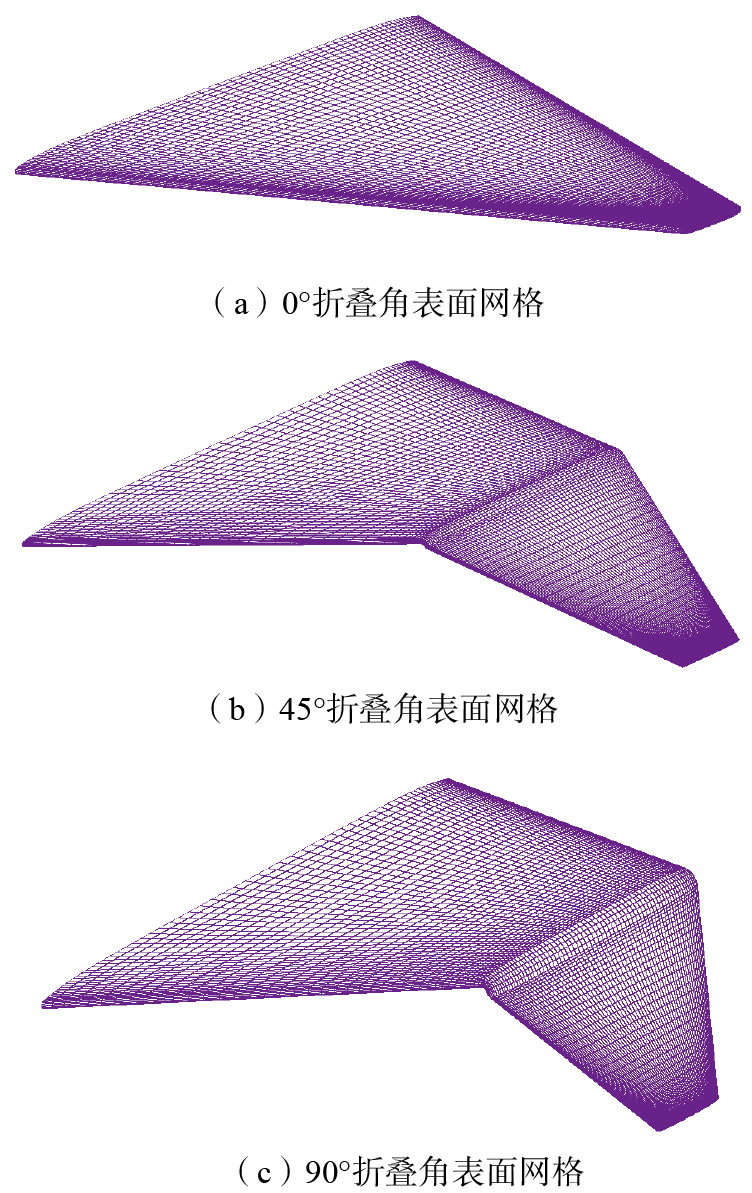
首先,以机翼作为研究对象,进行初步的机翼结构设计,机翼外形参数与第1.1节中所述气动布局的机翼保持一致。其结构主要分为两部分,靠近翼根部分保持平直不变,外翼部分可进行折叠变形,选择机翼折叠角度为0°、45°、90°的3种折叠状态作为研究对象,结构采用了常规“蒙皮+骨架”的构成形式,内部骨架通过翼梁和翼肋作为主要承力结构。在材料选择上参考了机翼热结构设计研究中的材料配置,选择了TC4钛合金为蒙皮材料,内部支撑结构采用2A70铝合金材料[ 姚怀博. 柔固耦合高超声速飞行器热流固多场耦合计算研究[D]. 哈尔滨: 哈尔滨工业大学, 2018.YAO Huaibo. Research on multi field coupling calculation of thermal solid interaction in flexible solid coupled hypersonic aircraft[D]. Harbin: Harbin Institute of Technology, 2018. 19]。结合飞行器Ma 5的飞行条件与应用背景考虑热防护设计需求,增加了陶瓷纤维Nextel 312材料作为隔热层覆盖在蒙皮表面,蒙皮厚度为2 mm,蒙皮外的隔热层厚度为5 mm,由于隔热层不起承力作用,在结构受力分析时仅考虑机翼蒙皮与内部支撑结构的热力响应,结构传热分析时长为150 s,有关材料属性见表5。流场网格划分如图10所示。
表5 机翼结构及热防护配置材料属性
Table 5 Material properties of wing structure and thermal protection configuration
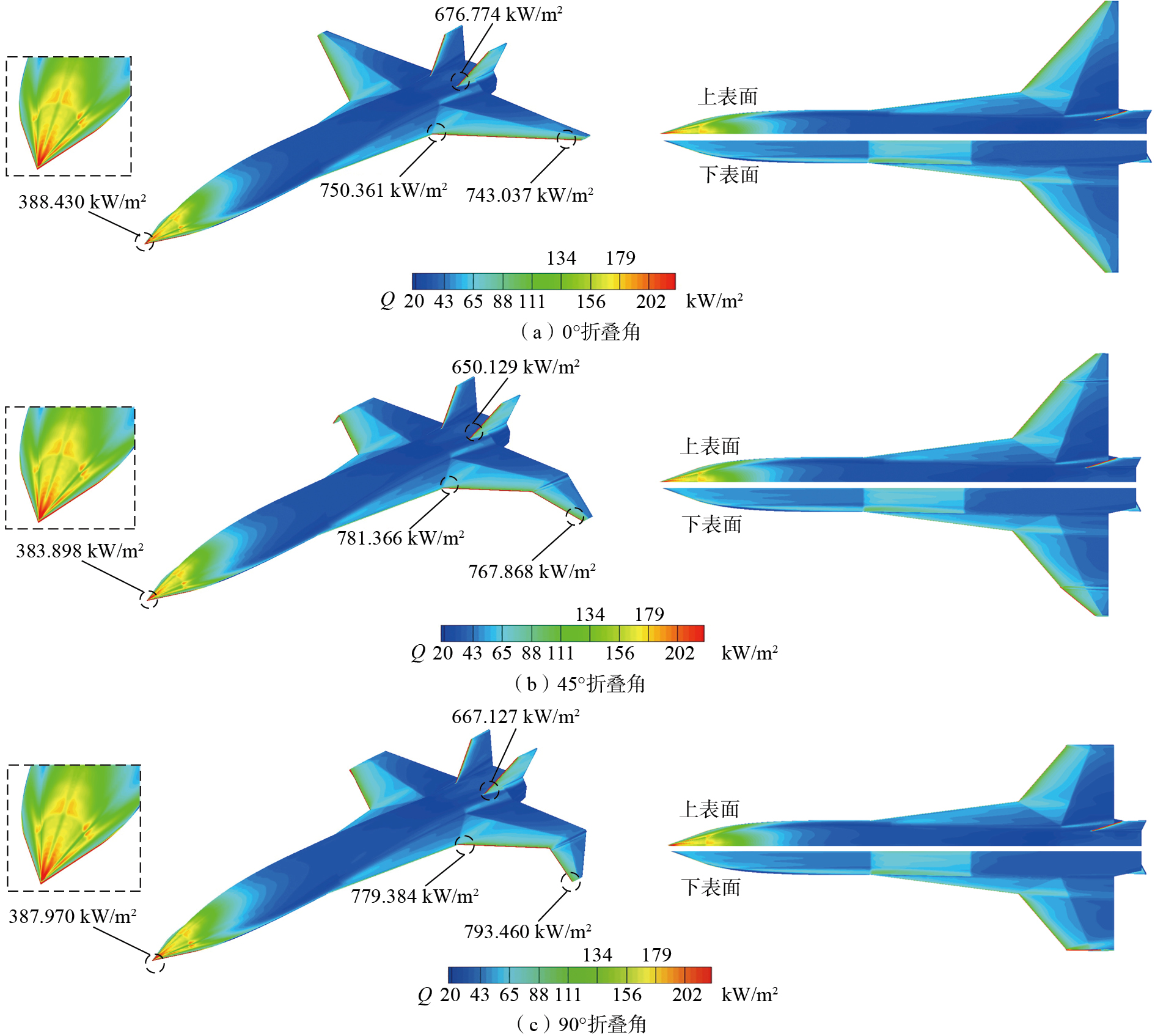
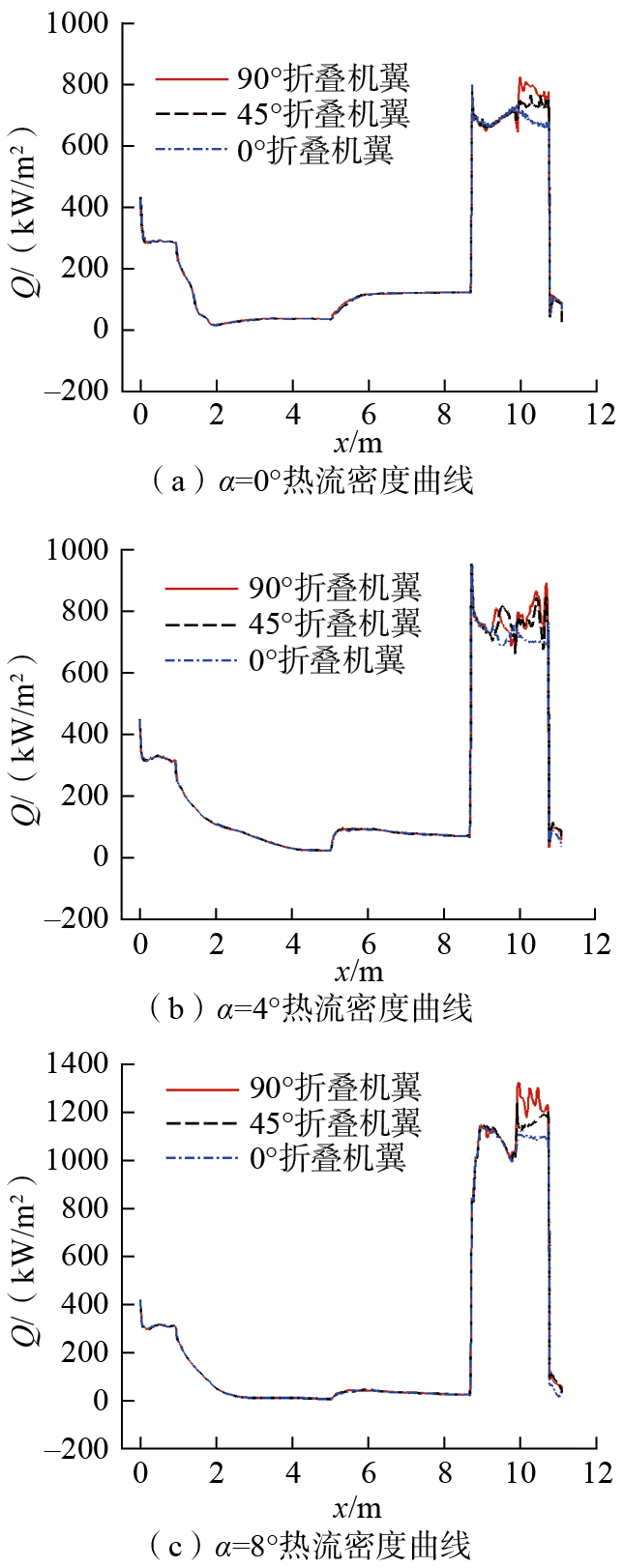
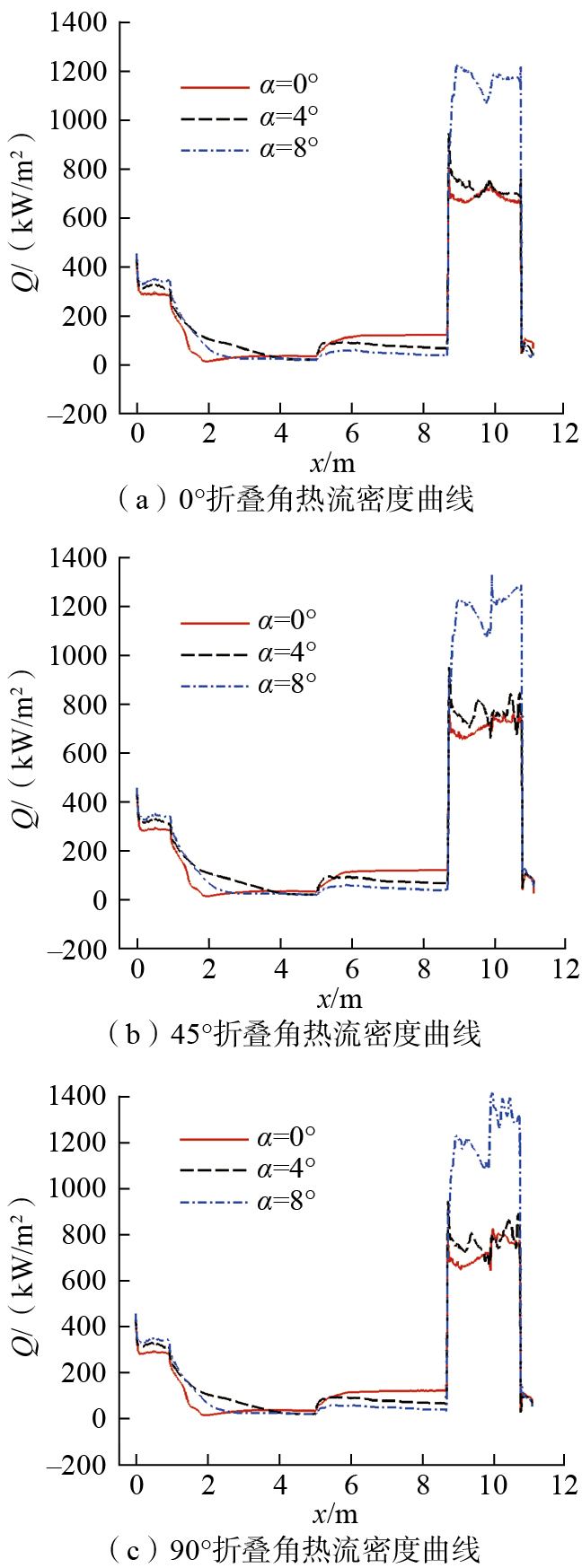
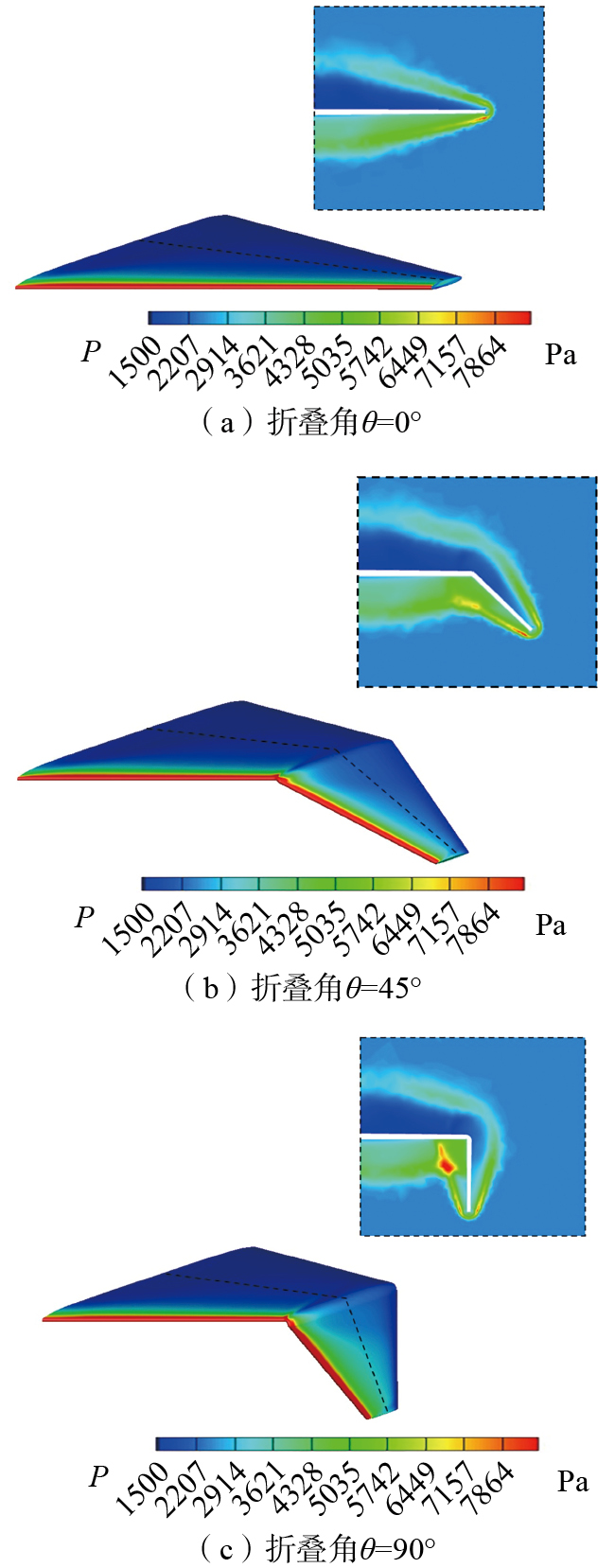
结构表面的隔热材料具有导热率较小而比热较高的属性特征,能够吸收大部分热量进而对机翼内部结构进行有效保护,在现有的气动载荷条件下结构温度最高值为机翼呈90°折叠角时的889.1 ℃,通过文献[ 闫然. 高超声速机翼热结构设计方法研究[D]. 南京: 南京航空航天大学, 2019.YAN Ran. Research on the design method of hypersonic wing thermal structure[D]. Nanjing: Nanjing University of Aeronautics and Astronautics, 2019. 20]中的数据可知本节选用的隔热材料能够承受的最高温度在1300 ℃以上。因此可以获得如下结论,在高超声速的飞行状态下,机翼折叠所引起的前缘气动加热现象更加剧烈,折叠角增大而带来的结构温度升高幅度较小,机翼前缘等防热重点区域可以通过选用隔热材料来消除机翼折叠给结构防热带来的负面影响。
Fig.19 Wing surface and flow field x=10.9 m plane pressure distribution
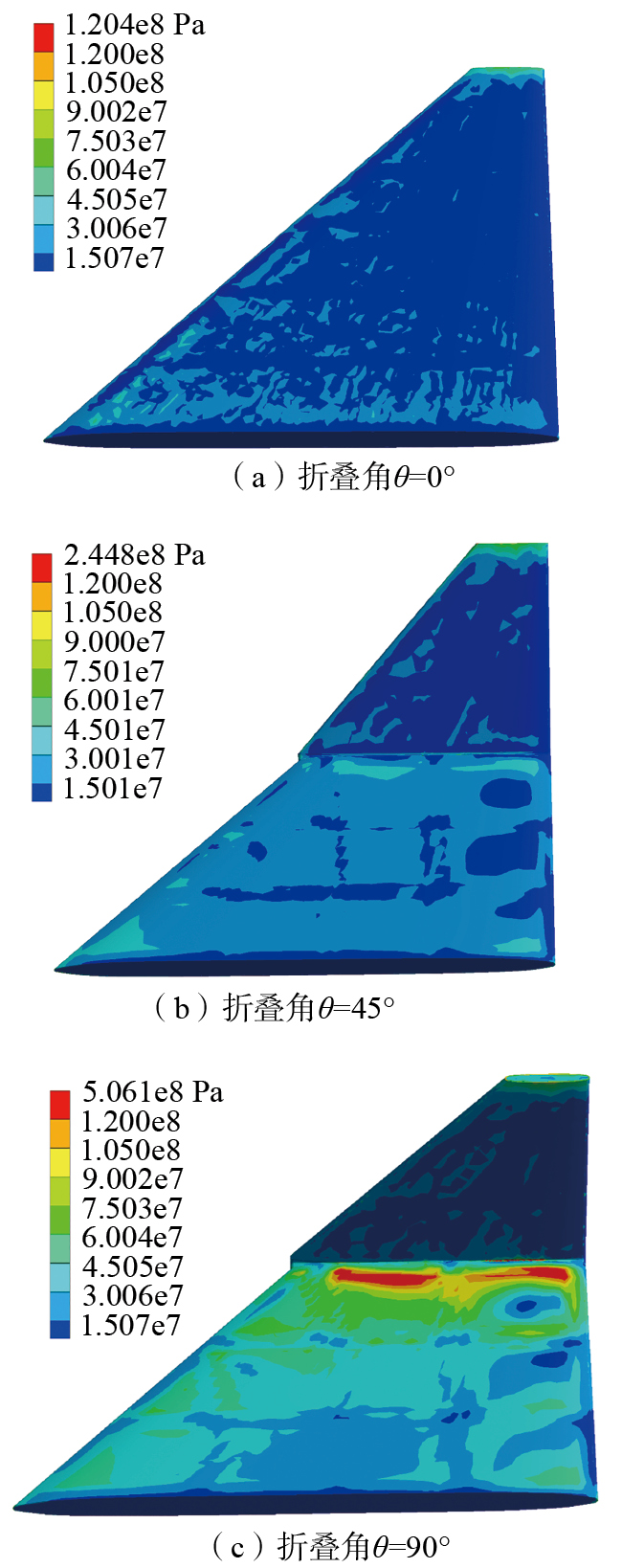
图20 机翼结构应力分布
Fig.20 Stress distribution of wing structure
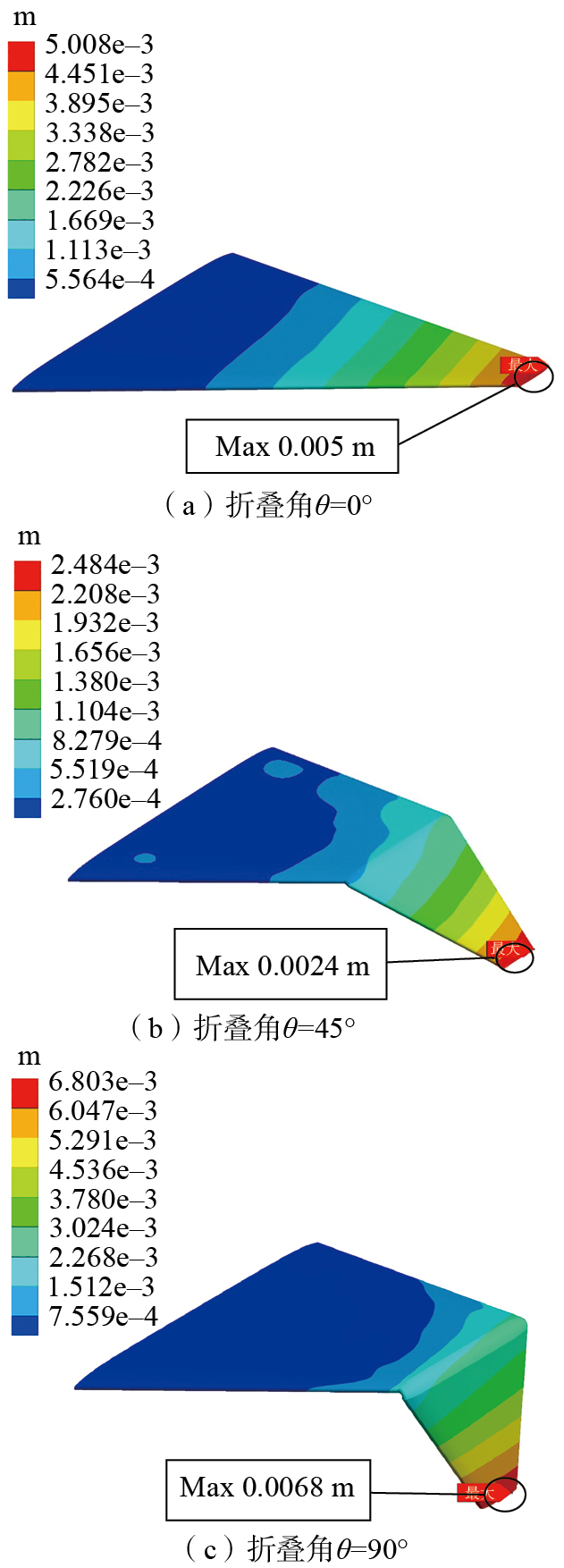
由图20可见,机翼的最大应力位置随折叠角度变化而改变,在0°和45°折叠角时,最大应力集中在翼尖处,随着折叠角度增大,最大应力的位置向机翼下表面转角附近移动,最大应力为506.1 MPa。最大应力的变化与气动载荷的分布规律一致,随着折叠角度增大,高压气流聚集在机翼下表面与外翼内侧之间,最大应力小于钛合金材料800 MPa的许用应力[ CASTELLANI M, COOPER J E, LEMMENS Y. Nonlinear static aeroelasticity of high-aspect-ratio-wing aircraft by finite element and multibody methods[J]. Journal of Aircraft, 2017, 54(2): 548-560. 21]。另外,图21给出了结构变形的分析结果,受结构自身抵抗变形能力和气动载荷分布变化影响,机翼结构变形位移随折叠角增大先减小后增大,最大变形位移为90°折叠角时6.80 mm。
董芃呈, 韩玉琪, 刘金超. 宽适应性高超声速空天动力技术发展分析[J]. 航空动力, 2020(6): 25-30. DONGPengcheng, HANYuqi, LIUJinchao. Analysis of the development of wide adaptability hypersonic aerospace power technology[J]. Aerospace Power, 2020(6): 25-30.
[2]
CHUL L, LIQ, GUF, et al. Design, modeling, and control of morphing aircraft: A review[J]. Chinese Journal of Aeronautics, 2022, 35(5): 220-246.
[3]
LIUZ, LIUJ, DINGF, et al. Novel methodology for wide-ranged multistage morphing waverider based on conical theory[J]. Acta Astronautica, 2017, 140: 362-369.
[4]
LEVYD, WAHLSR, ZICKUHRT, et al. Summary of data from the first AIAA CFD drag prediction workshop[C]//Proceedings of 40th AIAA Aerospace Sciences Meeting & Exhibit. Reston: AIAA, 2002.
[5]
RODRÍGUEZ-SEGADEM, HERNÁNDEZS, DÍAZJ. Multi-level and multi-objective structural optimization for hypersonic vehicle design[J]. Aerospace Science and Technology, 2024, 152: 109346.
[6]
李欣, 张剑飞, 何雅玲, 等. 二维流场、热结构松耦合模拟研究[J]. 工程热物理学报, 2012, 33(1): 87-90. LIXin, ZHANGJianfei, HEYaling, et al. Research on two dimensional flow field and thermal structure loose coupling simulation[J]. Journal of Engineering Thermophysics, 2012, 33(1): 87-90.
[7]
张兵, 韩景龙. 多场耦合计算平台与高超声速热防护结构传热问题研究[J]. 航空学报, 2011, 32(3): 400-409. ZHANGBing, HANJinglong. Research on heat transfer problems of multi field coupled computing platform and high ultrasonic thermal protection structure[J]. Acta Aeronautica et Astronautica Sinica, 2011, 32(3): 400-409.
[8]
苑凯华, 程萌. 高超声速气动力/热/结构多场耦合分析[J]. 战术导弹技术, 2017(5): 41-45. YUANKaihua, CHENGMeng. Multi field coupling analysis of hypersonic aerodynamics/heat/structure[J]. Tactical Missile Technology, 2017(5): 41-45.
[9]
王梓伊, 张伟伟, 刘磊. 高超声速飞行器热气动弹性仿真计算方法综述[J]. 气体物理, 2020, 5(6): 15-33. WANGZiyi, ZHANGWeiwei, LIULei. Overview of thermal aeroelastic simulation calculation methods for hypersonic aircraft[J]. Physics of Gases, 2020, 5(6): 15-33.
[10]
VIRGIL PETRESCUR V, AVERSAR, APICELLAA, et al. Modern propulsions for the aerospace industry[J]. American Journal of Engineering and Applied Sciences, 2018, 11(2): 715-755.
[11]
SASTRYY, KIROSB G, HAILUF, et al. Impact analysis of compressor rotor blades of an aircraft engine[J]. Frontiers of Structural and Civil Engineering, 2019, 13(3): 505-514.
[12]
GONGC, MAB F. Aerodynamic evaluation of an unmanned aerial vehicle with variable sweep and span[J]. Proceedings of the Institution of Mechanical Engineers, Part G: Journal of Aerospace Engineering, 2019, 233(13): 4980-4997.
[13]
FITZMAURICER. Boeing’s hypersonic passenger plane concept could one day get you from London to New York in 2 hours[EB/OL]. [2025-09-15]. http://www.businessinsider.com/boeing-hypersonic-passenger-plane-concept-london-to-new-york-in-two-hours-2018-6.
[14]
李素循. 典型外形高超声速流动特性[M]. 北京: 国防工业出版社, 2007. LISuxun. Typical shape hypersonic flow characteristics[M]. Beijing: National Defense Industry Press, 2007.
[15]
杜文聪, 陈智. 数据驱动的升力体飞行器表面热流快速预测[J]. 空气动力学学报, 2025, 43(7): 93-107. DUWencong, CHENZhi. Rapid prediction of surface heat flux for data-driven lift body aircraft[J]. Acta Aerodynamica Sinica, 2025, 43(7): 93-107.
[16]
WANGY G, LUOY J, KANGZ. Integrated design optimization of structural topology and heat source layout[J]. International Journal of Heat and Mass Transfer, 2021, 169: 120943.
[17]
WANGJ R, XIEW H, YUD, et al. Study on the multi-field coupling behavior of C/SiC composites under the combined action of the local extreme heat source and hypersonic airflow[J]. International Journal of Thermal Sciences, 2024, 200: 108952.
[18]
MAN, MENGJ H, LUOJ Q, et al. Optimization of thermal-fluid-structure coupling for variable-span inflatable wings considering case correlation[J]. Aerospace Science and Technology, 2024, 153: 109448.
[19]
姚怀博. 柔固耦合高超声速飞行器热流固多场耦合计算研究[D]. 哈尔滨: 哈尔滨工业大学, 2018. YAOHuaibo. Research on multi field coupling calculation of thermal solid interaction in flexible solid coupled hypersonic aircraft[D]. Harbin: Harbin Institute of Technology, 2018.
[20]
闫然. 高超声速机翼热结构设计方法研究[D]. 南京: 南京航空航天大学, 2019. YANRan. Research on the design method of hypersonic wing thermal structure[D]. Nanjing: Nanjing University of Aeronautics and Astronautics, 2019.
[21]
CASTELLANIM, COOPERJ E, LEMMENSY. Nonlinear static aeroelasticity of high-aspect-ratio-wing aircraft by finite element and multibody methods[J]. Journal of Aircraft, 2017, 54(2): 548-560.