Study of Ventilated Acoustic Attenuation-Bearing Metamaterial: Design and Additive Manufacturing
Citations
LUO Jiajie, ZHANG Shaoji, ZHANG Mangong, et al. Study of ventilated acoustic attenuation-bearing metamaterial: design and additive manufacturing[J]. Aeronautical Manufacturing Technology, 2026, 69(1/2): 25010143.
1.State Key Laboratory of Materials Processing and Die & Mould Technology, Huazhong University of Science and Technology, Wuhan430074, China
2.Wuhan Second Ship Design and Research Institute, Wuhan430064, China
3.State Key Laboratory of Mechanics and Control of Aerospace Structures, Nanjing University of Aeronautics and Astronautics, Nanjing210016, China
4.Nanjing Center for Multifunctional Lightweight Materials and Structures (MLMS), Nanjing University of Aeronautics and Astronautics, Nanjing210016, China
Citations
LUO Jiajie, ZHANG Shaoji, ZHANG Mangong, et al. Study of ventilated acoustic attenuation-bearing metamaterial: design and additive manufacturing[J]. Aeronautical Manufacturing Technology, 2026, 69(1/2): 25010143.
Abstract
Low-frequency noise control has consistently been a key focus and challenge in the field of noise control. Due to the limited effectiveness of traditional duct silencing materials in absorbing low-frequency noise, acoustic metamaterials have emerged as a prominent research topic. Previous designs of acoustic metamaterials often overlooked the structural load-bearing performance requirements imposed by practical application environments. Lattice-enhanced structures, as a significant branch of mechanical metamaterials, can be integrated into acoustic metamaterials to enhance their mechanical properties, thereby increasing the feasibility of applying acoustic metamaterials. This study introduces the plate-lattice structure from lattice-enhanced structures into a Helmholtz resonator, designing ventilated acoustic attenuation-bearing metamaterials (VAABM). VAABM samples were fabricated using fused deposition modeling (FDM) technology. Their low-frequency sound attenuation performance was calculated using the transfer matrix method (TMM) and validated through finite element (FE) simulation and acoustic impedance tube testing. The results demonstrate that the transmission loss (TL) reaches 21.3 dB at 674 Hz and 33.8 dB at 1078 Hz, with a TL greater than 10 dB across the frequency band of 642–1600 Hz. Furthermore, the study investigates the influence of key geometric parameters of the metamaterial structure on the sound attenuation performance of VAABM, which is shown to primarily originate from the resonance effect. Additionally, the mechanical performance of VAABM is discussed and compared with that of two classic triply periodic minimal surface (TPMS) structures. The results indicate that VAABM exhibits superior load-bearing capacity and dimensional stability. The multifunctionality of VAABM endows it with broad application prospects in the field of duct noise control.
自工业革命以来,噪声污染广泛存在于航空航天、工业生产以及日常生活等领域,损害人体健康,干扰设备运行,已成为现代社会亟待解决的问题[ TAO Y P, REN M S, ZHANG H, et al. Recent progress in acoustic materials and noise control strategies–A review[J]. Applied Materials Today, 2021, 24: 101141. BASNER M, BABISCH W, DAVIS A, et al. Auditory and non-auditory effects of noise on health[J]. Lancet, 2014, 383(9925): 1325–1332. RAWAT I, GAIKWAD N N, MEENA M S, et al. Occupational noise hazards in agri-based industries in India[J]. National Academy Science Letters, 2021, 44(3): 185–188. 1-3]。为将噪声保持在合理的水平,泡沫材料[ GAO N S, TANG L L, DENG J, et al. Design, fabrication and sound absorption test of composite porous metamaterial with embedding I-plates into porous polyurethane sponge[J]. Applied Acoustics, 2021, 175: 107845. CAO L T, FU Q X, SI Y, et al. Porous materials for sound absorption[J]. Composites Communications, 2018, 10: 25–35. LEE J, KIM J, SHIN Y, et al. Multilayered graphene oxide impregnated polyurethane foam for ultimate sound absorbing performance: Algorithmic approach and experimental validation[J]. Applied Acoustics, 2023, 203: 109194. 4-6]、纤维材料[ GOH G D, NEO S J C, DIKSHIT V, et al. Quasi-static indentation and sound-absorbing properties of 3D printed sandwich core panels[J]. Journal of Sandwich Structures & Materials, 2022, 24(2): 1206–1225. SUN Y, XU Y J, LI W J, et al. Functional modification of softwood fiber and its application in natural fiber-based sound-absorbing composite[J]. Industrial Crops and Products, 2024, 218: 119044. SHARMA S, SUDHAKARA P, SINGH J, et al. Emerging progressive developments in the fibrous composites for acoustic applications[J]. Journal of Manufacturing Processes, 2023, 102: 443–477. 7-9]等多孔材料被应用于针对频率高于2000 Hz高频噪声的吸收。但对于在航空航天器件、船舶管路系统中存在的20~2000 Hz中低频噪声,由于其长波长特性,传统多孔材料难以有效将其耗损,因此穿孔板结构[ STARKEY T A, SMITH J D, HIBBINS A P, et al. Thin structured rigid body for acoustic absorption[J]. Applied Physics Letters, 2017, 110(4): 041902. LIU C R, WU J H, YANG Z R, et al. Ultra-broadband acoustic absorption of a thin microperforated panel metamaterial with multi-order resonance[J]. Composite Structures, 2020, 246: 112366. 10-11]和尖劈结构[ MECHEL F P. Modal analysis in lined wedge-shaped ducts[J]. Journal of Sound and Vibration, 1998, 216(4): 673–696. 12]被应用于中低频噪声的消除,但是穿孔板结构和尖劈结构的共同缺点在于其吸声原理均为基于声波与结构的阻抗匹配,可导致吸声结构通常的吸声频段较窄,体积较为臃肿。
声学超材料的研发与应用为中低频噪声的控制提供了新的思路方法。超材料是一种人工设计的周期/准周期性结构,通过调控其几何构型和结构参数,可实现对波(声波、电磁波)的负折射[ YU K H, FANG N X, HUANG G L, et al. Magnetoactive acoustic metamaterials[J]. Advanced Materials, 2018, 30(21): 1706348. 梁庆宣, 杨贞, 何锦, 等. 超材料结构增材制造技术及其应用研究进展[J]. 航空制造技术, 2019, 59(1/2): 30–37, 63.LIANG Qingxuan, YANG Zhen, HE Jin, et al. Research progress of additive manufacturing technology and its applications for metamaterial structure[J]. Aeronautical Manufacturing Technology, 2019, 59(1/2): 30–37, 63. 13-14]、聚焦[ ZHANG T C, CHEN J H, QIAN J, et al. Observation of ultrabroadband acoustic focusing based on V–shaped meta-atoms[J]. Advanced Materials Technologies, 2020, 5(2): 1900956. LIU T, CHEN F, LIANG S J, et al. Subwavelength sound focusing and imaging via gradient metasurface-enabled spoof surface acoustic wave modulation[J]. Physical Review Applied, 2019, 11(3): 034061. SHEN Y X, PENG Y G, CAI F Y, et al. Ultrasonic super-oscillation wave-packets with an acoustic meta-lens[J]. Nature Communications, 2019, 10: 3411. 15-17]、隐身[ ZIGONEANU L, POPA B I, CUMMER S A. Three-dimensional broadband omnidirectional acoustic ground cloak[J]. Nature Materials, 2014, 13(4): 352–355. FAN S W, ZHAO S D, CAO L Y, et al. Reconfigurable curved metasurface for acoustic cloaking and illusion[J]. Physical Review B, 2020, 101(2): 024104. 18-19]等特殊功能。同样的,声学超材料在亚波长尺度下中低频声波的吸收与消除的性能卓越,日渐受到广泛关注。如Huang等[ Huang S, Fang X, Wang X, et al. Acoustic perfect absorbers via Helmholtz resonators with embedded apertures[J]. The Journal of the Acoustical Society of America, 2019, 145(1): 254. 20]设计了一种基于亥姆霍兹共振腔的轻量化吸声超材料,可在137 Hz的低频处实现接近100%的声波吸收,且其尺寸仅为其工作波长的1/50。但前文所叙的噪声环境的复杂性注定了声学超材料的发展不能局限于对声学性能的研究,智能化[ FAN J X, ZHANG L, WANG X B, et al. 3D printed ultra-thin acoustic metamaterials with adaptable low-frequency absorption performance[J]. Chinese Journal of Mechanical Engineering: Additive Manufacturing Frontiers, 2022, 1(3): 100036. LUO J J, FAN J X, SONG B, et al. 4D printing of reconfigurable acoustic metamaterials with multiband low-frequency absorption[J]. Additive Manufacturing Frontiers, 2024, 4(1): 200183. 21-22]、多功能化[ LI X, YU X, ZHAO M, et al. Multi–level bioinspired microlattice with broadband sound–absorption capabilities and deformation–tolerant compressive response[J]. Advanced Functional Materials, 2023, 33(2): 2210160. LI S H, YANG J J, WANG Z M. Multi-laser powder bed fusion of Ti–6.5Al–2Zr–Mo–V alloy powder: Defect formation mechanism and microstructural evolution[J]. Powder Technology, 2021, 384: 100-111. LI X W, CHUA J W, YU X, et al. 3D-printed lattice structures for sound absorption: Current progress, mechanisms and models, structural-property relationships, and future outlook[J]. Advanced Science, 2024, 11(4): 2305232. 王俪静, 吴晓莉, 徐晓美. 基于亥姆霍兹谐振器通风隔声结构性能研究[J]. 建筑科学, 2024, 40(10): 171–178.WANG Lijing, WU Xiaoli, XU Xiaomei. A study on the performance of a ventilation sound insulation structure based on the Helmholtz resonator[J]. Building Science, 2024, 40(10): 171–178. 23-26]将是声学超材料发展的必然趋势。具体而言,对于流体自由流动的环境(例如管道通风系统),管道流动性能和降噪性能此消彼长,构成矛盾[ YANG M, LI Y, MENG C, et al. Sound absorption by subwavelength membrane structures: A geometric perspective[J]. Comptes Rendus Mécanique, 2015, 343(12): 635–644. 27]。因此,通风性能和声学性能的协同优化是消声型声学超材料的研究热点之一。通风消声超材料的声学性能通常通过传递损失(TL)评估,TL值超过10 dB意味着90%声能的耗散,被视为有效降噪的标志[ WEN G L, ZHANG S D, WANG H X, et al. Origami-based acoustic metamaterial for tunable and broadband sound attenuation[J]. International Journal of Mechanical Sciences, 2023, 239: 107872. 28],而通风性能通常用开放面积占比进行评估[ GAO Y X, CHENG Y, LIANG B, et al. Acoustic skin meta-muffler[J]. Science China Physics, Mechanics & Astronomy, 2021, 64(9): 294311. 29]。Sun等[ SUN M, FANG X S, MAO D X, et al. Broadband acoustic ventilation barriers[J]. Physical Review Applied, 2020, 13(4): 044028. 30]设计了一种基于法诺共振干涉原理的设计了一种平面型、通风面积为20.25%、亚波长厚度(约λ/8)的通风消声超材料,通过螺旋迷宫式通道的结构设计改变声程从而实现在900~1418 Hz范围内实现超过10 dB的传递损失。现有的研究趋势是将消声超材料的消声频段向低频移动,并且尽可能拓宽消声频带。Zhang等[ ZHANG Y Y, WU C L, LI N, et al. Ventilated low-frequency sound absorber based on Helmholtz acoustic metamaterial[J]. Physics Letters A, 2024, 523: 129779. 31]设计一种多重亥姆霍兹共振腔耦合的通风消声超材料单元,其通风面积为25%,通过多级串联的方式得到长度为61.8 mm和110 mm两个通风消声筒,前者在661~1010 Hz频段TL值超过10 dB;后者的有效消声频段为454~698 Hz。
以往声学超材料的设计往往忽略了实际应用环境对结构承载性能的要求,存在管道激流[ 付鑫鑫, 王文龙, 赵伟. 多相流管道腐蚀研究进展[J]. 材料科学, 2023, 13(6): 536–541.FU Xinxin, WANG Wenlong, ZHAO Wei. Research progress of corrosion in multiphase pipeline[J]. Material Sciences, 2023, 13(6): 536–541. 32]破坏吸声管道风险,其矛盾点在于低频的消声多依赖于超材料的空腔结构,而空腔结构意味着超材料承载性能的削弱。点阵结构超材料因其多功能性和可设计性而广受关注,主要分为桁架结构[ NUÑO M, BÜHRING J, RAO M N, et al. Delamination testing of AlSi10Mg sandwich structures with pyramidal lattice truss core made by laser powder bed fusion[J]. Chinese Journal of Mechanical Engineering, 2021, 34(1): 126. 33]、板格结构[ LI X W, YU X, CHUA J W, et al. Microlattice metamaterials with simultaneous superior acoustic and mechanical energy absorption[J]. Small, 2021, 17(24): 2100336. 34]和三周期极小曲面结构[ YANG W J, AN J, CHUA C K, et al. Acoustic absorptions of multifunctional polymeric cellular structures based on triply periodic minimal surfaces fabricated by stereolithography[J]. Virtual and Physical Prototyping, 2020, 15(2): 242–249. 35](Triply periodic minimal surfaces,TPMS)。Fan等[ FAN J X, SONG B, ZHANG L, et al. Structural design and additive manufacturing of multifunctional metamaterials with low-frequency sound absorption and load-bearing performances[J]. International Journal of Mechanical Sciences, 2023, 238: 107848. 36]受板格结构的启发设计了一种吸声承载性能耦合的超材料,在354~424 Hz低频范围拥有80%吸声效率的同时,其弹性模量和屈服强度都显著高于相同体积分数的TPMS结构。由此可见,将点阵结构特征引入声学超材料设计是实现超材料声学–力学性能耦合的有效方法之一。
由于声学超材料几何构型复杂,传统制造方法如铸造、锻造、铣削等存在制造成本高且效率低的问题,增材制造技术可实现复杂结构的整体成形,显著提高了声学超材料的成型效率[ FAN J X, ZHANG L, WEI S S, et al. A review of additive manufacturing of metamaterials and developing trends[J]. Materials Today, 2021, 50: 303–328. HEMACHANDRA M, THAPLIYAL S, ADEPU K. A review on microstructural and tribological performance of additively manufactured parts[J]. Journal of Materials Science, 2022, 57(36): 17139–17161. LI X W, CHUA J W, YU X, et al. 3D-printed lattice structures for sound absorption: Current progress, mechanisms and models, structural-property relationships, and future outlook[J]. Advanced Science, 2024, 11(4): 2305232. 37-39]。声学超材料的设计也因增材制造有了更高的自由度,从而为更多功能的集成提供基础。本文以中低频噪声宽频吸收为目的,针对目前通风消声超材料普遍忽略力学承载性能的局限性,通过将点阵结构中的板格结构引入亥姆霍兹共振腔,设计制造可在航空航天、船舶管路等领域更具应用价值的通风消声承载多功能超材料(Ventilated acoustic attenuation-bearing metamaterial,VAABM)。
1 通风消声承载超材料设计及制造
1.1 通风消声承载超材料结构设计
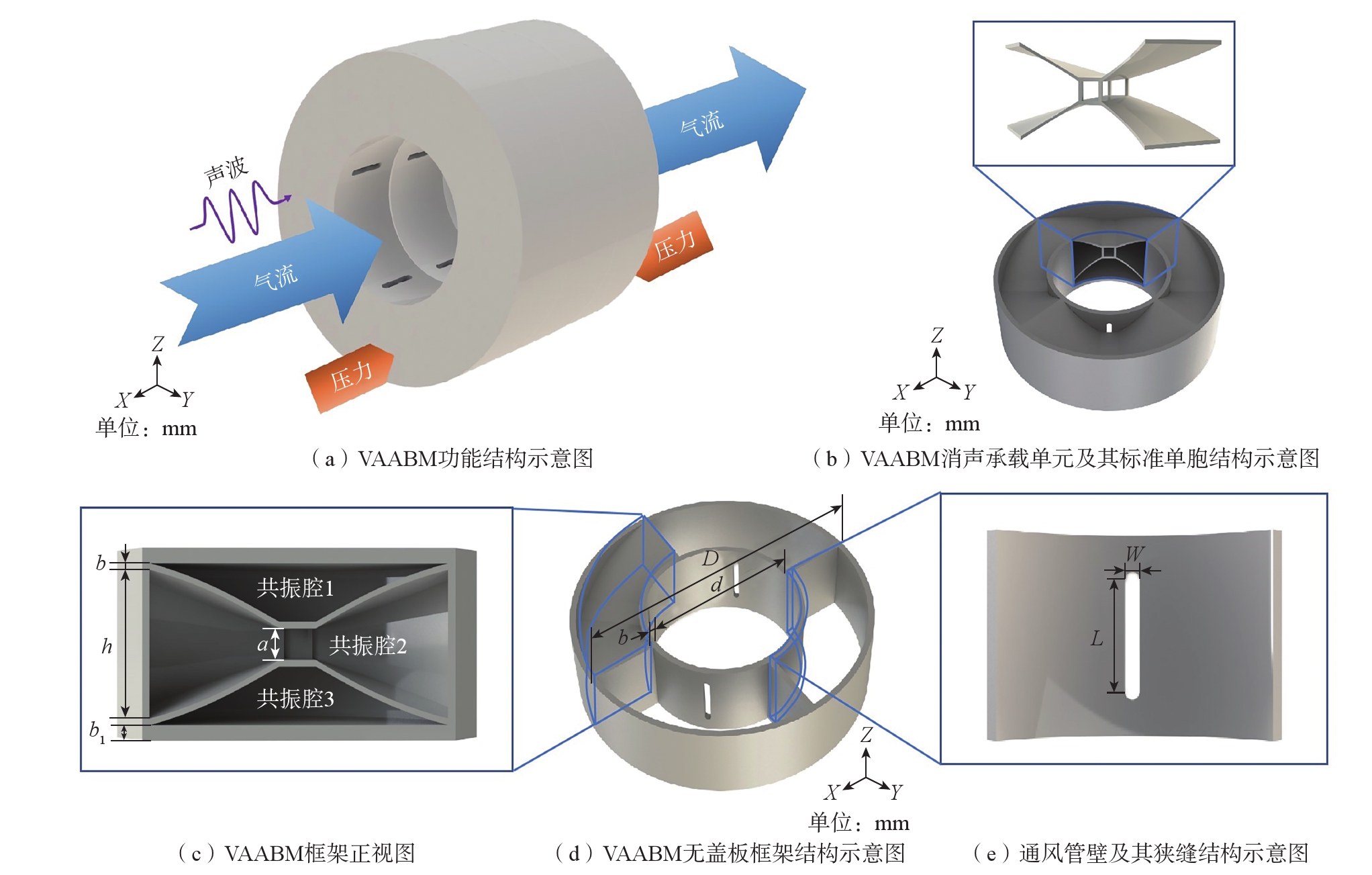
图1(a)为3层标准VAABM组成的通风消声管的功能图,空气气流可以从中央通风管流通,而特定频段的声波在经过中央通风管时则会被吸收,实现降噪;同时VAABM拥有z轴方向的承载能力。图1(b)为标准VAABM单胞去除上下盖板的外观示意图,该结构由4个消声承载单元围绕中央通风区圆周阵列组成,而中央通风区与各消声承载单元之间以狭缝相连接;图1(c)~(e)详细展示了消声承载单元内部结构和VAABM框架结构的尺寸参数。图1(c)为1个消声承载单元置于VAABM框架内的正视图,VAABM框架即由高度为h=25 mm的竖直支撑壁,厚度为b1=2.5 mm的上下盖板和中央通风管壁结合构成的空腔结构。板格结构沿中央通风管壁螺旋攀附将空腔分割为上中下3部分,同时也提高了超材料的结构强度。板格在中间位置呈水平取向,上下板格以框架连接,形成长宽均为a=5 mm的矩形孔。图1(d)为VAABM框架去除上下盖板后的结构示意图,其整体外径为D=99 mm,中央通风管壁内径为d=50 mm,其通风面积占总面积的25.51%,而构成框架的壁以及板格的厚度均为b=2 mm。图1(e)则展示了通风管壁及其上面切除出的宽为W=2 mm,长为L=14 mm的双圆槽狭缝,该狭缝使图1(c)所示的3个空腔与外界空气相通,形成3个串联狭缝型亥姆霍兹共振腔。在上述结构参数中,狭缝作为亥姆霍兹共振腔的窄颈,决定入射声阻抗;而竖直支撑壁的高度直接决定了亥姆霍兹共振腔的空腔体积,从而影响消声频段[ HUANG S B, FANG X S, WANG X, et al. Acoustic perfect absorbers via Helmholtz resonators with embedded apertures[J]. The Journal of the Acoustical Society of America, 2019, 145(1): 254. 40]。
图1 VAABM功能结构示意图
Fig.1 Schematic illustration of structure and functions of VAABM
本文设计的VAABM以亥姆霍兹共振器为基础,其在圆形管道中的声学性能可通过传递矩阵法[ WEN G L, ZHANG S D, WANG H X, et al. Origami-based acoustic metamaterial for tunable and broadband sound attenuation[J]. International Journal of Mechanical Sciences, 2023, 239: 107872. GAO Y X, CHENG Y, LIANG B, et al. Acoustic skin meta-muffler[J]. Science China Physics, Mechanics & Astronomy, 2021, 64(9): 294311. 28-29, LONG H Y, CHENG Y, et al. Asymmetric absorber with multiband and broadband for low-frequency sound[J]. Applied Physics Letters, 2017, 111(14): 143502. 41]进行计算分析。声波通过VAABM单胞时,其传播行为由传递矩阵Tm描述。
TAOY P, RENM S, ZHANGH, et al. Recent progress in acoustic materials and noise control strategies–A review[J]. Applied Materials Today, 2021, 24: 101141.
[2]
BASNERM, BABISCHW, DAVISA, et al. Auditory and non-auditory effects of noise on health[J]. Lancet, 2014, 383(9925): 1325–1332.
[3]
RAWATI, GAIKWADN N, MEENAM S, et al. Occupational noise hazards in agri-based industries in India[J]. National Academy Science Letters, 2021, 44(3): 185–188.
[4]
GAON S, TANGL L, DENGJ, et al. Design, fabrication and sound absorption test of composite porous metamaterial with embedding I-plates into porous polyurethane sponge[J]. Applied Acoustics, 2021, 175: 107845.
[5]
CAOL T, FUQ X, SIY, et al. Porous materials for sound absorption[J]. Composites Communications, 2018, 10: 25–35.
[6]
LEEJ, KIMJ, SHINY, et al. Multilayered graphene oxide impregnated polyurethane foam for ultimate sound absorbing performance: Algorithmic approach and experimental validation[J]. Applied Acoustics, 2023, 203: 109194.
[7]
GOHG D, NEOS J C, DIKSHITV, et al. Quasi-static indentation and sound-absorbing properties of 3D printed sandwich core panels[J]. Journal of Sandwich Structures & Materials, 2022, 24(2): 1206–1225.
[8]
SUNY, XUY J, LIW J, et al. Functional modification of softwood fiber and its application in natural fiber-based sound-absorbing composite[J]. Industrial Crops and Products, 2024, 218: 119044.
[9]
SHARMAS, SUDHAKARAP, SINGHJ, et al. Emerging progressive developments in the fibrous composites for acoustic applications[J]. Journal of Manufacturing Processes, 2023, 102: 443–477.
[10]
STARKEYT A, SMITHJ D, HIBBINSA P, et al. Thin structured rigid body for acoustic absorption[J]. Applied Physics Letters, 2017, 110(4): 041902.
[11]
LIUC R, WUJ H, YANGZ R, et al. Ultra-broadband acoustic absorption of a thin microperforated panel metamaterial with multi-order resonance[J]. Composite Structures, 2020, 246: 112366.
[12]
MECHELF P. Modal analysis in lined wedge-shaped ducts[J]. Journal of Sound and Vibration, 1998, 216(4): 673–696.
[13]
YUK H, FANGN X, HUANGG L, et al. Magnetoactive acoustic metamaterials[J]. Advanced Materials, 2018, 30(21): 1706348.
[14]
梁庆宣, 杨贞, 何锦, 等. 超材料结构增材制造技术及其应用研究进展[J]. 航空制造技术, 2019, 59(1/2): 30–37, 63. LIANGQingxuan, YANGZhen, HEJin, et al. Research progress of additive manufacturing technology and its applications for metamaterial structure[J]. Aeronautical Manufacturing Technology, 2019, 59(1/2): 30–37, 63.
[15]
ZHANGT C, CHENJ H, QIANJ, et al. Observation of ultrabroadband acoustic focusing based on V–shaped meta-atoms[J]. Advanced Materials Technologies, 2020, 5(2): 1900956.
[16]
LIUT, CHENF, LIANGS J, et al. Subwavelength sound focusing and imaging via gradient metasurface-enabled spoof surface acoustic wave modulation[J]. Physical Review Applied, 2019, 11(3): 034061.
[17]
SHENY X, PENGY G, CAIF Y, et al. Ultrasonic super-oscillation wave-packets with an acoustic meta-lens[J]. Nature Communications, 2019, 10: 3411.
[18]
ZIGONEANUL, POPAB I, CUMMERS A. Three-dimensional broadband omnidirectional acoustic ground cloak[J]. Nature Materials, 2014, 13(4): 352–355.
[19]
FANS W, ZHAOS D, CAOL Y, et al. Reconfigurable curved metasurface for acoustic cloaking and illusion[J]. Physical Review B, 2020, 101(2): 024104.
[20]
HuangS, FangX, WangX, et al. Acoustic perfect absorbers via Helmholtz resonators with embedded apertures[J]. The Journal of the Acoustical Society of America, 2019, 145(1): 254.
[21]
FANJ X, ZHANGL, WANGX B, et al. 3D printed ultra-thin acoustic metamaterials with adaptable low-frequency absorption performance[J]. Chinese Journal of Mechanical Engineering: Additive Manufacturing Frontiers, 2022, 1(3): 100036.
[22]
LUOJ J, FANJ X, SONGB, et al. 4D printing of reconfigurable acoustic metamaterials with multiband low-frequency absorption[J]. Additive Manufacturing Frontiers, 2024, 4(1): 200183.
[23]
LIX, YUX, ZHAOM, et al. Multi–level bioinspired microlattice with broadband sound–absorption capabilities and deformation–tolerant compressive response[J]. Advanced Functional Materials, 2023, 33(2): 2210160.
[24]
LIS H, YANGJ J, WANGZ M. Multi-laser powder bed fusion of Ti–6.5Al–2Zr–Mo–V alloy powder: Defect formation mechanism and microstructural evolution[J]. Powder Technology, 2021, 384: 100-111.
[25]
LIX W, CHUAJ W, YUX, et al. 3D-printed lattice structures for sound absorption: Current progress, mechanisms and models, structural-property relationships, and future outlook[J]. Advanced Science, 2024, 11(4): 2305232.
[26]
王俪静, 吴晓莉, 徐晓美. 基于亥姆霍兹谐振器通风隔声结构性能研究[J]. 建筑科学, 2024, 40(10): 171–178. WANGLijing, WUXiaoli, XUXiaomei. A study on the performance of a ventilation sound insulation structure based on the Helmholtz resonator[J]. Building Science, 2024, 40(10): 171–178.
[27]
YANGM, LIY, MENGC, et al. Sound absorption by subwavelength membrane structures: A geometric perspective[J]. Comptes Rendus Mécanique, 2015, 343(12): 635–644.
[28]
WENG L, ZHANGS D, WANGH X, et al. Origami-based acoustic metamaterial for tunable and broadband sound attenuation[J]. International Journal of Mechanical Sciences, 2023, 239: 107872.
[29]
GAOY X, CHENGY, LIANGB, et al. Acoustic skin meta-muffler[J]. Science China Physics, Mechanics & Astronomy, 2021, 64(9): 294311.
ZHANGY Y, WUC L, LIN, et al. Ventilated low-frequency sound absorber based on Helmholtz acoustic metamaterial[J]. Physics Letters A, 2024, 523: 129779.
[32]
付鑫鑫, 王文龙, 赵伟. 多相流管道腐蚀研究进展[J]. 材料科学, 2023, 13(6): 536–541. FUXinxin, WANGWenlong, ZHAOWei. Research progress of corrosion in multiphase pipeline[J]. Material Sciences, 2023, 13(6): 536–541.
[33]
NUÑOM, BÜHRINGJ, RAOM N, et al. Delamination testing of AlSi10Mg sandwich structures with pyramidal lattice truss core made by laser powder bed fusion[J]. Chinese Journal of Mechanical Engineering, 2021, 34(1): 126.
[34]
LIX W, YUX, CHUAJ W, et al. Microlattice metamaterials with simultaneous superior acoustic and mechanical energy absorption[J]. Small, 2021, 17(24): 2100336.
[35]
YANGW J, ANJ, CHUAC K, et al. Acoustic absorptions of multifunctional polymeric cellular structures based on triply periodic minimal surfaces fabricated by stereolithography[J]. Virtual and Physical Prototyping, 2020, 15(2): 242–249.
[36]
FANJ X, SONGB, ZHANGL, et al. Structural design and additive manufacturing of multifunctional metamaterials with low-frequency sound absorption and load-bearing performances[J]. International Journal of Mechanical Sciences, 2023, 238: 107848.
[37]
FANJ X, ZHANGL, WEIS S, et al. A review of additive manufacturing of metamaterials and developing trends[J]. Materials Today, 2021, 50: 303–328.
[38]
HEMACHANDRAM, THAPLIYALS, ADEPUK. A review on microstructural and tribological performance of additively manufactured parts[J]. Journal of Materials Science, 2022, 57(36): 17139–17161.
[39]
LIX W, CHUAJ W, YUX, et al. 3D-printed lattice structures for sound absorption: Current progress, mechanisms and models, structural-property relationships, and future outlook[J]. Advanced Science, 2024, 11(4): 2305232.
[40]
HUANGS B, FANGX S, WANGX, et al. Acoustic perfect absorbers via Helmholtz resonators with embedded apertures[J]. The Journal of the Acoustical Society of America, 2019, 145(1): 254.
[41]
LONGH Y, CHENGY, et al. Asymmetric absorber with multiband and broadband for low-frequency sound[J]. Applied Physics Letters, 2017, 111(14): 143502.
[42]
全国声学标准化技术委员会. 声学 阻抗管中传声损失的测量 传递矩阵法[Z]. 北京:中国标准出版社,2011. Acoustics. Acoustics-determination of sound transmission loss in impedance tubes-transfer matrix method[Z]. Beijing: Standards Press of China, 2011.