1.School of Mechanical and Energy Engineering, Guangdong Ocean University, Yangjiang529500, China
2.Institute of Intelligent Manufacturing, Guangdong Academy of Sciences, Guangzhou510000, China
3.School of Mechanical and Automotive Engineering, South China University of Technology, Guangzhou510000, China
Citations
ZHANG Mingkang, LIU Wenbin, CHEN Jie, et al. Design and acoustic characterization of microperforated plate–triply periodic minimal surface hybrid acoustic metamaterials[J]. Aeronautical Manufacturing Technology, 2026, 69(1/2): 25010070.
Abstract
Aimed at low-frequency noise in aerospace applications, a micro-perforated plate (MPP) and a Triply Periodic Minimal Surface (TPMS) was combined as a MPP–TPMS sandwich structure. This structure achieves efficient mid-to-low frequency sound absorption while maintaining advantages in lightweight design and compactness. The Primitive structure in the TPMS structure was selected as the structural core material, and a Helmholtz resonator array can be formed by designing a perforated plate-cavity unit. Based on microperforated plate sound absorption theory and Johnson-Champoux-Allard equivalent fluid theory, a theoretical sound absorption model of the MPP–Primitive sandwich structure was established to explore the coupling effect of local resonance effect and thermal viscous dissipation mechanism in sound wave attenuation. Samples were fabricated by fused deposition modeling (FDM) technology. The effects of MPP, unit cell size of Primitive, cavity thickness, and MPP aperture on the acoustic properties of the sandwich structure were systematically investigated through acoustic impedance tube tests and finite element simulations. The results demonstrate that the combination of MPP and TPMS activates the sound absorption mechanism of the Helmholtz resonance cavity and greatly improves the sound absorption characteristics, and the sound absorption frequency band moves towards the low-frequency region, and the sound absorption peak is close to 1. Increasing the size of the Primitive effectively expands the volume of the resonance cavity, reduces the low-frequency acoustic impedance, and enhances the acoustic impedance matching with low-frequency sound waves, thereby improving the absorption efficiency of low-frequency sound waves. Reducing the MPP’s aperture and increasing the surface acoustic resistance of the structure effectively broadens the bandwidth of the sound absorption peak, greatly improving the peak value of the sound absorption and migrating it to low frequencies. Increasing the thickness of the primitive cavity, extending the sound wave propagation path, and migrating the Helmholtz resonance peak to low frequencies by enhancing viscous dissipation and heat conduction effects. This work provides support for the design of sub-wavelength low-frequency sound-absorbing MPP–TPMS composite sound-absorbing metamaterials.
在航空领域,航空发动机的工作振动和飞行器的气流扰动都会产生低频噪音,严重影响乘客的乘坐体验和身体健康。但低频噪音的波长较长[ BERGLUND B, HASSMÉN P, JOB R F. Sources and effects of low-frequency noise[J]. The Journal of the Acoustical Society of America, 1996, 99(5): 2985–3002. 1],玻璃棉、矿棉板等传统吸声材料的材料厚度需要在远大于低频波长的情况下才能达到吸收低频噪音的目的[ YANG M, SHENG P. Sound absorption structures: From porous media to acoustic metamaterials[J]. Annual Review of Materials Research, 2017, 47: 83–114. 2]。这不符合航空器对结构材料的轻量化、高承载、耐极端环境以及多功能集成的设计要求[ 张卫红, 周涵, 李韶英, 等. 航天高性能薄壁构件的材料–结构一体化设计综述[J]. 航空学报, 2023, 44(9): 627428.ZHANG Weihong, ZHOU Han, LI Shaoying, et al. Material-structure integrated design for high-performance aerospace thin-walled component[J]. Acta Aeronautica et Astronautica Sinica, 2023, 44(9): 627428. 3]。声学超材料凭借局域共振效应[ CHANG I L, LIANG Z X, KAO H W, et al. The wave attenuation mechanism of the periodic local resonant metamaterial[J]. Journal of Sound and Vibration, 2018, 412: 349–359. ZHANG Y Y, GAO N S, WU J H. New mechanism of tunable broadband in local resonance structures[J]. Applied Acoustics, 2020, 169: 107482. 4-5]、热粘滞效应[ MOLERÓN M, SERRA-GARCIA M, DARAIO C. Visco-thermal effects in acoustic metamaterials: From total transmission to total reflection and high absorption[J]. New Journal of Physics, 2016, 18(3): 033003. KONE T C, LOPEZ M, GHINET S, et al. Thermoviscous-acoustic metamaterials to damp acoustic modes in complex shape geometries at low frequencies[J]. The Journal of the Acoustical Society of America, 2021, 150(3): 2272. 6-7]以及声阻抗匹配[ JIA X, LI Y, ZHOU Y H, et al. Wide bandwidth acoustic transmission via coiled-up metamaterial with impedance matching layers[J]. Science China Physics, Mechanics & Astronomy, 2019, 62(6): 964311. QU S C, GAO N, TINEL A, et al. Underwater metamaterial absorber with impedance-matched composite[J]. Science Advances, 2022, 8(20): eabm4206. 8-9]等物理机制,突破了传统吸声材料的“厚、重、窄频”的限制,可以利用较小的结构尺寸实现对低频长波长声波的有效控制。
目前,薄膜谐振器[ 曹尔泰, 延浩, 黄河源. 飞行器舱室内壁蛛网仿生薄膜声学超材料设计[J]. 航空科学技术, 2024, 35(3): 11–19.CAO Ertai, YAN Hao, HUANG Heyuan. Design of spider web bio-inspired membrane acoustic metamaterials for aircraft cabin walls[J]. Aeronautical Science & Technology, 2024, 35(3): 11–19. 顾金桃, 王晓乐, 汤又衡, 等. 提高飞机壁板低频宽带隔声的层合声学超材料[J]. 航空学报, 2022, 43(1): 224785.GU Jintao, WANG Xiaole, TANG Youheng, et al. Laminated acoustic metamaterial for improving low-frequency broadband sound insulation of aircraft wall panels[J]. Acta Aeronautica et Astronautica Sinica, 2022, 43(1): 224785. 10-11]、亥姆霍兹谐振器[ 顾鑫, 周国成, 徐文强, 等. 带延长颈亥姆霍兹共振器的宽带声衬设计与验证[J]. 噪声与振动控制, 2024, 44(3): 276–281.GU Xin, ZHOU Guocheng, XU Wenqiang, et al. Broadband acoustic liner design and verification of Helmholtz resonators with extended necks[J]. Noise and Vibration Control, 2024, 44(3): 276–281. 甘振鹏, 杨东. 带冷却气流的亥姆霍兹共振器的声类比模型[J]. 力学学报, 2022, 54(3): 577–587.GAN Zhenpeng, YANG Dong. An acoustic analogy model for Helmholtz resonators with cooling bias flow[J]. Chinese Journal of Theoretical and Applied Mechanics, 2022, 54(3): 577–587. 12-13]、悬臂梁共振超材料和微穿孔板[ 李程磊, 陆洋, 李森琛, 等. 基于微穿孔板的模型直升机舱内降噪研究[J]. 振动、测试与诊断, 2024, 44(5): 871–878.LI Chenglei, LU Yang, LI Senchen, et al. Study on noise reduction in model helicopter cabin based on microperforated plate[J]. Journal of Vibration,Measurement & Diagnosis, 2024, 44(5): 871–878. 张翔, 吴锦武, 周伟青, 等. 圆环形非常规排布微穿孔板吸声机理的研究[J]. 振动与冲击, 2021, 40(6): 272–277, 288.ZHANG Xiang, WU Jinwu, ZHOU Weiqing, et al. Sound absorption mechanism of micro perforated panels with unconventional annular arrangement of micropores[J]. Journal of Vibration and Shock, 2021, 40(6): 272–277, 288. 14-15](Microperforated panel,MPP)在航空领域应用研究都取得不错的进展。例如,Wang等[ WANG X L, SUN P, GU X, et al. Industrial-scale manufactured acoustic metamaterials for multi-bandgap sound reduction[J]. International Journal of Mechanical Sciences, 2025, 293: 110184. 16]通过注塑成型技术规模化制备模块化丙烯腈–丁二烯–苯乙烯(ABS)基多带隙声学超材料,其悬臂梁共振单元与螺柱–管耦合安装结构设计实现了500 Hz以下多频段空气/结构噪声协同抑制,并通过缩比飞机舱部署验证了航空复杂环境下轻量化降噪的工程适用性。梁庆宣等[ 梁庆宣, 闫欣, 吕佩瑶, 等. 轻质宽带吸声超材料设计及3D打印[J]. 航空制造技术, 2024, 67(19): 26–32.LIANG Qingxuan, YAN Xin, LÜ Peiyao, et al. Design and 3D printing of lightweight broadband sound absorption metamaterials[J]. Aeronautical Manufacturing Technology, 2024, 67(19): 26–32. 17]通过将蜂窝腔分成6个独立三角形腔体制备了一款轻质宽带蜂窝夹芯结构,利用单元之间的耦合作用实现了低频宽带高效的吸声效果。由芯材与面板构成的三明治结构,通过多尺度共振耗能、气–固耦合隔热及应力扩散协同机制,在实现宽频噪声抑制、高温环境绝热与高比强度承载的同时,兼具轻量化、抗冲击及模块化快速装配特性,为航空发动机短舱、高速飞行器热防护系统等极端场景提供多物理场一体化解决方案。在夹芯结构中,面板则主要提供气–固界面声阻抗匹配、声波入射/散射调控以及外部环境防护与承载,而芯材作为核心支撑体,主要承担结构支撑、能量吸收和声学调控等关键作用。针对MPP面板,其研究已从经典声学理论深化至宽频带、高声吸收率设计[ 熊引, 吴锦武, 燕山林. 蜂窝微穿孔吸声体的宽频吸声性能优化设计[J]. 声学技术, 2022, 41(1): 124–130.XIONG Yin, WU Jinwu, YAN Shanlin. Optimal design of broadband sound absorption performance of honeycomb microperforated sound absorber[J]. Technical Acoustics, 2022, 41(1): 124–130. 孟令晗, 朱海潮, 侯九霄. 折叠背腔微穿孔结构的宽频吸声特性研究[J]. 噪声与振动控制, 2022, 42(2): 90–94.MENG Linghan, ZHU Haichao, HOU Jiuxiao. Broadband sound absorption characteristics of the micro-perforated structure with a folded back cavity[J]. Noise and Vibration Control, 2022, 42(2): 90–94. 18-19],并借助激光微孔、3D打印等精密加工技术实现复杂微结构(如梯度孔径[ 卢伟健, 张斌, 李孝宽. 变截面微穿孔板吸声特性研究[J]. 噪声与振动控制, 2009, 29(2): 147–150.LU Weijian, ZHANG Bin, LI Xiaokuan. Study on acoustic characteristic of micro-perforated panel with variable cross-section[J]. Noise and Vibration Control, 2009, 29(2): 147–150. 20])的可控制造,显著提升了其在宽频吸声与航空复杂噪声环境下的工程适用性。常见的吸声夹芯结构有蜂窝夹芯结构[ MITRA A K, ARADHYE A A, JOGLEKAR D M. Low frequency ultrasonic guided wave propagation through honeycomb sandwich structures with non-uniform core thickness[J]. Mechanical Systems and Signal Processing, 2023, 191: 110155. ZHANG L, ZHANG W T, XIN F X. Broadband low-frequency sound absorption of honeycomb sandwich panels with rough embedded necks[J]. Mechanical Systems and Signal Processing, 2023, 196: 110311. DONG C H, LIU Z, PIERCE R, et al. Sound absorption performance of a micro perforated sandwich panel with honeycomb-hierarchical pore structure core[J]. Applied Acoustics, 2023, 203: 109200. 21-23]、泡沫夹芯结构[ MALLESH S, HWANG J, CHOI H, et al. Advanced acoustic design: 3D printed thermoplastic folded core sandwich structures with porous materials and microperforations for enhanced sound absorption[J]. Composite Structures, 2024, 345: 118371. WU L W, ZHANG X F, BAN J Y, et al. Design and optimization of multi-scale porous sandwich composites with excellent sound absorption and cushioning properties[J]. Journal of Sandwich Structures & Materials, 2021, 23(8): 4276–4293. LI T T, ZHANG X, WANG H Y, et al. Sound absorption and compressive property of PU foam-filled composite sandwiches: Effects of needle-punched fabric structure, porous structure, and fabric-foam interface[J]. Polymers for Advanced Technologies, 2020, 31(3): 451–460. 24-26]、波纹夹芯结构[ MENG H, GALLAND M A, ICHCHOU M, et al. Small perforations in corrugated sandwich panel significantly enhance low frequency sound absorption and transmission loss[J]. Composite Structures, 2017, 182: 1–11. LIU Q, YANG J S, TANG Y Y, et al. A carbon fiber composite corrugated resonator metamaterial with excellent sound absorption and mechanical strength[J]. Composite Structures, 2025, 363: 119115. LIU Q, YANG J S, TANG Y Y, et al. A multi-layered corrugated resonator acoustic metamaterial with excellent low-frequency broadband sound absorption performance[J]. Applied Acoustics, 2024, 216: 109800. 27-29]以及桁架夹芯结构[ GUO J J, XIAO Y, REN H, et al. Broadband low-frequency sound insulation of double-panel metastructures with a perforated lattice truss-core sandwich plate[J]. Mechanical Systems and Signal Processing, 2023, 200: 110634. GUO J J, LI Y Q, XIAO Y, et al. Multiscale modeling and design of lattice truss core sandwich metastructures for broadband low-frequency vibration reduction[J]. Composite Structures, 2022, 289: 115463. LI H, HU Y B, HUANG H Y, et al. Broadband low-frequency vibration attenuation in 3D printed composite meta-lattice sandwich structures[J]. Composites Part B: Engineering, 2021, 215: 108772. 30-32]。在满足轻量化设计以及多功能集成的同时,选取合适的芯材与穿孔板进行声学特性匹配,成为决定低频吸声性能的关键要素。近年来,三周期极小曲面(Triply periodic minimal surface,TPMS)因具有高比强度、高比刚度、高比表面积与连通孔隙等特点[ FENG J W, FU J Z, YAO X H, et al. Triply periodic minimal surface (TPMS) porous structures: From multi-scale design, precise additive manufacturing to multidisciplinary applications[J]. International Journal of Extreme Manufacturing, 2022, 4(2): 022001. 33],被广泛应用于力学[ ZHANG M K, YANG Y Q, XU M Z, et al. Mechanical properties of multi-materials porous structures based on triply periodic minimal surface fabricated by additive manufacturing[J]. Rapid Prototyping Journal, 2021, 27(9): 1681–1692. 34]、热学[ LIU C, ZHANG M K, BI G J, et al. Research on comprehensive heat dissipation characteristics of AlSi7Mg TPMS heat sinks manufactured by laser powder bed fusion[J]. Applied Thermal Engineering, 2025, 261: 124941. 35]、声学[ 周煜俊, 张鹏飞, 霍文娟, 等. 基于3D打印的三周期极小曲面结构吸声性能研究[J]. 机械设计与制造工程, 2025, 54(3): 10–14.ZHOU Yujun, ZHANG Pengfei, HUO Wenjuan, et al. Research on sound absorption performance of triply periodic minimal surface structure based on 3D printing[J]. Machine Design and Manufacturing Engineering, 2025, 54(3): 10–14. 36]与生物医学[ 孙亚迪, 王岩, 董本超, 等. 三周期极小曲面骨支架生物学性能研究进展[J]. 中华骨与关节外科杂志, 2024(4): 371–376.SUN Yadi, WANG Yan, DONG Benchao, et al. Research progress on biological performance of triply periodic minimal surface bone scaffolds[J]. Chinese Journal of Bone and Joint Surgery, 2024(4): 371–376. 37]等领域研究。基于TPMS芯层的夹芯结构可以获得良好的弯曲性能和能量吸收能力[ PENG C X, FOX K, QIAN M, et al. 3D printed sandwich beams with bioinspired cores: Mechanical performance and modelling[J]. Thin-Walled Structures, 2021, 161: 107471. 38],且其强度、模量和刚度重量比相较于蜂窝结构和格栅结构更佳[ ALSHAER A W, HARLAND D J. An investigation of the strength and stiffness of weight-saving sandwich beams with CFRP face sheets and seven 3D printed cores[J]. Composite Structures, 2021, 257: 113391. 39],说明TPMS芯层具有优异的机械承载能力和结构轻量化潜力,能很好满足夹芯结构的力学性能需求。
关于TPMS结构吸声性能的研究主要集中在结构参数对吸声系数的影响。在中高频吸声研究方面,Li等[ LI Z H, ZHOU Y J, KONG X N, et al. Sound absorption performance of a micro-perforated plate sandwich structure based on selective laser melting[J]. Virtual and Physical Prototyping, 2024, 19(1): e2321607. 40]通过声–振动模型与试验验证,揭示了微穿孔板Gyroid夹层结构的体积分数、面板厚度以及胞元层数在中高频段上吸声特性的调控规律。Kong等[ KONG X N, LIU B, LI Z H, et al. Research on sound absorption properties of tri-periodic minimal surface sandwich structure of selective laser melting titanium alloy[J]. Materials Transactions, 2023, 64(4): 861–868. 41]探究体积分数、面板厚度以及胞元层数对两种不同TPMS类型的钛合金夹层结构声学性能的影响,其中,Gyriod结构以共振吸声为主;Diamond结构结合共振与粘性损失,层数增加使吸声带宽先增后降。Yang等[ YANG W J, AN J, CHUA C K, et al. Acoustic absorptions of multifunctional polymeric cellular structures based on triply periodic minimal surfaces fabricated by stereolithography[J]. Virtual and Physical Prototyping, 2020, 15(2): 242–249. 42]对比了Primitive、Gyroid与Diamond 3种TPMS蜂窝结构,表明Diamond型结构在中高频(2000~6000 Hz)吸声最优,其性能随体积分数增大或晶胞尺寸减小而提升,且厚度调控可扩展有效频带。Zhang等[ ZHANG M K, LIU C, DENG M J, et al. Graded minimal surface structures with high specific strength for broadband sound absorption produced by laser powder bed fusion[J]. Coatings, 2023, 13(11): 1950. 43]利用线性函数、二次函数以及正弦函数调控梯度渐变Gyriod结构的孔隙分布,探究了梯度方向和梯度变化对吸声特性的影响。在低频吸声方面,Zhang等[ ZHANG P F, LI Z H, ZHOU Y J, et al. Improved sound absorption with 3D-printed micro-perforated sandwich structures[J]. Journal of Materials Research and Technology, 2025, 34: 855–865. 44]通过TPMS夹层填充聚氨酯构建复合吸声体,实现中低频相对带宽拓宽23.86%且峰值频率低移至294 Hz,揭示低频共振与高频粘滞耗能的多机制协同规律。上述研究阐明了TPMS夹芯结构几何参数(孔隙率、体积分数、层数、腔体厚度以及面板厚度)对吸声性能的定向调控机制,为宽频高效吸声结构设计提供理论依据,但是其低频吸声特性仍然不足。
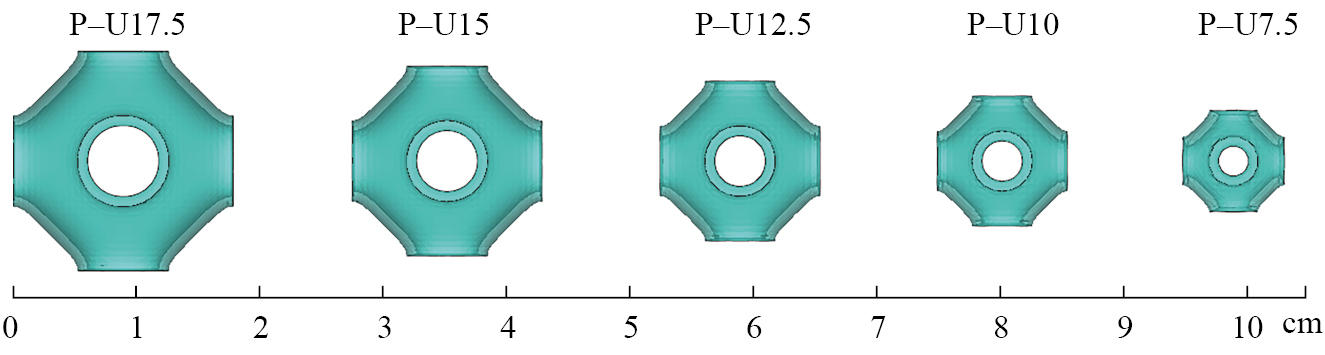
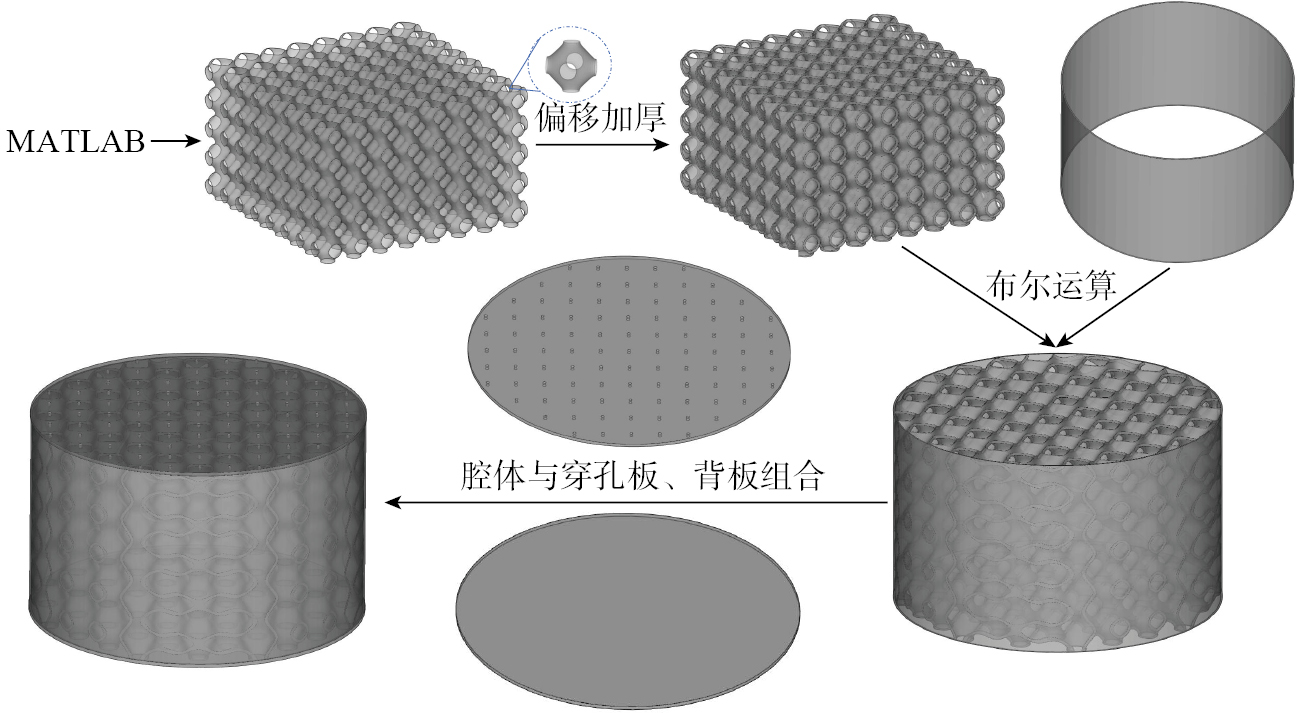
TPMS是由隐式三角函数生成的复杂光滑曲面三维周期性结构[ AL-KETAN O, ABU AL-RUB R K. Multifunctional mechanical metamaterials based on triply periodic minimal surface lattices[J]. Advanced Engineering Materials, 2019, 21(10): 1900524. 45],可通过修改隐函数的参数调控单元体尺寸、孔隙率和结构几何形状等几何特征来精确控制结构的声学性能。其中,Primitive结构与微穿孔板(MPP)组成的夹芯结构通过单连通孔腔强化共振、立方对称全向吸声及易调参数,兼具制造稳定性和宽频适配性。故而本研究选定Primitive类型TPMS结构作为基础,设计了一款MPP–Primitive夹芯结构,探究其结构参数对低频吸声的影响。本文设计使用的Primitive三周期极小曲面隐式函数为
基于Johnson–Champoux–Allard等效流体模型[ CHAMPOUX Y, ALLARD J F. Dynamic tortuosity and bulk modulus in air-saturated porous media[J]. Journal of Applied Physics, 1991, 70(4): 1975–1979. LAFARGE D, LEMARINIER P, ALLARD J F, et al. Dynamic compressibility of air in porous structures at audible frequencies[J]. The Journal of the Acoustical Society of America, 1997, 102(4): 1995–2006. JOHNSON D L, KOPLIK J, DASHEN R. Theory of dynamic permeability and tortuosity in fluid-saturated porous media[J]. Journal of Fluid Mechanics, 1987, 176: 379–402. 47-49],将Primitive结构等效为多孔介质骨架,忽略固体骨架的振动,将Primitive结构孔隙内的空气视为一种具有等效动态密度ρ(ω)和等效体积模量K(ω)的“等效流体”。ρ(ω)、K(ω)可分别由式(7)和(8)计算。
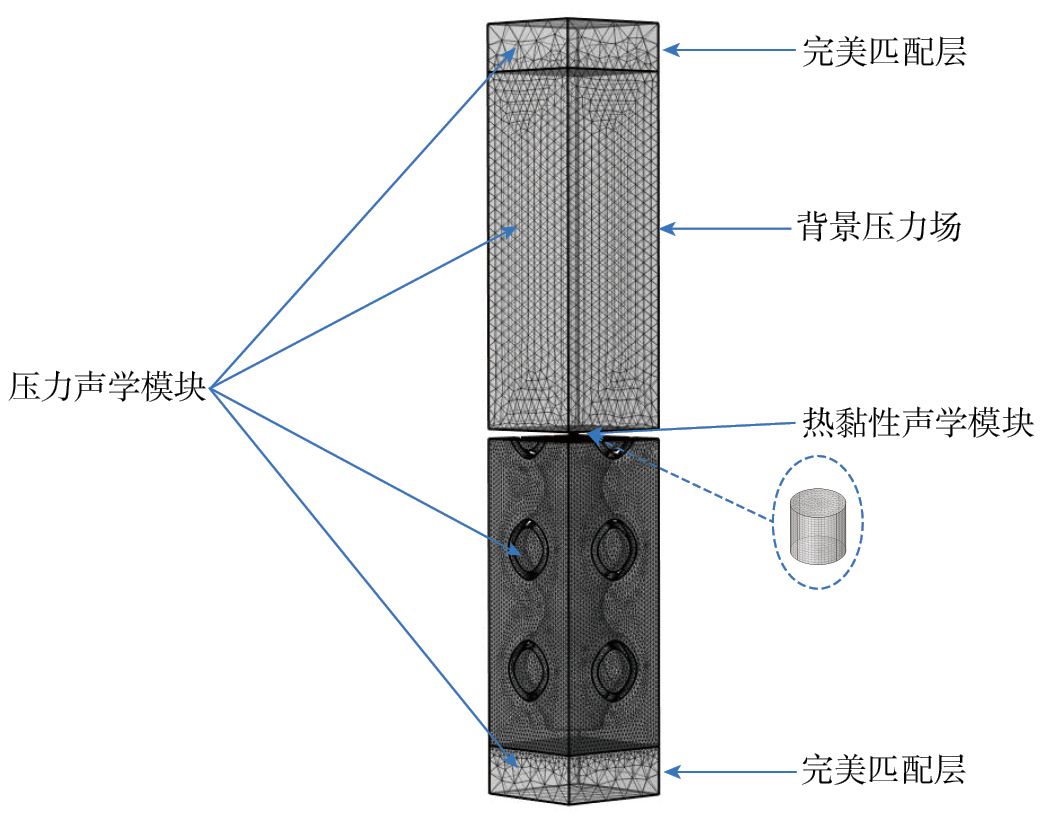
Fig.5 Grid diagram of the MPP–Primitive sandwich structure of a single unit
2 结果与讨论
2.1 MPP、Primitive不同单元体尺寸对吸声特性的影响
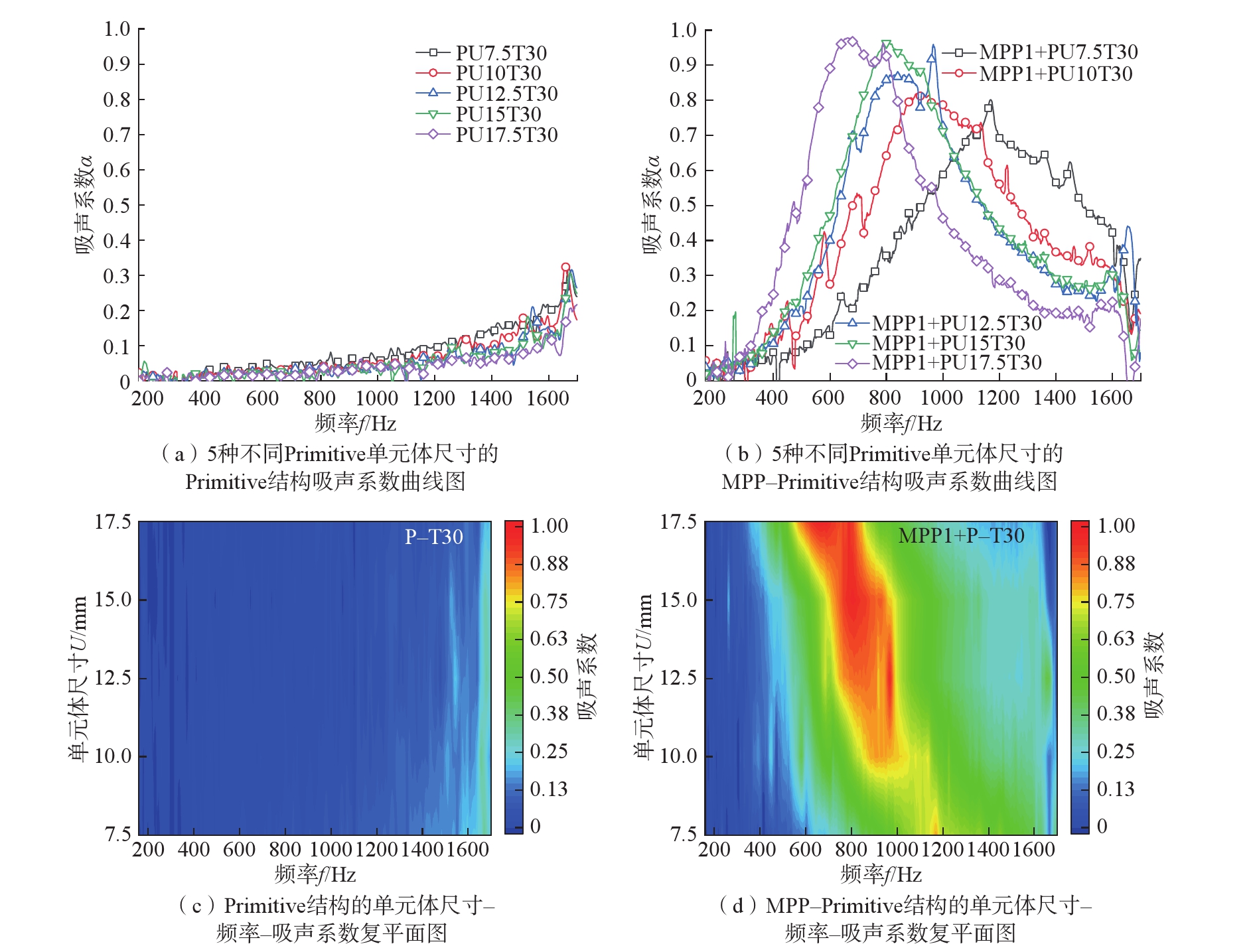
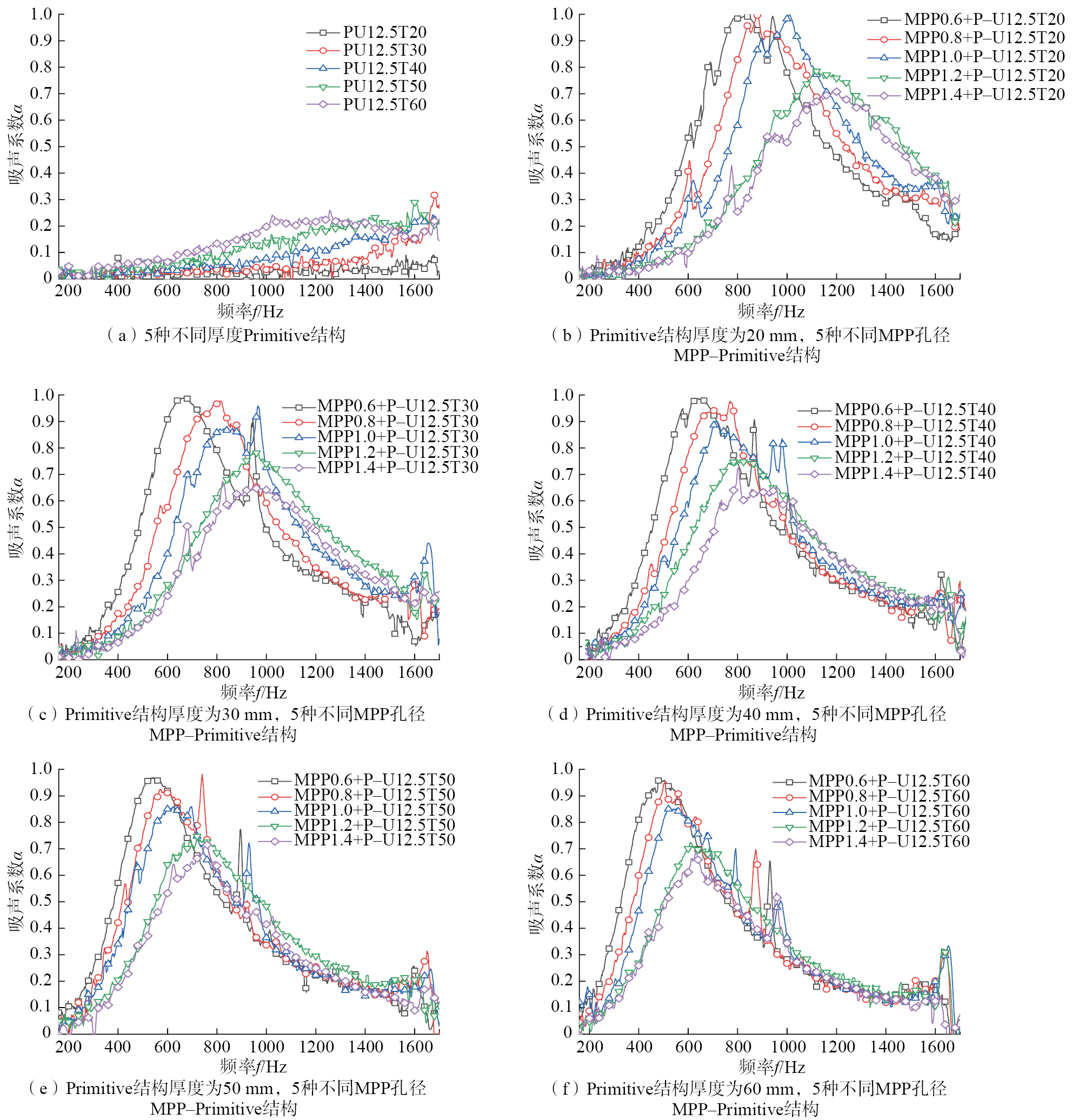
MPP、Primitive单元体尺寸对夹芯结构的吸声特性影响如图6所示。结果表明,Primitive单元体尺寸的增大导致了其吸声系数曲线的波峰峰值、波峰幅值以及有效吸收频宽发生明显改变。图6(a)和(c)展示了当结构没有微穿孔板时,不同单元体尺寸Primitive结构的吸声曲线出现很多细微波动,在中频范围上出现了低幅值吸收尖峰,但其吸声峰值均不超过0.35。说明了在未引入MPP之前,因Primitive结构具有高孔隙率、低流阻等物理特性,声波虽仍在Primitive结构中产生局部共振与粘滞耗散效应,但声阻不足导致多个弱阻尼共振模态叠加,导致能量耗散不足。在添加MPP之后,通过微孔粘滞摩擦产生高声阻,同时MPP的声质量与Prmitive空腔声顺耦合形成亥姆霍兹共振系统,并将原本分散的、效率较低的吸声机制协同整合和增强。此外,高声阻抗R会显著降低系统品质因子Q,从而将吸声频带拓宽,品质因子Q[ KINSLER L E, et al. Fundamentals of acoustics[M]. New York: Wiley, 2000. 50]可表示为式(15)。
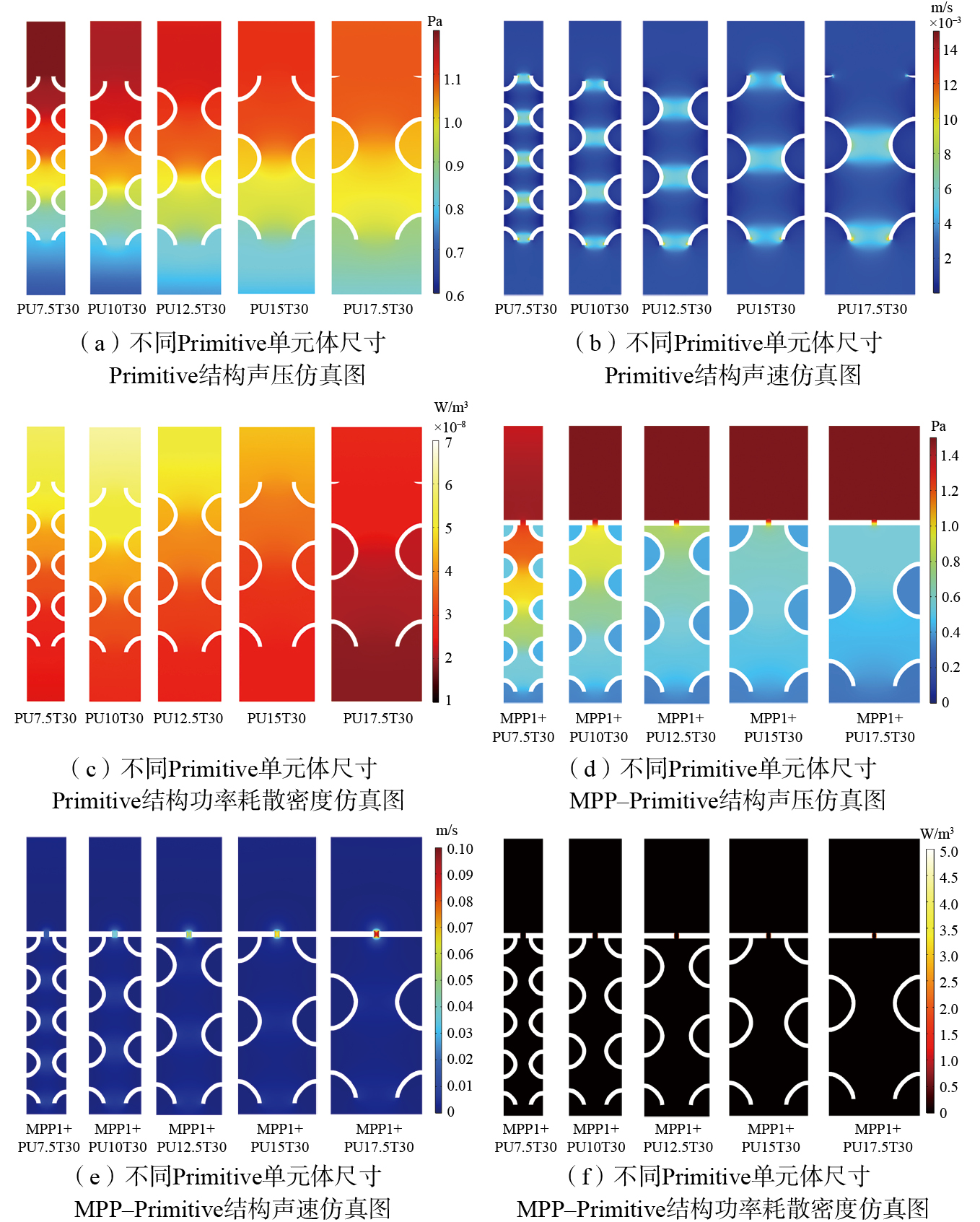
Fig.8 Simulation diagrams of sound pressure, sound velocity and power dissipation density of Primitive structures and MPP–Primitive structures with different Primitive unit sizes under the condition of a Primitive structure thickness of 30 mm
Fig.9 Influence of MPP aperture and Primitive cavity thickness on the sound absorption coefficient
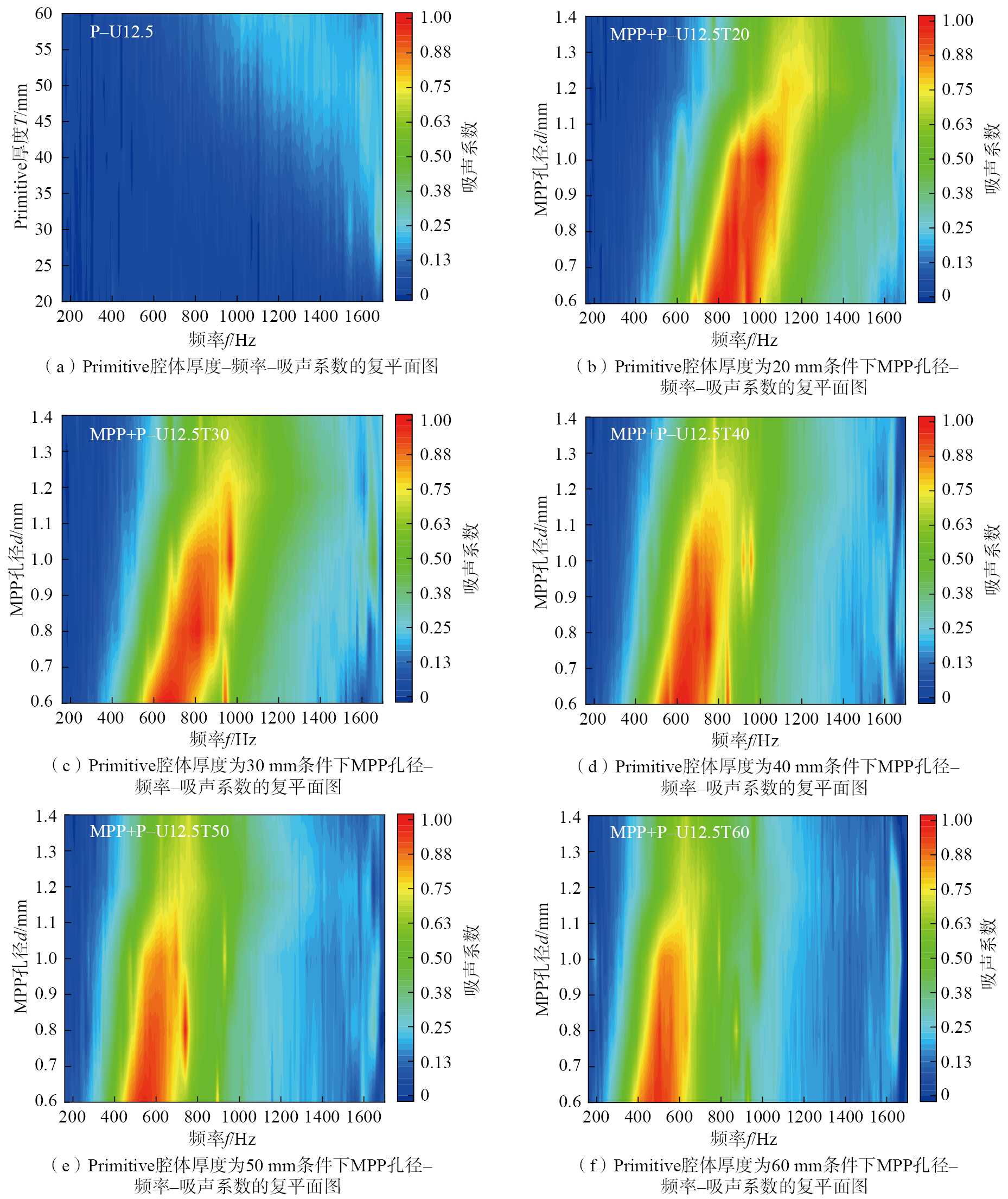
图10 不同腔体厚度条件下穿孔板孔径对MPP+Primitive吸声性能影响的复平面图
Fig.10 Complex plane diagram of the effect of perforated plate aperture on MPP+Primitive sound absorption performance under different cavity thickness conditions
表6 不同腔体厚度条件下穿孔板孔径对MPP+Primitive吸声特性影响的数据表
Table 6 Data table of the effect of perforated plate aperture on MPP+Primitive sound absorption characteristics under different cavity thickness conditions
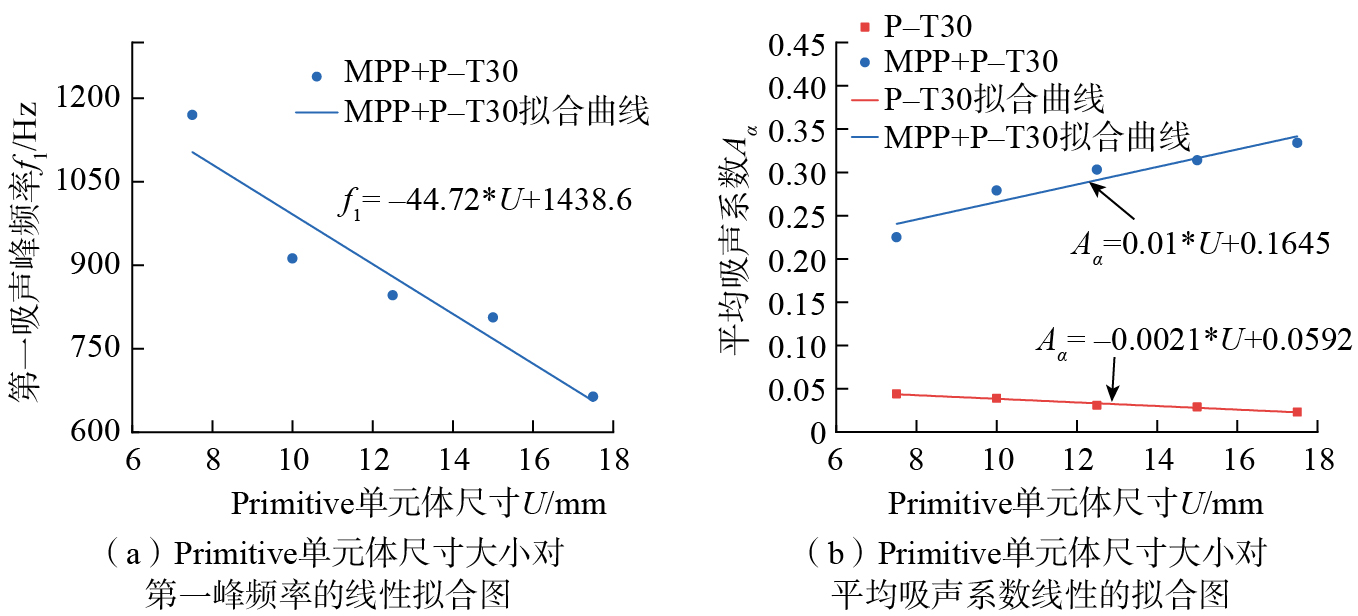
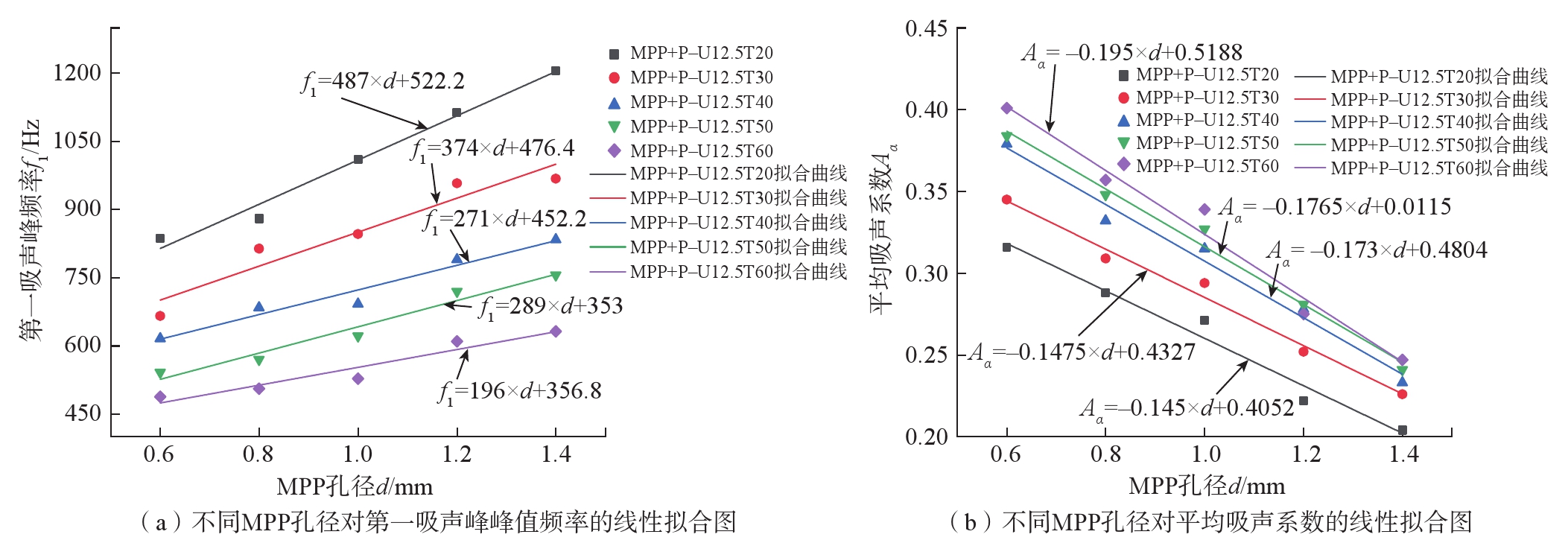
Fig.11 Influence of MPP aperture on the peak-to-peak frequency and average sound absorption coefficient of the first sound absorption peak of the MPP–Primitive sandwich structure
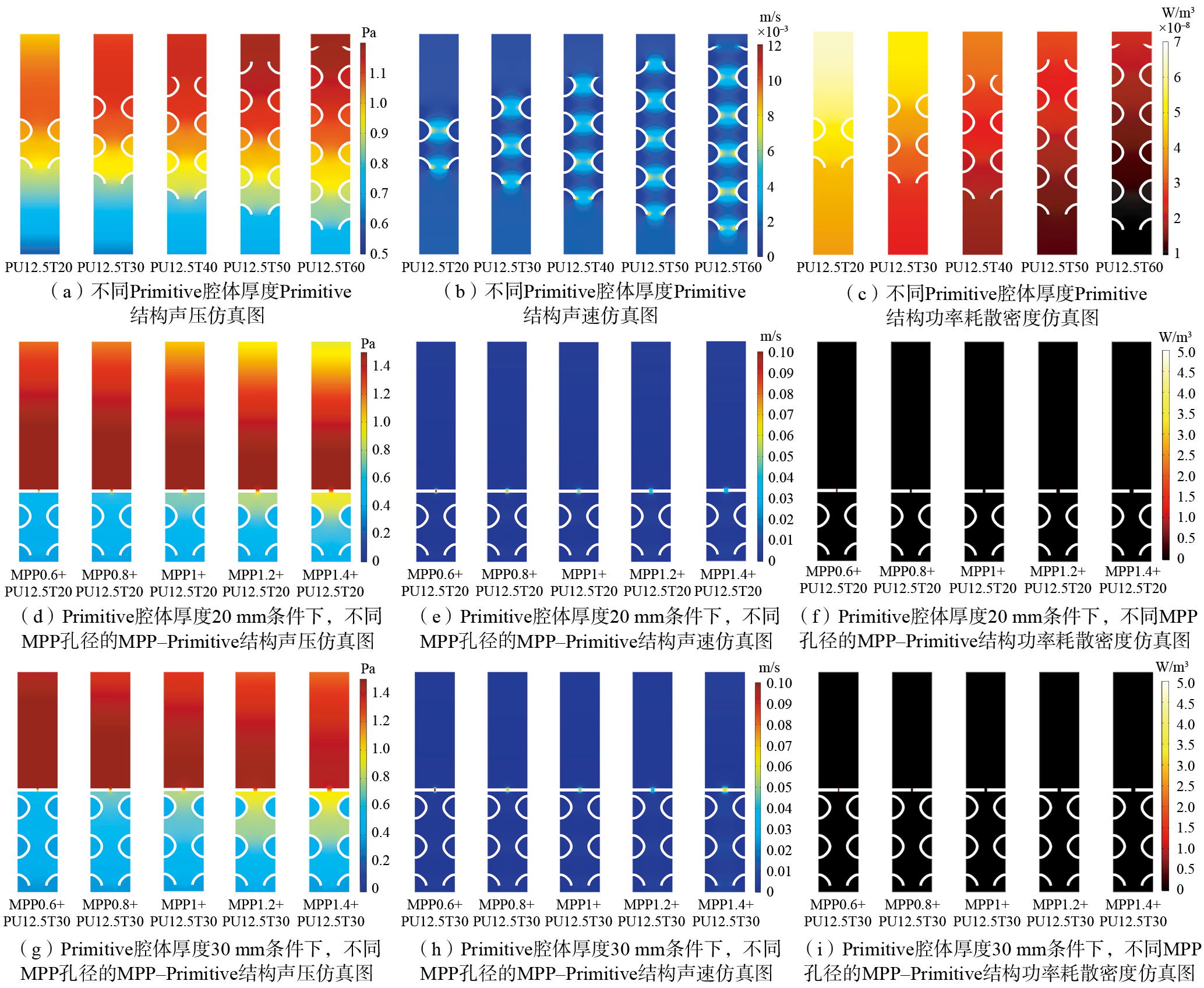
从图12(a)~(c)得知,PU12.5模型的声压变化随着腔体厚度的增加而更加明显,同时增加粒子共振速度和声波能量的耗散路径。而从图12(d)~(f)可知,孔径越小,可更有效地阻隔声波传播,使粒子的振动速度和能量耗散得到了显著提升。此外,孔径减小,微穿孔板的穿孔率会随之降低。当穿孔率降低时,声质量增加,但孔径减小会显著提升声阻抗,使声波更易通过摩擦耗能转化为热能,两者协同作用可增强对低频声波的阻抗匹配能力。从图12(d)~(f)可知,Primitive结构厚度的增加使结构的声压、声速以及能量耗散在一定程度上得到了增强。这说明增加背腔Primitive结构厚度,可延长声波传播路径,增强粘热效应,提升更低频段声波的吸收效果[ ZHANG P F, LI Z H, LIU B, et al. Sound absorption performance of micro-perforated plate sandwich structure based on triply periodic minimal surface[J]. Journal of Materials Research and Technology, 2023, 27: 386–400. 51]。
Fig.12 Simulation results of sound absorption characteristics of Primitive structure and MPP+Primitive structure under different Primitive cavity thickness conditions
BERGLUNDB, HASSMÉNP, JOBR F. Sources and effects of low-frequency noise[J]. The Journal of the Acoustical Society of America, 1996, 99(5): 2985–3002.
[2]
YANGM, SHENGP. Sound absorption structures: From porous media to acoustic metamaterials[J]. Annual Review of Materials Research, 2017, 47: 83–114.
[3]
张卫红, 周涵, 李韶英, 等. 航天高性能薄壁构件的材料–结构一体化设计综述[J]. 航空学报, 2023, 44(9): 627428. ZHANGWeihong, ZHOUHan, LIShaoying, et al. Material-structure integrated design for high-performance aerospace thin-walled component[J]. Acta Aeronautica et Astronautica Sinica, 2023, 44(9): 627428.
[4]
CHANGI L, LIANGZ X, KAOH W, et al. The wave attenuation mechanism of the periodic local resonant metamaterial[J]. Journal of Sound and Vibration, 2018, 412: 349–359.
[5]
ZHANGY Y, GAON S, WUJ H. New mechanism of tunable broadband in local resonance structures[J]. Applied Acoustics, 2020, 169: 107482.
[6]
MOLERÓNM, SERRA-GARCIAM, DARAIOC. Visco-thermal effects in acoustic metamaterials: From total transmission to total reflection and high absorption[J]. New Journal of Physics, 2016, 18(3): 033003.
[7]
KONET C, LOPEZM, GHINETS, et al. Thermoviscous-acoustic metamaterials to damp acoustic modes in complex shape geometries at low frequencies[J]. The Journal of the Acoustical Society of America, 2021, 150(3): 2272.
[8]
JIAX, LIY, ZHOUY H, et al. Wide bandwidth acoustic transmission via coiled-up metamaterial with impedance matching layers[J]. Science China Physics, Mechanics & Astronomy, 2019, 62(6): 964311.
[9]
QUS C, GAON, TINELA, et al. Underwater metamaterial absorber with impedance-matched composite[J]. Science Advances, 2022, 8(20): eabm4206.
[10]
曹尔泰, 延浩, 黄河源. 飞行器舱室内壁蛛网仿生薄膜声学超材料设计[J]. 航空科学技术, 2024, 35(3): 11–19. CAOErtai, YANHao, HUANGHeyuan. Design of spider web bio-inspired membrane acoustic metamaterials for aircraft cabin walls[J]. Aeronautical Science & Technology, 2024, 35(3): 11–19.
[11]
顾金桃, 王晓乐, 汤又衡, 等. 提高飞机壁板低频宽带隔声的层合声学超材料[J]. 航空学报, 2022, 43(1): 224785. GUJintao, WANGXiaole, TANGYouheng, et al. Laminated acoustic metamaterial for improving low-frequency broadband sound insulation of aircraft wall panels[J]. Acta Aeronautica et Astronautica Sinica, 2022, 43(1): 224785.
[12]
顾鑫, 周国成, 徐文强, 等. 带延长颈亥姆霍兹共振器的宽带声衬设计与验证[J]. 噪声与振动控制, 2024, 44(3): 276–281. GUXin, ZHOUGuocheng, XUWenqiang, et al. Broadband acoustic liner design and verification of Helmholtz resonators with extended necks[J]. Noise and Vibration Control, 2024, 44(3): 276–281.
[13]
甘振鹏, 杨东. 带冷却气流的亥姆霍兹共振器的声类比模型[J]. 力学学报, 2022, 54(3): 577–587. GANZhenpeng, YANGDong. An acoustic analogy model for Helmholtz resonators with cooling bias flow[J]. Chinese Journal of Theoretical and Applied Mechanics, 2022, 54(3): 577–587.
[14]
李程磊, 陆洋, 李森琛, 等. 基于微穿孔板的模型直升机舱内降噪研究[J]. 振动、测试与诊断, 2024, 44(5): 871–878. LIChenglei, LUYang, LISenchen, et al. Study on noise reduction in model helicopter cabin based on microperforated plate[J]. Journal of Vibration,Measurement & Diagnosis, 2024, 44(5): 871–878.
[15]
张翔, 吴锦武, 周伟青, 等. 圆环形非常规排布微穿孔板吸声机理的研究[J]. 振动与冲击, 2021, 40(6): 272–277, 288. ZHANGXiang, WUJinwu, ZHOUWeiqing, et al. Sound absorption mechanism of micro perforated panels with unconventional annular arrangement of micropores[J]. Journal of Vibration and Shock, 2021, 40(6): 272–277, 288.
[16]
WANGX L, SUNP, GUX, et al. Industrial-scale manufactured acoustic metamaterials for multi-bandgap sound reduction[J]. International Journal of Mechanical Sciences, 2025, 293: 110184.
[17]
梁庆宣, 闫欣, 吕佩瑶, 等. 轻质宽带吸声超材料设计及3D打印[J]. 航空制造技术, 2024, 67(19): 26–32. LIANGQingxuan, YANXin, LÜPeiyao, et al. Design and 3D printing of lightweight broadband sound absorption metamaterials[J]. Aeronautical Manufacturing Technology, 2024, 67(19): 26–32.
孟令晗, 朱海潮, 侯九霄. 折叠背腔微穿孔结构的宽频吸声特性研究[J]. 噪声与振动控制, 2022, 42(2): 90–94. MENGLinghan, ZHUHaichao, HOUJiuxiao. Broadband sound absorption characteristics of the micro-perforated structure with a folded back cavity[J]. Noise and Vibration Control, 2022, 42(2): 90–94.
[20]
卢伟健, 张斌, 李孝宽. 变截面微穿孔板吸声特性研究[J]. 噪声与振动控制, 2009, 29(2): 147–150. LUWeijian, ZHANGBin, LIXiaokuan. Study on acoustic characteristic of micro-perforated panel with variable cross-section[J]. Noise and Vibration Control, 2009, 29(2): 147–150.
[21]
MITRAA K, ARADHYEA A, JOGLEKARD M. Low frequency ultrasonic guided wave propagation through honeycomb sandwich structures with non-uniform core thickness[J]. Mechanical Systems and Signal Processing, 2023, 191: 110155.
[22]
ZHANGL, ZHANGW T, XINF X. Broadband low-frequency sound absorption of honeycomb sandwich panels with rough embedded necks[J]. Mechanical Systems and Signal Processing, 2023, 196: 110311.
[23]
DONGC H, LIUZ, PIERCER, et al. Sound absorption performance of a micro perforated sandwich panel with honeycomb-hierarchical pore structure core[J]. Applied Acoustics, 2023, 203: 109200.
[24]
MALLESHS, HWANGJ, CHOIH, et al. Advanced acoustic design: 3D printed thermoplastic folded core sandwich structures with porous materials and microperforations for enhanced sound absorption[J]. Composite Structures, 2024, 345: 118371.
[25]
WUL W, ZHANGX F, BANJ Y, et al. Design and optimization of multi-scale porous sandwich composites with excellent sound absorption and cushioning properties[J]. Journal of Sandwich Structures & Materials, 2021, 23(8): 4276–4293.
[26]
LIT T, ZHANGX, WANGH Y, et al. Sound absorption and compressive property of PU foam-filled composite sandwiches: Effects of needle-punched fabric structure, porous structure, and fabric-foam interface[J]. Polymers for Advanced Technologies, 2020, 31(3): 451–460.
[27]
MENGH, GALLANDM A, ICHCHOUM, et al. Small perforations in corrugated sandwich panel significantly enhance low frequency sound absorption and transmission loss[J]. Composite Structures, 2017, 182: 1–11.
[28]
LIUQ, YANGJ S, TANGY Y, et al. A carbon fiber composite corrugated resonator metamaterial with excellent sound absorption and mechanical strength[J]. Composite Structures, 2025, 363: 119115.
[29]
LIUQ, YANGJ S, TANGY Y, et al. A multi-layered corrugated resonator acoustic metamaterial with excellent low-frequency broadband sound absorption performance[J]. Applied Acoustics, 2024, 216: 109800.
[30]
GUOJ J, XIAOY, RENH, et al. Broadband low-frequency sound insulation of double-panel metastructures with a perforated lattice truss-core sandwich plate[J]. Mechanical Systems and Signal Processing, 2023, 200: 110634.
[31]
GUOJ J, LIY Q, XIAOY, et al. Multiscale modeling and design of lattice truss core sandwich metastructures for broadband low-frequency vibration reduction[J]. Composite Structures, 2022, 289: 115463.
[32]
LIH, HUY B, HUANGH Y, et al. Broadband low-frequency vibration attenuation in 3D printed composite meta-lattice sandwich structures[J]. Composites Part B: Engineering, 2021, 215: 108772.
[33]
FENGJ W, FUJ Z, YAOX H, et al. Triply periodic minimal surface (TPMS) porous structures: From multi-scale design, precise additive manufacturing to multidisciplinary applications[J]. International Journal of Extreme Manufacturing, 2022, 4(2): 022001.
[34]
ZHANGM K, YANGY Q, XUM Z, et al. Mechanical properties of multi-materials porous structures based on triply periodic minimal surface fabricated by additive manufacturing[J]. Rapid Prototyping Journal, 2021, 27(9): 1681–1692.
[35]
LIUC, ZHANGM K, BIG J, et al. Research on comprehensive heat dissipation characteristics of AlSi7Mg TPMS heat sinks manufactured by laser powder bed fusion[J]. Applied Thermal Engineering, 2025, 261: 124941.
[36]
周煜俊, 张鹏飞, 霍文娟, 等. 基于3D打印的三周期极小曲面结构吸声性能研究[J]. 机械设计与制造工程, 2025, 54(3): 10–14. ZHOUYujun, ZHANGPengfei, HUOWenjuan, et al. Research on sound absorption performance of triply periodic minimal surface structure based on 3D printing[J]. Machine Design and Manufacturing Engineering, 2025, 54(3): 10–14.
[37]
孙亚迪, 王岩, 董本超, 等. 三周期极小曲面骨支架生物学性能研究进展[J]. 中华骨与关节外科杂志, 2024(4): 371–376. SUNYadi, WANGYan, DONGBenchao, et al. Research progress on biological performance of triply periodic minimal surface bone scaffolds[J]. Chinese Journal of Bone and Joint Surgery, 2024(4): 371–376.
[38]
PENGC X, FOXK, QIANM, et al. 3D printed sandwich beams with bioinspired cores: Mechanical performance and modelling[J]. Thin-Walled Structures, 2021, 161: 107471.
[39]
ALSHAERA W, HARLANDD J. An investigation of the strength and stiffness of weight-saving sandwich beams with CFRP face sheets and seven 3D printed cores[J]. Composite Structures, 2021, 257: 113391.
[40]
LIZ H, ZHOUY J, KONGX N, et al. Sound absorption performance of a micro-perforated plate sandwich structure based on selective laser melting[J]. Virtual and Physical Prototyping, 2024, 19(1): e2321607.
[41]
KONGX N, LIUB, LIZ H, et al. Research on sound absorption properties of tri-periodic minimal surface sandwich structure of selective laser melting titanium alloy[J]. Materials Transactions, 2023, 64(4): 861–868.
[42]
YANGW J, ANJ, CHUAC K, et al. Acoustic absorptions of multifunctional polymeric cellular structures based on triply periodic minimal surfaces fabricated by stereolithography[J]. Virtual and Physical Prototyping, 2020, 15(2): 242–249.
[43]
ZHANGM K, LIUC, DENGM J, et al. Graded minimal surface structures with high specific strength for broadband sound absorption produced by laser powder bed fusion[J]. Coatings, 2023, 13(11): 1950.
[44]
ZHANGP F, LIZ H, ZHOUY J, et al. Improved sound absorption with 3D-printed micro-perforated sandwich structures[J]. Journal of Materials Research and Technology, 2025, 34: 855–865.
[45]
AL-KETANO, ABU AL-RUBR K. Multifunctional mechanical metamaterials based on triply periodic minimal surface lattices[J]. Advanced Engineering Materials, 2019, 21(10): 1900524.
CHAMPOUXY, ALLARDJ F. Dynamic tortuosity and bulk modulus in air-saturated porous media[J]. Journal of Applied Physics, 1991, 70(4): 1975–1979.
[48]
LAFARGED, LEMARINIERP, ALLARDJ F, et al. Dynamic compressibility of air in porous structures at audible frequencies[J]. The Journal of the Acoustical Society of America, 1997, 102(4): 1995–2006.
[49]
JOHNSOND L, KOPLIKJ, DASHENR. Theory of dynamic permeability and tortuosity in fluid-saturated porous media[J]. Journal of Fluid Mechanics, 1987, 176: 379–402.
[50]
KINSLERL E, et al. Fundamentals of acoustics[M]. New York: Wiley, 2000.
[51]
ZHANGP F, LIZ H, LIUB, et al. Sound absorption performance of micro-perforated plate sandwich structure based on triply periodic minimal surface[J]. Journal of Materials Research and Technology, 2023, 27: 386–400.