飞机复合材料壁板装配应力控制技术研究现状与展望

基金项目

国防基础科研计划JCKY2023205B006

中图分类号:

V262.3

文献标识码:

A

通信作者

毕运波,教授,博士生导师,研究方向为自动化装配与高性能连接。

编辑

责编 :逸飞

流转信息

收稿日期 : 2025-03-26

退修日期 : 2025-04-23

录用日期 : 2025-05-21

引用格式

引文格式:张永亮, 姜杰凤, 张辉, 等. 飞机复合材料壁板装配应力控制技术研究现状与展望[J]. 航空制造技术, 2026, 69(1/2): 25010039.

Research Status and Prospect of Stress Control Technology for Aircraft Composite Panel Assembly

Citations

ZHANG Yongliang, JIANG Jiefeng, ZHANG Hui, et al. Research status and prospect of stress control technology for aircraft composite panel assembly[J]. Aeronautical Manufacturing Technology, 2026, 69(1/2): 25010039.

航空制造技术    第69卷    第1/2期    36-53
Aeronautical Manufacturing Techinology    Vol.69    No.1/2 : 36-53
DOI: 10.16080/j.issn1671-833x.25010039
封面文章(COVER STORY)

飞机复合材料壁板装配应力控制技术研究现状与展望

  • 张永亮 1,2
  • 姜杰凤 3
  • 张辉 2
  • 毕运波 1
1.浙江大学杭州 310058
2.航空工业沈阳飞机工业(集团)有限公司沈阳 110034
3.杭州师范大学杭州 310036

通信作者

毕运波,教授,博士生导师,研究方向为自动化装配与高性能连接。

基金项目

国防基础科研计划JCKY2023205B006

中图分类号:

V262.3

文献标识码:

A

流转信息

收稿日期 : 2025-03-26     退修日期 : 2025-04-23     录用日期 : 2025-05-21     

引用格式

引文格式:张永亮, 姜杰凤, 张辉, 等. 飞机复合材料壁板装配应力控制技术研究现状与展望[J]. 航空制造技术, 2026, 69(1/2): 25010039.

摘要

碳纤维增强树脂基复合材料(Carbon fiber reinforced polymer,CFRP)凭借优异的比强度–刚度特性、耐环境腐蚀性及结构可设计性,已成为新一代航空飞行器主承力构件轻量化设计的核心材料体系。然而,受材料本征各向异性力学行为与层间界面弱结合特性制约,CFRP构件在装配过程中易因制造公差累积效应与装配协调性要求,诱发变形与应力集中,严重时会导致纤维/基体界面脱黏、层间剪切失效及基体微裂纹扩展等不可逆损伤。本文面向飞机复合材料壁板装配应力协调控制需求,综合考虑装夹定位、间隙补偿、机械连接等关键工艺环节,从定位布局优化与在线调控、间隙测量与填隙补偿、连接工艺控制等方面,综述了国内外相关技术研究和应用现状,指出了复合材料壁板装配应力控制技术未来发展方向,为复合材料柔性部件少/无应力装配提供参考。

关键词

装配应力;布局优化;在线调控;间隙补偿;螺栓连接;

Research Status and Prospect of Stress Control Technology for Aircraft Composite Panel Assembly

  • ZHANG Yongliang 1,2
  • JIANG Jiefeng 3
  • ZHANG Hui 2
  • BI Yunbo 1
1.Zhejiang University, Hangzhou 310058, China
2.AVIC Shenyang Aircraft Industry (Group) Co., Ltd., Shenyang 110034, China
3.Hangzhou Normal University, Hangzhou 310036, China

Citations

ZHANG Yongliang, JIANG Jiefeng, ZHANG Hui, et al. Research status and prospect of stress control technology for aircraft composite panel assembly[J]. Aeronautical Manufacturing Technology, 2026, 69(1/2): 25010039.

Abstract

Carbon Fiber Reinforced Polymer (CFRP) has become a core material for the lightweight design of primary load-bearing components in next-generation aircraft, owing to its high specific strength and stiffness, corrosion resistance, and structural tailorability. However, due to the intrinsic anisotropic mechanical behavior and weak interlaminar strrength, CFRP components are prone to non-uniform deformation and stress distribution during assembly, resulting from accumulated manufacturing tolerances and assembly coordination requirements. In severe cases, this can lead to irreversible damage modes such as fiber/matrix interface debonding, interlaminar shear failure, and matrix microcrack propagation. Focusing on the need for stress control during the assembly of aircraft composite panels, this study comprehensively considers key process steps including clamping and positioning, gap compensation, and mechanical joining. It reviews the current state of research and application of related technologies domestically and internationally—from the optimization and online adjustment of positioning layouts, gap measurement and compensation, to process control in mechanical joining. Future development directions for stress control technology in composite panel assembly are proposed, providing a reference for low- or no-stress assembly of flexible composite components.

Keywords

Assembly stress; Fixture layout optimization; Online adjustment and control; Shimming; Bolted connection;


新一代飞机在轻量化、高性能、长寿命及低成本等方面提出了更高的要求。复合材料因具有高强度、低密度、耐腐蚀优势和优异的设计灵活性,已成为飞机设计制造中的关键材料。在军用飞机领域,F–22和F–35战机的复合材料使用比例分别达到26%和36%;而在民用飞机领域,波音787和空客A350客机的复合材料占比更是高达50%以上[  李东升, 翟雨农, 李小强. 飞机复合材料结构少无应力装配方法研究与应用进展[J]. 航空制造技术, 2017, 60(9): 30–34.LI Dongsheng, ZHAI Yunong, LI Xiaoqiang. Research and application advances of stress-less assembly methods for composite airframe[J]. Aeronautical Manufacturing Technology, 2017, 60(9): 30–34.
 张永亮, 姜杰凤, 毕运波. 飞机确定性装配技术及应用[J]. 航空制造技术, 2022, 65(18): 38–45, 62.ZHANG Yongliang, JIANG Jiefeng, BI Yunbo. Aircraft determinate assembly technology and its application[J]. Aeronautical Manufacturing Technology, 2022, 65(18): 38–45, 62.
1-2
]
。值得注意的是,我国自主研发的C929宽体客机也计划将复合材料使用比例提升至50%以上[  刘镇阳, 翟雨农, 李东升, 等. 飞机复合材料壁板装配变形控制技术研究与应用进展[J]. 航空制造技术, 2022, 65(18): 46–54, 78.LIU Zhenyang, ZHAI Yunong, LI Dongsheng, et al. Research and application progress of deformation control technology for aircraft composite panel assembly[J]. Aeronautical Manufacturing Technology, 2022, 65(18): 46–54, 78.
 陈文亮, 李奕星, 冯素玲. 飞机复合材料机身壁板装配技术分析与展望[J]. 航空制造技术, 2024, 67(16): 59–73.CHEN Wenliang, LI Yixing, FENG Suling. Analysis and prospect of assembly technology of aircraft composite fuselage panel[J]. Aeronautical Manufacturing Technology, 2024, 67(16): 59–73.
3-4
]
。复合材料在飞机结构中的应用范围已经从早期的方向舵、整流罩等次承力部件,逐步扩展到整体式机身壁板和机翼壁板等主承力部件[  马志阳, 高丽敏, 徐吉峰. 复合材料在大飞机主承力结构上的应用与发展趋势[J]. 航空制造技术, 2021, 64(11): 24–30.MA Zhiyang, GAO Limin, XU Jifeng. Application and development for composite primary structure in large aircraft[J]. Aeronautical Manufacturing Technology, 2021, 64(11): 24–30.
5
]
,这标志着复合材料应用技术的显著进步。

与金属壁板的制造工艺不同,复合材料壁板通常采用预浸料铺放和热压罐固化工艺成型。固化过程中,由于复合材料的各向异性、基体收缩不均,以及构件与模具热膨胀系数不同等因素,复合材料内部易产生残余应力,进而引发翘曲、回弹等变形,导致制造偏差[  程文礼, 邱启艳, 陈静. 热压罐成型复合材料固化变形机理及控制研究[J]. 材料导报, 2012(2): 410–414.CHENG Wenli, QIU Qiyan, CHEN Jing. Study on the cure-induced deformation mechanism and control of composite structures in autoclave process[J]. Materials Reports, 2012(2): 410–414.
6
]
。为了确保整体装配结构的外形精度,通常需要对复合材料柔性构件进行外力校形等处理[  宋孟燕, 傅向荣, 田歌, 等. 复合材料整体化构件的装配破坏仿真研究[J]. 纤维复合材料, 2013, 30(3): 21–26.SONG Mengyan, FU Xiangrong, TIAN Ge, et al. The study on assembly damage simulation of composite integrative component[J]. Fiber Composites, 2013, 30(3): 21–26.
7
]
,但这会引入装配应力。由于复合材料脆性大、耐冲击性差,在外力作用下容易发生分层损伤,因此复合材料构件在装配过程中,不仅要保证外形精度,还需要严格控制装配应力水平。Dong等[  DONG C S, KANG L. Deformation and stress of a composite–metal assembly[J]. The International Journal of Advanced Manufacturing Technology, 2012, 61(9): 1035–1042.
8
]
研究了复合材料长桁和铝合金蒙皮的装配问题,建立了零件偏差与装配残余应力之间的定量关系,并采用蒙特卡洛方法对最大残余应力进行了统计分析。Söderberg等[  SÖDERBERG R, WÄRMEFJORD K, LINDKVIST L. Variation simulation of stress during assembly of composite parts[J]. CIRP Annals, 2015, 64(1): 17–20.
9
]
针对飞机复合材料翼盒的装配,利用有限元方法分析了制造偏差与装配应力之间的线性关系,并通过Tsai–Hill失效准则评估了复合材料翼盒的损伤风险。由此可见,复合材料构件的精确制造[  单忠德, 宋文哲, 范聪泽, 等. 面向2035年复合材料构件精确制造发展战略研究[J]. 中国工程科学, 2023, 25(1): 113–120.SHAN Zhongde, SONG Wenzhe, FAN Congze, et al. Development strategy for precision manufacturing of composite components facing 2035[J]. Strategic Study of CAE, 2023, 25(1): 113–120.
10
]
是控制装配应力和降低损伤风险的关键和基础。

复合材料壁板构件通常尺寸较大,军用飞机壁板长度可达数m,民用飞机壁板则可达到十几m甚至更长。在定位过程中,壁板由于刚度较低,容易受装夹误差、自身重力及装调力(如调姿、压紧)的影响,从而产生装配变形和残余应力[  严伟苗. 大型飞机壁板装配变形控制与校正技术研究[D]. 杭州: 浙江大学, 2015.YAN Weimiao. Study on technologies for controlling and correcting large aircraft panel assembly deformation[D]. Hangzhou: Zhejiang University, 2015.
11
]
。此外,复合材料构件的制造偏差常导致装配过程中出现间隙,若采用强迫装配,会引起较大的装配应力,进而影响结构的力学性能[  张桂书. 飞机复合材料构件装配间隙补偿研究[D]. 南京: 南京航空航天大学, 2015.ZHANG Guishu. Research on assembly gap compensation for aircraft composite components[D]. Nanjing: Nanjing University of Aeronautics and Astronautics, 2015.
12
]
。为了弥补装配间隙,加垫补偿成为复合材料结构装配的主要手段,尽管这种方法能够缓解装配应力集中,但可能导致装配结构整体性能的下降[  岳烜德. 垫片填充非均匀间隙的复合材料装配结构力学特性研究[D]. 南京: 南京航空航天大学, 2018.YUE Xuande. Research on the mechanical behavior of composite assembly structure with non-uniform gap-filling[D]. Nanjing: Nanjing University of Aeronautics and Astronautics, 2018.
13
]
。在复合材料结构连接阶段,螺栓连接也会引入较大应力,若拧紧工艺参数控制不当,容易引发应力集中,从而削弱结构的力学性能[  WANG J, ZHU C R, YANG Y P, et al. Effect of riveting displacement on the mechanical behavior of CFRP bolted joints with elliptical-head non-lug self-locking rivet nut[J]. The International Journal of Advanced Manufacturing Technology, 2023, 125(5): 2161–2182.
 潘玉森. CFRP/铝叠层椭圆头无耳托板自锁螺母–螺栓连接力学性能研究[D]. 杭州: 浙江大学, 2023.PAN Yusen. Research on the mechanical performance of oval-head no-lug self-locking nut-bolt joints in CFRP/aluminum stacks[D]. Hangzhou: Zhejiang University, 2023.
14-15
]
。总体而言,在飞机复合材料构件的装配过程中,各种装配工艺都不可避免地产生装配应力,而过大的应力或应力集中将显著增加结构损伤的风险[  王世杰, 陈振, 徐鹏, 等. 复合材料加筋壁板装配应力对结构失效影响的试验与数值分析[J]. 复合材料科学与工程, 2021(4): 96–101.WANG Shijie, CHEN Zhen, XU Peng, et al. Experimental and numerical analysis of the effect of assembly stress on the composite stiffened panel failure[J]. Composites Science and Engineering, 2021(4): 96–101.
16
]
。为此,旨在降低应力集中、提高装配性能的装配应力均匀化[  刘检华, 孙清超, 程晖, 等. 产品装配技术的研究现状、技术内涵及发展趋势[J]. 机械工程学报, 2018, 54(11): 2–28.LIU Jianhua, SUN Qingchao, CHENG Hui, et al. The state-of-the-art, connotation and developing trends of the products assembly technology[J]. Journal of Mechanical Engineering, 2018, 54(11): 2–28.
 巩浩, 刘检华, 孙清超, 等. 精密机电产品均匀性装配的定义与关键技术[J]. 机械工程学报, 2021, 57(3): 174–184.GONG Hao, LIU Jianhua, SUN Qingchao, et al. Definition and key technologies of uniform assembly for precision electromechanical products[J]. Journal of Mechanical Engineering, 2021, 57(3): 174–184.
17-18
]
和应力均衡[  王伟. 理论创新推动技术变革助力新一代飞机高性能制造—“复合材料/金属叠层薄壁结构装配应力均衡理论及性能控制方法”取得重要进展[J]. 科技成果管理与研究, 2023, 18(3): 85–86.WANG Wei. Theoretical innovation promotes technological change and helps high-performance manufacturing of a new generation of aircraft—important progress has been made in “assembly stress balance theory and performance control method of composite/metal laminated thin-walled structure”[J]. Management and Research on Scientific & Technological Achievements, 2023, 18(3): 85–86.
19
]
理念应运而生,推动了应力均衡调控技术的相关研究。

典型的现代机翼翼盒(图1)由上壁板、下壁板、前梁、后梁、翼肋等零组件构成。其中,上、下壁板通常采用复合材料制造,而梁和翼肋等骨架构件多由铝合金等金属材料制成。复合材料壁板的装配包括定位、校形与压紧、间隙测量、填隙补偿、临时紧固、制孔和连接等关键工艺环节,如图2所示。上述多个工艺环节与装配应力控制关系密切,涉及以下3个主要问题。
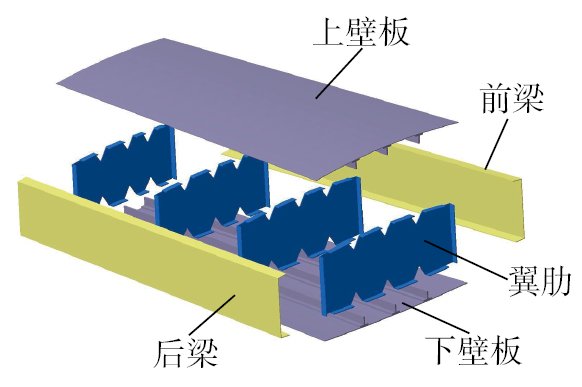
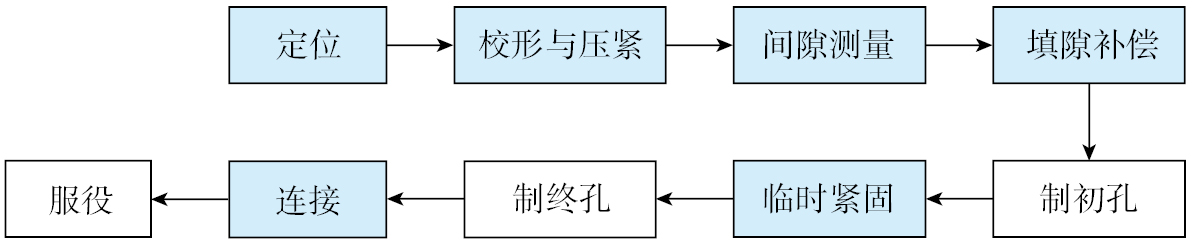
图1     机翼翼盒结构示意图
Fig.1     Diagram of wing-box structure
图2     复合材料机翼壁板装配工艺流程
Fig.2     Assembly process of composite wing panel

(1)由于复合材料壁板的薄壁件特性,定位支撑点数量与定位器布局方式对壁板变形和应力分布产生重要影响;同时,在利用定位器和压紧器等柔性工装进行在线调控校形时,控制和限制装配应力水平也同等重要。

(2)在大尺寸复合材料壁板制造偏差普遍存在、填隙补偿成为常规工艺的背景下,借助数字化测量方法获取构件外形数据并预测装配间隙,成为优化装配工艺的一个有效途径。而间隙测量精度与效率是衡量该方法实用与否的关键;在获取装配间隙基础上,填隙补偿工艺方案的设计合理性和实施情况,会对壁板装配应力及结构力学性能产生重要影响。

(3)与金属壁板装配相比,复合材料壁板螺栓连接中,预紧力、钉/孔配合量等重要工艺参数对结构装配应力的影响展现出新特点、新变化;叠加孔形、孔位误差和间隙偏差等影响给复合材料螺栓连接结构的装配应力均衡控制带来新挑战。

国内外学者在定位布局优化与在线调控、数字化测量与间隙预测、加垫补偿工艺评价、螺栓连接工艺控制等方面开展了大量研究工作。本文将对这些研究所涉及的工艺、方法、装备等进行系统综述和分析(图3),进而提出飞机复合材料壁板装配应力控制技术的发展方向。
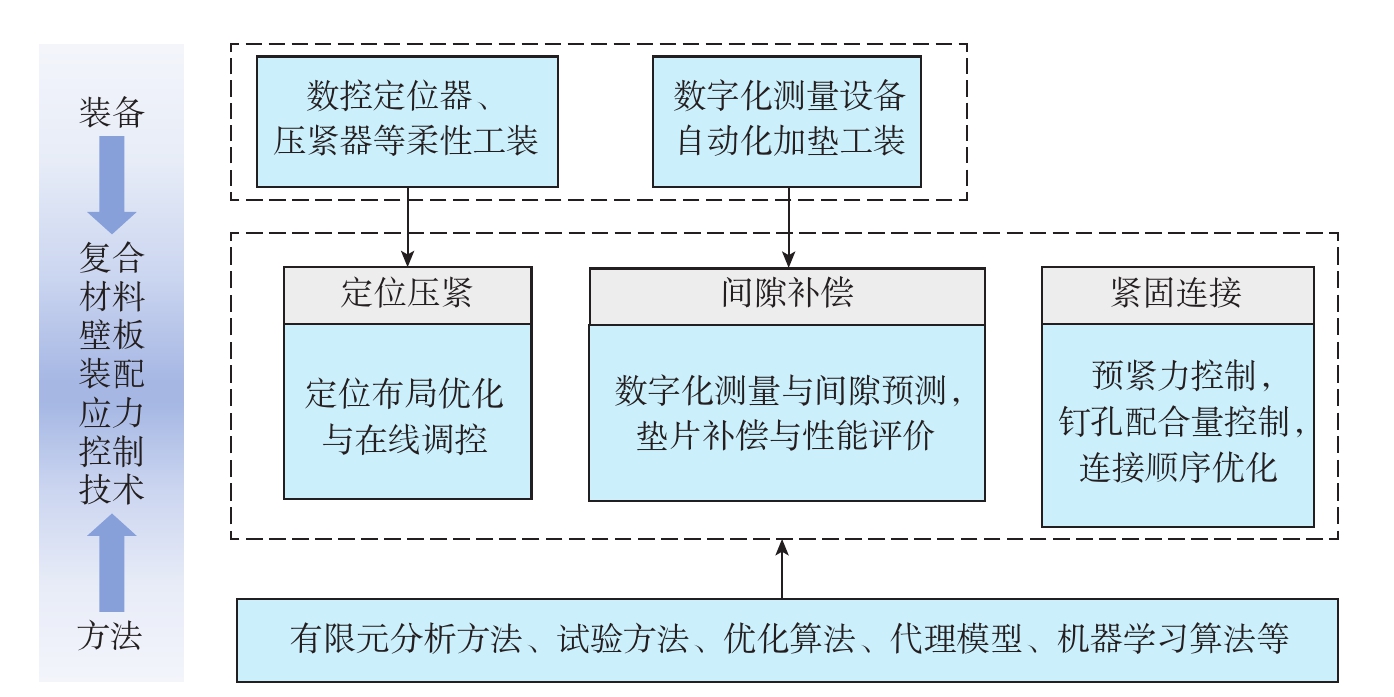
图3     复合材料壁板装配应力控制技术
Fig.3     Stress control technology for composite panel assembly

1     定位布局优化和在线调控

零组件(特别是薄壁类构件)在装夹定位时,由于其长厚比大,垂直于面内方向(法向)刚性差,在自重或受外力作用下易产生变形和应力集中。通过优化定位支撑点的数量和布局,可有效缓解装配过程中应力集中现象。当柔性壁板存在少量几何尺寸偏差和定位误差时,可以充分利用其固有柔性特性,借助定位器和压紧器等柔性工装施加适当外力,实现构件的精确调整。这种调整方法不仅能够校正外形,还可实现对壁板应力的主动调控。定位布局优化主要用于装夹前对定位支撑点进行静态优化设计,而在线调控侧重于装夹过程中利用柔性工装实施动态调整。

1.1     定位布局优化

定位支撑点的数量和空间分布是定位布局的核心参数,影响薄壁类零组件的变形和应力分布。而定位布局优化主要是利用有限元模拟方法和一些优化算法,对核心参数进行优化分析,控制工件变形和应力水平。在定位支撑点数量方面,传统六点定位方法对于薄壁零件的适应性差,容易引起较大变形和应力集中。因此,更具针对性的过定位和辅助支撑的多点定位方式应运而生。Cai等[  CAI W, HU S J, YUAN J X. Deformable sheet metal fixturing: Principles, algorithms, and simulations[J]. Journal of Manufacturing Science and Engineering, 1996, 118(3): 318–324.
20
]
提出了适用于薄壁件定位的“N–2–1”定位原理,并验证了该原理在钣金件定位中的有效性;随后,借助MSC/NASTRAN有限元分析软件和二次规划算法对“N”个定位器的布局进行了优化[  CAI W. Fixture optimization for sheet panel assembly considering welding Gun variations[J]. Proceedings of the Institution of Mechanical Engineers, Part C: Journal of Mechanical Engineering Science, 2008, 222(2): 235–246.
21
]
。Wang等[  WANG Z Q, YANG Y, KANG Y G, et al. A location optimization method for aircraft weakly-rigid structures[J]. International Journal for Simulation and Multidisciplinary Design Optimization, 2014, 5: A18.
22
]
以重力作用下最小化钣金件关键点法向变形控制为目标,利用ABAQUS软件和非线性规划算法,寻找定位支撑的最优数量和位置。王少锋等[  王少锋, 洪军, 王建国, 等. 大型薄壁件多点定位的初始布局优化算法研究[J]. 西安交通大学学报, 2016, 50(5): 38–44.WANG Shaofeng, HONG Jun, WANG Jianguo, et al. Initial distribution optimization for multi-point location of large thin-walled components[J]. Journal of Xi’an Jiaotong University, 2016, 50(5): 38–44.
23
]
针对大型薄壁件加工中的多点支承定位问题,提出了一种基于加工区域布置定位点的“X–2–1”定位原理和方法,通过试验验证了该方法的可行性;并开发了以最小化工件加工变形为目标的定位布局优化方法,优化“X”这一多点支撑的分布。陆俊百等[  陆俊百, 周凯, 张伯鹏. 飞行器薄壁件柔性工装定位/支承阵列优化自生成研究[J]. 中国机械工程, 2010, 21(19): 2369–2374, 2378.LU Junbai, ZHOU Kai, ZHANG Bopeng. Research on optimization of location/support array of flexible tooling system for aircraft large-scale thin-wall workpiece[J]. China Mechanical Engineering, 2010, 21(19): 2369–2374, 2378.
24
]
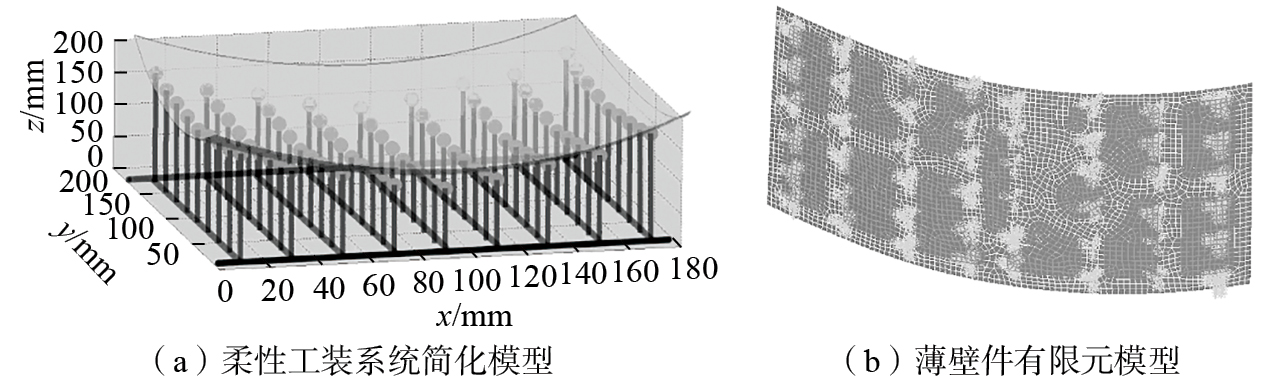
根据薄壁件结构外形特点,采用阵列式定位/支撑原理,并提出了支撑点优化自生成方法,如图4所示,通过自寻优途径实现了大型薄壁件定位/支承阵列拓扑形态和分布密度的全局优化。

图4     薄壁件阵列式定位方式[  陆俊百, 周凯, 张伯鹏. 飞行器薄壁件柔性工装定位/支承阵列优化自生成研究[J]. 中国机械工程, 2010, 21(19): 2369–2374, 2378.LU Junbai, ZHOU Kai, ZHANG Bopeng. Research on optimization of location/support array of flexible tooling system for aircraft large-scale thin-wall workpiece[J]. China Mechanical Engineering, 2010, 21(19): 2369–2374, 2378.
24
]
Fig.4     Array positioning method of thin-walled components[  陆俊百, 周凯, 张伯鹏. 飞行器薄壁件柔性工装定位/支承阵列优化自生成研究[J]. 中国机械工程, 2010, 21(19): 2369–2374, 2378.LU Junbai, ZHOU Kai, ZHANG Bopeng. Research on optimization of location/support array of flexible tooling system for aircraft large-scale thin-wall workpiece[J]. China Mechanical Engineering, 2010, 21(19): 2369–2374, 2378.
24
]

在定位布局优化方法方面,随着人工智能技术的发展,遗传算法等启发式优化方法被广泛采用。李西宁等[  李西宁, 王悦舜, 李玉华, 等. 基于遗传算法的飞机弱刚性件夹持方案优化设计[J]. 航空制造技术, 2019, 62(1/2): 82–86, 94.LI Xining, WANG Yueshun, LI Yuhua, et al. Optimization design of aircraft weak rigid parts clamping scheme based on genetic algorithm[J]. Aeronautical Manufacturing Technology, 2019, 62(1/2): 82–86, 94.
25
]
针对航空器弱刚性薄壁零件的装夹,提出了一种集成遗传算法与有限元计算的定位与夹紧方案优化算法,并通过长桁案例验证了该算法在定位布局和夹紧顺序优化方面的有效性。王仲奇团队以最小化重力作用下的整体变形能为优化目标,通过有限元分析和多种生物启发算法(如萤火虫算法[  王仲奇, 黄杰, 康永刚, 等. 基于萤火虫算法的飞机弱刚性件装配定位策略优化[J]. 机械科学与技术, 2016, 35(4): 626–629.WANG Zhongqi, HUANG Jie, KANG Yonggang, et al. Locating strategy optimization of aircraft weakly rigid parts assembly based on firefly algorithm[J]. Mechanical Science and Technology for Aerospace Engineering, 2016, 35(4): 626–629.
26
]
、布谷鸟搜索算法[  YANG B, WANG Z Q, YANG Y, et al. Optimization of fixture locating layout for sheet metal part by cuckoo search algorithm combined with finite element analysis[J]. Advances in Mechanical Engineering, 2017, 9(6): 168781401770483.
27
]
、鲸鱼优化算法[  LI C, WANG Z Q, TONG H, et al. Optimization of the number and positions of fixture locators for curved thin-walled parts by whale optimization algorithm[J]. Journal of Physics: Conference Series, 2022, 2174(1): 012013.
28
]
)的有机结合,成功优化了飞机蒙皮等薄壁件定位器的空间布局。由于航空薄壁构件一般尺寸较大,所需有限元计算量大,而代理模型通过构建低成本替代模型,可显著降低计算成本并提升优化效率。常用的代理模型包括人工神经网络、Kriging代理模型和支持向量回归模型等。秦国华等[  秦国华, 赵旭亮, 吴竹溪. 基于神经网络与遗传算法的薄壁件多重装夹布局优化[J]. 机械工程学报, 2015, 51(1): 203–212.QIN Guohua, ZHAO Xuliang, WU Zhuxi. Optimization of multi-fixturing layout for thin-walled workpiece based on neural network and genetic algorithm[J]. Journal of Mechanical Engineering, 2015, 51(1): 203–212.
29
]
针对框类薄壁零件定位布局与夹紧顺序优化问题,通过神经网络建立夹具布局与零件变形之间的映射关系,进而利用遗传算法实现定位元件配置和布局的协同优化。李诚等[  李诚, 王仲奇, 童话, 等. 基于Kriging与FPA的薄壁件夹具布局设计[J]. 航空制造技术, 2020, 63(18): 95–101.LI Cheng, WANG Zhongqi, TONG Hua, et al. Design of fixture locating layout for thin-walled part based on Kriging and FPA[J]. Aeronautical Manufacturing Technology, 2020, 63(18): 95–101.
30
]
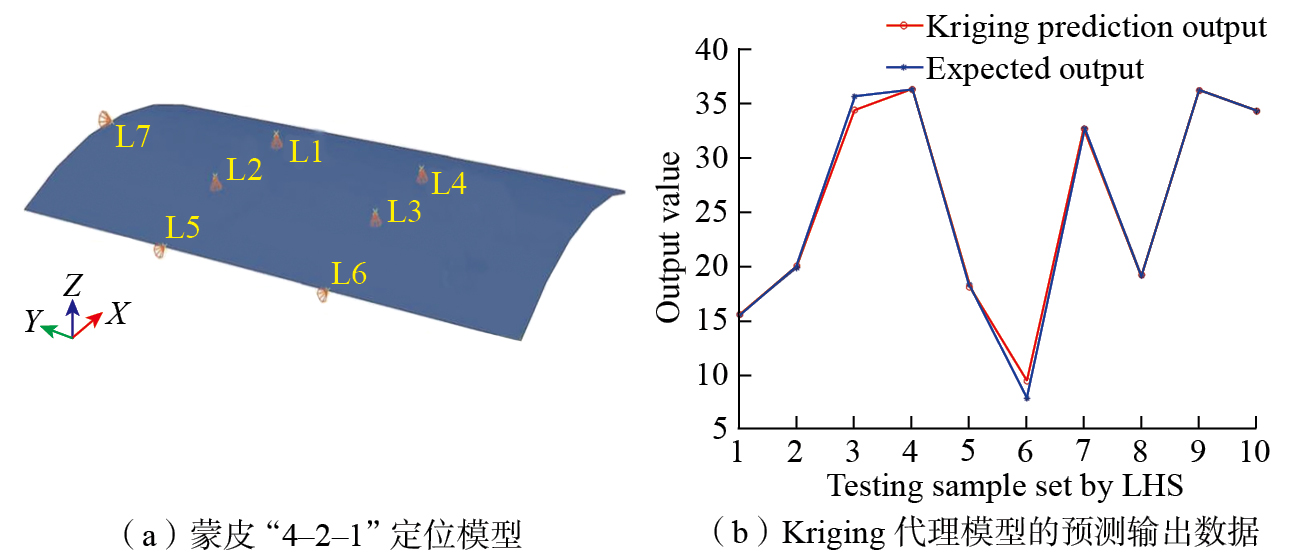
通过Kriging代理模型优化飞机蒙皮的定位元件布局,并结合花授粉算法提升了优化效果(图5)。杨元等[  杨元, 王仲奇, 杨勃, 等. 基于SVR的航空薄壁件夹具布局优化预测模型[J]. 计算机集成制造系统, 2017, 23(6): 1302–1309.YANG Yuan, WANG Zhongqi, YANG Bo, et al. Prediction model for aeronautical thin-walled part fixture layout optimization based on SVR[J]. Computer Integrated Manufacturing Systems, 2017, 23(6): 1302–1309.
31
]
将多目标遗传算法与支持向量回归模型相结合,对薄壁零件的定位布局进行了优化,获得1组Pareto最优解。Bi等[  BI Y B, YAN W M, KE Y L. Multi load-transmitting device based support layout optimization for large fuselage panels in digital assembly[J]. Proceedings of the Institution of Mechanical Engineers, Part C: Journal of Mechanical Engineering Science, 2015, 229(10): 1792–1804.
32
]
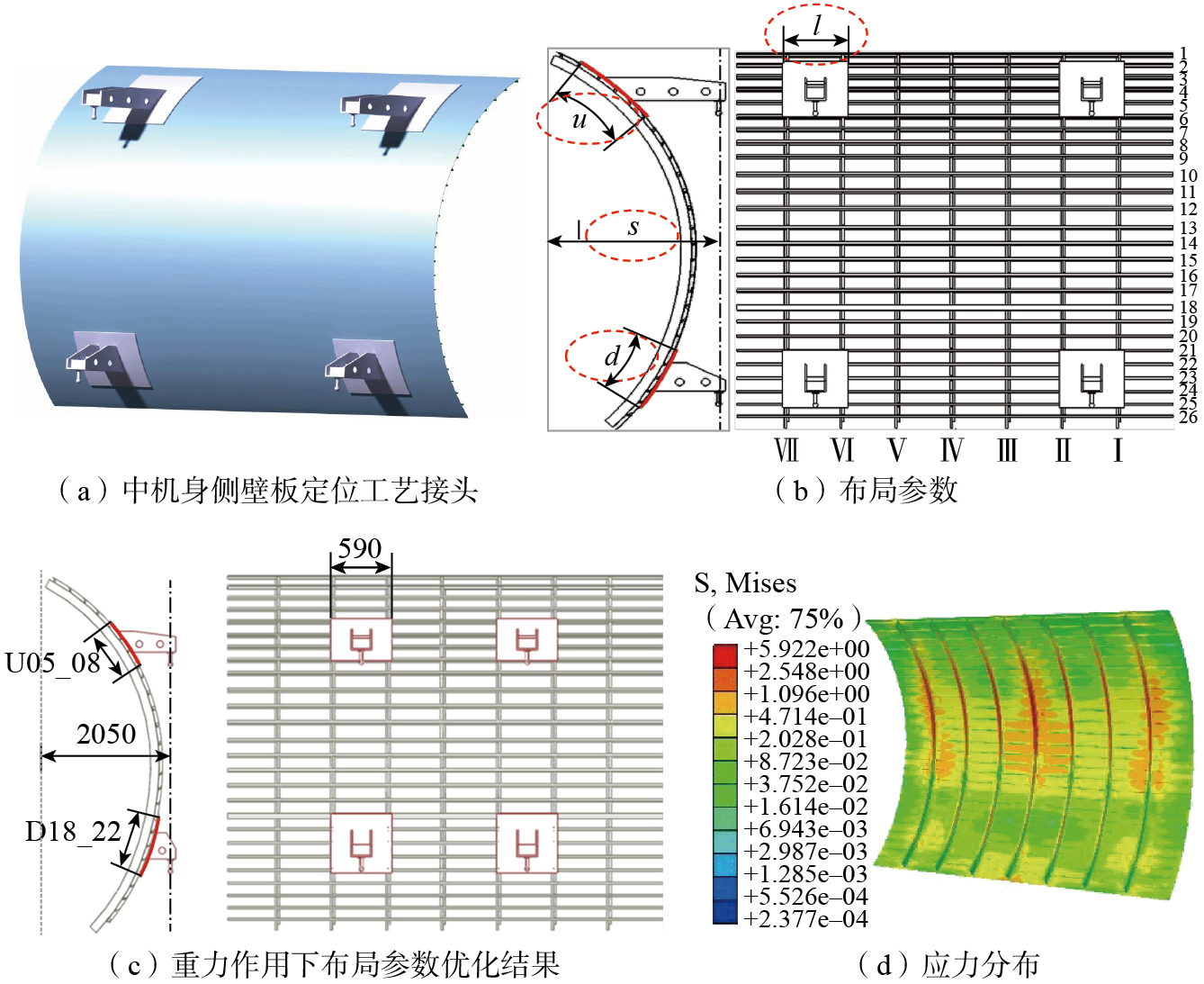
采用混合均匀设计法和有限元分析,构建了工艺接头(定位支撑点)布局与壁板应变能之间的模型,以最小化壁板装配应变能为优化目标,最终获得了优化的壁板定位布局,如图6所示,优化分析结果表明支撑点处未产生应力集中,整体应力水平较低,分布均匀。

图5     基于Kriging代理模型的定位布局优化[  李诚, 王仲奇, 童话, 等. 基于Kriging与FPA的薄壁件夹具布局设计[J]. 航空制造技术, 2020, 63(18): 95–101.LI Cheng, WANG Zhongqi, TONG Hua, et al. Design of fixture locating layout for thin-walled part based on Kriging and FPA[J]. Aeronautical Manufacturing Technology, 2020, 63(18): 95–101.
30
]
Fig.5     Positioning layout optimization based on Kriging surrogate model[  李诚, 王仲奇, 童话, 等. 基于Kriging与FPA的薄壁件夹具布局设计[J]. 航空制造技术, 2020, 63(18): 95–101.LI Cheng, WANG Zhongqi, TONG Hua, et al. Design of fixture locating layout for thin-walled part based on Kriging and FPA[J]. Aeronautical Manufacturing Technology, 2020, 63(18): 95–101.
30
]
图6     中机身侧壁板工装布局优化[  BI Y B, YAN W M, KE Y L. Multi load-transmitting device based support layout optimization for large fuselage panels in digital assembly[J]. Proceedings of the Institution of Mechanical Engineers, Part C: Journal of Mechanical Engineering Science, 2015, 229(10): 1792–1804.
32
]
Fig.6     Fixture layout optimization for side panel of middle fuselage[  BI Y B, YAN W M, KE Y L. Multi load-transmitting device based support layout optimization for large fuselage panels in digital assembly[J]. Proceedings of the Institution of Mechanical Engineers, Part C: Journal of Mechanical Engineering Science, 2015, 229(10): 1792–1804.
32
]

定位布局优化技术通过对定位支撑点数量和空间分布的优化,来降低薄壁件的定位变形和应力集中。然而,当前研究多以变形量最小为优化目标展开,而针对复合材料壁板装配定位,以应力限值或应力均衡为优化目标将成为定位布局优化技术研究的发展方向。在布局优化方法上,当前研究主要围绕薄壁件有限元模型的构建与计算展开,通过引入代理模型或将之与生物启发算法相结合的优化策略,显著减少了计算量并提高了优化效率。在处理大尺寸各向异性的复合材料壁板时,发掘代理模型等智能算法和定位布局优化深度融合的通用方法,将推动定位支撑智能计算和优化设计水平的全面提升。

1.2     在线调控

在飞机零部件装配过程中,传统工装定位方法逐步向柔性化方向发展。针对柔性壁板装配过程中出现的几何偏差和定位误差问题,现代装配系统采用具有主动调整功能的定位器和压紧器,通过施加可控外力实现精确修正。其中,三坐标定位器(POGO柱)、并联机器人和阵列式真空吸盘等先进柔性工装不仅具备精确定位功能,还可实现拉/压等校形操作。这些设备集成了高精度传感器系统,通过实时反馈装配状态,实现装配过程的在线自动调整。同时,结合有限元分析方法,能够准确预测壁板调整过程中的应力分布情况。在压紧器应用方面,利用有限元仿真与智能优化算法进行压紧器的布局优化设计,可有效控制壁板的外形精度和应力分布。

1.2.1     定位器调控

Arista等[  ARISTA R, FALGARONE H. Flexible best fit assembly of large aircraft components. Airbus A350 XWB case study[C]//Proceedings of 14th IFIP WG 5.1 International Conference on Product Lifecycle Management (PLM2017). Cham: Springer International Publishing, 2017.
33
]
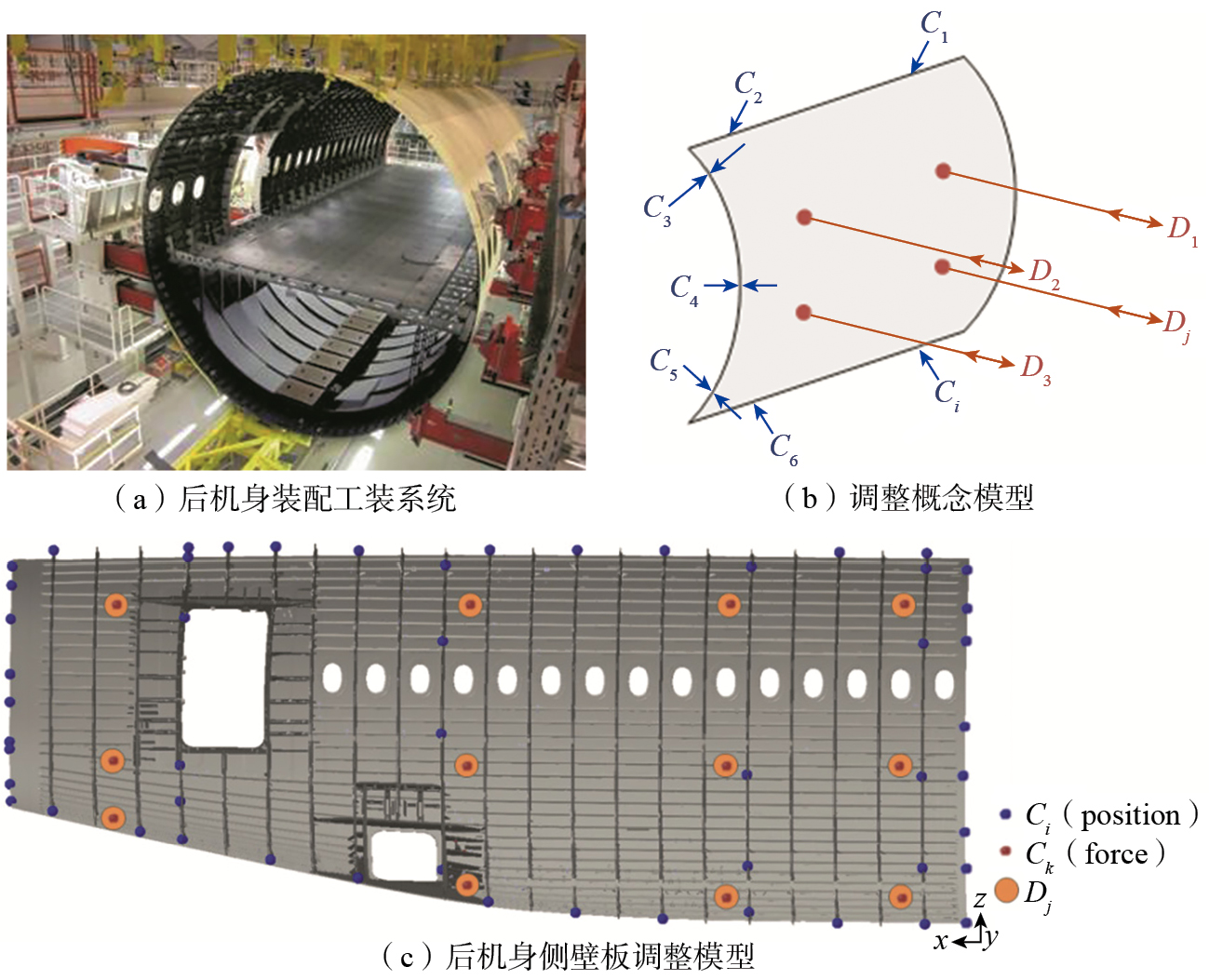
研发了一种基于三自由度定位器的柔性工装系统,并将之成功应用于A350复合材料机身壁板的装配协调;该系统的理论基础是假设壁板变形符合线弹性小位移条件,通过在定位点施加可控拉力或压力,并结合理论数模进行最佳拟合调整,实现初始状态点到目标位形的精确控制(图7);然而,该方法的局限性在于未引入有限元分析,无法全面评估壁板应力分布状态及复合材料可能产生的损伤风险。针对这一问题,Bi等[  BI Y B, YAN W M, KE Y L. Numerical study on predicting and correcting assembly deformation of a large fuselage panel during digital assembly[J]. Assembly Automation, 2014, 34(2): 204–216.
34
]
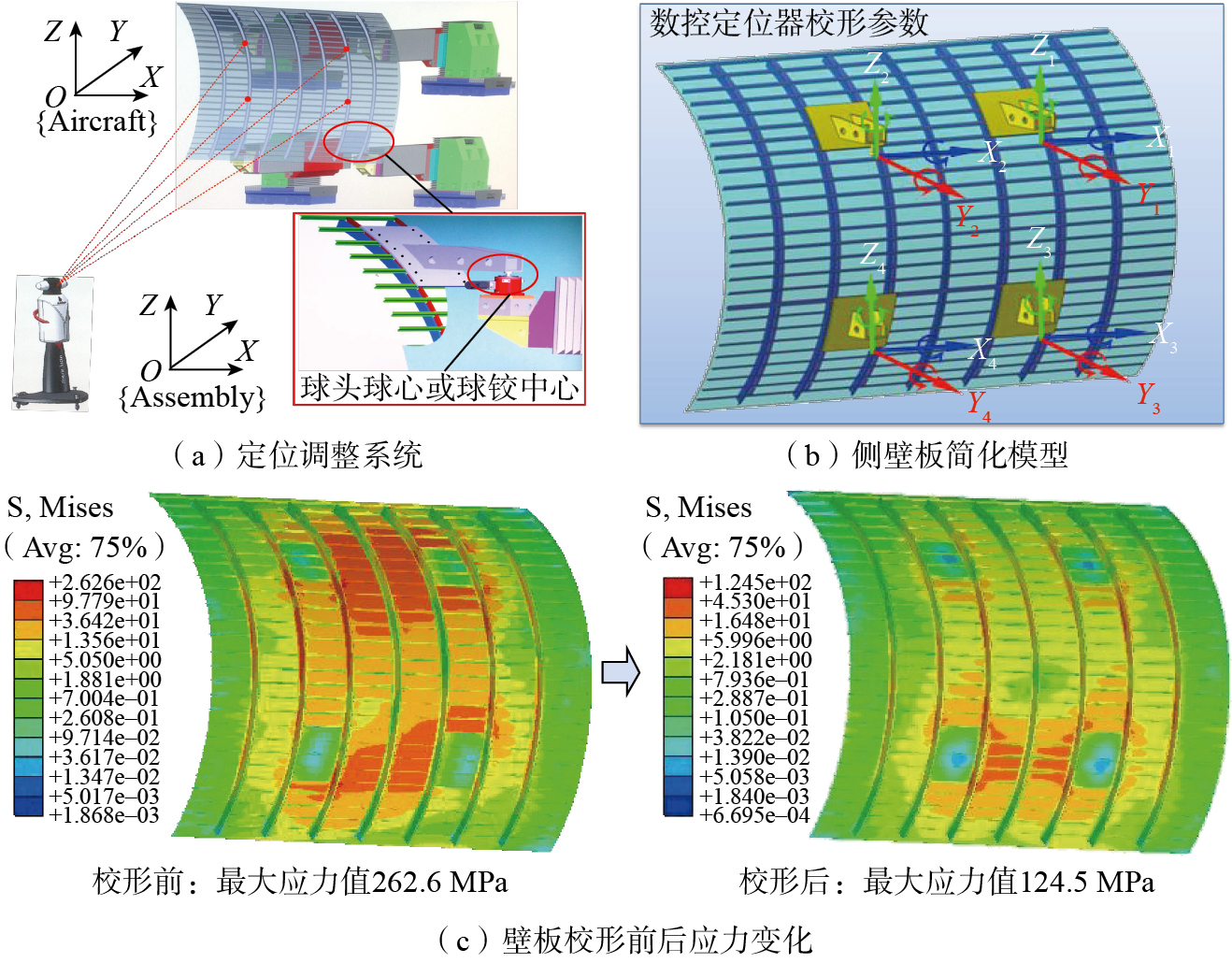
通过构建机身壁板的有限元模型,系统研究了壁板在三坐标数控定位器牵引过程中的变形特性,并采用偏最小二乘回归分析法建立了定位器位移数据与检测点位置误差之间的反演计算模型,实现了对机身壁板装配变形的精确预测与有效校正;研究结果表明,采用三坐标定位器进行校形后,壁板的最大应力值显著降低(图8)。

图7     空客A350机身壁板调形[  ARISTA R, FALGARONE H. Flexible best fit assembly of large aircraft components. Airbus A350 XWB case study[C]//Proceedings of 14th IFIP WG 5.1 International Conference on Product Lifecycle Management (PLM2017). Cham: Springer International Publishing, 2017.
33
]
Fig.7     Shape adjustment for Airbus A350 fuselage panel[  ARISTA R, FALGARONE H. Flexible best fit assembly of large aircraft components. Airbus A350 XWB case study[C]//Proceedings of 14th IFIP WG 5.1 International Conference on Product Lifecycle Management (PLM2017). Cham: Springer International Publishing, 2017.
33
]
图8     飞机壁板校正前后应力与变形变化[  BI Y B, YAN W M, KE Y L. Numerical study on predicting and correcting assembly deformation of a large fuselage panel during digital assembly[J]. Assembly Automation, 2014, 34(2): 204–216.
34
]
Fig.8     Changes in stress and deformation of aircraft panels before and after correction[  BI Y B, YAN W M, KE Y L. Numerical study on predicting and correcting assembly deformation of a large fuselage panel during digital assembly[J]. Assembly Automation, 2014, 34(2): 204–216.
34
]

Ramirez等[  RAMIREZ J, WOLLNACK J. Flexible automated assembly systems for large CFRP-structures[J]. Procedia Technology, 2014, 15: 447–455.
35
]
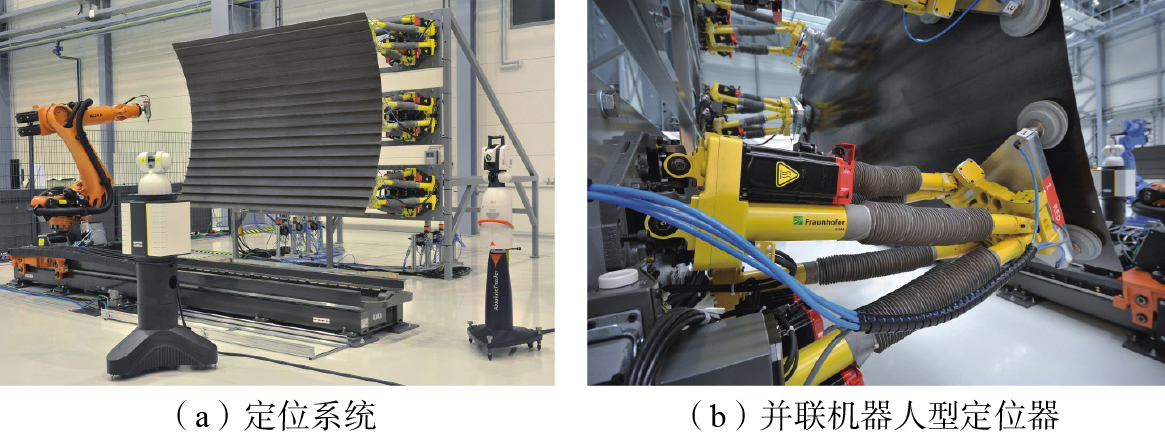
针对飞机大尺寸复合材料壁板的调姿和控形,成功开发了一种新型模块化并联机器人工装系统(图9);该智能工装系统采用6组并联机器人单元协同作业模式,并集成真空吸盘技术实现稳定吸附与夹持,可完成壁板的定位、姿态调整及外形偏差修正等复杂操作;相比传统三坐标定位器,该系统在调形能力方面具有显著优势。李东升等[  李东升, 杨应科, 翟雨农, 等. 民用飞机复合材料机身壁板装配协调形性调控技术研究[J]. 复合材料学报, 2022, 39(9): 4310–4318.LI Dongsheng, YANG Yingke, ZHAI Yunong, et al. Research on shape and force control technology for commercial aircraft CFRP fuselage panel assembly[J]. Acta Materiae Compositae Sinica, 2022, 39(9): 4310–4318.
 杨应科, 李东升, 沈立恒, 等. 大型复合材料机身壁板多机器人协同装配调姿控形方法[J]. 航空学报, 2023, 44(14): 428006.YANG Yingke, LI Dongsheng, SHEN Liheng, et al. Pose and shape adjustment method for CFRP fuselage panel based on multi-robot collaboration[J]. Acta Aeronautica et Astronautica Sinica, 2023, 44(14): 428006.
36-37
]
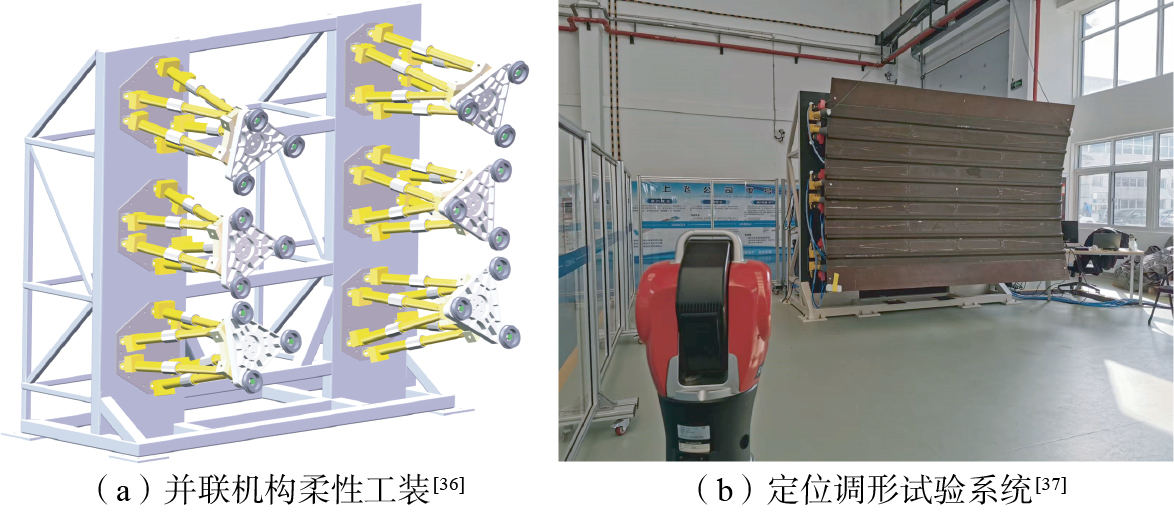
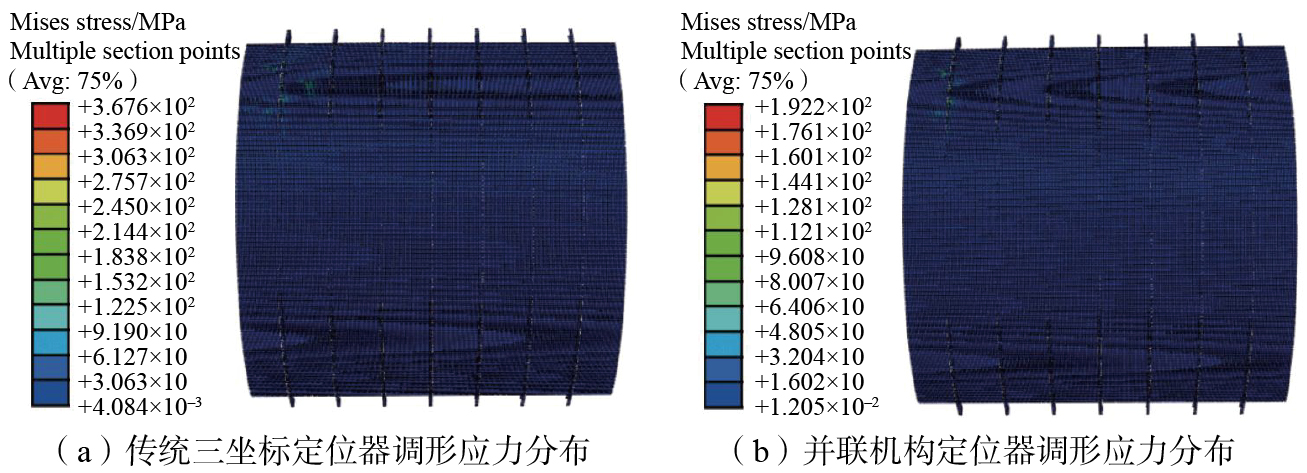
基于六自由度并联机构研制出复合材料壁板装配的柔性工装系统(图10),并开展了有限元仿真和试验研究;通过激光跟踪仪测量数据与有限元分析相结合,建立了壁板装配外形调控量与受力变化量之间的数学关系预测模型,实现了在壁板装配过程中自动调姿与调形;仿真分析结果表明,并联机构在调形过程中产生的应力值明显低于传统三坐标定位器,如图11所示[  李东升, 杨应科, 翟雨农, 等. 民用飞机复合材料机身壁板装配协调形性调控技术研究[J]. 复合材料学报, 2022, 39(9): 4310–4318.LI Dongsheng, YANG Yingke, ZHAI Yunong, et al. Research on shape and force control technology for commercial aircraft CFRP fuselage panel assembly[J]. Acta Materiae Compositae Sinica, 2022, 39(9): 4310–4318.
36
]

图9     基于并联机器人的定位系统[  RAMIREZ J, WOLLNACK J. Flexible automated assembly systems for large CFRP-structures[J]. Procedia Technology, 2014, 15: 447–455.
35
]
Fig.9     Parallel robot-based positioning system[  RAMIREZ J, WOLLNACK J. Flexible automated assembly systems for large CFRP-structures[J]. Procedia Technology, 2014, 15: 447–455.
35
]
图10     并联机构柔性装配工装
Fig.10     Flexible assembly fixture based on parallel mechanism
图11     CFRP 机身壁板在不同装配工装调形下的应力云图[  李东升, 杨应科, 翟雨农, 等. 民用飞机复合材料机身壁板装配协调形性调控技术研究[J]. 复合材料学报, 2022, 39(9): 4310–4318.LI Dongsheng, YANG Yingke, ZHAI Yunong, et al. Research on shape and force control technology for commercial aircraft CFRP fuselage panel assembly[J]. Acta Materiae Compositae Sinica, 2022, 39(9): 4310–4318.
36
]
Fig.11     Stress and displacement contours of CFRP fuselage panel with different assembly fixture shape adjustments[  李东升, 杨应科, 翟雨农, 等. 民用飞机复合材料机身壁板装配协调形性调控技术研究[J]. 复合材料学报, 2022, 39(9): 4310–4318.LI Dongsheng, YANG Yingke, ZHAI Yunong, et al. Research on shape and force control technology for commercial aircraft CFRP fuselage panel assembly[J]. Acta Materiae Compositae Sinica, 2022, 39(9): 4310–4318.
36
]

1.2.2     压紧器调控

Wen等[  WEN Y C, YUE X W, HUNT J H, et al. Feasibility analysis of composite fuselage shape control via finite element analysis[J]. Journal of Manufacturing Systems, 2018, 46: 272–281.
 WEN Y C, YUE X W, HUNT J H, et al. Virtual assembly and residual stress analysis for the composite fuselage assembly process[J]. Journal of Manufacturing Systems, 2019, 52: 55–62.
38-39
]
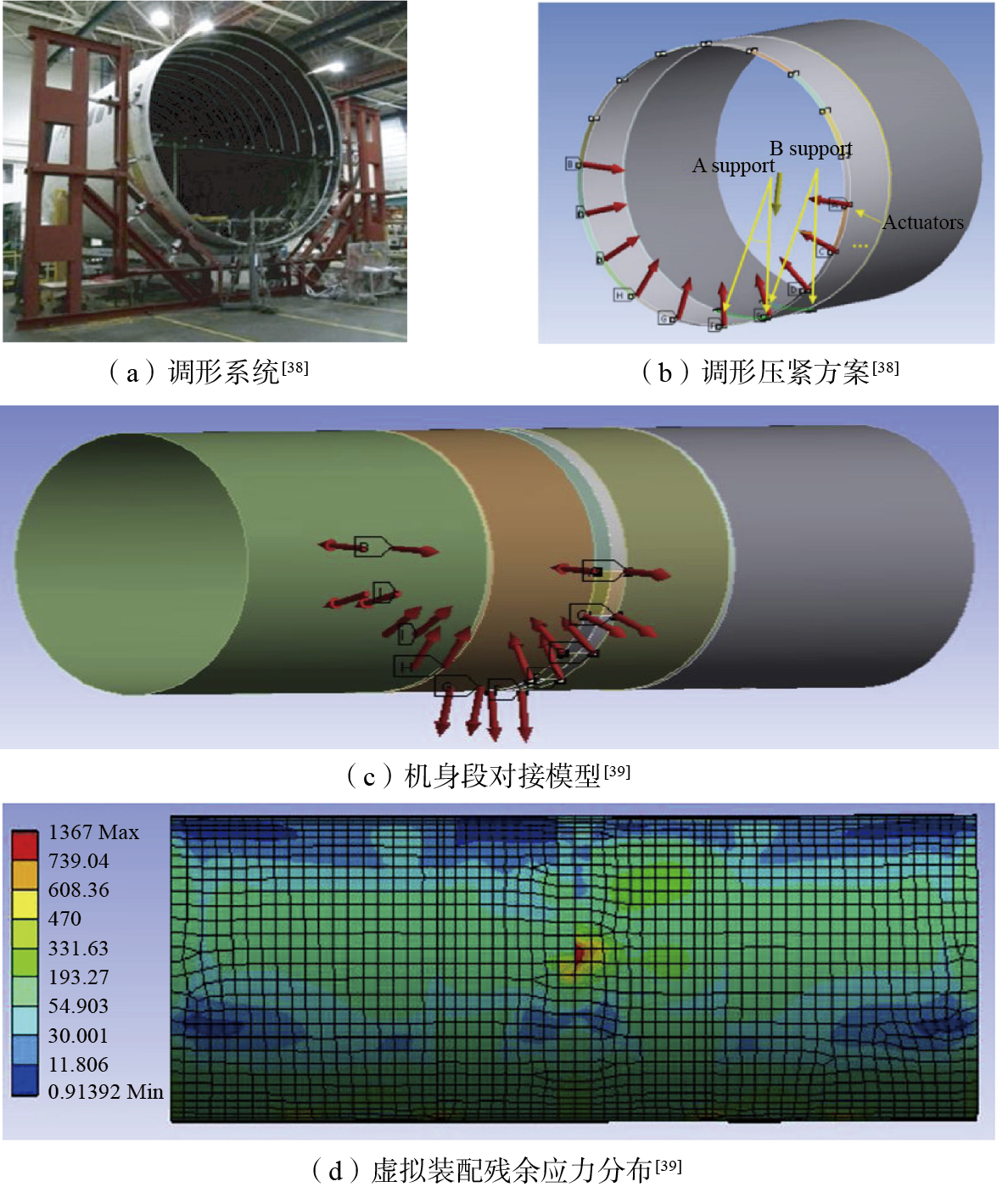
开发了一种复合材料机身筒段对接调形的方法,如图12所示;该方法通过压紧器施加压力或拉力调整对接部位的外形,以解决机身段对接过程中偏差过大的问题;研究人员构建了包括复合材料性能、铺层设计、定位支撑点和压紧器布局的有限元模型,并通过物理试验验证了采用10个压紧器进行外形调控的可行性;然而,该研究也发现压紧器作业区域存在残余应力集中现象。为了提高仿真效率并优化压紧器的动作,Yue等[  YUE X W, WEN Y C, HUNT J H, et al. Surrogate model-based control considering uncertainties for composite fuselage assembly[J]. Journal of Manufacturing Science and Engineering, 2018, 140(4): 041017.
40
]
引入了代理模型,将之嵌入前馈控制算法中,通过多变量优化确定压紧器的最佳位移动作;继而采用主动学习算法,提升了有限样本条件下复合材料机身外形调控性能的预测精度[  YUE X W, WEN Y C, HUNT J H, et al. Active learning for Gaussian process considering uncertainties with application to shape control of composite fuselage[J]. IEEE Transactions on Automation Science and Engineering, 2021, 18(1): 36–46.
41
]

图12     复合材料机身对接调形
Fig.12     Shape control of composite fuselage during docking

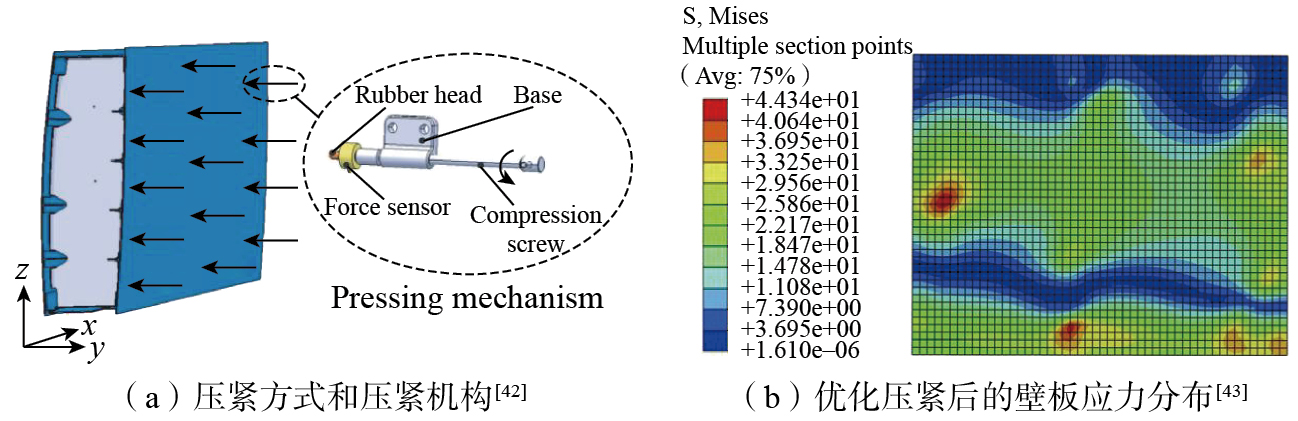
此外,针对飞机复合材料翼盒装配间隙问题,有学者采用单自由度的压紧器对蒙皮进行压紧,并将遗传算法与有限元法相结合,对压紧力大小和布局进行优化,如图13所示[  张秋月, 安鲁陵, 岳烜德, 等. 基于遗传算法的飞机复合材料结构装配压紧力大小与布局的优化[J]. 复合材料学报, 2019, 36(6): 1546–1557.ZHANG Qiuyue, AN Luling, YUE Xuande, et al. Optimization of size and layout of pressing force for composite airframe structure assembly based on genetic algorithm[J]. Acta Materiae Compositae Sinica, 2019, 36(6): 1546–1557.
 ZHANG W, AN L L, CHEN Y, et al. Optimisation for clamping force of aircraft composite structure assembly considering form defects and part deformations[J]. Advances in Mechanical Engineering, 2021, 13(4): 1687814021995703.
42-43
]
;通过构建基于内聚力单元的有限元模型,评估压紧力对复合材料结构的影响,在不产生损伤的情况下,成功消除了装配间隙。黎雪婷等[  黎雪婷, 安鲁陵, 岳烜德, 等. 飞机复合材料壁板装配中临时紧固件数量与布局优化方法[J]. 复合材料学报, 2022, 39(8): 4102–4116.LI Xueting, AN Luling, YUE Xuande, et al. Optimization method of the number and layout of temporary fasteners in composite panel assembly of aircraft[J]. Acta Materiae Compositae Sinica, 2022, 39(8): 4102–4116.
44
]
提出了一种临时紧固件数量与布局优化方法,以装配间隙消除量为优化目标,利用有限元分析与遗传算法,实现了复合材料壁板装配过程中临时紧固件布局的智能优化,并通过试验验证了该优化方法的可行性。

图13     复合材料翼盒装配压紧布局优化
Fig.13     Pressing layout optimization for composite wing box assembly

综上所述,通过合理配置具有主动调控功能的三坐标定位器、并联机构、压紧器等柔性工装系统,借助有限元分析和优化算法等手段,实现外力的精确施加,在完成校形的同时能够避免应力集中。针对复合材料壁板装配应力在线调控问题,以下方面须进一步突破:(1)在满足装配协调精度的同时,深入研究复合材料壁板变形均匀和应力均衡的在线调控机理、模型和方法;(2)深度融合有限元方法与人工智能技术,使装配工装系统逐步具备自主学习和工艺优化能力,为实现装配变形与应力的智能化控制提供技术支撑;(3)集成定位器与压紧器的综合在线调控技术,为实现复合材料壁板装配控形控性开辟新的技术路径。

2     间隙数字化测量和加垫补偿

与金属材料相比,复合材料的成型质量更难控制,特别是碳纤维复合材料在成型过程中容易出现厚度、平面度、扭转等尺寸和形状误差,导致复合材料构件装配过程中在接合面处产生间隙或干涉,强迫装配可能引起较大的装配应力,造成复合材料构件服役性能下降[  李伟, 闫雨哲, 李兆远, 等. 装配间隙对飞机结构强度影响研究[J]. 飞机设计, 2022, 42(2): 13–16.LI Wei, YAN Yuzhe, LI Zhaoyuan, et al. Research on the influence of assembly clearance on aircraft structural strength[J]. Aircraft Design, 2022, 42(2): 13–16.
45
]
。对于装配干涉问题,通常预留设计余量,通过后续铣削加工去除干涉部位的材料;而对于间隙问题,则普遍采用垫片填隙的方式进行补偿。填隙补偿不仅能实现接合面上下表面的有效接触,还可抑制连接件的变形,降低装配应力,进而提升连接结构的承载能力。在制定填隙补偿方案之前,需要通过有效的测量方法获取准确的装配间隙数据。

2.1     数字化测量与间隙预测

2.1.1     数字化测量

传统间隙测量依赖零部件的预装配,采用机械式塞尺进行间隙数据采集,这一过程往往耗时较长,且预装配常会遮蔽构件内部部位,导致无法放入塞尺等测量工具。随着数字化测量技术的发展,特别是基于视觉的非接触式测量方法[  李彬鹏, 茅健. 大尺寸飞机零部件检测技术研究进展[J]. 上海工程技术大学学报, 2021, 35(4): 346–353.LI Binpeng, MAO Jian. Research progress on detection technology of large-size aircraft parts[J]. Journal of Shanghai University of Engineering Science, 2021, 35(4): 346–353.
46
]
的引入,已无需实际预装配,通过零件阶段测量、数据处理和虚拟装配[  郝龙, 刘涵予, 黄翔, 等. 基于实测数据的飞机虚拟预装配技术发展综述[J]. 航空制造技术, 2024, 67(6): 65–77.HAO Long, LIU Hanyu, HUANG Xiang, et al. Review of virtual pre-assembly technology for aircraft based on measured data[J]. Aeronautical Manufacturing Technology, 2024, 67(6): 65–77.
47
]
就能够预测零部件装配间隙,显著提升了装配效率。目前,主流的非接触测量系统包括计算机视觉测量系统、激光跟踪测量系统和激光扫描测量系统等。其中,计算机视觉测量系统通过1台或多台摄像机采集物体图像,并利用图像处理、特征提取和三维坐标计算技术,获取物体的尺寸、形状和位置;该系统具有高精度、适用于大面积批量测量的特点。激光跟踪测量系统[  张开富, 史越, 骆彬, 等. 大型飞机装配中的高精度测量技术研究进展[J]. 激光与光电子学进展, 2023, 60(3): 0312004.ZHANG Kaifu, SHI Yue, LUO Bin, et al. Research progress of high precision measurement technology in large aircraft assembly[J]. Laser & Optoelectronics Progress, 2023, 60(3): 0312004.
48
]
基于激光反射和位置传感器原理,具有优异的动态性能,可实现亚毫米级测量精度,特别适合于高精度工业测量和单点测量任务。激光扫描测量系统[  郑璐晗, 杜兆才, 陈龙. 基于三维激光扫描技术的装配间隙补偿方法研究[J]. 现代制造技术与装备, 2020, 56(4): 24–29, 37.ZHENG Luhan, DU Zhaocai, CHEN Long. Research on assembly gap compensation method based on 3D laser scanning[J]. Modern Manufacturing Technology and Equipment, 2020, 56(4): 24–29, 37.
49
]
利用激光测距原理,能够快速获取被测零件表面采样点的三维坐标信息,生成点云数据。

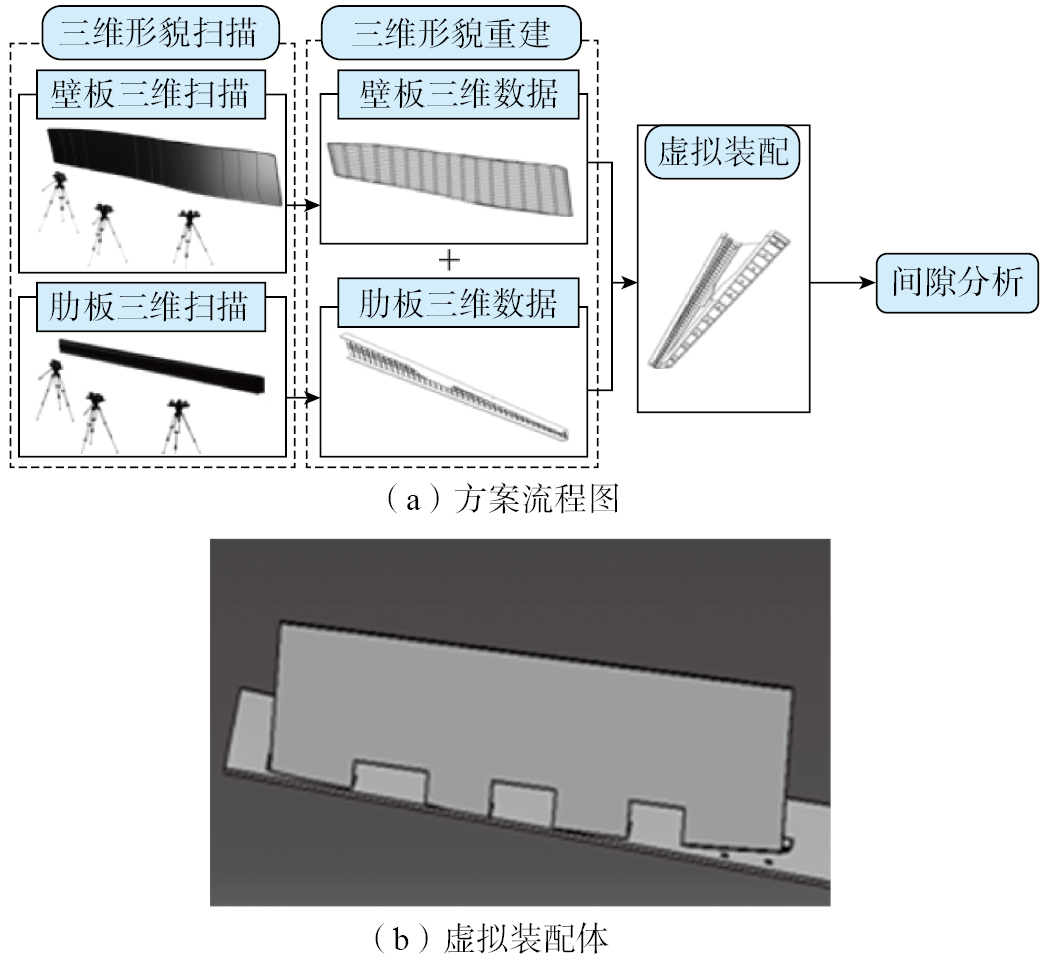
三维激光扫描技术通过高频率采样实现对零件表面的数据采集,经过数据处理后获得零件表面信息,在装配间隙测量方面得到了大量应用。目前存在单纯利用三维激光扫描测量、三维扫描与其他数字化测量方法相结合的两大类测量方式。单纯利用三维扫描测量方式,主要是将零件表面扫描测量数据与理论数模CAD进行比较,评估构件偏差和变形,进而预测装配构件之间的间隙情况[  MAROPOULOS P G, MUELANER J E, SUMMERS M D, et al. A new paradigm in large-scale assembly—Research priorities in measurement assisted assembly[J]. The International Journal of Advanced Manufacturing Technology, 2014, 70(1): 621–633.
 YANG Y, JIN Y, PRICE M, et al. Gap volume prediction for aircraft wing assembly[J]. Procedia Manufacturing, 2021, 54: 227–232.
 OSPINA-ALDANA G, HASSAN ALI M I, ODENDAAL H, et al. Predictive shimming of frame-panel assemblies using FEM and laser scanning[C]//Proceedings of ASME 2019 International Mechanical Engineering Congress and Exposition. New York: ASME, 2020.
50-52
]
。三维扫描与其他测量结合方式,则以三维扫描测量表面为主,以坐标测量机(CMM)[  YANG Y, JIN Y, PRICE M, et al. Investigation of point cloud registration uncertainty for gap measurement of aircraft wing assembly[C]//Proceedings of 2021 IEEE 8th International Workshop on Metrology for AeroSpace (MetroAeroSpace). Piscatawa: IEEE, 2021.
53
]
、激光跟踪仪[  BRIESKORN L, VARGAS M. Gap measurement for thermoplastic adhesive joining of aircraft frames[J]. The Journal of Adhesion, 2022, 98(6): 647–655.
54
]
、摄像机视觉测量[  CROSSLEY R, RATCHEV S. Aerospace assembly gap measurement using low cost smart tools with machine vision[C]//Proceedings of 8th IFIP WG 5.5 International Precision Assembly Seminar (IPAS2018). Cham: Springer International Publishing, 2018.
55
]
为辅助,利用辅助测量方式获得构件的绝对坐标位置,为装配构件表面扫描点云配准提供支持。三维扫描测量产生的数据量大,当被测装配零部件尺寸较大、特征较多时,点云数据显著增加。此时,如何高效、准确地处理大量点云数据成为预测装配间隙的关键要素。

2.1.2     装配间隙预测

在点云数据处理领域,目前主要采用基于原始点云的间隙预测模型和基于重构数模的间隙预测模型两种形式的实测数据模型进行装配间隙预测[  罗振伟, 梅中义. 基于测量数据的飞机数字化预装配技术[J]. 航空制造技术, 2013, 56(20): 99–102, 108.LUO Zhenwei, MEI Zhongyi. Aircraft digital preassembly technology based on measured data[J]. Aeronautical Manufacturing Technology, 2013, 56(20): 99–102, 108.
56
]

基于原始点云的间隙预测模型,是通过数字化测量设备采集零件外形数据(如关键点、基准点、特征外形、轮廓边界及曲面数据等),直接利用点云数据进行匹配拼合,从而构建实测的点云间隙数据模型。为了构建精确的间隙模型,Schmick等[  SCHMICK F, LÜDERS N O, WOLLNACK J. Automated assembly of large CFRP structures: Adaptive filling of joining gaps with additive manufacturing[C]//Proceedings of 2016 IEEE International Symposium on Assembly and Manufacturing (ISAM). Piscataway: IEEE, 2016.
57
]
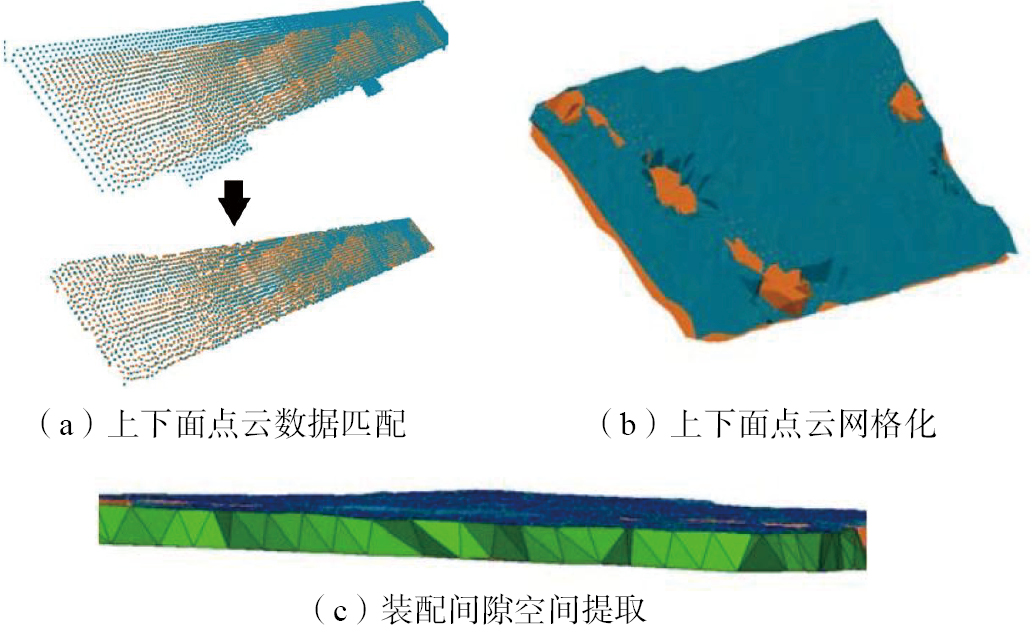
提出一套完整的点云数据处理流程:首先确定两个点云的相对位置,随后进行重复点去除、匹配对齐、滤波等处理,最终生成两个表面点云网格并封闭两曲面之间的空间(图14)。Lacroix等[  LACROIX C, MATHIEU L, THIÉBAUT F, et al. Numerical process based on measuring data for gap prediction of an assembly[J]. Procedia CIRP, 2015, 27: 97–102.
58
]
将间隙预测纳入装配流程中,提出在装配前通过数字化测量组件来预测间隙,通过实例详细说明了预测过程的原理、步骤及测量数据的集成,并进行了试验验证。针对飞机装配的特殊需求,窦亚东[  窦亚冬. 飞机装配间隙协调及数字化加垫补偿技术研究[D]. 杭州: 浙江大学, 2018.DOU Yadong. Study on gap coordination and shim compensation in aircraft assembly[D]. Hangzhou: Zhejiang University, 2018.
59
]
提出了一种提取非均匀间隙的方法:首先基于扫描测量数据,利用种子点和区域增长算法分割局部间隙区域点云;随后运用点云切片方法提取截面线,从而获得非均匀间隙数据,为垫片的参数化设计提供依据。邢宏文等[  邢宏文, 刘思仁, 邱磊, 等. 基于点云数据的对接间隙自动化检测方法[J]. 航空精密制造技术, 2020, 56(3): 6–9, 58.XING Hongwen, LIU Siren, QIU Lei, et al. An automatic detection method for wing–fuselage assembly gap measurement based on point cloud data[J]. Aviation Precision Manufacturing Technology, 2020, 56(3): 6–9, 58.
60
]
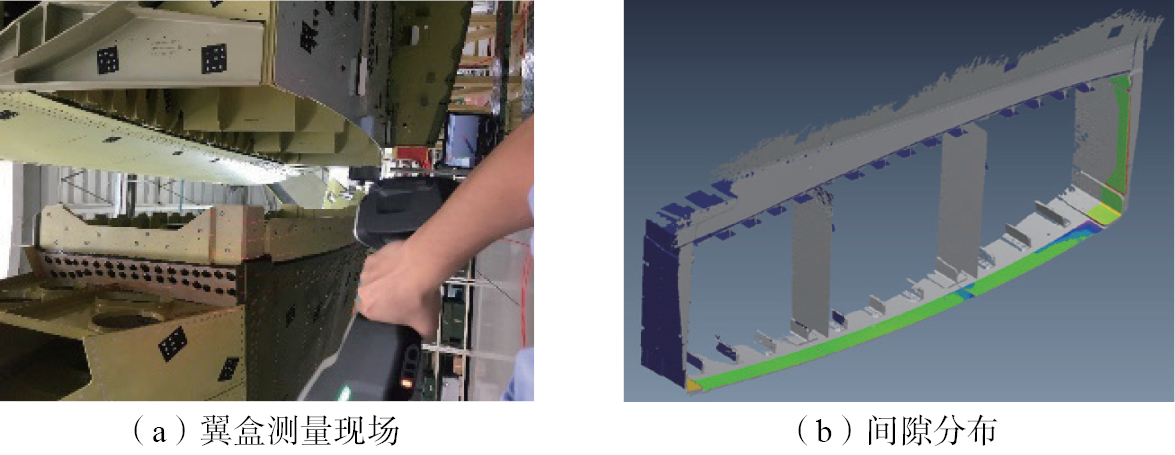
将摄影测量和三维扫描相结合,提出了一种飞机翼身装配对接间隙测量方法;该方法将摄影测量点作为部件装配对接面的位姿约束,利用摄影测量带位姿变换矩阵实现对接面点云的配准,有效解决了封闭环境中间隙测量的难题,并通过装配现场试验验证了该方法的可行性(图15)。

图14     点云处理预测间隙[  SCHMICK F, LÜDERS N O, WOLLNACK J. Automated assembly of large CFRP structures: Adaptive filling of joining gaps with additive manufacturing[C]//Proceedings of 2016 IEEE International Symposium on Assembly and Manufacturing (ISAM). Piscataway: IEEE, 2016.
57
]
Fig.14     Gap prediction based on point cloud processing[  SCHMICK F, LÜDERS N O, WOLLNACK J. Automated assembly of large CFRP structures: Adaptive filling of joining gaps with additive manufacturing[C]//Proceedings of 2016 IEEE International Symposium on Assembly and Manufacturing (ISAM). Piscataway: IEEE, 2016.
57
]
图15     翼盒装配间隙预测[  邢宏文, 刘思仁, 邱磊, 等. 基于点云数据的对接间隙自动化检测方法[J]. 航空精密制造技术, 2020, 56(3): 6–9, 58.XING Hongwen, LIU Siren, QIU Lei, et al. An automatic detection method for wing–fuselage assembly gap measurement based on point cloud data[J]. Aviation Precision Manufacturing Technology, 2020, 56(3): 6–9, 58.
60
]
Fig.15     Gap prediction of wing box assembly[  邢宏文, 刘思仁, 邱磊, 等. 基于点云数据的对接间隙自动化检测方法[J]. 航空精密制造技术, 2020, 56(3): 6–9, 58.XING Hongwen, LIU Siren, QIU Lei, et al. An automatic detection method for wing–fuselage assembly gap measurement based on point cloud data[J]. Aviation Precision Manufacturing Technology, 2020, 56(3): 6–9, 58.
60
]

基于重构数模的间隙预测模型,是通过专业测量软件或重构算法将实测点云数据重构为三维实体数模,进行虚拟装配,进而直接分析间隙,或者提取间隙三维模型进行分析。梁标[  梁标. 飞机装配几何特征自动识别与重构技术[D]. 南京: 南京航空航天大学, 2022.LIANG Biao. Automatic recognition and reconstruction technology of aircraft assembly geometric features[D]. Nanjing: Nanjing University of Aeronautics and Astronautics, 2022.
61
]
研究了基于实测数据的装配几何特征自动识别技术,提出了一种面向虚拟预装配的几何特征拟合重构方法。赵海洋等[  赵海洋, 张洋, 兰志广, 等. 基于点云三维重构的配合面装配间隙分析方法研究[J]. 计测技术, 2017, 37(3): 20–23.ZHAO Haiyang, ZHANG Yang, LAN Zhiguang, et al. Research on fitting clearance analysis method based on 3D reconstruction of point cloud[J]. Metrology & Measurement Technology, 2017, 37(3): 20–23.
62
]
针对航空缩比零件的装配,提出了一种间隙测量与预测方法,如图16所示;该方法综合运用双目视觉和激光扫描技术,基于LabVIEW数据采集系统,扫描获取零件的3D点云数据;随后在CATIA软件中完成航空平板类零件的重构、装配与分析,验证了三维重构装配间隙预测方法。

图16     三维重构虚拟装配预测间隙[  赵海洋, 张洋, 兰志广, 等. 基于点云三维重构的配合面装配间隙分析方法研究[J]. 计测技术, 2017, 37(3): 20–23.ZHAO Haiyang, ZHANG Yang, LAN Zhiguang, et al. Research on fitting clearance analysis method based on 3D reconstruction of point cloud[J]. Metrology & Measurement Technology, 2017, 37(3): 20–23.
62
]
Fig.16     Gap prediction based on 3D reconstruction and virtual assembly[  赵海洋, 张洋, 兰志广, 等. 基于点云三维重构的配合面装配间隙分析方法研究[J]. 计测技术, 2017, 37(3): 20–23.ZHAO Haiyang, ZHANG Yang, LAN Zhiguang, et al. Research on fitting clearance analysis method based on 3D reconstruction of point cloud[J]. Metrology & Measurement Technology, 2017, 37(3): 20–23.
62
]

机器学习和数字孪生等新兴技术的发展为装配间隙预测提供了新的解决方案。Manohar等[  MANOHAR K, HOGAN T, BUTTRICK J, et al. Predicting shim gaps in aircraft assembly with machine learning and sparse sensing[J]. Journal of Manufacturing Systems, 2018, 48: 87–95.
63
]
提出了一种基于机器学习和稀疏感知的间隙预测策略,基于53架飞机的已知垫片分布,应用鲁棒主成分分析算法提取间隙测量中的低维特征模式,利用优化的稀疏感知器(仅使用约3%的激光扫描点),成功预测了新一架飞机主组件99%的间隙尺寸。为了减少反复预装配和人工间隙测量等工作,Esposito等[  ESPOSITO C, COSENZA C, GERBINO S, et al. Virtual shimming simulation for smart assembly of aircraft skin panels based on a physics-driven digital twin[J]. International Journal on Interactive Design and Manufacturing (IJIDeM), 2022, 16(2): 753–763.
64
]
结合在线测量系统和基于物理的大规模模拟技术,提出了一种新型装配间隙预测方法;该方法基于物理驱动的数字孪生技术,通过模拟分析建立了蒙皮多阶段装配过程的变化模型,并在商用飞机垂直方向舵的装配过程中进行了验证;试验结果表明,使用该方法节省了75%的装配时间。

非接触式数字化测量方法为飞机装配间隙测量提供了重要的实现途径,特别是三维激光扫描技术,可基于实测数据通过原始点云和三维重构数模两种关键途径进行虚拟装配和间隙预测,而机器学习和数字孪生技术的最新发展为装配间隙预测提供了全新思路。在复合材料壁板装配中应用数字化测量和预测方法,需要在提高间隙测量和预测精度、效率方面开展深入研究:(1)进一步改进点云配准算法,提高特征配准精度;(2)深度挖掘数字孪生技术应用潜力,将虚拟环境装配变形预测融入点云测量间隙当中,提高实际装配过程中间隙的预测精度;(3)利用机器学习等人工智能技术,开展高保真度的稀疏数据测量优化研究,提高大尺寸、多特征的复合材料壁板测量数据处理和装配间隙预测的效率。

2.2     填隙补偿工艺与力学性能分析

2.2.1     填隙补偿工艺

填隙补偿工艺通过使用不同形状和材料的垫片填充间隙,实现连接件的间接接触,进而减少装配变形和装配应力,保障装配质量。常见的垫片类型包括液体垫片、固体垫片、可剥垫片及混合垫片。液体垫片由环氧树脂制成,适用于不规则形状或尺寸的间隙,广泛用于填隙补偿;固体垫片主要由钛合金、铝合金、合金钢等制成,通常需要根据间隙的形状在装配现场加工成形,效率较低;可剥垫片的材质主要有合金、碳纤维和玻璃纤维等,通过薄片在垂直和水平两个方向压叠成形,各层之间通过胶黏剂连接,使用时根据间隙大小剥离出合适厚度的垫片;混合垫片是指液体垫片和固体垫片的混合使用,先用固体垫片补偿一定的间隙,然后使用液体垫片补偿剩余的间隙。

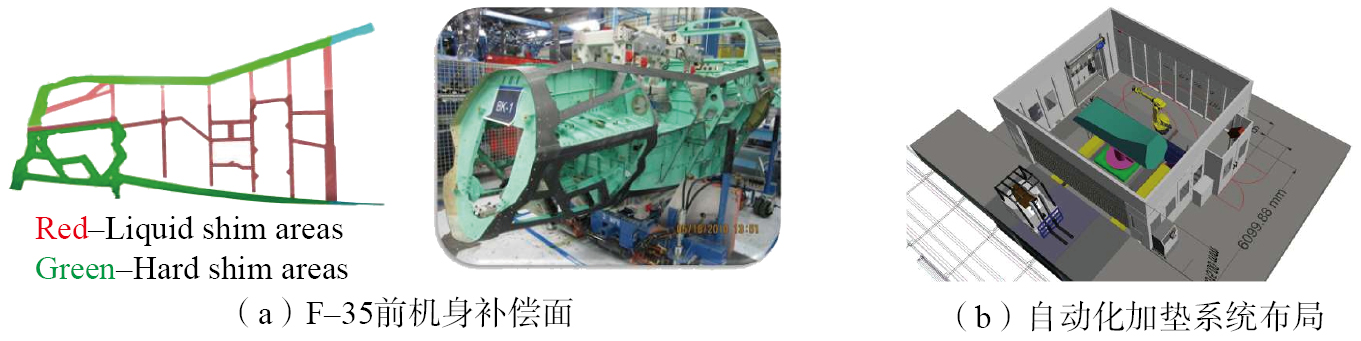
垫片的制作,特别是液体垫片,国内主要采用人工涂刷方式,而国外已开始进行液体垫片自动化制作的研究与应用尝试。针对F–35战机前机身装配间隙的补偿问题,Smith[  SMITH J. Concept development of an automated shim cell for F–35 forward fuselage outer mold line control[D]. Menomonie: University of Wisconsin-Stout, 2011.
65
]
提出了自动化加垫系统的整体解决方案;该系统包括自动测量和机器人喷涂单元、飞机结构外模线控制工装等,如图17所示;研究证实了该系统的可行性,为实际开发奠定了基础。Antolin-Urbaneja等[  ANTOLIN-URBANEJA J C, LIVINALLI J, PUERTO M, et al. End-effector for automatic shimming of composites[C]//Proceedings of SAE 2016 Aerospace Manufacturing and Automated Fastening Conference & Exhibition. New York: SAE, 2016.
66
]
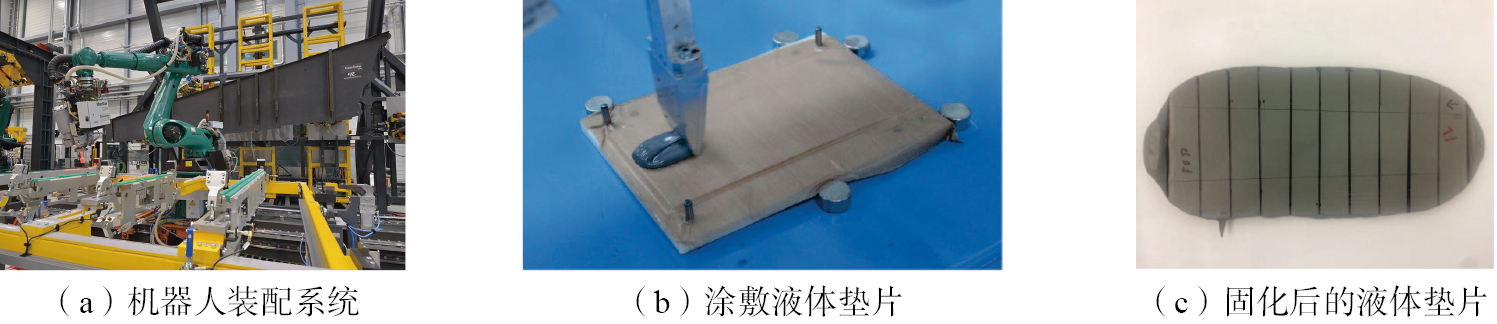
开发了一种机器人末端执行器样机,可用于在复合材料结构表面制作ABS垫片;该设备采用3D打印技术,由标准数控G代码控制运动速度和轨迹,可根据预先测量的间隙体积,精确打印垫片的几何形状。Ehmke等[  EHMKE F, RAO S, WOLLNACK J. Single step shimming solution for automated aircraft assembly[C]//Proceedings of 2017 13th IEEE Conference on Automation Science and Engineering (CASE). Piscataway: IEEE, 2018.
67
]
针对大型飞机复合材料机翼构件装配间隙,开发了一套机器人自动化涂胶和填隙系统;基于零件扫描获得的间隙数据,该填隙系统可自动化制作需求精度的液体垫片,同时还有效避免了垫片的浪费,如图18所示。

图17     F–35前机身自动化垫片补偿系统概念[  SMITH J. Concept development of an automated shim cell for F–35 forward fuselage outer mold line control[D]. Menomonie: University of Wisconsin-Stout, 2011.
65
]
Fig.17     F–35 forward fuselage automated shimming system concept[  SMITH J. Concept development of an automated shim cell for F–35 forward fuselage outer mold line control[D]. Menomonie: University of Wisconsin-Stout, 2011.
65
]
图18     机器人自动化制作液体垫片[  EHMKE F, RAO S, WOLLNACK J. Single step shimming solution for automated aircraft assembly[C]//Proceedings of 2017 13th IEEE Conference on Automation Science and Engineering (CASE). Piscataway: IEEE, 2018.
67
]
Fig.18     Automated manufacturing of liquid shim sample using robot[  EHMKE F, RAO S, WOLLNACK J. Single step shimming solution for automated aircraft assembly[C]//Proceedings of 2017 13th IEEE Conference on Automation Science and Engineering (CASE). Piscataway: IEEE, 2018.
67
]

2.2.2     补偿方案力学性能分析

尽管填隙补偿工艺已成为飞机装配的常规技术,但目前行业内仍缺乏统一的间隙补偿工艺标准。在国外,Campbell[  CAMPBELL F C. Manufacturing Processes for Advanced Composites[M]. Oxford: Elsevier Advanced Technology, 2004.
68
]
认为,当间隙为0.127~0.762 mm时,应使用液体垫片;而当间隙>0.762 mm时,则使用固体垫片。Smith[  SMITH J. Concept development of an automated shim cell for F–35 forward fuselage outer mold line control[D]. Menomonie: University of Wisconsin-Stout, 2011.
65
]
指出,间隙大于0.23 mm时需要使用垫片,并推荐选择厚度为0.127 mm的可剥垫片,最大厚度可达1.5 mm。Ehmke等[  EHMKE F, RAO S, WOLLNACK J. Single step shimming solution for automated aircraft assembly[C]//Proceedings of 2017 13th IEEE Conference on Automation Science and Engineering (CASE). Piscataway: IEEE, 2018.
67
]
提议,当间隙<1.5 mm时使用液体垫片,间隙>1.5 mm时则应使用固体垫片。在国内,徐福泉等[  徐福泉, 高大伟. 复合材料结构装配过程中的制孔和连接[J]. 航空制造技术, 2010, 53(17): 72–74.XU Fuquan, GAO Dawei. Drilling and linking during composites structure assembly process[J]. Aeronautical Manufacturing Technology, 2010, 53(17): 72–74.
69
]
建议,当间隙为0.2~0.8 mm时,应使用液体垫片;而当间隙>0.8 mm时,应采用固体垫片。

不同的间隙补偿方案对复合材料结构装配应力具有显著影响。蒋麒麟等[  蒋麒麟, 安鲁陵, 云一珅, 等. 间隙补偿对单螺栓连接层合板轴向刚度的影响研究[J]. 玻璃钢/复合材料, 2016(11): 59–64.JIANG Qilin, AN Luling, YUN Yishen, et al. Effect of gap compensation on axial stiffness in single bolt fastening composite laminates[J]. Fiber Reinforced Plastics/Composites, 2016(11): 59–64.
70
]
通过有限元仿真和试验发现,当装配间隙>0.05 mm时,使用液体垫片可以显著增加连接件的有效接触面积,而且液体垫片的弹性模量越大,越有利于提升螺栓连接的轴向刚度。进一步地,蒋麒麟等[  蒋麒麟, 安鲁陵, 云一珅, 等. 间隙补偿及液体垫片参数对层合板单层与层间应力的影响[J]. 机械科学与技术, 2017, 36(10): 1633–1640.JIANG Qilin, AN Luling, YUN Yishen, et al. Effect of gap compensation and parameters of liquid shim on composite laminates internal stress and interlaminar stress[J]. Mechanical Science and Technology for Aerospace Engineering, 2017, 36(10): 1633–1640.
71
]
通过有限元分析表明,对于两端固支的复合材料连接件,使用液体垫片进行填隙补偿时复合材料各层的应力分布更加均匀,有效降低了应力集中现象。岳烜德等[  岳烜德, 安鲁陵, 云一珅, 等. 液体垫片对复合材料装配结构应力和应变的影响[J]. 复合材料学报, 2018, 35(10): 2665–2677.YUE Xuande, AN Luling, YUN Yishen, et al. Effect of liquid shim on stress and strain of composite assembly structure[J]. Acta Materiae Compositae Sinica, 2018, 35(10): 2665–2677.
72
]
构建了复合材料单排三螺栓连接的有限元模型,分析了强迫装配和液体垫片补偿情况下的应力分布;在强迫装配时间隙边缘的应力较大,使用液体垫片填隙后,整体结构应力分布更加均匀,复合材料的安全裕度也有所增加;然而当装配间隙>0.7 mm时,安全裕度的提升趋缓,表明液体垫片不再适合补偿较大间隙。云一珅[  云一珅. 填隙补偿参数对复材螺栓连接结构的力学性能的影响研究[D]. 南京: 南京航空航天大学, 2017.YUN Yishen. Research on the effect of gap-filling parameters on mechanical behavior of the bolt connected composite structure[D]. Nanjing: Nanjing University of Aeronautics and Astronautics, 2017.
73
]
研究了复合材料螺栓连接单搭接有限元模型,当装配间隙为0.1~0.4 mm时,液体垫片的补偿效果显著提高;当装配间隙>0.4 mm时,液体垫片的补偿效果逐渐减弱;同时,通过对比液体垫片和可剥垫片对结构装配应力的影响,发现可剥垫片对间隙的补偿效果较差。叶鑫等[  叶鑫, 安鲁陵, 岳烜德, 等. 间隙与垫片补偿下复材–铝合金结构表面应变的研究[J]. 机械制造与自动化, 2020, 49(6): 18–20, 35.YE Xin, AN Luling, YUE Xuande, et al. Research on surface strain of composite–aluminum alloy structures with gap and shim compensation[J]. Machine Building & Automation, 2020, 49(6): 18–20, 35.
74
]
的研究对上述结论提供了支持,在分析垫片对复合材料–铝合金螺栓连接性能的影响时,发现虽然液体垫片和可剥垫片均能减少复合材料与铝合金的弯曲变形,从而降低装配应力,但由于可剥垫片存在加工误差,其补偿效果不如液体垫片。

间隙补偿方案不仅影响结构装配应力,还进一步影响连接结构的承载性能。崔雁民[  崔雁民. 复合材料钛合金叠层结构间隙加垫补偿的拉伸性能研究[D]. 杭州: 浙江大学, 2018.CUI Yanmin. Research on the effect of gap compensation method on tensile properity of titanium alloy and composite structure[D]. Hangzhou: Zhejiang University, 2018.
75
]
通过有限元分析研究了填隙补偿方案对复合材料–钛合金螺栓连接件装配应力和拉伸性能的影响;对比了1.5 mm非均匀间隙下不同垫片方案的补偿效果:使用金属堆叠垫片时,连接件装配应力最大且使用不便,全液体垫片和单块均匀金属垫片的应力补偿效果相似,但全液体垫片对连接件的承载能力提升不及单块均匀金属垫片明显。杨宇星[  杨宇星. 虑及填隙装配的CFRP构件螺接性能研究[D]. 大连: 大连理工大学, 2019.YANG Yuxing. Research on bolted joint performance of CFRP components considering shimming assembly[D]. Dalian: Dalian University of Technology, 2019.
76
]
通过试验对比了液体垫片和混合垫片对复合材料螺栓连接结构摩擦刚度和承载能力的影响,并得出了不同间隙条件下复合材料填隙补偿的最佳方案:当间隙<0.1 mm时使用液体垫片,当间隙>0.1 mm时使用混合垫片;研究还指出,若填隙比例达到100%,补偿效果最佳;如果无法实现完全填隙,则垫片应远离连接孔中心进行分布。Zhai等[  ZHAI Y N, LI D S, LI X Q, et al. An experimental study on the effect of joining interface condition on bearing response of single-lap, countersunk composite–aluminum bolted joints[J]. Composite Structures, 2015, 134: 190–198.
77
]
通过试验进一步揭示了垫片类型对复合材料–铝合金螺栓接头承载性能的影响机制;与液体垫片相比,固体垫片具有较高的拉伸模量和接头弯曲刚度,可提供更优异的承载性能。Liu等[  LIU L, ZHANG J, CHEN K, et al. Experimental and numerical analysis of the mechanical behavior of composite–to–titanium bolted joints with liquid shim[J]. Aerospace Science and Technology, 2016, 49: 167–172.
78
]
通过试验和数值模拟研究了液体垫片对复合材料–钛合金机械接头性能的影响;结果表明,失效载荷和刚度随垫片厚度的增加而减小,而在0.5~1.0 mm的垫片厚度范围内,垫片厚度的影响较小。

综上所述,在获取装配间隙模型(通常为非均匀间隙)的基础上,应用自动化和数字化手段精准制作垫片,特别是3D打印垫片,成为当前研究的重点方向。通过加垫填隙工艺设计与方案优化,能够有效消除复合材料连接结构间隙、降低装配应力集中和改善结构承载性能。针对复合材料壁板和骨架之间装配间隙精准补偿问题,须从以下两方面进一步突破:(1)当前研究对象多为试验板级试件,针对大尺寸的复合材料壁板构件,其补偿方案的力学特性影响仍需深入研究和试验验证;(2)自动化加垫工艺研究目前仍停留在概念和试验验证阶段,面向未来实际工程应用,需要对机器人运动规划、液体垫片涂敷、加压塑形和固化等工艺进行综合分析和科学控制。

3     螺栓连接工艺控制

由于复合材料易受到冲击而产生分层等损伤,铆接的应用逐渐减少,而螺栓连接因承载能力强且紧固方便,广泛应用于复合材料结构连接。螺栓连接主要通过轴向(连接厚度方向)和径向(连接面内)影响连接结构的变形和应力分布。在螺栓轴向上,预紧力作为关键工艺参数由拧紧力矩控制,对装配应力分布具有决定性影响。在径向上,钉孔配合状态是核心控制参数,直接影响装配孔周的应力分布和承载性能。此外,对于连接结构尺寸较大、存在间隙等装配偏差情况下,螺栓组的布局和连接顺序等因素也会影响装配应力及结构承载能力。

3.1     预紧力控制

在螺栓连接中,扭矩法是目前应用最广泛的预紧力施加方法。然而,该方法易受到现场工艺因素的干扰,导致预紧力偏差,进而引发应力集中问题,影响结构的承载性能[  李梅平, 张永亮, 刘宏伟, 等. 飞机复合材料结构装配中的力学行为研究进展[J]. 机械制造与自动化, 2024, 53(6): 20–27.LI Meiping, ZHANG Yongliang, LIU Hongwei, et al. Research progress of mechanical behavior in aircraft composite structure assembly[J]. Machine Building & Automation, 2024, 53(6): 20–27.
79
]
。拧紧力矩与预紧力之间存在简单的关系式:T=KFdT为拧紧力矩,F为预紧力,d为螺栓直径,K为扭矩系数)。然而,实际上两者之间的关系较为复杂,主要是因为扭矩系数K受摩擦因数、螺纹几何参数、连接结构材料等因素的影响,因此需要结合试验和工程实际情况来确定。Finkenbiner[  FINKENBINER M. Atlas Copco tools and assembly systems advanced fastening technology[M]. Nacka: Atlas Copco, 2010.
80
]
研究了拧紧力矩与预紧力之间的关系,并将扭矩系数K分解为3部分:螺纹几何参数、螺纹摩擦因数和螺母接触摩擦因数。Croccolo等[  CROCCOLO D, DE AGOSTINIS M, VINCENZI N. Failure analysis of bolted joints: Effect of friction coefficients in torque-preloading relationship[J]. Engineering Failure Analysis, 2011, 18(1): 364–373.
81
]
分析了摩擦因数对拧紧力矩与预紧力之间关系的影响,研究表明,在相同的拧紧力矩条件下,摩擦因数越小,产生的预紧力越大,预紧力的变化幅度可达320%。Friedrich等[  FRIEDRICH C, HUBBERTZ H. Engineering calculation of threaded fastening systems considering deviations in advanced design[C]//Proceedings of ASME 2012 International Mechanical Engineering Congress and Exposition. New York: ASME, 2013.
82
]
对比研究了一定预紧力(20 kN)下连接钢板、复合材料板所需的拧紧力矩;试验结果表明,相比于钢板件,复合材料板连接所需的拧紧力矩变化范围较大(19.5~55 N·m)。这一现象揭示了复合材料与传统金属在紧固行为上的差异,原因在于复合材料板孔周与螺母接触面的摩擦特性在短时间内发生显著变化,导致拧紧过程中摩擦系数波动并引起粘滑振动。

对于复合材料板件的螺栓连接,拧紧工况对预紧力具有重要影响。蔡跃波等[  蔡跃波, 安鲁陵, 王楚凡, 等. 螺栓拧紧过程中工况对复合材料连接结构夹紧力的影响[J]. 复合材料学报, 2022, 39(2): 812–822.CAI Yuebo, AN Luling, WANG Chufan, et al. Effect of operating conditions on the clamping force of composite material structure during bolt tightening process[J]. Acta Materiae Compositae Sinica, 2022, 39(2): 812–822.
83
]
通过试验研究了拧紧工况对复合材料结构螺栓连接的影响,结果表明,润滑、垫圈和拧紧速度对预紧力和拧紧力矩曲线的离散度、变化趋势均有显著影响。齐原等[  齐原, 包飞, 安金岚, 等. 拧紧工况对复合材料螺栓连接结构预紧力的影响[J/OL]. 机械科学与技术, 2024–11–28. https://link.cnki.net/doi/10.13433/j.cnki.1003-8728.20240157.QI Yuan, BAO Fei, AN Jinlan, et al. Effect of tightening conditions on preload force of composite bolted connection structure[J/OL]. Mechanical Science and Technology for Aerospace Engineering, 2024–11–28. https://link.cnki.net/doi/10.13433/j.cnki.1003-8728.20240157.
84
]
根据扭矩法原理以某型号螺栓为对象进行了试验研究,发现不同垫圈材质、夹层材料及湿装配介质条件对拧紧力矩–预紧力曲线和扭矩系数–预紧力曲线均产生不同程度的影响。针对复合材料结构中螺栓拧紧过程中的预紧力偏差问题,黄稳等[  黄稳, 杜伟, 凡志磊, 等. 复合材料结构中螺栓拧紧的有限元仿真研究[J]. 机械制造与自动化, 2022, 51(6): 127–131.HUANG Wen, DU Wei, FAN Zhilei, et al. Finite element simulation research on bolt tightening of CFRP[J]. Machine Building & Automation, 2022, 51(6): 127–131.
85
]
采用参数化手段建立了螺纹紧固件的六面体网格有限元模型,并模拟了拧紧过程,仿真结果与试验数据误差在4%以内,验证了模型的可靠性。为了精准获得单螺栓连接结构所需的预紧力,胡鹏等[  胡鹏, 江丙云, 鲍益东, 等. 复合材料单螺栓连接结构的预紧力[J]. 计算机辅助工程, 2023, 32(3): 42–47, 54.HU Peng, JIANG Bingyun, BAO Yidong, et al. Preload of composite connection structure of single bolt[J]. Computer Aided Engineering, 2023, 32(3): 42–47, 54.
86
]
基于螺纹轮廓几何表达式,采用Python语言对复合材料螺栓连接结构进行了参数化建模,并利用有限元方法进行分析;结果表明,在扭矩为定值时,螺栓公称直径越小,预紧力越大,而摩擦系数对拧紧力矩–预紧力关系的影响最为显著。

在实际连接装配过程中,被连接件制造偏差、工装定位误差、孔垂直度误差、被连接件端面不平行等几何偏差普遍存在。这些偏差可能影响复合材料的预紧力、拧紧力矩与预紧力的转化关系,进而影响层合板的应力分布。陈德安[  陈德安. 几何偏差下螺栓预紧力和残余扭矩形成机理的研究[D]. 大连: 大连理工大学, 2019.CHEN Dean. Study on the bolt pretension and residual torque forming under geometric deviations[D]. Dalian: Dalian University of Technology, 2019.
87
]
针对拧紧加载过程中的扭矩–预紧力关系,通过分析非平行端面、螺纹螺距和牙型角等几何偏差对接触应力分布的影响,探讨了各接触面摩擦半径和分解扭矩的变化,揭示了几何偏差对预紧力偏差的作用机制。刘宁等[  刘宁, 安鲁陵, 许文豪, 等. 偏差对螺栓连接拧紧力矩–预紧力关系的影响[J]. 机械设计与研究, 2024, 40(4): 249–255, 260.LIU Ning, AN Luling, XU Wenhao, et al. Influence of deviation on tightening torque–preload relation of bolted joints[J]. Machine Design and Research, 2024, 40(4): 249–255, 260.
88
]
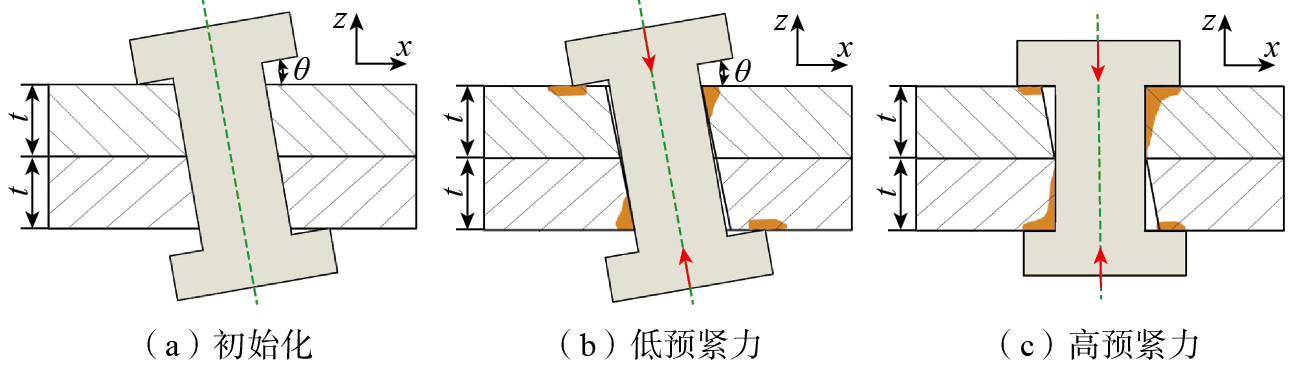
结合试验与有限元仿真方法研究了上述偏差对拧紧力矩与预紧力转化关系的影响,发现孔垂直度误差存在一个阈值,超过该阈值后,影响显著,最大预紧力下降超过30%;端面不平行偏差也具有类似的影响。刘学术等[  刘学术, 杨宇星, 鲍永杰, 等. 垂直度误差影响复合材料层合板层间应力分析[J]. 机械科学与技术, 2018, 37(1): 138–147.LIU Xueshu, YANG Yuxing, BAO Yongjie, et al. Effect of hole perpendicularity error on inter-laminar stress of CFRP[J]. Mechanical Science and Technology for Aerospace Engineering, 2018, 37(1): 138–147.
89
]
通过有限元仿真和试验相结合的方法分析了连接孔垂直度误差对连接区层间应力的影响规律,研究表明,垂直度误差会影响螺栓与连接件之间的接触关系,导致连接区应力分布不均匀;随着垂直度误差的增加,层间剪应力显著增大;适当提高螺栓预紧力有助于缓解垂直度误差带来的不良影响,如图19所示。

图19     预紧力对含垂直度误差孔边应力分布的影响[  刘学术, 杨宇星, 鲍永杰, 等. 垂直度误差影响复合材料层合板层间应力分析[J]. 机械科学与技术, 2018, 37(1): 138–147.LIU Xueshu, YANG Yuxing, BAO Yongjie, et al. Effect of hole perpendicularity error on inter-laminar stress of CFRP[J]. Mechanical Science and Technology for Aerospace Engineering, 2018, 37(1): 138–147.
89
]
Fig.19     Influence of preload on stress distribution at hole edge of holes with perpendicularity error[  刘学术, 杨宇星, 鲍永杰, 等. 垂直度误差影响复合材料层合板层间应力分析[J]. 机械科学与技术, 2018, 37(1): 138–147.LIU Xueshu, YANG Yuxing, BAO Yongjie, et al. Effect of hole perpendicularity error on inter-laminar stress of CFRP[J]. Mechanical Science and Technology for Aerospace Engineering, 2018, 37(1): 138–147.
89
]

3.2     钉孔配合量控制

螺栓杆与安装孔之间的配合状态通常分为间隙配合和干涉配合。干涉配合连接(过盈连接)可以在孔周形成均匀的预压应力,有效阻碍疲劳裂纹的扩展并提高结构的疲劳强度,因此广泛应用于铝合金等金属飞机承力结构的机械连接[  姜杰凤, 董辉跃, 柯映林. 高锁螺栓干涉连接中极限干涉量[J]. 机械工程学报, 2013, 49(3): 145–152.JIANG Jiefeng, DONG Huiyue, KE Yinglin. Maximum interference fit size of hi-lock bolted joints[J]. Journal of Mechanical Engineering, 2013, 49(3): 145–152.
 JIANG J F, BI Y B, DONG H Y, et al. Influence of interference fit size on hole deformation and residual stress in hi-lock bolt insertion[J]. Proceedings of the Institution of Mechanical Engineers, Part C: Journal of Mechanical Engineering Science, 2014, 228(18): 3296–3305.
90-91
]
。然而,相较于金属材料,复合材料延展率小、层间强度低、抗冲击能力差,在干涉螺栓安装过程中,层合板孔壁受到螺栓杆轴向力的作用,当轴向力超过复合材料层间承受能力时,层合板孔壁可能出现分层损伤[  ZUO Y J, YUE T, JIANG R S, et al. Bolt insertion damage and mechanical behaviors investigation of CFRP/CFRP interference fit bolted joints[J]. Chinese Journal of Aeronautics, 2022, 35(9): 354–365.
92
]
。可见,控制分层损伤的关键在于限制干涉安装过程中的轴向力,而轴向力大小主要由干涉量决定,这就使问题演变为对钉/孔干涉量的精准控制[  宋丹龙, 张开富, 钟衡, 等. 层合板干涉螺接分层损伤及其临界干涉量[J]. 航空学报, 2016, 37(5): 1677–1688.SONG Danlong, ZHANG Kaifu, ZHONG Heng, et al. Delamination damage and critical interference percentage for interference fit bolt joint of laminates[J]. Acta Aeronautica et Astronautica Sinica, 2016, 37(5): 1677–1688.
93
]
。因此,提升航空复合材料结构装配质量的关键在于实现精密的干涉连接[  程晖, 樊新田, 徐冠华, 等. 航空复合材料结构精密干涉连接技术综述[J]. 航空学报, 2021, 42(10): 524876.CHENG Hui, FAN Xintian, XU Guanhua, et al. State of the art of precise interference-fit technology for composite structures in aircraft[J]. Acta Aeronautica et Astronautica Sinica, 2021, 42(10): 524876.
94
]
。随着新机型研制中复合材料用量的大幅增加,为避免干涉安装时轴向力过大造成层合板损伤,波音787机翼、空客A350翼盒和中机身等部件装配采用了美铝公司(ALCOA)、LISI集团等企业的带衬套连接件进行干涉配合连接[  刘华东, 赵庆云. 长寿命机械连接技术研究应用进展[J]. 航空制造技术, 2016, 59(19): 64–69, 79.LIU Huadong, ZHAO Qingyun. Development of long-life mechanical joining technology[J]. Aeronautical Manufacturing Technology, 2016, 59(19): 64–69, 79.
95
]
。然而,螺栓干涉连接技术尚未在中国现役飞机的复合材料结构中广泛应用,更多的是采用无头铆钉、单面螺纹抽钉等紧固件进行小干涉连接(0.05%~0.35%)。魏景超等[  魏景超, 柴亚南, 刘风雷, 等. 单面螺纹抽钉干涉配合复合材料连接结构的疲劳性能研究[J]. 航空制造技术, 2017, 60(22): 50–55.WEI Jingchao, CHAI Yanan, LIU Fenglei, et al. Effect of several influencing factors on fatigue behaviour of interference-fit bolted composite joints[J]. Aeronautical Manufacturing Technology, 2017, 60(22): 50–55.
96
]
通过试验研究了单面螺纹抽钉干涉配合复合材料连接结构的疲劳性能,结果表明,选择适当的干涉配合量、紧固件类型和搭接板材料能够提高结构的疲劳寿命。

复合材料叠层结构螺栓连接,多采用钉孔间隙配合方式。通过优化调整钉孔间隙量,可以实现钉载的均匀分布,从而提高结构的承载能力[  MCCARTHY M A, MCCARTHY C T. Finite element analysis of effects of clearance on single shear composite bolted joints[J]. Plastics, Rubber and Composites, 2003, 32(2): 65–70.
97
]
。Lawlor等[  LAWLOR V P, MCCARTHY M A, STANLEY W F. An experimental study of bolt-hole clearance effects in double-lap, multi-bolt composite joints[J]. Composite Structures, 2005, 71(2): 176–190.
98
]
通过试验研究了3钉螺栓复材连接结构中各个钉孔间隙的影响,研究结果表明,钉孔间隙的变化会改变螺栓载荷的分布,载荷会向没有间隙的螺栓转移,且在较高载荷下,钉载分布趋于均匀。为进一步优化钉载分配,谢宗蕻等[  谢宗蕻, 李想, 郭家平, 等. 考虑间隙配合的复合材料钉载分配均匀化方法[J]. 复合材料学报, 2016, 33(4): 806–813.XIE Zonghong, LI Xiang, GUO Jiaping, et al. Load distribution homogenization method of multi-bolt composite joint with consideration of bolt-hole clearance[J]. Acta Materiae Compositae Sinica, 2016, 33(4): 806–813.
99
]
基于弹簧质量模型以钉孔间隙为设计变量,构建了多钉连接的钉载分配二次规划优化模型;以复合材料5钉双剪接头为例,优化了钉孔间隙,最大钉载比例由41.1%降至20%,实现了复合材料多钉连接中钉载分配比例的均匀化设计。李伟等[  李伟, 宋鑫, 林湘齐, 等. 复合材料连接结构的钉载均匀化快速寻优方法[J]. 航空学报, 2024, 45(23): 230345.LI Wei, SONG Xin, LIN Xiangqi, et al. Fast optimization method for nail load homogenization of composite joint structures[J]. Acta Aeronautica et Astronautica Sinica, 2024, 45(23): 230345.
100
]
针对钉孔间隙优化问题提出了最优拉丁超立方算法和NLPQL算法的组合优化策略,实现了连接结构螺栓的均匀承载;基于最优钉孔间隙的分布提出了最优曲线概念,并利用该曲线实现了双搭接复材连接结构钉载均匀化的快速优化。

在复合材料薄壁件和骨架的机械连接过程中,孔位误差导致的上下孔同轴度误差直接影响钉孔间的原始配合状态。这种偏差使得螺栓强迫装配过程中产生非均匀挤压,导致上下板件孔周产生应力集中[  YOON D, KIM S, KIM J, et al. Study on bearing strength and failure mode of a carbon-epoxy composite laminate for designing bolted joint structures[J]. Composite Structures, 2020, 239: 112023.
101
]
。Liu等[  LIU C N, LI Y, CHENG Y, et al. Investigation on deformation of composite multi-bolted joints considering influences of hole-location errors and installation sequence[J]. Engineering Failure Analysis, 2022, 140: 106592.
102
]
构建了存在孔位误差的复合材料多螺栓连接模型,有限元计算和试验结果表明,强迫装配过程中螺栓发生不均匀偏移,使复合材料孔周受到较大的轴向力和不均匀的挤压变形,复合材料接头的最大变形与孔位误差成正比。随后,Liu等[  LIU C N, LI Y, CHENG Y, et al. Investigation of stress distribution and damage behavior caused by forced installation of a composite bolted joint with a hole-location error[J]. Chinese Journal of Aeronautics, 2024, 37(1): 201–217.
103
]
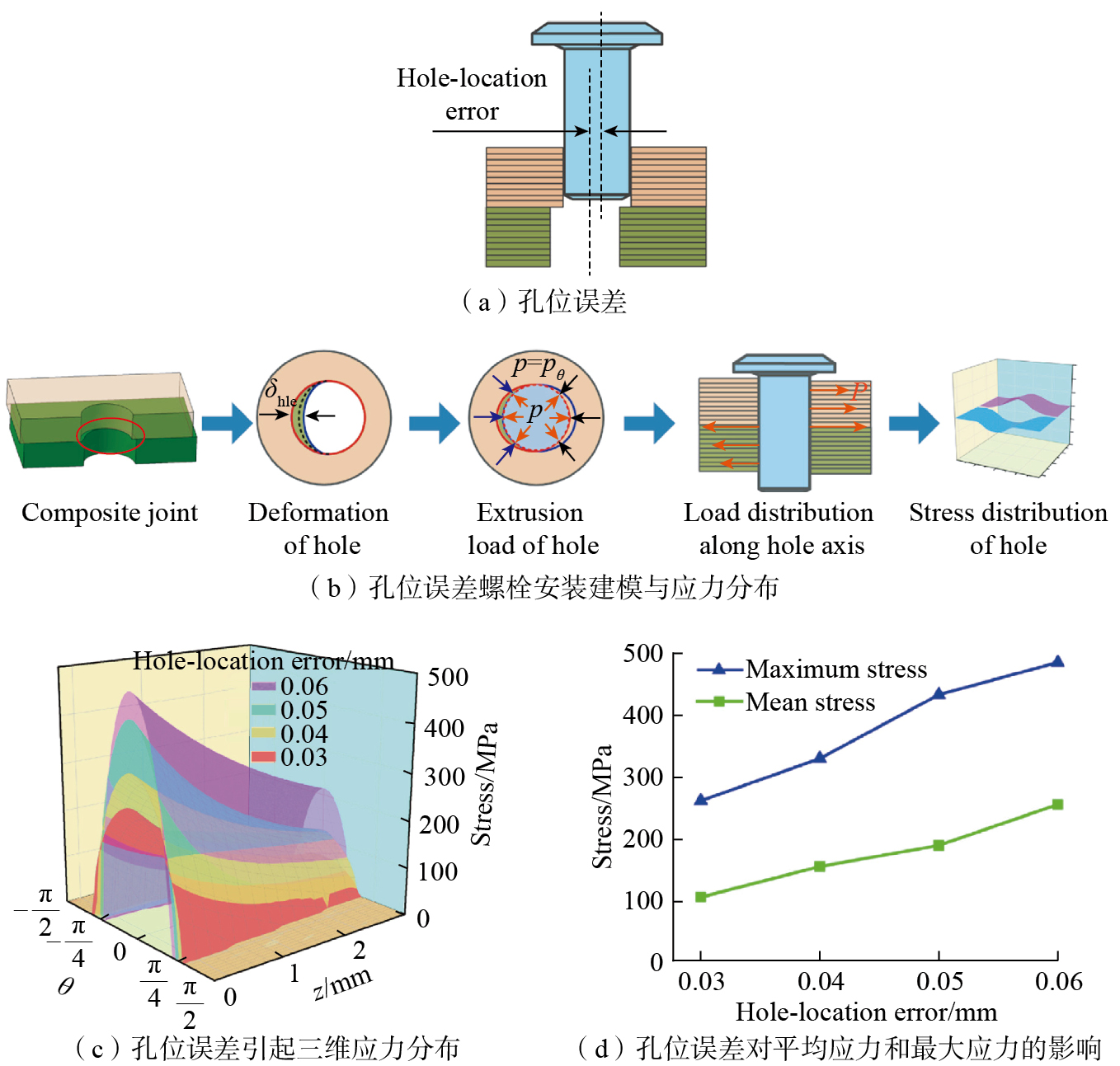
进一步提出了复合材料螺栓连接孔周应力分布的分析模型,如图20所示,并开展了螺栓安装的应力分析和试验研究;研究结果表明,当孔位误差>1%(螺杆6 mm,误差0.06 mm)时,上下板孔的变形量相同,且应力呈中心对称分布;随着孔位误差的增大,最大应力和平均应力均呈增长趋势,但复合材料接头没有明显损伤;然而,当孔隙误差>1%时,上板应力分布保持不变,而下板孔周应力呈现凹形分布,并在孔周围出现压碎、分层和开裂等损伤,且下板损伤程度较上板更为严重;因此,为确保连接质量,复合材料连接中孔位误差应控制在1%以内。

图20     孔位误差对螺栓连接孔周应力分布的影响[  LIU C N, LI Y, CHENG Y, et al. Investigation of stress distribution and damage behavior caused by forced installation of a composite bolted joint with a hole-location error[J]. Chinese Journal of Aeronautics, 2024, 37(1): 201–217.
103
]
Fig.20     Influence of hole-location error on stress distribution around hole of bolted connection[  LIU C N, LI Y, CHENG Y, et al. Investigation of stress distribution and damage behavior caused by forced installation of a composite bolted joint with a hole-location error[J]. Chinese Journal of Aeronautics, 2024, 37(1): 201–217.
103
]

3.3     连接顺序优化

在机械连接过程中,螺栓组连接的应力应变分布特性受到连接顺序的显著影响。胡敏[  胡敏. 白车身车门螺栓组装配工艺的研究[D]. 天津: 天津理工大学, 2018.HU Min. Research of bolt group assembly process on the body-in-white door[D]. Tianjin: Tianjin University of Technology, 2018.
104
]
针对白车身车门装配中的高强度钢螺栓连接,系统研究了4种螺栓分布形式(X形、不规则X形、方形、环形)下的应力应变分布规律;有限元计算结果表明,随着拧紧次数的增加,连接件的最大变形略有增大,但整体变形和应力分布变得更加均匀;相较于顺序加载方式,对称加载方式能够实现更均匀的变形和应力,而采用方形分布的螺栓组和多次对称拧紧策略效果最佳。程燕等[  程燕, 黄凡康, 许晋, 等. 复杂结构体的螺栓组预紧工艺研究[J]. 华中科技大学学报(自然科学版), 2023, 51(11): 9–13.CHENG Yan, HUANG Fankang, XU Jin, et al. Research on tightening process of bolt group for complex structures[J]. Journal of Huazhong University of Science and Technology (Natural Science Edition), 2023, 51(11): 9–13.
105
]
通过有限元分析方法,结合单个螺栓位移和整体偏移的关联性,建立了基于拧紧顺序调整的整体偏移优化方案。周石恩[  周石恩. 基于数字孪生的复杂产品装配建模与精度分析方法[D]. 杭州: 浙江大学, 2019.ZHOU Shien. Assembly modeling and accuracy analysis method of complex product based on digital twin[D]. Hangzhou: Zhejiang University, 2019.
106
]
以最小化薄壁零件的平均变形量为优化目标,采用混合粒子群算法构建了多点定位优化模型,获得最佳定位布局,并提出基于Pareto非劣解的多螺栓拧紧力矩优化方法,通过求解非劣解集实现低应力装配。

在飞机装配领域,复合材料壁板与骨架贴合面存在装配间隙时,螺栓连接顺序对结构变形和应力分布的影响显著。徐贺等[  徐贺, 孟庆勋, 张辉, 等. 螺栓拧紧顺序对飞机CFRP壁板装配变形影响[J]. 机械科学与技术, 2025, 44(9): 1658–1667.XU He, MENG Qingxun, ZHANG Hui, et al. Effect of bolt tightening sequences on deformation in assembling of CFRP panel[J]. Mechanical Science and Technology for Aerospace Engineering, 2025, 44(9): 1658–1667.
107
]
通过对比3种螺栓拧紧顺序(正向顺序、中间向外、两侧向内)对壁板变形和位移的影响规律,发现两侧向内的拧紧顺序使壁板的空间偏移最小,而中间向外的拧紧顺序有利于控制壁板面内变形。针对复合材料壁板加垫后的装配变形及应力集中问题,孟庆勋等[  孟庆勋, 徐贺, 张辉, 等. CFRP壁板螺栓填隙补偿连接过程变形及局部应力分析[J]. 航空制造技术, 2024, 67(16): 130–137.MENG Qingxun, XU He, ZHANG Hui, et al. Analysis of deformation and localized stress during gap compensation joining process of CFRP panel bolting[J]. Aeronautical Manufacturing Technology, 2024, 67(16): 130–137.
108
]
研究了填隙补偿后螺栓紧固顺序对CFRP壁板装配质量的影响机制,并通过有限元仿真与试验验证相结合的方法进行了系统分析,研究表明,改变螺栓紧固顺序后,法向变形的最大值减小约63.4%;对称性连接较顺序连接更具优势;孔周应力分布与间隙跨度和间隙量之间密切关联,随着间隙量的增加,应力值和应力传递范围均呈现逐渐增大趋势。

螺栓连接是复合材料壁板装配应力产生最为明显的过程,以上研究分析了该过程中预紧力、钉孔配合状态等工艺参数控制和螺栓连接顺序的影响。扭矩系数作为表征拧紧力矩与预紧力关系的关键参数,受摩擦因素、螺纹几何参数等因素的影响;复合材料螺栓连接的拧紧工况及孔垂直度偏差也会影响预紧力。在钉孔配合量方面,精密干涉配合有助于提升复合材料结构的强度,钉孔配合的间隙量影响钉载均匀分配和结构承载能力,而叠层结构孔位误差会改变初始钉孔配合状态,进而影响复材结构螺栓安装的安全性。螺栓组连接顺序会影响连接变形和应力分布,特别是在壁板和骨架结合面存在间隙的情况下,优化连接顺序有助于减小变形并均衡应力分布。在螺栓连接中,正常情况下预紧力和钉孔配合量对装配应力的影响研究已较为成熟,然而实际装配连接中常会出现孔垂直度误差、孔位误差和间隙偏差等问题,使问题变得复杂、难控。因此,针对复合材料壁板螺栓连接,未来需要重点突破:(1)通过拧紧力矩控制、几何误差抑制和连接顺序优化等多要素一体化耦合调控,保障复合材料连接结构的力学性能满足设计要求;(2)构建装配连接工艺数据集,结合深度学习、强化学习等人工智能方法,实现基于历史数据的连接结构装配应力的快速评价。

4     结论与展望

复合材料壁板是新一代飞机主承力结构之一,其装配几何精度和应力均衡性直接影响飞机整体装配质量和最终服役性能。本文面向复合材料壁板高精度、低损伤、低应力的装配性能与技术指标,从壁板定位压紧、填隙补偿、机械连接等关键装配工艺环节出发,系统分析了定位布局优化与在线调控、间隙数字化测量与预测、填隙工艺力学性能评价、螺栓连接工艺优化等装配应力控制技术的国内外研究进展和应用现状,以期为航空制造技术人员提供技术参考和借鉴。目前,飞机制造中的应力控制技术得到快速发展和深度应用,并取得显著效果。展望未来,装配应力控制技术在以下3个方面仍须加强研究。

(1)装配应力均衡性表征。飞机壁板各部位应力差异较大,如机械连接、装夹、定位等区域应力较集中且应力值大,传统最大应力值、应力均值、应变能等方法只能表征壁板装配应力的部分特性,无法表征壁板装配应力整体分布状态的均衡性。有必要深入研究并建立壁板装配应力分布数学统计模型,构建应力梯度与应力区面积的对应关系,再辅以应力均值、最大应力值等指标,综合表征壁板装配应力的均衡性,从而完善应力控制指标体系。

(2)装配应力场高精度检测。应力检测是实现复合材料结构健康监测和评价的前提,常见的应力无损方法有超声波法、X射线衍射法、中子衍射法、拉曼光谱法等,综合考虑应用范围、检测精度、可操作性等因素,超声波法是适用于大尺寸复合材料结构应力无损检测的优选方法,但针对复合材料多组分、分层、各向异性等特点,在声弹性理论模型、超声信号衰减机理等方面还须进一步深入研究。融合应力检测和数值仿真数据,构建飞机壁板装配应力场数字孪生模型,将为工程技术人员提供更直观和全面的结构装配应力状态信息。

(3)装配应力智能化控制。整合定位压紧、填隙补偿、机械连接等装配工艺数据和应力检测数据,构建多源数据集;考虑不同产品对象不同工艺下训练数据的疏密特性,优选机器学习、深度学习等人工智能方法,从历史数据中学习、推断和预测结构装配应力;通过对模型进行优化和调参,提高其泛化能力,再利用大语言模型构建装配应力动态知识图谱,形成从知识抽取到知识检索再到智能评估的完整体系,提升飞机复合材料壁板装配应力智能化控制技术水平。

作者介绍


张永亮 研究员级高级工程师,博士研究生,研究方向为飞机数字化、智能化制造技术。

参考文献

[1]

李东升, 翟雨农, 李小强. 飞机复合材料结构少无应力装配方法研究与应用进展[J]. 航空制造技术, 2017, 60(9): 3034.
LI Dongsheng, ZHAI Yunong, LI Xiaoqiang. Research and application advances of stress-less assembly methods for composite airframe[J]. Aeronautical Manufacturing Technology, 2017, 60(9): 3034.

[2]

张永亮, 姜杰凤, 毕运波. 飞机确定性装配技术及应用[J]. 航空制造技术, 2022, 65(18): 3845, 62.
ZHANG Yongliang, JIANG Jiefeng, BI Yunbo. Aircraft determinate assembly technology and its application[J]. Aeronautical Manufacturing Technology, 2022, 65(18): 3845, 62.

[3]

刘镇阳, 翟雨农, 李东升, . 飞机复合材料壁板装配变形控制技术研究与应用进展[J]. 航空制造技术, 2022, 65(18): 4654, 78.
LIU Zhenyang, ZHAI Yunong, LI Dongsheng, et al. Research and application progress of deformation control technology for aircraft composite panel assembly[J]. Aeronautical Manufacturing Technology, 2022, 65(18): 4654, 78.

[4]

陈文亮, 李奕星, 冯素玲. 飞机复合材料机身壁板装配技术分析与展望[J]. 航空制造技术, 2024, 67(16): 5973.
CHEN Wenliang, LI Yixing, FENG Suling. Analysis and prospect of assembly technology of aircraft composite fuselage panel[J]. Aeronautical Manufacturing Technology, 2024, 67(16): 5973.

[5]

马志阳, 高丽敏, 徐吉峰. 复合材料在大飞机主承力结构上的应用与发展趋势[J]. 航空制造技术, 2021, 64(11): 2430.
MA Zhiyang, GAO Limin, XU Jifeng. Application and development for composite primary structure in large aircraft[J]. Aeronautical Manufacturing Technology, 2021, 64(11): 2430.

[6]

程文礼, 邱启艳, 陈静. 热压罐成型复合材料固化变形机理及控制研究[J]. 材料导报, 2012(2): 410414.
CHENG Wenli, QIU Qiyan, CHEN Jing. Study on the cure-induced deformation mechanism and control of composite structures in autoclave process[J]. Materials Reports, 2012(2): 410414.

[7]

宋孟燕, 傅向荣, 田歌, . 复合材料整体化构件的装配破坏仿真研究[J]. 纤维复合材料, 2013, 30(3): 2126.
SONG Mengyan, FU Xiangrong, TIAN Ge, et al. The study on assembly damage simulation of composite integrative component[J]. Fiber Composites, 2013, 30(3): 2126.

[8]

DONG C S, KANG L. Deformation and stress of a composite–metal assembly[J]. The International Journal of Advanced Manufacturing Technology, 2012, 61(9): 10351042.

[9]

SÖDERBERG R, WÄRMEFJORD K, LINDKVIST L. Variation simulation of stress during assembly of composite parts[J]. CIRP Annals, 2015, 64(1): 1720.

[10]

单忠德, 宋文哲, 范聪泽, . 面向2035年复合材料构件精确制造发展战略研究[J]. 中国工程科学, 2023, 25(1): 113120.
SHAN Zhongde, SONG Wenzhe, FAN Congze, et al. Development strategy for precision manufacturing of composite components facing 2035[J]. Strategic Study of CAE, 2023, 25(1): 113120.

[11]

严伟苗. 大型飞机壁板装配变形控制与校正技术研究[D]. 杭州: 浙江大学, 2015.
YAN Weimiao. Study on technologies for controlling and correcting large aircraft panel assembly deformation[D]. Hangzhou: Zhejiang University, 2015.

[12]

张桂书. 飞机复合材料构件装配间隙补偿研究[D]. 南京: 南京航空航天大学, 2015.
ZHANG Guishu. Research on assembly gap compensation for aircraft composite components[D]. Nanjing: Nanjing University of Aeronautics and Astronautics, 2015.

[13]

岳烜德. 垫片填充非均匀间隙的复合材料装配结构力学特性研究[D]. 南京: 南京航空航天大学, 2018.
YUE Xuande. Research on the mechanical behavior of composite assembly structure with non-uniform gap-filling[D]. Nanjing: Nanjing University of Aeronautics and Astronautics, 2018.

[14]

WANG J, ZHU C R, YANG Y P, et al. Effect of riveting displacement on the mechanical behavior of CFRP bolted joints with elliptical-head non-lug self-locking rivet nut[J]. The International Journal of Advanced Manufacturing Technology, 2023, 125(5): 21612182.

[15]

潘玉森. CFRP/铝叠层椭圆头无耳托板自锁螺母–螺栓连接力学性能研究[D]. 杭州: 浙江大学, 2023.
PAN Yusen. Research on the mechanical performance of oval-head no-lug self-locking nut-bolt joints in CFRP/aluminum stacks[D]. Hangzhou: Zhejiang University, 2023.

[16]

王世杰, 陈振, 徐鹏, . 复合材料加筋壁板装配应力对结构失效影响的试验与数值分析[J]. 复合材料科学与工程, 2021(4): 96101.
WANG Shijie, CHEN Zhen, XU Peng, et al. Experimental and numerical analysis of the effect of assembly stress on the composite stiffened panel failure[J]. Composites Science and Engineering, 2021(4): 96101.

[17]

刘检华, 孙清超, 程晖, . 产品装配技术的研究现状、技术内涵及发展趋势[J]. 机械工程学报, 2018, 54(11): 228.
LIU Jianhua, SUN Qingchao, CHENG Hui, et al. The state-of-the-art, connotation and developing trends of the products assembly technology[J]. Journal of Mechanical Engineering, 2018, 54(11): 228.

[18]

巩浩, 刘检华, 孙清超, . 精密机电产品均匀性装配的定义与关键技术[J]. 机械工程学报, 2021, 57(3): 174184.
GONG Hao, LIU Jianhua, SUN Qingchao, et al. Definition and key technologies of uniform assembly for precision electromechanical products[J]. Journal of Mechanical Engineering, 2021, 57(3): 174184.

[19]

王伟. 理论创新推动技术变革助力新一代飞机高性能制造—“复合材料/金属叠层薄壁结构装配应力均衡理论及性能控制方法”取得重要进展[J]. 科技成果管理与研究, 2023, 18(3): 8586.
WANG Wei. Theoretical innovation promotes technological change and helps high-performance manufacturing of a new generation of aircraft—important progress has been made in “assembly stress balance theory and performance control method of composite/metal laminated thin-walled structure”[J]. Management and Research on Scientific & Technological Achievements, 2023, 18(3): 8586.

[20]

CAI W, HU S J, YUAN J X. Deformable sheet metal fixturing: Principles, algorithms, and simulations[J]. Journal of Manufacturing Science and Engineering, 1996, 118(3): 318324.

[21]

CAI W. Fixture optimization for sheet panel assembly considering welding Gun variations[J]. Proceedings of the Institution of Mechanical Engineers, Part C: Journal of Mechanical Engineering Science, 2008, 222(2): 235246.

[22]

WANG Z Q, YANG Y, KANG Y G, et al. A location optimization method for aircraft weakly-rigid structures[J]. International Journal for Simulation and Multidisciplinary Design Optimization, 2014, 5: A18.

[23]

王少锋, 洪军, 王建国, . 大型薄壁件多点定位的初始布局优化算法研究[J]. 西安交通大学学报, 2016, 50(5): 3844.
WANG Shaofeng, HONG Jun, WANG Jianguo, et al. Initial distribution optimization for multi-point location of large thin-walled components[J]. Journal of Xi’an Jiaotong University, 2016, 50(5): 3844.

[24]

陆俊百, 周凯, 张伯鹏. 飞行器薄壁件柔性工装定位/支承阵列优化自生成研究[J]. 中国机械工程, 2010, 21(19): 23692374, 2378.
LU Junbai, ZHOU Kai, ZHANG Bopeng. Research on optimization of location/support array of flexible tooling system for aircraft large-scale thin-wall workpiece[J]. China Mechanical Engineering, 2010, 21(19): 23692374, 2378.

[25]

李西宁, 王悦舜, 李玉华, . 基于遗传算法的飞机弱刚性件夹持方案优化设计[J]. 航空制造技术, 2019, 62(1/2): 8286, 94.
LI Xining, WANG Yueshun, LI Yuhua, et al. Optimization design of aircraft weak rigid parts clamping scheme based on genetic algorithm[J]. Aeronautical Manufacturing Technology, 2019, 62(1/2): 8286, 94.

[26]

王仲奇, 黄杰, 康永刚, . 基于萤火虫算法的飞机弱刚性件装配定位策略优化[J]. 机械科学与技术, 2016, 35(4): 626629.
WANG Zhongqi, HUANG Jie, KANG Yonggang, et al. Locating strategy optimization of aircraft weakly rigid parts assembly based on firefly algorithm[J]. Mechanical Science and Technology for Aerospace Engineering, 2016, 35(4): 626629.

[27]

YANG B, WANG Z Q, YANG Y, et al. Optimization of fixture locating layout for sheet metal part by cuckoo search algorithm combined with finite element analysis[J]. Advances in Mechanical Engineering, 2017, 9(6): 168781401770483.

[28]

LI C, WANG Z Q, TONG H, et al. Optimization of the number and positions of fixture locators for curved thin-walled parts by whale optimization algorithm[J]. Journal of Physics: Conference Series, 2022, 2174(1): 012013.

[29]

秦国华, 赵旭亮, 吴竹溪. 基于神经网络与遗传算法的薄壁件多重装夹布局优化[J]. 机械工程学报, 2015, 51(1): 203212.
QIN Guohua, ZHAO Xuliang, WU Zhuxi. Optimization of multi-fixturing layout for thin-walled workpiece based on neural network and genetic algorithm[J]. Journal of Mechanical Engineering, 2015, 51(1): 203212.

[30]

李诚, 王仲奇, 童话, . 基于Kriging与FPA的薄壁件夹具布局设计[J]. 航空制造技术, 2020, 63(18): 95101.
LI Cheng, WANG Zhongqi, TONG Hua, et al. Design of fixture locating layout for thin-walled part based on Kriging and FPA[J]. Aeronautical Manufacturing Technology, 2020, 63(18): 95101.

[31]

杨元, 王仲奇, 杨勃, . 基于SVR的航空薄壁件夹具布局优化预测模型[J]. 计算机集成制造系统, 2017, 23(6): 13021309.
YANG Yuan, WANG Zhongqi, YANG Bo, et al. Prediction model for aeronautical thin-walled part fixture layout optimization based on SVR[J]. Computer Integrated Manufacturing Systems, 2017, 23(6): 13021309.

[32]

BI Y B, YAN W M, KE Y L. Multi load-transmitting device based support layout optimization for large fuselage panels in digital assembly[J]. Proceedings of the Institution of Mechanical Engineers, Part C: Journal of Mechanical Engineering Science, 2015, 229(10): 17921804.

[33]

ARISTA R, FALGARONE H. Flexible best fit assembly of large aircraft components. Airbus A350 XWB case study[C]//Proceedings of 14th IFIP WG 5.1 International Conference on Product Lifecycle Management (PLM2017). Cham: Springer International Publishing, 2017.

[34]

BI Y B, YAN W M, KE Y L. Numerical study on predicting and correcting assembly deformation of a large fuselage panel during digital assembly[J]. Assembly Automation, 2014, 34(2): 204216.

[35]

RAMIREZ J, WOLLNACK J. Flexible automated assembly systems for large CFRP-structures[J]. Procedia Technology, 2014, 15: 447455.

[36]

李东升, 杨应科, 翟雨农, . 民用飞机复合材料机身壁板装配协调形性调控技术研究[J]. 复合材料学报, 2022, 39(9): 43104318.
LI Dongsheng, YANG Yingke, ZHAI Yunong, et al. Research on shape and force control technology for commercial aircraft CFRP fuselage panel assembly[J]. Acta Materiae Compositae Sinica, 2022, 39(9): 43104318.

[37]

杨应科, 李东升, 沈立恒, . 大型复合材料机身壁板多机器人协同装配调姿控形方法[J]. 航空学报, 2023, 44(14): 428006.
YANG Yingke, LI Dongsheng, SHEN Liheng, et al. Pose and shape adjustment method for CFRP fuselage panel based on multi-robot collaboration[J]. Acta Aeronautica et Astronautica Sinica, 2023, 44(14): 428006.

[38]

WEN Y C, YUE X W, HUNT J H, et al. Feasibility analysis of composite fuselage shape control via finite element analysis[J]. Journal of Manufacturing Systems, 2018, 46: 272281.

[39]

WEN Y C, YUE X W, HUNT J H, et al. Virtual assembly and residual stress analysis for the composite fuselage assembly process[J]. Journal of Manufacturing Systems, 2019, 52: 5562.

[40]

YUE X W, WEN Y C, HUNT J H, et al. Surrogate model-based control considering uncertainties for composite fuselage assembly[J]. Journal of Manufacturing Science and Engineering, 2018, 140(4): 041017.

[41]

YUE X W, WEN Y C, HUNT J H, et al. Active learning for Gaussian process considering uncertainties with application to shape control of composite fuselage[J]. IEEE Transactions on Automation Science and Engineering, 2021, 18(1): 3646.

[42]

张秋月, 安鲁陵, 岳烜德, . 基于遗传算法的飞机复合材料结构装配压紧力大小与布局的优化[J]. 复合材料学报, 2019, 36(6): 15461557.
ZHANG Qiuyue, AN Luling, YUE Xuande, et al. Optimization of size and layout of pressing force for composite airframe structure assembly based on genetic algorithm[J]. Acta Materiae Compositae Sinica, 2019, 36(6): 15461557.

[43]

ZHANG W, AN L L, CHEN Y, et al. Optimisation for clamping force of aircraft composite structure assembly considering form defects and part deformations[J]. Advances in Mechanical Engineering, 2021, 13(4): 1687814021995703.

[44]

黎雪婷, 安鲁陵, 岳烜德, . 飞机复合材料壁板装配中临时紧固件数量与布局优化方法[J]. 复合材料学报, 2022, 39(8): 41024116.
LI Xueting, AN Luling, YUE Xuande, et al. Optimization method of the number and layout of temporary fasteners in composite panel assembly of aircraft[J]. Acta Materiae Compositae Sinica, 2022, 39(8): 41024116.

[45]

李伟, 闫雨哲, 李兆远, . 装配间隙对飞机结构强度影响研究[J]. 飞机设计, 2022, 42(2): 1316.
LI Wei, YAN Yuzhe, LI Zhaoyuan, et al. Research on the influence of assembly clearance on aircraft structural strength[J]. Aircraft Design, 2022, 42(2): 1316.

[46]

李彬鹏, 茅健. 大尺寸飞机零部件检测技术研究进展[J]. 上海工程技术大学学报, 2021, 35(4): 346353.
LI Binpeng, MAO Jian. Research progress on detection technology of large-size aircraft parts[J]. Journal of Shanghai University of Engineering Science, 2021, 35(4): 346353.

[47]

郝龙, 刘涵予, 黄翔, . 基于实测数据的飞机虚拟预装配技术发展综述[J]. 航空制造技术, 2024, 67(6): 6577.
HAO Long, LIU Hanyu, HUANG Xiang, et al. Review of virtual pre-assembly technology for aircraft based on measured data[J]. Aeronautical Manufacturing Technology, 2024, 67(6): 6577.

[48]

张开富, 史越, 骆彬, . 大型飞机装配中的高精度测量技术研究进展[J]. 激光与光电子学进展, 2023, 60(3): 0312004.
ZHANG Kaifu, SHI Yue, LUO Bin, et al. Research progress of high precision measurement technology in large aircraft assembly[J]. Laser & Optoelectronics Progress, 2023, 60(3): 0312004.

[49]

郑璐晗, 杜兆才, 陈龙. 基于三维激光扫描技术的装配间隙补偿方法研究[J]. 现代制造技术与装备, 2020, 56(4): 2429, 37.
ZHENG Luhan, DU Zhaocai, CHEN Long. Research on assembly gap compensation method based on 3D laser scanning[J]. Modern Manufacturing Technology and Equipment, 2020, 56(4): 2429, 37.

[50]

MAROPOULOS P G, MUELANER J E, SUMMERS M D, et al. A new paradigm in large-scale assembly—Research priorities in measurement assisted assembly[J]. The International Journal of Advanced Manufacturing Technology, 2014, 70(1): 621633.

[51]

YANG Y, JIN Y, PRICE M, et al. Gap volume prediction for aircraft wing assembly[J]. Procedia Manufacturing, 2021, 54: 227232.

[52]

OSPINA-ALDANA G, HASSAN ALI M I, ODENDAAL H, et al. Predictive shimming of frame-panel assemblies using FEM and laser scanning[C]//Proceedings of ASME 2019 International Mechanical Engineering Congress and Exposition. New York: ASME, 2020.

[53]

YANG Y, JIN Y, PRICE M, et al. Investigation of point cloud registration uncertainty for gap measurement of aircraft wing assembly[C]//Proceedings of 2021 IEEE 8th International Workshop on Metrology for AeroSpace (MetroAeroSpace). Piscatawa: IEEE, 2021.

[54]

BRIESKORN L, VARGAS M. Gap measurement for thermoplastic adhesive joining of aircraft frames[J]. The Journal of Adhesion, 2022, 98(6): 647655.

[55]

CROSSLEY R, RATCHEV S. Aerospace assembly gap measurement using low cost smart tools with machine vision[C]//Proceedings of 8th IFIP WG 5.5 International Precision Assembly Seminar (IPAS2018). Cham: Springer International Publishing, 2018.

[56]

罗振伟, 梅中义. 基于测量数据的飞机数字化预装配技术[J]. 航空制造技术, 2013, 56(20): 99102, 108.
LUO Zhenwei, MEI Zhongyi. Aircraft digital preassembly technology based on measured data[J]. Aeronautical Manufacturing Technology, 2013, 56(20): 99102, 108.

[57]

SCHMICK F, LÜDERS N O, WOLLNACK J. Automated assembly of large CFRP structures: Adaptive filling of joining gaps with additive manufacturing[C]//Proceedings of 2016 IEEE International Symposium on Assembly and Manufacturing (ISAM). Piscataway: IEEE, 2016.

[58]

LACROIX C, MATHIEU L, THIÉBAUT F, et al. Numerical process based on measuring data for gap prediction of an assembly[J]. Procedia CIRP, 2015, 27: 97102.

[59]

窦亚冬. 飞机装配间隙协调及数字化加垫补偿技术研究[D]. 杭州: 浙江大学, 2018.
DOU Yadong. Study on gap coordination and shim compensation in aircraft assembly[D]. Hangzhou: Zhejiang University, 2018.

[60]

邢宏文, 刘思仁, 邱磊, . 基于点云数据的对接间隙自动化检测方法[J]. 航空精密制造技术, 2020, 56(3): 69, 58.
XING Hongwen, LIU Siren, QIU Lei, et al. An automatic detection method for wing–fuselage assembly gap measurement based on point cloud data[J]. Aviation Precision Manufacturing Technology, 2020, 56(3): 69, 58.

[61]

梁标. 飞机装配几何特征自动识别与重构技术[D]. 南京: 南京航空航天大学, 2022.
LIANG Biao. Automatic recognition and reconstruction technology of aircraft assembly geometric features[D]. Nanjing: Nanjing University of Aeronautics and Astronautics, 2022.

[62]

赵海洋, 张洋, 兰志广, . 基于点云三维重构的配合面装配间隙分析方法研究[J]. 计测技术, 2017, 37(3): 2023.
ZHAO Haiyang, ZHANG Yang, LAN Zhiguang, et al. Research on fitting clearance analysis method based on 3D reconstruction of point cloud[J]. Metrology & Measurement Technology, 2017, 37(3): 2023.

[63]

MANOHAR K, HOGAN T, BUTTRICK J, et al. Predicting shim gaps in aircraft assembly with machine learning and sparse sensing[J]. Journal of Manufacturing Systems, 2018, 48: 8795.

[64]

ESPOSITO C, COSENZA C, GERBINO S, et al. Virtual shimming simulation for smart assembly of aircraft skin panels based on a physics-driven digital twin[J]. International Journal on Interactive Design and Manufacturing (IJIDeM), 2022, 16(2): 753763.

[65]

SMITH J. Concept development of an automated shim cell for F–35 forward fuselage outer mold line control[D]. Menomonie: University of Wisconsin-Stout, 2011.

[66]

ANTOLIN-URBANEJA J C, LIVINALLI J, PUERTO M, et al. End-effector for automatic shimming of composites[C]//Proceedings of SAE 2016 Aerospace Manufacturing and Automated Fastening Conference & Exhibition. New York: SAE, 2016.

[67]

EHMKE F, RAO S, WOLLNACK J. Single step shimming solution for automated aircraft assembly[C]//Proceedings of 2017 13th IEEE Conference on Automation Science and Engineering (CASE). Piscataway: IEEE, 2018.

[68]

CAMPBELL F C. Manufacturing Processes for Advanced Composites[M]. Oxford: Elsevier Advanced Technology, 2004.

[69]

徐福泉, 高大伟. 复合材料结构装配过程中的制孔和连接[J]. 航空制造技术, 2010, 53(17): 7274.
XU Fuquan, GAO Dawei. Drilling and linking during composites structure assembly process[J]. Aeronautical Manufacturing Technology, 2010, 53(17): 7274.

[70]

蒋麒麟, 安鲁陵, 云一珅, . 间隙补偿对单螺栓连接层合板轴向刚度的影响研究[J]. 玻璃钢/复合材料, 2016(11): 5964.
JIANG Qilin, AN Luling, YUN Yishen, et al. Effect of gap compensation on axial stiffness in single bolt fastening composite laminates[J]. Fiber Reinforced Plastics/Composites, 2016(11): 5964.

[71]

蒋麒麟, 安鲁陵, 云一珅, . 间隙补偿及液体垫片参数对层合板单层与层间应力的影响[J]. 机械科学与技术, 2017, 36(10): 16331640.
JIANG Qilin, AN Luling, YUN Yishen, et al. Effect of gap compensation and parameters of liquid shim on composite laminates internal stress and interlaminar stress[J]. Mechanical Science and Technology for Aerospace Engineering, 2017, 36(10): 16331640.

[72]

岳烜德, 安鲁陵, 云一珅, . 液体垫片对复合材料装配结构应力和应变的影响[J]. 复合材料学报, 2018, 35(10): 26652677.
YUE Xuande, AN Luling, YUN Yishen, et al. Effect of liquid shim on stress and strain of composite assembly structure[J]. Acta Materiae Compositae Sinica, 2018, 35(10): 26652677.

[73]

云一珅. 填隙补偿参数对复材螺栓连接结构的力学性能的影响研究[D]. 南京: 南京航空航天大学, 2017.
YUN Yishen. Research on the effect of gap-filling parameters on mechanical behavior of the bolt connected composite structure[D]. Nanjing: Nanjing University of Aeronautics and Astronautics, 2017.

[74]

叶鑫, 安鲁陵, 岳烜德, . 间隙与垫片补偿下复材–铝合金结构表面应变的研究[J]. 机械制造与自动化, 2020, 49(6): 1820, 35.
YE Xin, AN Luling, YUE Xuande, et al. Research on surface strain of composite–aluminum alloy structures with gap and shim compensation[J]. Machine Building & Automation, 2020, 49(6): 1820, 35.

[75]

崔雁民. 复合材料钛合金叠层结构间隙加垫补偿的拉伸性能研究[D]. 杭州: 浙江大学, 2018.
CUI Yanmin. Research on the effect of gap compensation method on tensile properity of titanium alloy and composite structure[D]. Hangzhou: Zhejiang University, 2018.

[76]

杨宇星. 虑及填隙装配的CFRP构件螺接性能研究[D]. 大连: 大连理工大学, 2019.
YANG Yuxing. Research on bolted joint performance of CFRP components considering shimming assembly[D]. Dalian: Dalian University of Technology, 2019.

[77]

ZHAI Y N, LI D S, LI X Q, et al. An experimental study on the effect of joining interface condition on bearing response of single-lap, countersunk composite–aluminum bolted joints[J]. Composite Structures, 2015, 134: 190198.

[78]

LIU L, ZHANG J, CHEN K, et al. Experimental and numerical analysis of the mechanical behavior of composite–to–titanium bolted joints with liquid shim[J]. Aerospace Science and Technology, 2016, 49: 167172.

[79]

李梅平, 张永亮, 刘宏伟, . 飞机复合材料结构装配中的力学行为研究进展[J]. 机械制造与自动化, 2024, 53(6): 2027.
LI Meiping, ZHANG Yongliang, LIU Hongwei, et al. Research progress of mechanical behavior in aircraft composite structure assembly[J]. Machine Building & Automation, 2024, 53(6): 2027.

[80]

FINKENBINER M. Atlas Copco tools and assembly systems advanced fastening technology[M]. Nacka: Atlas Copco, 2010.

[81]

CROCCOLO D, DE AGOSTINIS M, VINCENZI N. Failure analysis of bolted joints: Effect of friction coefficients in torque-preloading relationship[J]. Engineering Failure Analysis, 2011, 18(1): 364373.

[82]

FRIEDRICH C, HUBBERTZ H. Engineering calculation of threaded fastening systems considering deviations in advanced design[C]//Proceedings of ASME 2012 International Mechanical Engineering Congress and Exposition. New York: ASME, 2013.

[83]

蔡跃波, 安鲁陵, 王楚凡, . 螺栓拧紧过程中工况对复合材料连接结构夹紧力的影响[J]. 复合材料学报, 2022, 39(2): 812822.
CAI Yuebo, AN Luling, WANG Chufan, et al. Effect of operating conditions on the clamping force of composite material structure during bolt tightening process[J]. Acta Materiae Compositae Sinica, 2022, 39(2): 812822.

[84]

齐原, 包飞, 安金岚, . 拧紧工况对复合材料螺栓连接结构预紧力的影响[J/OL]. 机械科学与技术, 2024–11–28. https://link.cnki.net/doi/10.13433/j.cnki.1003-8728.20240157.
QI Yuan, BAO Fei, AN Jinlan, et al. Effect of tightening conditions on preload force of composite bolted connection structure[J/OL]. Mechanical Science and Technology for Aerospace Engineering, 2024–11–28. https://link.cnki.net/doi/10.13433/j.cnki.1003-8728.20240157.

[85]

黄稳, 杜伟, 凡志磊, . 复合材料结构中螺栓拧紧的有限元仿真研究[J]. 机械制造与自动化, 2022, 51(6): 127131.
HUANG Wen, DU Wei, FAN Zhilei, et al. Finite element simulation research on bolt tightening of CFRP[J]. Machine Building & Automation, 2022, 51(6): 127131.

[86]

胡鹏, 江丙云, 鲍益东, . 复合材料单螺栓连接结构的预紧力[J]. 计算机辅助工程, 2023, 32(3): 4247, 54.
HU Peng, JIANG Bingyun, BAO Yidong, et al. Preload of composite connection structure of single bolt[J]. Computer Aided Engineering, 2023, 32(3): 4247, 54.

[87]

陈德安. 几何偏差下螺栓预紧力和残余扭矩形成机理的研究[D]. 大连: 大连理工大学, 2019.
CHEN Dean. Study on the bolt pretension and residual torque forming under geometric deviations[D]. Dalian: Dalian University of Technology, 2019.

[88]

刘宁, 安鲁陵, 许文豪, . 偏差对螺栓连接拧紧力矩–预紧力关系的影响[J]. 机械设计与研究, 2024, 40(4): 249255, 260.
LIU Ning, AN Luling, XU Wenhao, et al. Influence of deviation on tightening torque–preload relation of bolted joints[J]. Machine Design and Research, 2024, 40(4): 249255, 260.

[89]

刘学术, 杨宇星, 鲍永杰, . 垂直度误差影响复合材料层合板层间应力分析[J]. 机械科学与技术, 2018, 37(1): 138147.
LIU Xueshu, YANG Yuxing, BAO Yongjie, et al. Effect of hole perpendicularity error on inter-laminar stress of CFRP[J]. Mechanical Science and Technology for Aerospace Engineering, 2018, 37(1): 138147.

[90]

姜杰凤, 董辉跃, 柯映林. 高锁螺栓干涉连接中极限干涉量[J]. 机械工程学报, 2013, 49(3): 145152.
JIANG Jiefeng, DONG Huiyue, KE Yinglin. Maximum interference fit size of hi-lock bolted joints[J]. Journal of Mechanical Engineering, 2013, 49(3): 145152.

[91]

JIANG J F, BI Y B, DONG H Y, et al. Influence of interference fit size on hole deformation and residual stress in hi-lock bolt insertion[J]. Proceedings of the Institution of Mechanical Engineers, Part C: Journal of Mechanical Engineering Science, 2014, 228(18): 32963305.

[92]

ZUO Y J, YUE T, JIANG R S, et al. Bolt insertion damage and mechanical behaviors investigation of CFRP/CFRP interference fit bolted joints[J]. Chinese Journal of Aeronautics, 2022, 35(9): 354365.

[93]

宋丹龙, 张开富, 钟衡, . 层合板干涉螺接分层损伤及其临界干涉量[J]. 航空学报, 2016, 37(5): 16771688.
SONG Danlong, ZHANG Kaifu, ZHONG Heng, et al. Delamination damage and critical interference percentage for interference fit bolt joint of laminates[J]. Acta Aeronautica et Astronautica Sinica, 2016, 37(5): 16771688.

[94]

程晖, 樊新田, 徐冠华, . 航空复合材料结构精密干涉连接技术综述[J]. 航空学报, 2021, 42(10): 524876.
CHENG Hui, FAN Xintian, XU Guanhua, et al. State of the art of precise interference-fit technology for composite structures in aircraft[J]. Acta Aeronautica et Astronautica Sinica, 2021, 42(10): 524876.

[95]

刘华东, 赵庆云. 长寿命机械连接技术研究应用进展[J]. 航空制造技术, 2016, 59(19): 6469, 79.
LIU Huadong, ZHAO Qingyun. Development of long-life mechanical joining technology[J]. Aeronautical Manufacturing Technology, 2016, 59(19): 6469, 79.

[96]

魏景超, 柴亚南, 刘风雷, . 单面螺纹抽钉干涉配合复合材料连接结构的疲劳性能研究[J]. 航空制造技术, 2017, 60(22): 5055.
WEI Jingchao, CHAI Yanan, LIU Fenglei, et al. Effect of several influencing factors on fatigue behaviour of interference-fit bolted composite joints[J]. Aeronautical Manufacturing Technology, 2017, 60(22): 5055.

[97]

MCCARTHY M A, MCCARTHY C T. Finite element analysis of effects of clearance on single shear composite bolted joints[J]. Plastics, Rubber and Composites, 2003, 32(2): 6570.

[98]

LAWLOR V P, MCCARTHY M A, STANLEY W F. An experimental study of bolt-hole clearance effects in double-lap, multi-bolt composite joints[J]. Composite Structures, 2005, 71(2): 176190.

[99]

谢宗蕻, 李想, 郭家平, . 考虑间隙配合的复合材料钉载分配均匀化方法[J]. 复合材料学报, 2016, 33(4): 806813.
XIE Zonghong, LI Xiang, GUO Jiaping, et al. Load distribution homogenization method of multi-bolt composite joint with consideration of bolt-hole clearance[J]. Acta Materiae Compositae Sinica, 2016, 33(4): 806813.

[100]

李伟, 宋鑫, 林湘齐, . 复合材料连接结构的钉载均匀化快速寻优方法[J]. 航空学报, 2024, 45(23): 230345.
LI Wei, SONG Xin, LIN Xiangqi, et al. Fast optimization method for nail load homogenization of composite joint structures[J]. Acta Aeronautica et Astronautica Sinica, 2024, 45(23): 230345.

[101]

YOON D, KIM S, KIM J, et al. Study on bearing strength and failure mode of a carbon-epoxy composite laminate for designing bolted joint structures[J]. Composite Structures, 2020, 239: 112023.

[102]

LIU C N, LI Y, CHENG Y, et al. Investigation on deformation of composite multi-bolted joints considering influences of hole-location errors and installation sequence[J]. Engineering Failure Analysis, 2022, 140: 106592.

[103]

LIU C N, LI Y, CHENG Y, et al. Investigation of stress distribution and damage behavior caused by forced installation of a composite bolted joint with a hole-location error[J]. Chinese Journal of Aeronautics, 2024, 37(1): 201217.

[104]

胡敏. 白车身车门螺栓组装配工艺的研究[D]. 天津: 天津理工大学, 2018.
HU Min. Research of bolt group assembly process on the body-in-white door[D]. Tianjin: Tianjin University of Technology, 2018.

[105]

程燕, 黄凡康, 许晋, . 复杂结构体的螺栓组预紧工艺研究[J]. 华中科技大学学报(自然科学版), 2023, 51(11): 913.
CHENG Yan, HUANG Fankang, XU Jin, et al. Research on tightening process of bolt group for complex structures[J]. Journal of Huazhong University of Science and Technology (Natural Science Edition), 2023, 51(11): 913.

[106]

周石恩. 基于数字孪生的复杂产品装配建模与精度分析方法[D]. 杭州: 浙江大学, 2019.
ZHOU Shien. Assembly modeling and accuracy analysis method of complex product based on digital twin[D]. Hangzhou: Zhejiang University, 2019.

[107]

徐贺, 孟庆勋, 张辉, . 螺栓拧紧顺序对飞机CFRP壁板装配变形影响[J]. 机械科学与技术, 2025, 44(9): 16581667.
XU He, MENG Qingxun, ZHANG Hui, et al. Effect of bolt tightening sequences on deformation in assembling of CFRP panel[J]. Mechanical Science and Technology for Aerospace Engineering, 2025, 44(9): 16581667.

[108]

孟庆勋, 徐贺, 张辉, . CFRP壁板螺栓填隙补偿连接过程变形及局部应力分析[J]. 航空制造技术, 2024, 67(16): 130137.
MENG Qingxun, XU He, ZHANG Hui, et al. Analysis of deformation and localized stress during gap compensation joining process of CFRP panel bolting[J]. Aeronautical Manufacturing Technology, 2024, 67(16): 130137.

目录