1.School of Aerospace Engineering, Xiamen University, Xiamen361102, China
2.Beijing Institute of Structure and Environment Engineering, Beijing100076, China
Citations
LÜ Zhengyuan, HUANG Jia, WEI Min, et al. Study on ultra-low cycle fatigue properties and failure mechanism of TC4 titanium alloy[J]. Aeronautical Manufacturing Technology, 2025, 68(21): 145–154.
Abstract
TC4 titanium alloy is the main material of aircraft landing frame and other structural parts. The study of its ultra-low cycle fatigue properties is essential for evaluating the reusability of aircraft structures that experience substantial loads. In this paper, the ultra-low cycle fatigue tests on TC4 titanium alloy at room temperature are conducted utilizing the axial strain control method and the fatigue fracture mechanism is analyzed. The alloy exhibits continuous cyclic softening behavior under significant heavy fatigue loading. The ultra-low cycle fatigue properties of TC4 titanium alloy are characterized respectively by the Coffin–Manson formula, the strain energy density-based model and the power-exponent function model, with the latter presenting better properties and precisions for fatigue life prediction under different strain ratios. Under different strain amplitudes, secondary cracks and holes appear in the materials, and as the strain amplitude increases, the fracture mode transitions from the normal fracture to the shear fracture.
钛合金具有比强度高、韧性好等优点,是空天飞行器的重要结构材料,主要用于制备着陆架结构、起落架结构件等。目前,可重复使用的超高声速飞行器已成为各国新一代飞行器与战略武器发展的新方向[ 张灿, 王轶鹏, 叶蕾. 国外近十年高超声速飞行器技术发展综述[J]. 战术导弹技术, 2020(6): 81–86.ZHANG Can, WANG Yipeng, YE Lei. Summary of the technological development of overseas hypersonics in the past ten years[J]. Tactical Missile Technology, 2020(6): 81–86. 1],这类飞行器的服役条件极为严峻,如数十次往返的航天器、飞行中仅能承受数十次机动过载的战略和战术导弹等[ 乙晓伟, 王泓, 杨智, 等. 2124–T851厚板S向超低周疲劳行为及断裂特征[J]. 稀有金属材料与工程, 2014, 43(6): 1347–1351.YI Xiaowei, WANG Hong, YANG Zhi, et al. Extremely low cycle fatigue behavior and fracture characteristics of 2124–T851 thick plate in short transverse direction[J]. Rare Metal Materials and Engineering, 2014, 43(6): 1347–1351. 2]。以航天飞行器着陆架为例,在飞行器正常服役状态下,由于起降与过载等因素,飞行器的结构件往往承受着较大的交变载荷,着陆时由于冲击载荷过大,着陆架接头等结构局部会发生较大塑性变形,多次飞行任务会积累塑性损伤。因而,材料在经历较少的循环次数(通常在100次以内)后,存在发生超低周疲劳断裂的风险。针对这类飞行器服役的极端载荷条件,超低周疲劳作为低周疲劳问题的延伸也随之被提出。
目前,超低周疲劳的研究内容主要包括试验与寿命预测模型。在试验方面,李有堂[ 李有堂, 谭帅, 段红燕. 轴向加载条件下中碳钢的超低周疲劳断裂设计[J]. 兰州理工大学学报, 2007, 33(3): 156–160.LI Youtang, TAN Shuai, DUAN Hongyan. Fracture design of medium carbon steel with extra-low cyclic fatigue under axial loading[J]. Journal of Lanzhou University of Technology, 2007, 33(3): 156–160. 3]与罗云蓉[ 罗云蓉, 王清远, 付磊, 等. 地震频率对Q235钢结构材料超低周疲劳行为的影响[J]. 实验力学, 2018, 33(5): 743–750.LUO Yunrong, WANG Qingyuan, FU Lei, et al. On the effect of seismic frequency on extremely low cycle fatigue behaviors of Q235 steel structure material[J]. Journal of Experimental Mechanics, 2018, 33(5): 743–750. 4]等探讨了载荷形式、加载方式及加载频率对钢材的超低周疲劳寿命的影响。在寿命预测模型方面,超低周疲劳寿命预测模型主要由低周疲劳寿命预测模型发展而来,Coffin–Manson公式与应变能是描述材料低周疲劳的重要方法,不少研究表明,对于超低周疲劳寿命预测,Coffin–Manson公式仍具有一定的适用性,例如,乙晓伟等[ 乙晓伟, 王泓, 杨智, 等. 2124–T851厚板S向超低周疲劳行为及断裂特征[J]. 稀有金属材料与工程, 2014, 43(6): 1347–1351.YI Xiaowei, WANG Hong, YANG Zhi, et al. Extremely low cycle fatigue behavior and fracture characteristics of 2124–T851 thick plate in short transverse direction[J]. Rare Metal Materials and Engineering, 2014, 43(6): 1347–1351. 2]与吴鑫等[ 吴鑫, 付磊, 张应迁, 等. 氢对30CrMo钢拉伸和超低周疲劳性能的影响[J]. 钢铁研究学报, 2024, 36(3): 378–388.WU Xin, FU Lei, ZHANG Yingqian, et al. Effect of hydrogen on tensile and ultra-low cycle fatigue properties of 30CrMo steel[J]. Journal of Iron and Steel Research. 2024, 36(3): 378–388. 5]分别采用Coffin–Manson公式描述铝合金棒材与30CrMo钢的名义应变幅–超低周疲劳寿命的关系。Kang等[ KANG L, GE H B. Predicting ductile crack initiation of steel bridge structures due to extremely low-cycle fatigue using local and non-local models[J]. Journal of Earthquake Engineering, 2013, 17(3): 323–349. 6]对比了Tateishi、Xue及原始Coffin–Manson 3种模型对SM490A母材及焊接区域的超低周疲劳寿命预测结果,结果显示3种模型没有显著差异。然而,也有研究者指出,基于Coffin–Manson公式的超低周疲劳寿命预测结果会出现较大偏差,并为此进行了相应的修正与改进,Pereira等[ PEREIRA J C R, DE JESUS A M P, XAVIER J, et al. Ultra low-cycle fatigue behaviour of a structural steel[J]. Engineering Structures, 2014, 60: 214–222. 7]对S185结构钢缺口试件的超低周疲劳试验结果表明,采用Coffin–Manson公式会过低估计超低周疲劳寿命。Xue[ XUE L. A unified expression for low cycle fatigue and extremely low cycle fatigue and its implication for monotonic loading[J]. International Journal of Fatigue, 2008, 30(10–11): 1691–1698. 8]在Coffin–Manson公式基础上提出了一个指数型损伤函数,实现了从超低周疲劳到低周疲劳范围内的寿命预测。Kuroda等[ KURODA M. Extremely low cycle fatigue life prediction based on a new cumulative fatigue damage model[J]. International Journal of Fatigue, 2002, 24(6): 699–703. 9]在Coffin–Manson公式基础上,引入裂纹扩展系数与延性损伤,其预测结果与试验结果吻合良好。另外,在低周疲劳寿命预测的基于Coffin–Manson公式的体系方法中,模型描述能力比较强的是陈立杰等[ 陈立杰, 冮铁强, 谢里阳. 应用幂变换法构造低周疲劳寿命预测的幂指函数模型[J]. 航空学报, 2006, 27(2): 267–271.CHEN Lijie, GANG Tieqiang, XIE Liyang. Power-exponent function model of low-cycle fatigue life prediction based on power transformation methods[J]. Acta Aeronautica et Astronautica Sinica, 2006, 27(2): 267–271. 10]提出的幂指函数模型,但其研究中的数据亦有部分处于超低周疲劳范畴。从宏观来看,疲劳过程是一个能量循环吸收与扩散的过程[ SHAO C W, ZHANG P, LIU R, et al. Low-cycle and extremely-low-cycle fatigue behaviors of high-Mn austenitic TRIP/TWIP alloys: Property evaluation, damage mechanisms and life prediction[J]. Acta Materialia, 2016, 103: 781–795. SHI G, GAO Y, WANG X, et al. Energy-based low cycle fatigue analysis of low yield point steels[J]. Journal of Constructional Steel Research, 2018, 150: 346–353. 班慧勇, 杨晓峰, 石永久. 基于应变能的不锈钢复合钢材低周疲劳性能研究[J]. 建筑结构学报, 2023, 44(12): 216–224.BAN Huiyong, YANG Xiaofeng, SHI Yongjiu. Strain energy-based low-cycle fatigue behaviour analyses of stainless-clad bimetallic steel[J]. Journal of Building Structures, 2023, 44(12): 216–224. 11-13]。因此,除Coffin–Manson公式体系的方法外,应变能也常作为重要参数用于描述材料的疲劳寿命。Shi等[ SHI G, GAO Y, WANG X, et al. Energy-based low cycle fatigue analysis of low yield point steels[J]. Journal of Constructional Steel Research, 2018, 150: 346–353. 12]基于能量的方法研究了国产低屈服点钢的低周疲劳行为,其试验结果涵盖了部分超低周疲劳数据,且预测结果处于1.2倍分散带内,间接说明了基于能量的方法对超低周疲劳具有一定的适用性。班慧勇等[ 班慧勇, 杨晓峰, 石永久. 基于应变能的不锈钢复合钢材低周疲劳性能研究[J]. 建筑结构学报, 2023, 44(12): 216–224.BAN Huiyong, YANG Xiaofeng, SHI Yongjiu. Strain energy-based low-cycle fatigue behaviour analyses of stainless-clad bimetallic steel[J]. Journal of Building Structures, 2023, 44(12): 216–224. 13]基于应变能对复合钢材的低周疲劳寿命进行研究,模型对于疲劳寿命在10~10000周次范围内具有良好的预测结果,试验数据涵盖了超低周疲劳的部分。
上述超低周疲劳的研究主要集中在结构钢及铝合金等材料,关于TC4钛合金的超低周疲劳性能却鲜有报道。TC4钛合金在飞行器部件使用的钛合金中占比约为80%~90%[ 白澄岩, 兰亮, 辛如意, 等. 增材制造Ti–6Al–4V钛合金低周疲劳性能研究进展[J]. 材料科学与工艺, 2023, 31(1): 79–90.BAI Chengyan, LAN Liang, XIN Ruyi, et al. Research progress on low-cycle fatigue properties of Ti–6Al–4V alloy by additive manufacturing[J]. Materials Science and Technology, 2023, 31(1): 79–90. 14],目前考虑飞行器结构件常规服役环境条件,对TC4钛合金的研究主要集中于高/低周疲劳以及裂纹扩展等相关的研究工作,然而在大应变载荷条件下对其超低周疲劳性能未见相关的系统研究报道。值得注意的是,部分低周疲劳试验研究工作在低寿命区的数据已达到超低周疲劳范畴[ LONG J, ZHANG L J, ZHU L, et al. Comparison of low-cycle fatigue properties of two kinds of high energy beam welded joints of TC4 alloy[J]. Transactions of Nonferrous Metals Society of China, 2023, 33(11): 3376–3386. KIMURA Y, OGAWA F, ITOH T. Fatigue property of additively manufactured Ti–6Al–4V under nonproportional multiaxial loading[J]. Chinese Journal of Mechanical Engineering, 2021, 34(1): 103. WU M, ITOH T, SHIMIZU Y, et al. Low cycle fatigue life of Ti–6Al–4V alloy under non-proportional loading[J]. International Journal of Fatigue, 2012, 44: 14–20. VINJAMURI R, DWIVEDI P K, SABAT R K, et al. Role of crystallographic orientation on the deformation behaviour of Ti–6Al–4V alloy during low cycle fatigue[J]. Philosophical Magazine, 2023, 103(7): 673–692. XI J J, HU Y, XING H, et al. The low-cycle fatigue behavior, failure mechanism and prediction of SLM Ti–6Al–4V alloy with different heat treatment methods[J]. Materials, 2021, 14(21): 6276. 15-19]。为此,本文开展TC4钛合金超低周疲劳性能的试验研究,并分析其超低周疲劳断裂机理,分析几种低周疲劳寿命预测模型对超低周疲劳问题的适用性,为大载荷下可重复使用钛合金结构件的疲劳可靠性评估提供基础支撑。
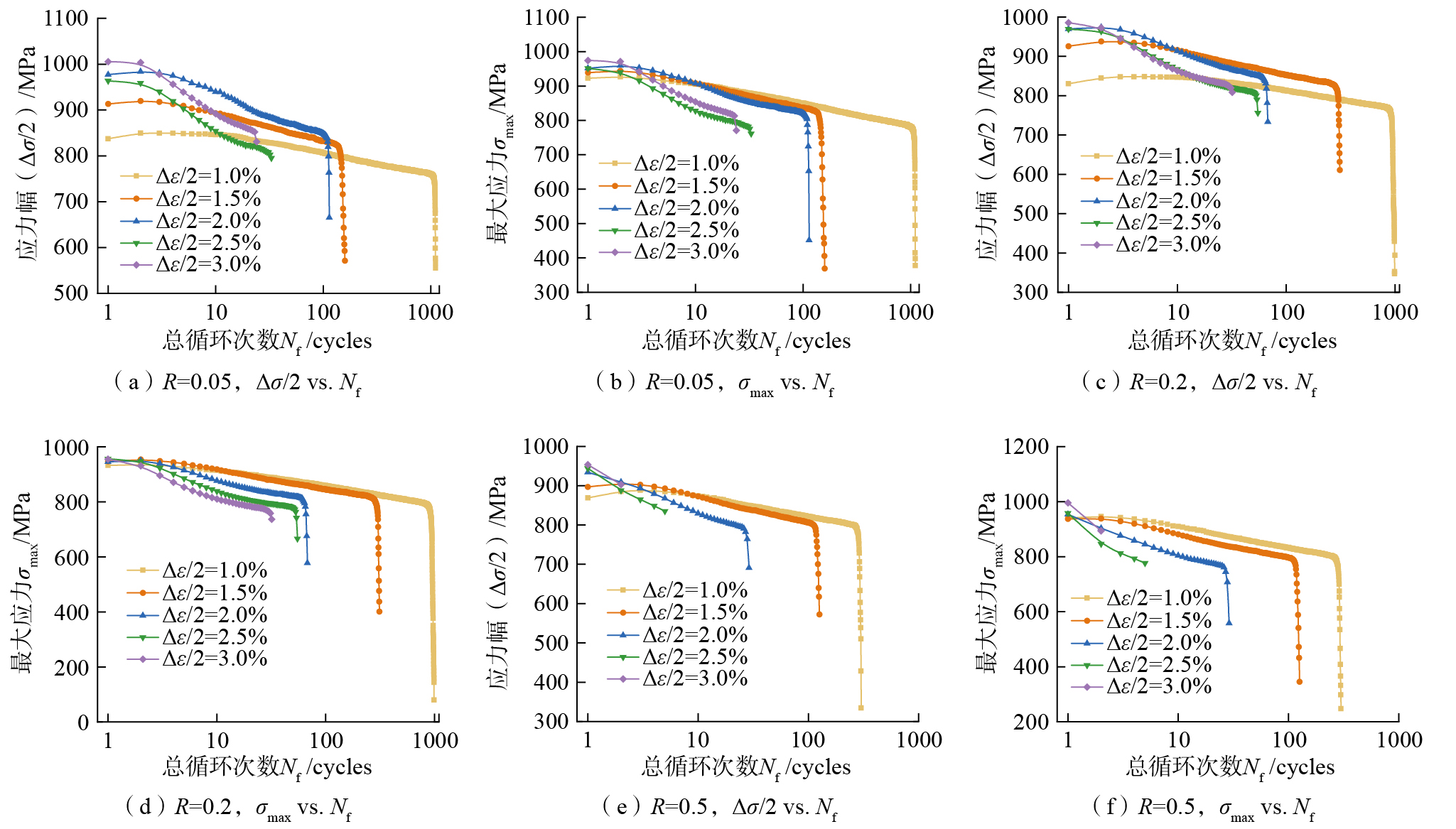
Fig.3 Δσ/2–cycle curves and σmax–cycle curves of TC4 titanium alloy at room temperature
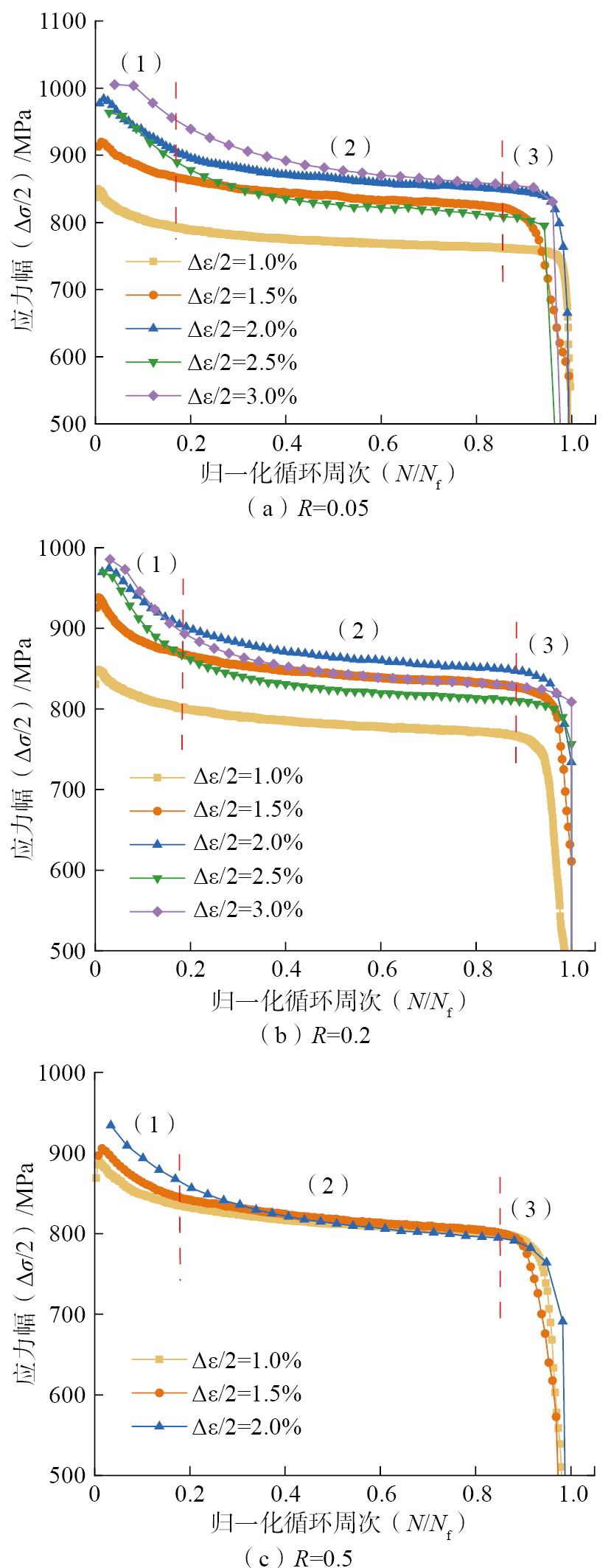
由图3可知,在相同的应变比下TC4钛合金在超低周疲劳试验过程中循环应力响应依赖于施加的应变幅(∆ε/2)值,具体表现为:当∆ε/2≤2.0%时,循环应力响应呈现轻微硬化后出现持续循环软化的特性;当∆ε/2>2.0%时,随着循环次数的增加,最大循环应力或循环应力幅持续稳定下降,表现持续循环软化的特性。σmax或Δσ/2随Nf的变化表现出相似的循环应力响应规律,TC4合金在超低周疲劳试验中,主要表现出稳定的循环软化特性,在许多TC4钛合金的特性研究[ JHA J S, DHALA S, TOPPO S P, et al. Effect of strain amplitude on low cycle fatigue and microstructure evolution in Ti–6Al–4V : A TKD and TEM characterization[J]. Materials Characterization, 2019, 155: 109829. XU H F, YE D Y, MEI L B. A study of the back stress and the friction stress behaviors of Ti–6Al–4V alloy during low cycle fatigue at room temperature[J]. Materials Science and Engineering: A, 2017, 700: 530–539. WANG Q, REN J Q, XIN C, et al. Low cycle fatigue behavior of near-alpha titanium alloys used in deep-driving submersible: Ti–6Al–3 Nb–2Zr–1Mo vs. Ti–6Al–4 V ELI[J]. Journal of Alloys and Compounds, 2023, 934: 167856. 罗云蓉, 王清远, 刘永杰, 等. Q235、Q345钢结构材料的低周疲劳性能[J]. 四川大学学报(工程科学版), 2012, 44(2): 169–175.LUO Yunrong, WANG Qingyuan, LIU Yongjie, et al. Low cycle fatigue properties of steel structure materials Q235 and Q345[J]. Journal of Sichuan University (Engineering Science Edition), 2012, 44(2): 169–175. 20-23]中均观测到与本文相同的循环软化现象。
值得注意的是,在较大∆ε/2下(∆ε/2>2.0%时),循环软化非常迅速,这是由于此时材料内部的损伤较为严重,损伤随着循环加载进程而快速发展。文献[ VINJAMURI R, DWIVEDI P K, SABAT R K, et al. Role of crystallographic orientation on the deformation behaviour of Ti–6Al–4V alloy during low cycle fatigue[J]. Philosophical Magazine, 2023, 103(7): 673–692. 18]中指出,较高应变幅下的循环变形有利于位错的重排并形成亚晶粒,这可能是导致循环加载时应力降低的原因。
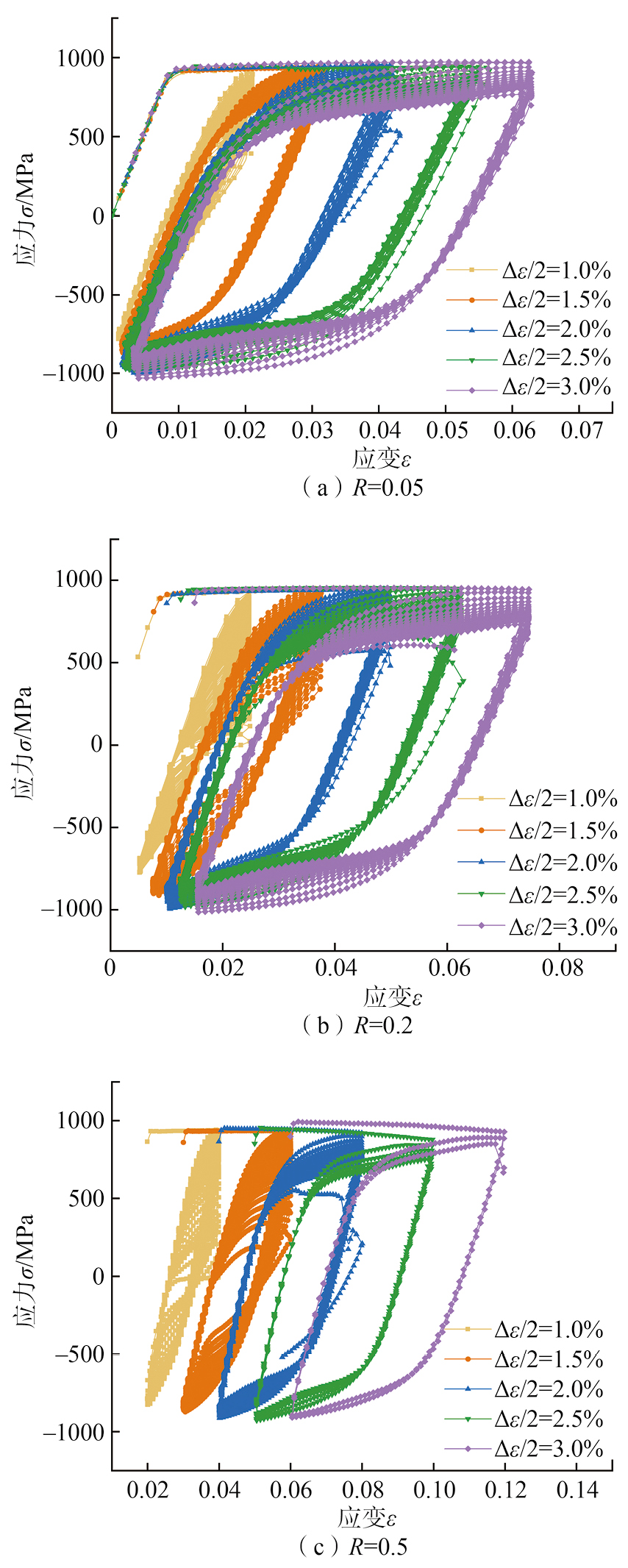
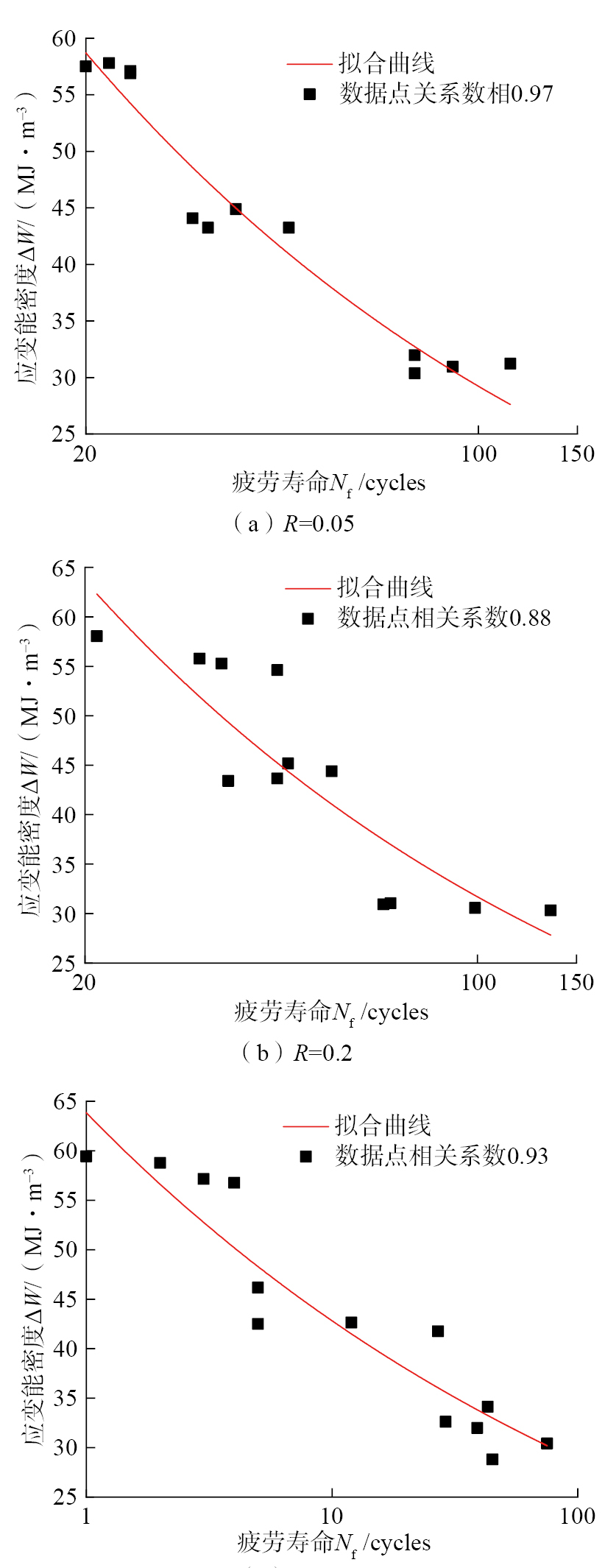
不同试件应变能密度由半寿命应力–应变滞回曲线面积得到[ 姚卫星. 结构疲劳寿命分析[M]. 北京: 科学出版社, 2019.YAO Weixing. Fatigue life estimation of structures[M]. Beijing: Science Press, 2019. 24],其结果平均值如表1所示。对于超低周疲劳这种较大载荷加载,同一应变幅下,不同应变比的试件平均应变能密度相似;在同一应变比下,试件平均应变能密度随着加载应变幅的增加而增大,平均应变能密度与应变幅近似呈线性关系。
表1 试件平均应变能密度
Table 1 Specimen average strain energy density
(MJ ·m–3)
应变比R
应变幅(∆ε/2)/%
1.0
1.5
2.0
2.5
3.0
0.05
5.191
18.725
31.125
43.863
57.324
0.2
5.800
17.467
30.720
44.148
55.921
0.5
6.891
17.493
31.581
43.259
58.020
2.3 超低周疲劳寿命特性
2.3.1 应变–寿命曲线
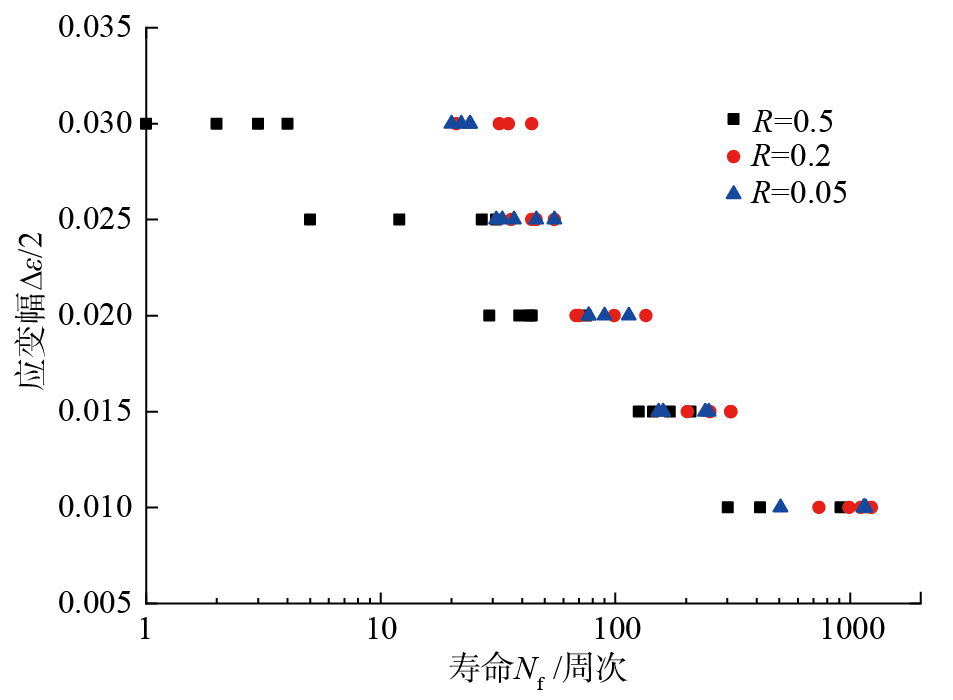
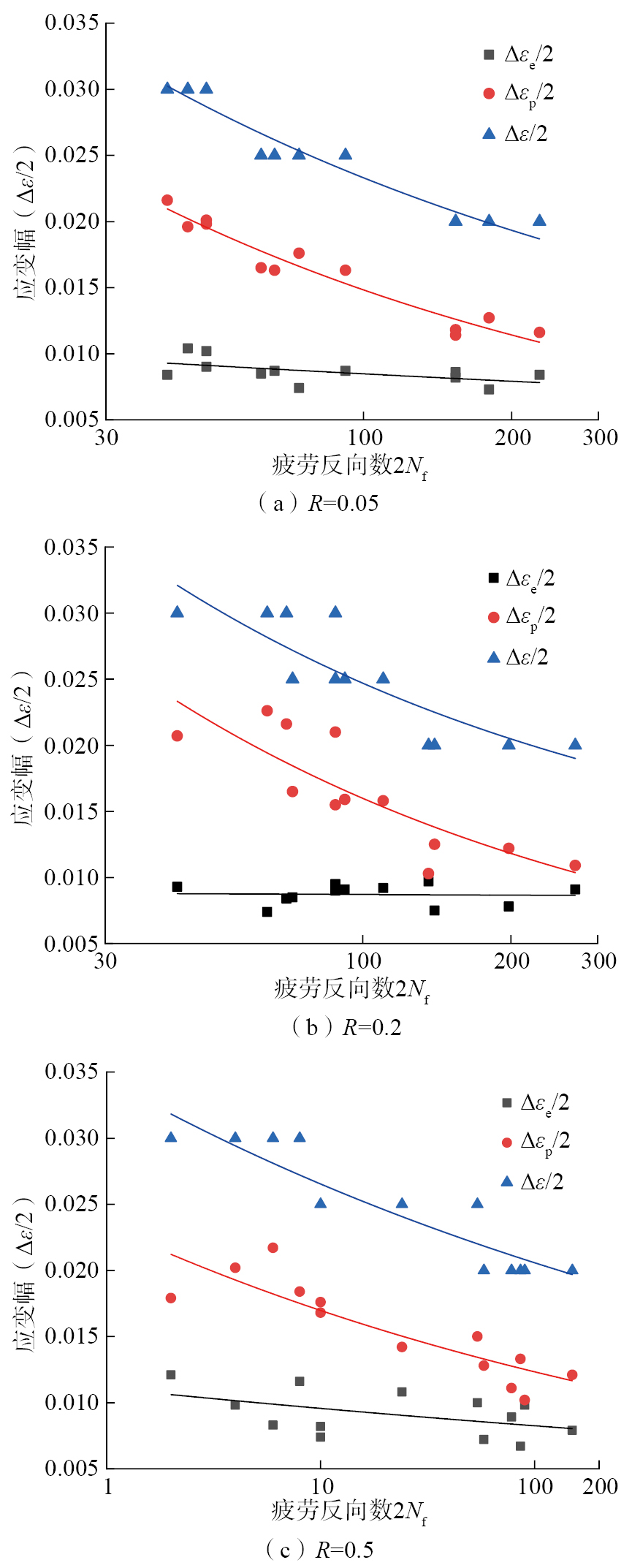
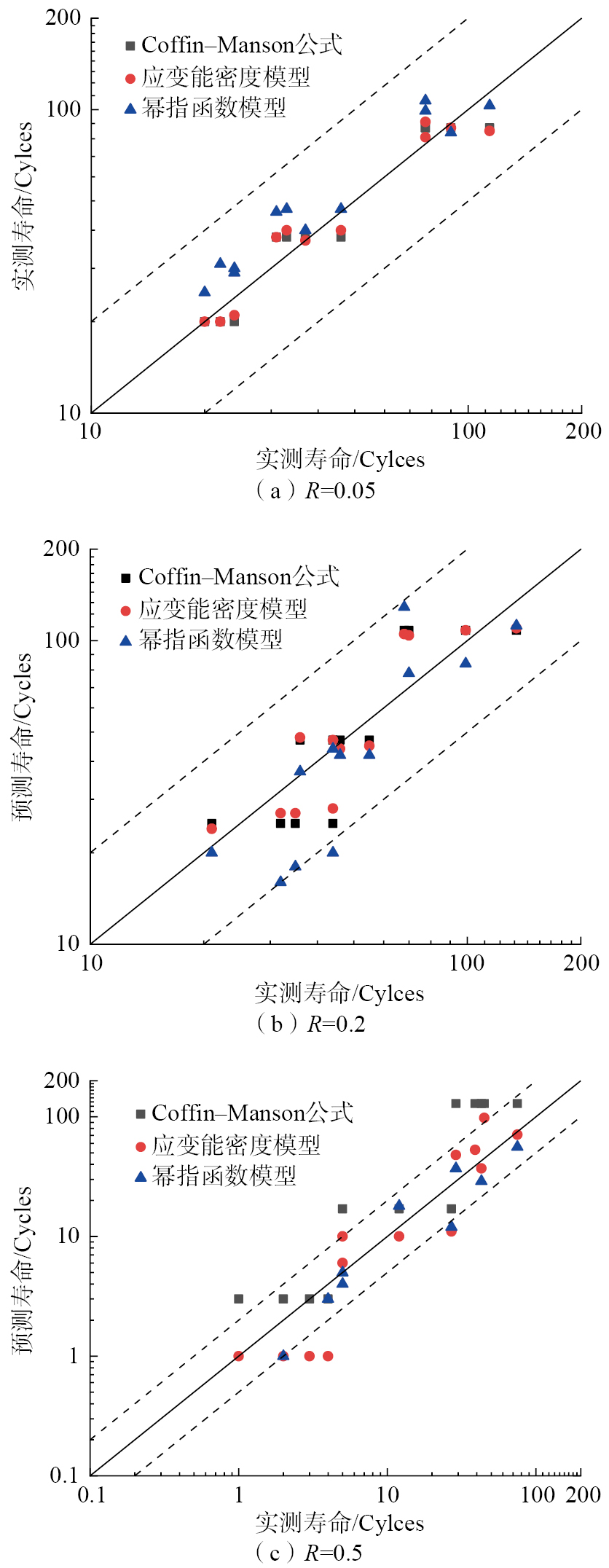
Coffin–Manson公式[ GE H B, KANG L. A damage index-based evaluation method for predicting the ductile crack initiation in steel structures[J]. Journal of Earthquake Engineering, 2012, 16(5): 623–643. 25]是应用最多的低周疲劳寿命模型之一。已有部分研究工作表明,Coffin–Manson方程对超低周疲劳寿命的预测具有一定的适用性[ LONG J, ZHANG L J, ZHU L, et al. Comparison of low-cycle fatigue properties of two kinds of high energy beam welded joints of TC4 alloy[J]. Transactions of Nonferrous Metals Society of China, 2023, 33(11): 3376–3386. 15, 甘露萍, 黄洪钟, 袁容, 等. 基于总应变能密度的轮盘低周疲劳寿命模型及可靠性研究[J]. 中国科技论文, 2012, 7(8): 616–621.GAN Luping, HUANG Hongzhong, YUAN Rong, et al. Low cyclic fatigue life model and reliability analysis of turbine disks using total strain energy density[J]. China Sciencepaper, 2012, 7(8): 616–621. 26]。在较大循环荷载下,材料进入弹塑性变形阶段,材料最薄弱位置的总应变幅对疲劳寿命的作用可以表示为弹性应变幅与塑性应变幅的共同作用。
Fig.6 Total strain-life curves of ultra-low cycle fatigue test at different strain ratios of TC4 at room temperature
2.3.2 基于应变能密度的疲劳寿命曲线
疲劳损伤过程实际上就是一个能耗过程,每一循环损伤能为材料在该循环下吸收的塑性应变能,因而基于能量准则的损伤模型,可能会更贴近工程实际[ 甘露萍, 黄洪钟, 袁容, 等. 基于总应变能密度的轮盘低周疲劳寿命模型及可靠性研究[J]. 中国科技论文, 2012, 7(8): 616–621.GAN Luping, HUANG Hongzhong, YUAN Rong, et al. Low cyclic fatigue life model and reliability analysis of turbine disks using total strain energy density[J]. China Sciencepaper, 2012, 7(8): 616–621. 26]。故本文基于能量准则,采用应变能密度模型。
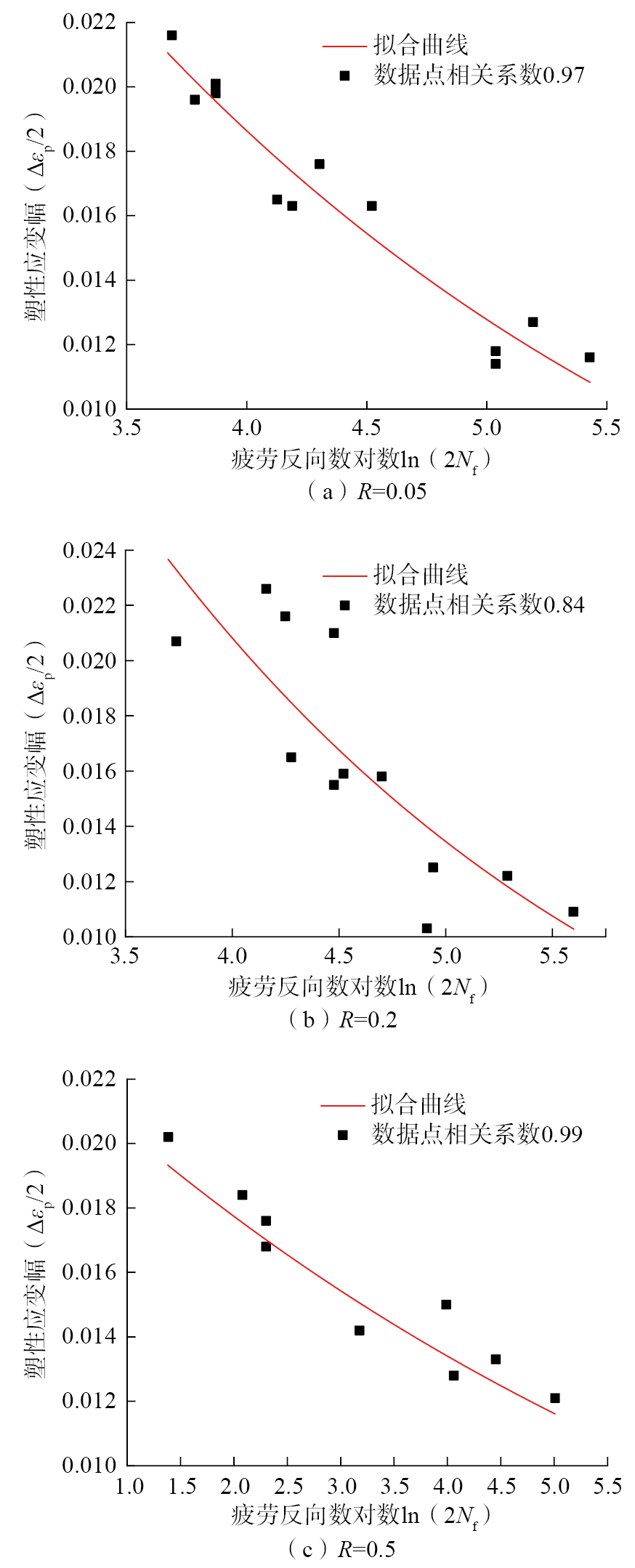
2.3.3 幂指函数模型[ XI J J, HU Y, XING H, et al. The low-cycle fatigue behavior, failure mechanism and prediction of SLM Ti–6Al–4V alloy with different heat treatment methods[J]. Materials, 2021, 14(21): 6276. 19]
张灿, 王轶鹏, 叶蕾. 国外近十年高超声速飞行器技术发展综述[J]. 战术导弹技术, 2020(6): 81–86. ZHANGCan, WANGYipeng, YELei. Summary of the technological development of overseas hypersonics in the past ten years[J]. Tactical Missile Technology, 2020(6): 81–86.
[2]
乙晓伟, 王泓, 杨智, 等. 2124–T851厚板S向超低周疲劳行为及断裂特征[J]. 稀有金属材料与工程, 2014, 43(6): 1347–1351. YIXiaowei, WANGHong, YANGZhi, et al. Extremely low cycle fatigue behavior and fracture characteristics of 2124–T851 thick plate in short transverse direction[J]. Rare Metal Materials and Engineering, 2014, 43(6): 1347–1351.
[3]
李有堂, 谭帅, 段红燕. 轴向加载条件下中碳钢的超低周疲劳断裂设计[J]. 兰州理工大学学报, 2007, 33(3): 156–160. LIYoutang, TANShuai, DUANHongyan. Fracture design of medium carbon steel with extra-low cyclic fatigue under axial loading[J]. Journal of Lanzhou University of Technology, 2007, 33(3): 156–160.
[4]
罗云蓉, 王清远, 付磊, 等. 地震频率对Q235钢结构材料超低周疲劳行为的影响[J]. 实验力学, 2018, 33(5): 743–750. LUOYunrong, WANGQingyuan, FULei, et al. On the effect of seismic frequency on extremely low cycle fatigue behaviors of Q235 steel structure material[J]. Journal of Experimental Mechanics, 2018, 33(5): 743–750.
[5]
吴鑫, 付磊, 张应迁, 等. 氢对30CrMo钢拉伸和超低周疲劳性能的影响[J]. 钢铁研究学报, 2024, 36(3): 378–388. WUXin, FULei, ZHANGYingqian, et al. Effect of hydrogen on tensile and ultra-low cycle fatigue properties of 30CrMo steel[J]. Journal of Iron and Steel Research.2024, 36(3): 378–388.
[6]
KANGL, GEH B. Predicting ductile crack initiation of steel bridge structures due to extremely low-cycle fatigue using local and non-local models[J]. Journal of Earthquake Engineering, 2013, 17(3): 323–349.
[7]
PEREIRAJ C R, DE JESUSA M P, XAVIERJ, et al. Ultra low-cycle fatigue behaviour of a structural steel[J]. Engineering Structures, 2014, 60: 214–222.
[8]
XUEL. A unified expression for low cycle fatigue and extremely low cycle fatigue and its implication for monotonic loading[J]. International Journal of Fatigue, 2008, 30(10–11): 1691–1698.
[9]
KURODAM. Extremely low cycle fatigue life prediction based on a new cumulative fatigue damage model[J]. International Journal of Fatigue, 2002, 24(6): 699–703.
[10]
陈立杰, 冮铁强, 谢里阳. 应用幂变换法构造低周疲劳寿命预测的幂指函数模型[J]. 航空学报, 2006, 27(2): 267–271. CHENLijie, GANGTieqiang, XIELiyang. Power-exponent function model of low-cycle fatigue life prediction based on power transformation methods[J]. Acta Aeronautica et Astronautica Sinica, 2006, 27(2): 267–271.
[11]
SHAOC W, ZHANGP, LIUR, et al. Low-cycle and extremely-low-cycle fatigue behaviors of high-Mn austenitic TRIP/TWIP alloys: Property evaluation, damage mechanisms and life prediction[J]. Acta Materialia, 2016, 103: 781–795.
[12]
SHIG, GAOY, WANGX, et al. Energy-based low cycle fatigue analysis of low yield point steels[J]. Journal of Constructional Steel Research, 2018, 150: 346–353.
[13]
班慧勇, 杨晓峰, 石永久. 基于应变能的不锈钢复合钢材低周疲劳性能研究[J]. 建筑结构学报, 2023, 44(12): 216–224. BANHuiyong, YANGXiaofeng, SHIYongjiu. Strain energy-based low-cycle fatigue behaviour analyses of stainless-clad bimetallic steel[J]. Journal of Building Structures, 2023, 44(12): 216–224.
[14]
白澄岩, 兰亮, 辛如意, 等. 增材制造Ti–6Al–4V钛合金低周疲劳性能研究进展[J]. 材料科学与工艺, 2023, 31(1): 79–90. BAIChengyan, LANLiang, XINRuyi, et al. Research progress on low-cycle fatigue properties of Ti–6Al–4V alloy by additive manufacturing[J]. Materials Science and Technology, 2023, 31(1): 79–90.
[15]
LONGJ, ZHANGL J, ZHUL, et al. Comparison of low-cycle fatigue properties of two kinds of high energy beam welded joints of TC4 alloy[J]. Transactions of Nonferrous Metals Society of China, 2023, 33(11): 3376–3386.
[16]
KIMURAY, OGAWAF, ITOHT. Fatigue property of additively manufactured Ti–6Al–4V under nonproportional multiaxial loading[J]. Chinese Journal of Mechanical Engineering, 2021, 34(1): 103.
[17]
WUM, ITOHT, SHIMIZUY, et al. Low cycle fatigue life of Ti–6Al–4V alloy under non-proportional loading[J]. International Journal of Fatigue, 2012, 44: 14–20.
[18]
VINJAMURIR, DWIVEDIP K, SABATR K, et al. Role of crystallographic orientation on the deformation behaviour of Ti–6Al–4V alloy during low cycle fatigue[J]. Philosophical Magazine, 2023, 103(7): 673–692.
[19]
XIJ J, HUY, XINGH, et al. The low-cycle fatigue behavior, failure mechanism and prediction of SLM Ti–6Al–4V alloy with different heat treatment methods[J]. Materials, 2021, 14(21): 6276.
[20]
JHAJ S, DHALAS, TOPPOS P, et al. Effect of strain amplitude on low cycle fatigue and microstructure evolution in Ti–6Al–4V : A TKD and TEM characterization[J]. Materials Characterization, 2019, 155: 109829.
[21]
XUH F, YED Y, MEIL B. A study of the back stress and the friction stress behaviors of Ti–6Al–4V alloy during low cycle fatigue at room temperature[J]. Materials Science and Engineering: A, 2017, 700: 530–539.
[22]
WANGQ, RENJ Q, XINC, et al. Low cycle fatigue behavior of near-alpha titanium alloys used in deep-driving submersible: Ti–6Al–3 Nb–2Zr–1Mo vs. Ti–6Al–4 V ELI[J]. Journal of Alloys and Compounds, 2023, 934: 167856.
[23]
罗云蓉, 王清远, 刘永杰, 等. Q235、Q345钢结构材料的低周疲劳性能[J]. 四川大学学报(工程科学版), 2012, 44(2): 169–175. LUOYunrong, WANGQingyuan, LIUYongjie, et al. Low cycle fatigue properties of steel structure materials Q235 and Q345[J]. Journal of Sichuan University (Engineering Science Edition), 2012, 44(2): 169–175.
[24]
姚卫星. 结构疲劳寿命分析[M]. 北京: 科学出版社, 2019. YAOWeixing. Fatigue life estimation of structures[M]. Beijing: Science Press, 2019.
[25]
GEH B, KANGL. A damage index-based evaluation method for predicting the ductile crack initiation in steel structures[J]. Journal of Earthquake Engineering, 2012, 16(5): 623–643.
[26]
甘露萍, 黄洪钟, 袁容, 等. 基于总应变能密度的轮盘低周疲劳寿命模型及可靠性研究[J]. 中国科技论文, 2012, 7(8): 616–621. GANLuping, HUANGHongzhong, YUANRong, et al. Low cyclic fatigue life model and reliability analysis of turbine disks using total strain energy density[J]. China Sciencepaper, 2012, 7(8): 616–621.
目录
摘要
关键词
Abstract
Keywords
1 试验材料与超低周疲劳试验方法
2 试验结果与讨论
2.1 循环应力响应特性
2.2 应力–应变滞回线
2.3 超低周疲劳寿命特性
2.3.1 应变–寿命曲线
2.3.2 基于应变能密度的疲劳寿命曲线
2.3.3 幂指函数模型[ XI J J, HU Y, XING H, et al. The low-cycle fatigue behavior, failure mechanism and prediction of SLM Ti–6Al–4V alloy with different heat treatment methods[J]. Materials, 2021, 14(21): 6276. 19]