Study on Effect of Meshing Treatment on Electrothermal Temperature Distribution of Carbon Nanotube Films
Citations
YAN Ruobin, MAO Xinjie, PENG Chong, et al. Study on effect of meshing treatment on electrothermal temperature distribution of carbon nanotube films[J]. Aeronautical Manufacturing Technology, 2025, 68(21): 114–121.
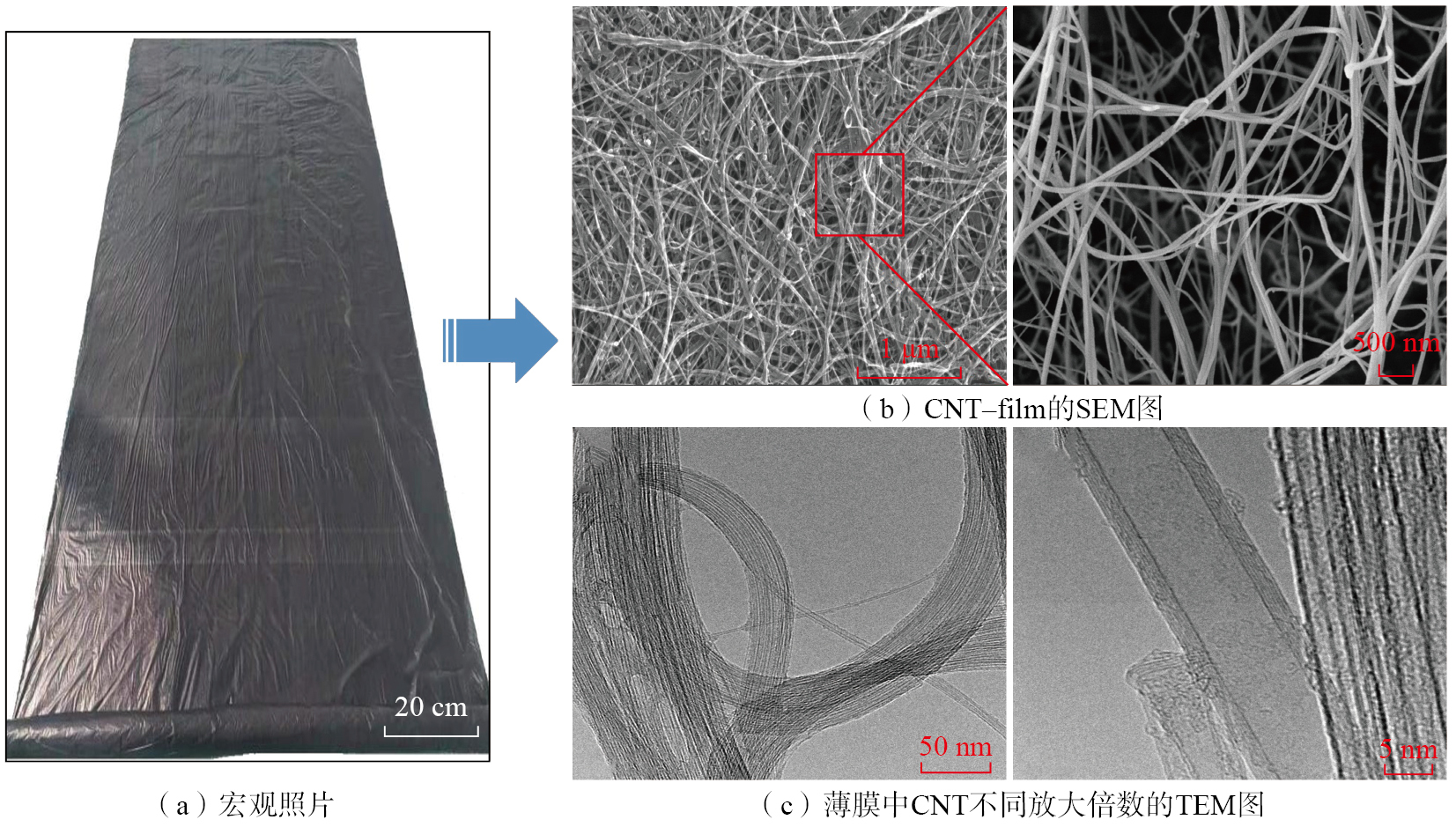
图1 CNT–film的形貌[ HUANG Y F, YANG K, GAO J, et al. Study on the law and mechanism of anisotropic conductivity of carbon nanotubes film prepared by floating catalytic chemical vapor deposition method[J]. Journal of Materials Research and Technology, 2023, 26: 3571–3585. 21]
1.School of Mechanical, Electrical & Information Engineering, Shandong University, Weihai264209, China
2.Composites Technology Center, AVIC Manufacturing Technology Institute, Beijing100024, China
Citations
YAN Ruobin, MAO Xinjie, PENG Chong, et al. Study on effect of meshing treatment on electrothermal temperature distribution of carbon nanotube films[J]. Aeronautical Manufacturing Technology, 2025, 68(21): 114–121.
Abstract
The electrothermal properties of meshed carbon nanotube film (CNT–film) were investigated by means of simulation and experimental verification. Firstly, the influence of different mesh shape, orientation, mesh spacing and fillet radius on the temperature distribution and uniformity of electric heating element was studied by finite element analysis. The results demonstrate that the temperature distribution uniformity of CNT–film heating element is the best when the parameters of square grid, vertical current direction, mesh spacing d of 5 mm and fillet radius r of 1 mm were adopted. Then, on the basis of simulation optimization, experiments are carried out to verify the reliability of simulation results. The experimental results are consistent with the simulation results, indicating that the meshing scheme can significantly improve temperature uniformity and resistance value of CNT–film electric heating elements, avoiding the problems of uneven temperature distribution and high local temperature caused by uneven surface electrical properties of traditional CNT–film electric heating elements. The optimization scheme not only expands the potential use of CNT–film in surface heating area, but also provides a new idea and method for designing heating elements with local opened pore.
Keywords
Carbon nanotube film; Meshing; Electrothermal property; Finite element analysis; Temperature distribution;
电致加热技术在工业领域的应用极为广泛,包括电动汽车电池加热与保温[ KHAN A, YAQUB S, ALI M, et al. A state-of-the-art review on heating and cooling of lithium-ion batteries for electric vehicles[J]. Journal of Energy Storage, 2024, 76: 109852. 1]、飞机前缘与后缘防/除冰[ ZHANG Y N, WEI J, LIU C, et al. Reduced graphene oxide modified Ti/CFRP structure-function integrated laminates for surface Joule heating and deicing[J]. Composites Part A: Applied Science and Manufacturing, 2023, 166: 107377. 2]、寒冷地区电子元器件的温控保护[ BELL L E. Cooling, heating, generating power, and recovering waste heat with thermoelectric systems[J]. Science, 2008, 321(5895): 1457–1461. 3]等。这项技术主要依赖焦耳热效应,通过电阻元件将电能转化为热能[ SHI L, GE R Q, TAN N C, et al. Non-contact heating methods of carbon fiber thermoplastic composites based on Joule thermal properties: Optimization and validation[J]. Carbon, 2024, 219: 118830. 4]。目前常用的电热材料有金属基电阻丝、陶瓷基硅碳棒、硅钼棒及新型碳基薄膜和石墨烯[ HONG S, LEE H, LEE J, et al. Highly stretchable and transparent metal nanowire heater for wearable electronics applications[J]. Advanced Materials, 2015, 27(32): 4744–4751. JANUSZKIEWICZ K T. Numerical model of the heating-up system with heating rods[J]. Advances in Engineering Software, 1999, 30(2): 141–145. ZHU Z, LU H, ZHAO W J, et al. Materials, performances and applications of electric heating films[J]. Renewable and Sustainable Energy Reviews, 2023, 184: 113540. 5-7]。传统的金属和陶瓷基加热材料多为丝状或棒状,电热转换效率较低,且难以满足面内均匀加热的要求。因此,各领域对以碳纳米管薄膜、石墨烯为加热体的面状均匀加热技术的关注度越来越高[ LI R Y, ZHANG L B, SHI L, et al. MXene Ti3C2: An effective 2D light-to-heat conversion material[J]. ACS Nano, 2017, 11(4): 3752–3759. 8]。
相较于传统电阻丝加热,面状加热具有更大的法向散热面积,发热效率和热利用效率较丝状或棒状加热体明显提高[ ZHONG Y D, TANG W, ZHANG C, et al. Programmable thermochromic soft actuators with “two dimensional” bilayer architectures for soft robotics[J]. Nano Energy, 2022, 102: 107741. KOSTARAS C, PAVLOU C, KOUTROUMANIS N, et al. Rapid resistive heating in graphene/carbon nanotube hybrid films for de-icing applications[J]. ACS Applied Nano Materials, 2023, 6(7): 5155–5167. CHENG X, CAI J, LIU P, et al. Multifunctional flexible MXene/AgNW composite thin film with ultrahigh conductivity enabled by a sandwich-structured assembly strategy[J]. Small, 2024, 20(3): 2304327. 9-11]。例如,Hu等[ HU P Y, LYU J, FU C, et al. Multifunctional aramid nanofiber/carbon nanotube hybrid aerogel films[J]. ACS Nano, 2020, 14(1): 688–697. 12]制备了由碳纳米管、芳纶纳米纤维和氟碳树脂组成的复合膜,在10 V下可达到113.5 ℃的饱和温度。Jia等[ JIA P F, ZHU Y L, LU J Y, et al. Multifunctional fireproof electromagnetic shielding polyurethane films with thermal management performance[J]. Chemical Engineering Journal, 2022, 439: 135673. 13]通过微胶囊化技术将导电MXene包裹的聚磷酸铵加入到聚氨酯薄膜中,制备了厚度为1.0 mm的MXene/聚氨酯复合膜,在6 V下表面温度可达68.1 ℃。Li等[ LI D Q, TANG B, LU X, et al. Hierarchically carbonized silk/ceramic composites for electro-thermal conversion[J]. Composites Part A: Applied Science and Manufacturing, 2021, 141: 106237. 14]将蚕丝织物和蚕茧作为碳质前驱体,制备了碳化纤维/陶瓷复合材料,在施加15 V电压时,其表面温度可达178.0 ℃。Abolhasani等[ ABOLHASANI A, PACHENARI A, MOHAMMAD RAZAVIAN S, et al. Towards new generation of electrode-free conductive cement composites utilizing nano carbon black[J]. Construction and Building Materials, 2022, 323: 126576. 15]采用纳米炭黑制得纳米炭黑/水泥复合材料,在60 V下的表面温度高达55.0 ℃。杨阔等[ 杨阔, 潘宝宇, 李小龙, 等. CNT薄膜电热原位共固化复合材料板的温度均匀性研究[J]. 固体火箭技术, 2024, 47(2): 237–245.YANG Kuo, PAN Baoyu, LI Xiaolong, et al. Temperature uniformity study of electrothermal in situ co-curing of composite plate with CNT film[J]. Journal of Solid Rocket Technology, 2024, 47(2): 237–245. 16]使用碳纳米管薄膜作为内源加热材料,所得薄膜在15 V下的表面温度可达180 ℃,并保持稳定。以上研究均表明,面状加热在实际生产中是一种高效的加热方式。
近年来,碳纳米管(CNT)等碳基电热材料获得了广泛关注,并在柔性可穿戴加热、理疗加热、地暖和墙暖等领域得到了应用[ ZHU Z, LU H, ZHAO W J, et al. Materials, performances and applications of electric heating films[J]. Renewable and Sustainable Energy Reviews, 2023, 184: 113540. 7, XIAO Z, SHENG C J, XIA Y, et al. Electrical heating behavior of flexible thermoplastic polyurethane/Super-P nanoparticle composite films for advanced wearable heaters[J]. Journal of Industrial and Engineering Chemistry, 2019, 71: 293–300. 17]。碳纳米管薄膜(CNT–film)是由nm级CNT通过长程有序排列组成的二维网络结构,具有优良的导电性和导热性,以及良好的拉伸强度和柔韧性,是一种理想的面状电热材料[ WU K J, NIU Y T, ZHANG Y Y, et al. Continuous growth of carbon nanotube films: From controllable synthesis to real applications[J]. Composites Part A: Applied Science and Manufacturing, 2021, 144: 106359. 18],其纯碳成分和自支撑结构使得该材料具备优越的耐高低温和耐酸碱环境特性。CNT–film的优异功能和微观多孔结构使之成为电热复合材料的理想选择,广泛应用于航天器局部加热、飞机电热除冰、仪表盘加热等领域[ LU W B, ZU M, BYUN J H, et al. State of the art of carbon nanotube fibers: Opportunities and challenges[J]. Advanced Materials, 2012, 24(14): 1805–1833. 19]。然而,在实际应用中,由于铆钉连接、仪表按键等功能要求,包括CNT–film在内的面状加热体内部常出现孔洞,单一孔洞可能对整体面状加热均匀性造成负面影响,导致局部过热,从而影响整体加热效果,甚至导致树脂基复合材料的局部失效[ CAMINERO M A, LOPEZ-PEDROSA M, PINNA C, et al. Damage monitoring and analysis of composite laminates with an open hole and adhesively bonded repairs using digital image correlation[J]. Composites Part B: Engineering, 2013, 53: 76–91. 20]。此外,现有商业化CNT–film常采用浮动催化剂化学气相沉积(FCCVD)法进行制备,方阻通常小于10 Ω/□,且由于收集碳纳米管时的明显随机性,导致产物出现明显的各向异性,其电阻可控范围有限,不利于加热元件的设计[ HUANG Y F, YANG K, GAO J, et al. Study on the law and mechanism of anisotropic conductivity of carbon nanotubes film prepared by floating catalytic chemical vapor deposition method[J]. Journal of Materials Research and Technology, 2023, 26: 3571–3585. 21]。
基于仿真结果,采用优化的网格切割方案,以验证CNT–film的电热效果。试验所用CNT–film由北京碳垣新材料科技有限公司提供,采用FCCVD法制得,形貌如图1所示[ HUANG Y F, YANG K, GAO J, et al. Study on the law and mechanism of anisotropic conductivity of carbon nanotubes film prepared by floating catalytic chemical vapor deposition method[J]. Journal of Materials Research and Technology, 2023, 26: 3571–3585. 21]。
图1 CNT–film的形貌[ HUANG Y F, YANG K, GAO J, et al. Study on the law and mechanism of anisotropic conductivity of carbon nanotubes film prepared by floating catalytic chemical vapor deposition method[J]. Journal of Materials Research and Technology, 2023, 26: 3571–3585. 21]
Fig.1 Morphology of CNT–film[ HUANG Y F, YANG K, GAO J, et al. Study on the law and mechanism of anisotropic conductivity of carbon nanotubes film prepared by floating catalytic chemical vapor deposition method[J]. Journal of Materials Research and Technology, 2023, 26: 3571–3585. 21]
Fig.3 Influence of mesh shape on distribution of electrothermal temperature of CNT–film
正方形网格上下顶点区域的电流密度较大(图3(e)),产生该现象的原因是电流的尖端效应,而尖端效应的本质源于导体尖端的几何形态[ WANG C P, YU X, ZHANG Y J, et al. Tip effect of a micro-needle in a diamond-coating external field[J]. Surface and Coatings Technology, 2019, 359: 239–246. CHEN Y J, DAI H C, WANG W, et al. Needleless electrospinning method based on tip effect of conductor[J]. Chemical Journal of Chinese Universities, 2017, 38(6): 975–981. 22-23]。根据电场分布规律,电场强度E与导体表面曲率半径r′成反比。导体尖端越尖锐,曲率半径越小,电荷越集中,电场强度越大。电流轨迹曲率在接近上下顶点区域时逐渐增大,因此该区域电流密度偏大;斜向通路的电流轨迹平缓,曲率较小,电流密度相对均匀。从图3(f)可以看出,正方形网格结构的整体温度分布较为均匀,区域温差较小。
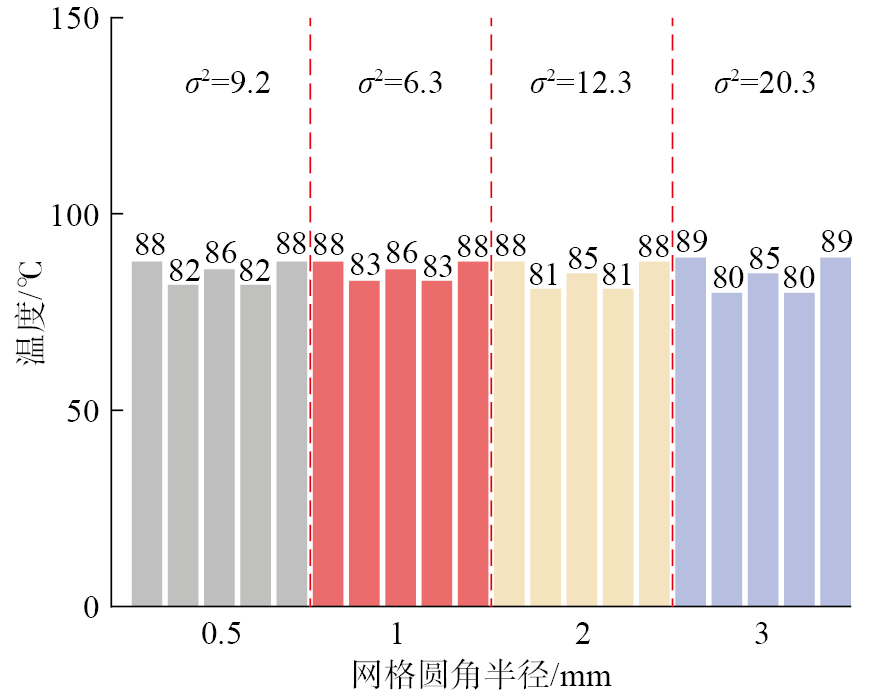
Fig.4 Variances of temperature distributions of different meshing models
2.2 取向方向对CNT–film温度分布的影响
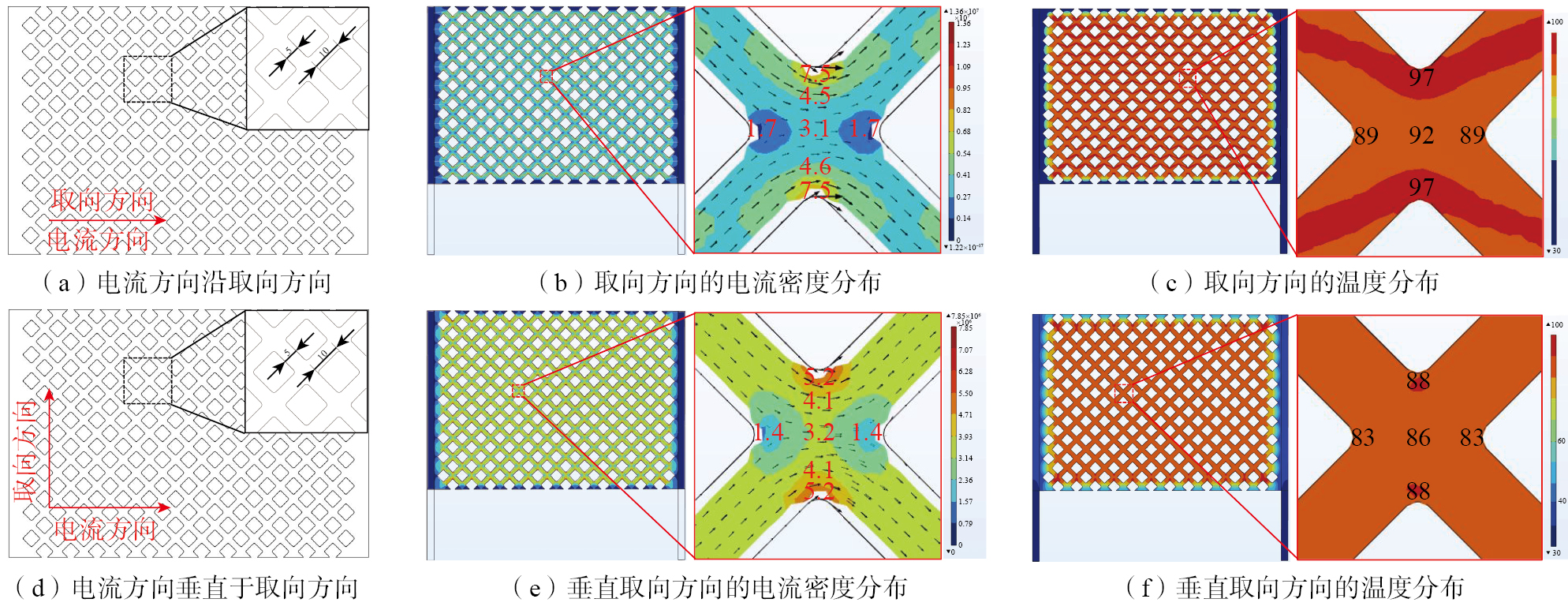
使用FCCVD法制备的CNT–film具有明显的取向性,取向方向的电导率高于垂直取向方向的电导率[ CHEN J H, LEKAWA-RAUS A, TREVARTHEN J, et al. Carbon nanotube films spun from a gas phase reactor for manufacturing carbon nanotube film/carbon fibre epoxy hybrid composites for electrical applications[J]. Carbon, 2020, 158: 282–290. 24]。本文所用CNT–film取向方向和垂直取向方向的电导率分别为6×10⁴ S/m和4×104 S/m(表1)。因此,分别针对电流沿取向方向和垂直取向方向的CNT–film进行电热仿真,探究电流方向对CNT–film电热温度分布均匀性的影响,结果如图5所示。
图5 电流方向对CNT–film电热温度分布的影响
Fig.5 Influence of current direction on distribution of electrothermal temperature of CNT–film
KHANA, YAQUBS, ALIM, et al. A state-of-the-art review on heating and cooling of lithium-ion batteries for electric vehicles[J]. Journal of Energy Storage, 2024, 76: 109852.
[2]
ZHANGY N, WEIJ, LIUC, et al. Reduced graphene oxide modified Ti/CFRP structure-function integrated laminates for surface Joule heating and deicing[J]. Composites Part A: Applied Science and Manufacturing, 2023, 166: 107377.
[3]
BELLL E. Cooling, heating, generating power, and recovering waste heat with thermoelectric systems[J]. Science, 2008, 321(5895): 1457–1461.
[4]
SHIL, GER Q, TANN C, et al. Non-contact heating methods of carbon fiber thermoplastic composites based on Joule thermal properties: Optimization and validation[J]. Carbon, 2024, 219: 118830.
[5]
HONGS, LEEH, LEEJ, et al. Highly stretchable and transparent metal nanowire heater for wearable electronics applications[J]. Advanced Materials, 2015, 27(32): 4744–4751.
[6]
JANUSZKIEWICZK T. Numerical model of the heating-up system with heating rods[J]. Advances in Engineering Software, 1999, 30(2): 141–145.
[7]
ZHUZ, LUH, ZHAOW J, et al. Materials, performances and applications of electric heating films[J]. Renewable and Sustainable Energy Reviews, 2023, 184: 113540.
[8]
LIR Y, ZHANGL B, SHIL, et al. MXene Ti3C2: An effective 2D light-to-heat conversion material[J]. ACS Nano, 2017, 11(4): 3752–3759.
[9]
ZHONGY D, TANGW, ZHANGC, et al. Programmable thermochromic soft actuators with “two dimensional” bilayer architectures for soft robotics[J]. Nano Energy, 2022, 102: 107741.
[10]
KOSTARASC, PAVLOUC, KOUTROUMANISN, et al. Rapid resistive heating in graphene/carbon nanotube hybrid films for de-icing applications[J]. ACS Applied Nano Materials, 2023, 6(7): 5155–5167.
[11]
CHENGX, CAIJ, LIUP, et al. Multifunctional flexible MXene/AgNW composite thin film with ultrahigh conductivity enabled by a sandwich-structured assembly strategy[J]. Small, 2024, 20(3): 2304327.
[12]
HUP Y, LYUJ, FUC, et al. Multifunctional aramid nanofiber/carbon nanotube hybrid aerogel films[J]. ACS Nano, 2020, 14(1): 688–697.
[13]
JIAP F, ZHUY L, LUJ Y, et al. Multifunctional fireproof electromagnetic shielding polyurethane films with thermal management performance[J]. Chemical Engineering Journal, 2022, 439: 135673.
[14]
LID Q, TANGB, LUX, et al. Hierarchically carbonized silk/ceramic composites for electro-thermal conversion[J]. Composites Part A: Applied Science and Manufacturing, 2021, 141: 106237.
[15]
ABOLHASANIA, PACHENARIA, MOHAMMAD RAZAVIANS, et al. Towards new generation of electrode-free conductive cement composites utilizing nano carbon black[J]. Construction and Building Materials, 2022, 323: 126576.
[16]
杨阔, 潘宝宇, 李小龙, 等. CNT薄膜电热原位共固化复合材料板的温度均匀性研究[J]. 固体火箭技术, 2024, 47(2): 237–245. YANGKuo, PANBaoyu, LIXiaolong, et al. Temperature uniformity study of electrothermal in situ co-curing of composite plate with CNT film[J]. Journal of Solid Rocket Technology, 2024, 47(2): 237–245.
[17]
XIAOZ, SHENGC J, XIAY, et al. Electrical heating behavior of flexible thermoplastic polyurethane/Super-P nanoparticle composite films for advanced wearable heaters[J]. Journal of Industrial and Engineering Chemistry, 2019, 71: 293–300.
[18]
WUK J, NIUY T, ZHANGY Y, et al. Continuous growth of carbon nanotube films: From controllable synthesis to real applications[J]. Composites Part A: Applied Science and Manufacturing, 2021, 144: 106359.
[19]
LUW B, ZUM, BYUNJ H, et al. State of the art of carbon nanotube fibers: Opportunities and challenges[J]. Advanced Materials, 2012, 24(14): 1805–1833.
[20]
CAMINEROM A, LOPEZ-PEDROSAM, PINNAC, et al. Damage monitoring and analysis of composite laminates with an open hole and adhesively bonded repairs using digital image correlation[J]. Composites Part B: Engineering, 2013, 53: 76–91.
[21]
HUANGY F, YANGK, GAOJ, et al. Study on the law and mechanism of anisotropic conductivity of carbon nanotubes film prepared by floating catalytic chemical vapor deposition method[J]. Journal of Materials Research and Technology, 2023, 26: 3571–3585.
[22]
WANGC P, YUX, ZHANGY J, et al. Tip effect of a micro-needle in a diamond-coating external field[J]. Surface and Coatings Technology, 2019, 359: 239–246.
[23]
CHENY J, DAIH C, WANGW, et al. Needleless electrospinning method based on tip effect of conductor[J]. Chemical Journal of Chinese Universities, 2017, 38(6): 975–981.
[24]
CHENJ H, LEKAWA-RAUSA, TREVARTHENJ, et al. Carbon nanotube films spun from a gas phase reactor for manufacturing carbon nanotube film/carbon fibre epoxy hybrid composites for electrical applications[J]. Carbon, 2020, 158: 282–290.