Design, Manufacturing, and Application Exploration of Direct Ink Writing 3D Printed Sensors
Citations
LI Maoyang, YU Peishi, ZHU Zhinan, et al. Design, manufacturing, and application exploration of direct ink writing 3D printed sensors[J]. Aeronautical Manufacturing Technology, 2025, 68(21): 88–103.
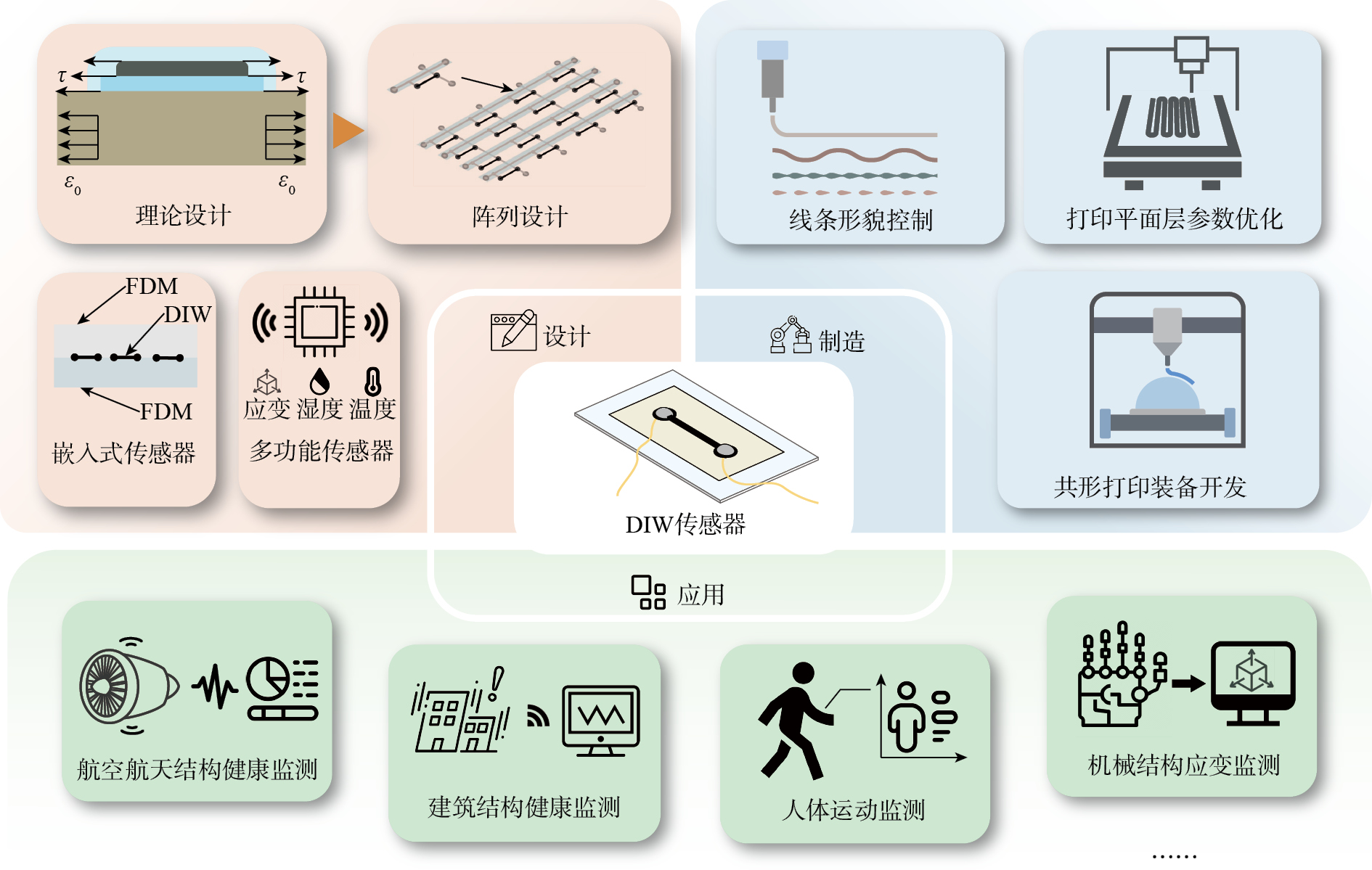
图1 DIW 3D打印传感器在设计、制造、应用方面的研究进展
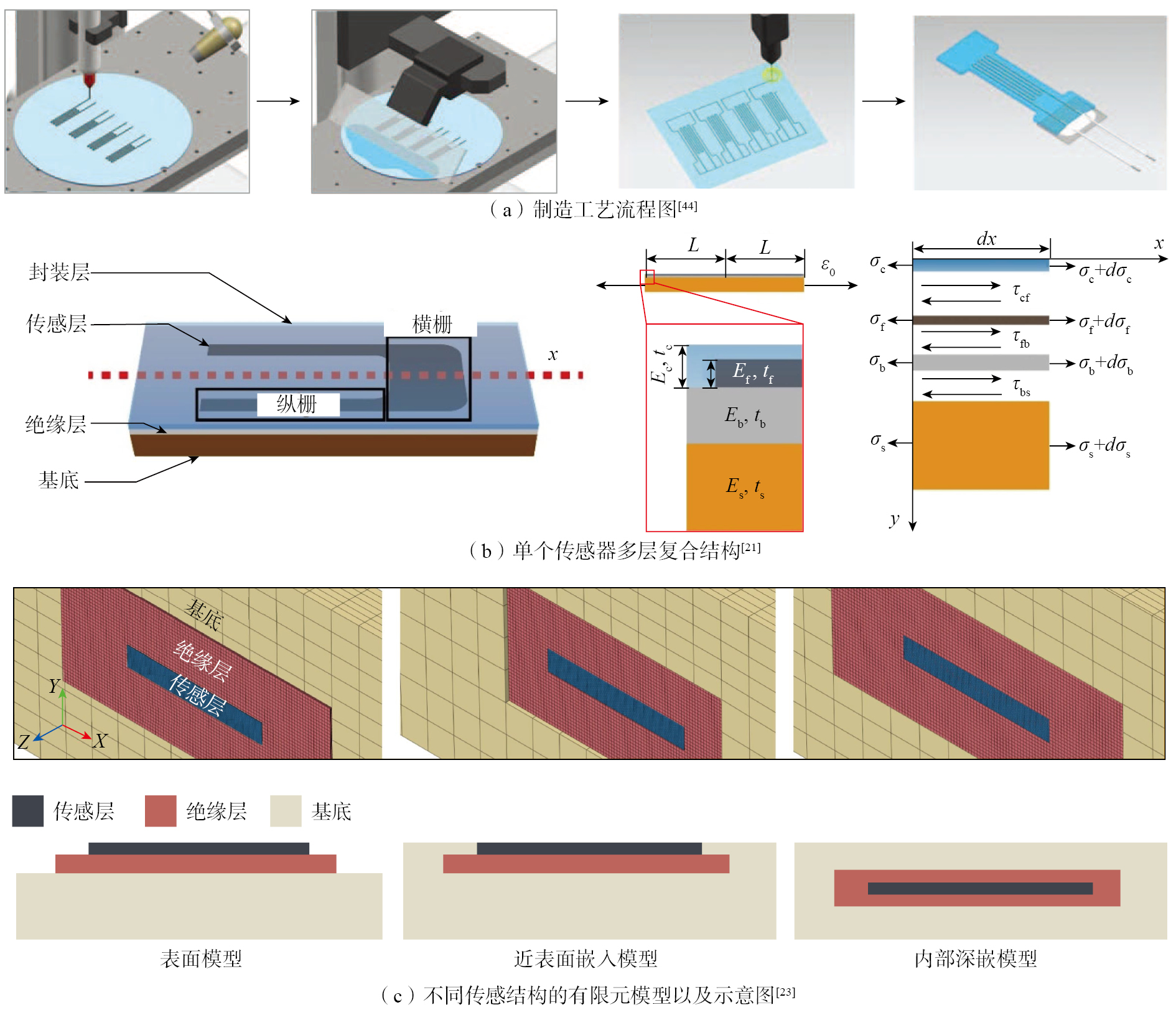
图2 单个DIW传感器复合结构设计的研究进展
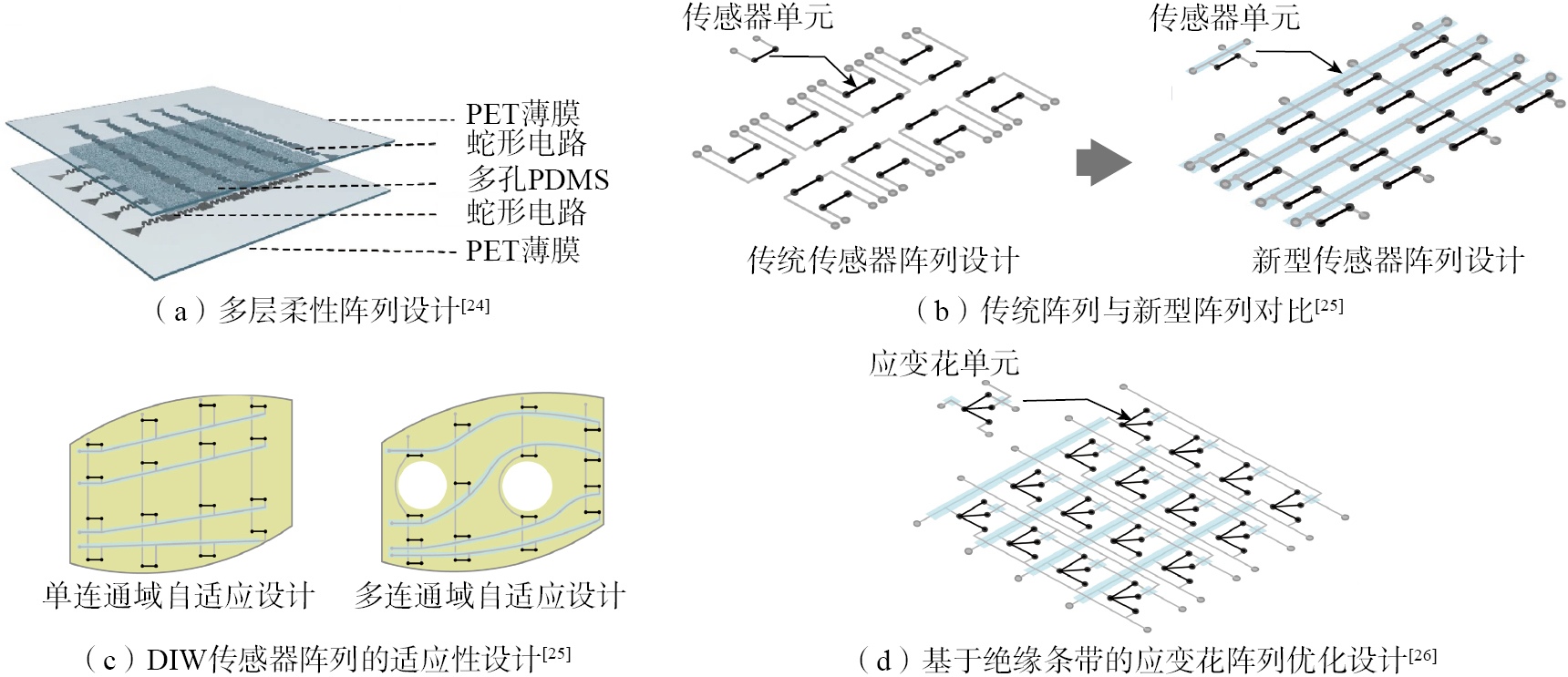
图3 传感器阵列的多层结构优化与设计
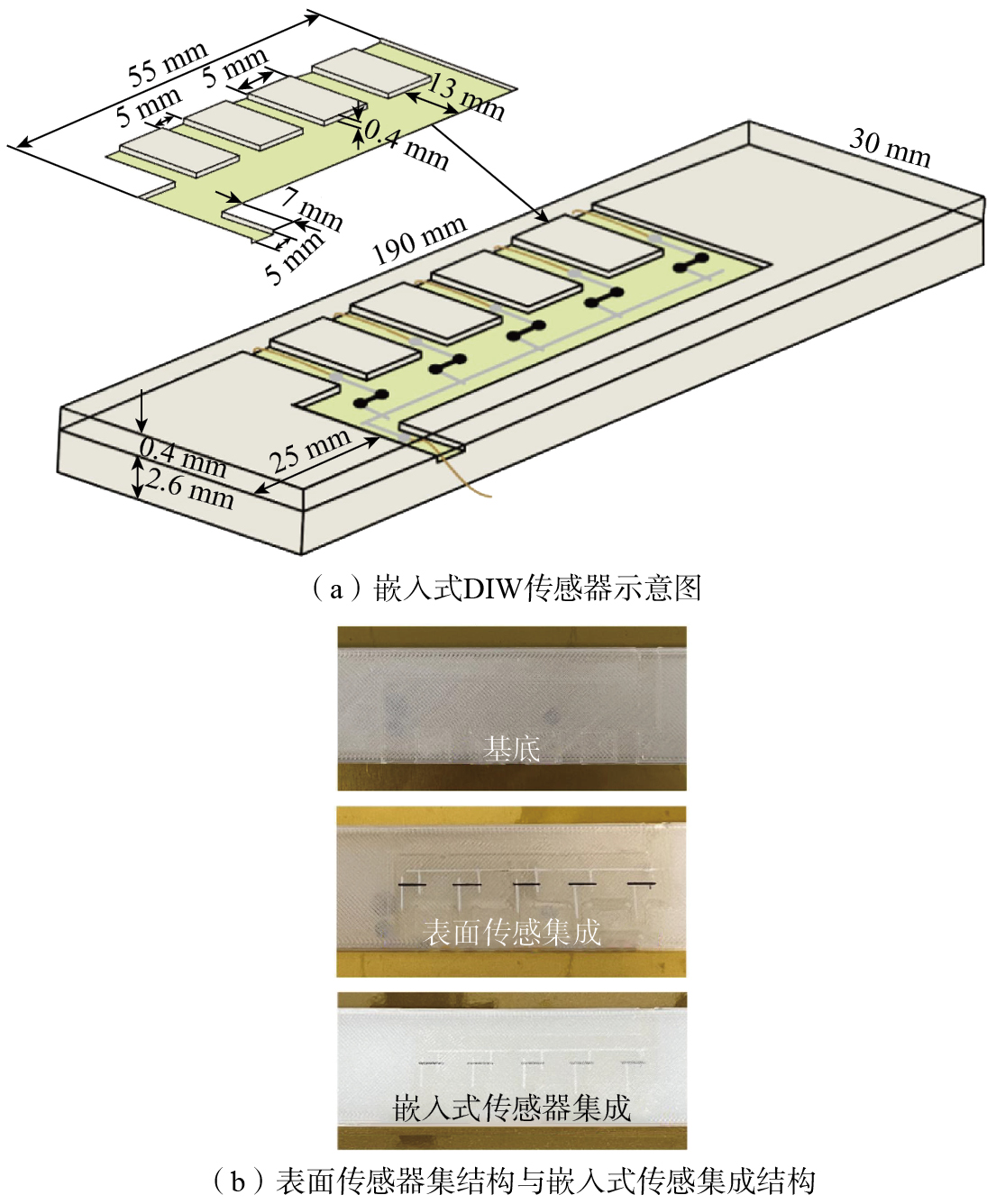
图4 嵌入式DIW传感器的设计[ TAO Y, YU P S, ZHANG X, et al. Displacement-reconstruction-realized components by structure-sensing integration via a hybrid 3D printing strategy[J]. Composites Part A: Applied Science and Manufacturing, 2024, 177: 107896. 27]
图5 DIW 3D打印多功能传感器阵列的设计[ YU P S, LIU H Z, WANG Z L, et al. Direct-ink-writing printed multifunctional sensor array for simultaneous detection of strain, temperature and humidity[J]. Nondestructive Testing and Evaluation, 2024: 2326889. 28]
图6表2对应的环氧树脂层上打印的导电碳浆层表面平面度[ GUO Z Y, YU P S, LIU Y, et al. High-precision resistance strain sensors of multilayer composite structure via direct ink writing: Optimized layer flatness and interfacial strength[J]. Composites Science and Technology, 2021, 201: 108530. 22]
图7 打印油墨线条形貌的定量相图[ LI M Y, YU P S, GUO Z Y, et al. High-resolution and programmable line-morphologies of material-extrusion 3D printed self-leveling inks[J]. Additive Manufacturing, 2023, 71: 103582. 30]
图8 DIW曲面共形打印装备开发的研究进展
图9 应用于航空航天领域的DIW高温传感器的研究展示
图10 DIW传感器在不同领域的应用展示
图11 DIW 3D打印传感器在航空航天结构健康监测领域的应用前景
表1 WID技术与其他典型3D打印技术的对比总结[ NGO T D, KASHANI A, IMBALZANO G, et al. Additive manufacturing (3D printing): A review of materials, methods, applications and challenges[J]. Composites Part B: Engineering, 2018, 143: 172–196. ZHOU L Y, FU J Z, HE Y. A review of 3D printing technologies for soft polymer materials[J]. Advanced Functional Materials, 2020, 30(28): 2000187. LIU H D, ZHANG H J, HAN W Q, et al. 3D printed flexible strain sensors: From printing to devices and signals[J]. Advanced Materials, 2021, 33(8): 2004782. ZHOU L F, MILLER J, VEZZA J, et al. Additive manufacturing: A comprehensive review[J]. Sensors, 2024, 24(9): 2668. 14-17]
表2 具有不同表面平面度的环氧树脂层DIW制造参数[ GUO Z Y, YU P S, LIU Y, et al. High-precision resistance strain sensors of multilayer composite structure via direct ink writing: Optimized layer flatness and interfacial strength[J]. Composites Science and Technology, 2021, 201: 108530. 22]
1.Jiangsu Key Laboratory of Advanced Food Manufacturing Equipment & Technology, School of Mechanical Engineering, Jiangnan University, Wuxi214122, China
2.Jiangsu Province Engineering Research Center of Micro-Nano Additive and Subtractive Manufacturing, Jiangnan University, Wuxi214122, China
Citations
LI Maoyang, YU Peishi, ZHU Zhinan, et al. Design, manufacturing, and application exploration of direct ink writing 3D printed sensors[J]. Aeronautical Manufacturing Technology, 2025, 68(21): 88–103.
Abstract
Direct ink writing (DIW) 3D-printed sensors exhibit significant potential in aerospace structural health monitoring due to their design flexibility and high manufacturing precision. This paper reviews recent advances in the design, fabrication, and application of DIW sensors. First, we systematically summarize key breakthroughs in sensor design, including theoretical approaches for multilayer composite structures, optimized layouts for sensor arrays, integrated designs for embedded sensors, and decoupling strategies for multifunctional sensors. Regarding fabrication, we highlight the importance of process parameter optimization for controllable high-precision manufacturing, as well as the development of multi-axis printing systems for conformal deposition on complex curved surfaces. In terms of applications, successful implementations are demonstrated in aerospace structural monitoring, building vibration detection, human motion capture, and closed-loop control of soft robotics. Finally, we discuss current challenges and propose future research directions. Owing to its exceptional material compatibility and conformal printing capabilities, DIW technology is poised to become a critical tool for enhancing flight safety and extending equipment service life.
Keywords
Direct ink writing; Strain sensor; Structural health monitoring; Process optimization; Conformal manufacturing; Sensor array; Embedded Sensors;
航空航天装备通常长期处于极端服役环境中,包括高温、高压、高振动以及复杂气象条件等。在这种严苛的服役条件下往往会导致结构疲劳、腐蚀、微裂纹等损伤产生,严重威胁飞行安全并缩短装备寿命。因此,结构健康监测(Structural health monitoring,SHM)成为保障航空航天器可靠性的关键技术[ 田童, 李建乐, 邓德双, 等. 飞行器结构健康监测技术研究进展[J]. 航空制造技术, 2024, 67(13): 41–67, 98.TIAN Tong, LI Jianle, DENG Deshuang, et al. Research progress of structural health monitoring technology for aircraft[J]. Aeronautical Manufacturing Technology, 2024, 67(13): 41–67, 98. 蒋孝伟, 章文瑾, 刘玲. 复合材料结构健康监测中机器学习方法研究进展[J]. 航空制造技术, 2024, 67(13): 30–40.JIANG Xiaowei, ZHANG Wenjin, LIU Ling. Research progress on machine learning methods in structural health monitoring of composite materials[J]. Aeronautical Manufacturing Technology, 2024, 67(13): 30–40. 王彬文, 肖迎春, 白生宝, 等. 飞机结构健康监测与管理技术研究进展和展望[J]. 航空制造技术, 2022, 65(3): 30–41.WANG Binwen, XIAO Yingchun, BAI Shengbao, et al. Research progress and prospect of aircraft structural health monitoring and management technology[J]. Aeronautical Manufacturing Technology, 2022, 65(3): 30–41. 刘青旭, 陈海峰, ANTON B, 等. 航天复合材料结构健康监测技术应用进展[J]. 复合材料学报, 2024, 41(9): 4563–4588.LIU Qingxu, CHEN Haifeng, ANTON B, et al. Application progress of structural health monitoring technology for aerospace composite structures[J]. Acta Materiae Compositae Sinica, 2024, 41(9): 4563–4588. 1-4],以实现对航空航天推进系统关键部件的实时监测。随着航空航天技术的迅猛发展,飞行器的研制正朝着智能化的方向快速迭代,传统的刚性传感器[ KIM K H, JANG N S, HA S H, et al. Highly sensitive and stretchable resistive strain sensors based on microstructured metal nanowire/elastomer composite films[J]. Small, 2018, 14(14): 1704232. SCOTT JACKSON P G. The early days of the Saunders-Roe foil strain gauge[J]. Strain, 1990, 26(2): 61–66. CANALI C, MALVASI D, MORTEN B, et al. Strain sensitivity in thick-film resistors[J]. IEEE Transactions on Components, Hybrids, and Manufacturing Technology, 1980, 3(3): 421–423. WHITE N, CRANNY A. Design and fabrication of thick film sensors[J]. Microelectronics International, 1987, 4(1): 32–35. 5-8]已经无法满足在大面积部署、复杂表面共形、多状态监测等方面的新要求,逐渐暴露出诸多的局限性。设计和制造能够应用于结构健康监测的智能化、一体化的新型传感器成为了目前亟须解决的问题。近年来,随着材料科学和3D打印技术的发展,如何使用3D打印技术针对各种不同场景快速制备长周期、多任务、多状态感知的集成化传感器成为了备受关注的热点领域。在众多的新型制造技术中,3D打印技术一直被视为未来产业升级的一个重要增长点,受到了世界各国的高度重视[ 李小丽, 马剑雄, 李萍, 等. 3D打印技术及应用趋势[J]. 自动化仪表, 2014, 35(1): 1–5.LI Xiaoli, MA Jianxiong, LI Ping, et al. 3D printing technology and its application trend[J]. Process Automation Instrumentation, 2014, 35(1): 1–5. MAHMOOD A, PERVEEN F, CHEN S G, et al. Polymer composites in 3D/4D printing: Materials, advances, and prospects[J]. Molecules, 2024, 29(2): 319. 9-10],将成为服务于包括航空航天[ 胡家亮, 吴江鹏, 脱朝智, 等. 3D打印飞机颤振风洞试验模型设计与应用[J]. 航空科学技术, 2022, 33(9): 43–50.HU Jialiang, WU Jiangpeng, TUO Chaozhi, et al. Design and application of 3D printed aircraft flutter wind tunnel test model[J]. Aeronautical Science & Technology, 2022, 33(9): 43–50. 11]、工程机械[ MAZEEVA A, MASAYLO D, KONOV G, et al. Multi-metal additive manufacturing by extrusion-based 3D printing for structural applications: A review[J]. Metals, 2024, 14(11): 1296. 12]以及医疗生物[ JIANG C, JIANG Z W, DAI S X, et al. The application of 3D printing technology in tumor radiotherapy in the era of precision medicine[J]. Applied Materials Today, 2024, 40: 102368. 13]等领域的重要支柱。直书写(Direct ink writing,DIW)3D打印技术具备制造快速、精度较高、功能多变等优势,为应变传感器的制备提供了经济且灵活的选择。表1[ NGO T D, KASHANI A, IMBALZANO G, et al. Additive manufacturing (3D printing): A review of materials, methods, applications and challenges[J]. Composites Part B: Engineering, 2018, 143: 172–196. ZHOU L Y, FU J Z, HE Y. A review of 3D printing technologies for soft polymer materials[J]. Advanced Functional Materials, 2020, 30(28): 2000187. LIU H D, ZHANG H J, HAN W Q, et al. 3D printed flexible strain sensors: From printing to devices and signals[J]. Advanced Materials, 2021, 33(8): 2004782. ZHOU L F, MILLER J, VEZZA J, et al. Additive manufacturing: A comprehensive review[J]. Sensors, 2024, 24(9): 2668. 14-17]展示了DIW技术与其他典型3D打印技术包括熔融沉积成型(Fused deposition modeling,FDM)、数字光处理(Digital light processing,DLP)、立体光刻(Stereolithography,SLA)、选择性激光烧结(Selective laser sintering,SLS)、材料喷射(Material jetting,MJ)在打印精度、生产成本、多材料兼容性等方面的对比总结。相较于其他3D打印技术,DIW打印技术具有较高的打印精度和较低的生产成本,能够使用包括导电浆料[ SANANDIYA N D, PAI A R, SEYEDIN S, et al. Chitosan-based electroconductive inks without chemical reaction for cost-effective and versatile 3D printing for electromagnetic interference (EMI) shielding and strain-sensing applications[J]. Carbohydrate Polymers, 2024, 337: 122161. 18]、弹性体[ WANG Y L, WILLENBACHER N. Phase-change-enabled, rapid, high-resolution direct ink writing of soft silicone[J]. Advanced Materials, 2022, 34(15): 2109240. 19]、水凝胶[ LIU H D, DU C F, LIAO L L, et al. Approaching intrinsic dynamics of MXenes hybrid hydrogel for 3D printed multimodal intelligent devices with ultrahigh superelasticity and temperature sensitivity[J]. Nature Communications, 2022, 13(1): 3420. 20]等可固化流变材料,适合开发高精度、多材料需求的项目。同时,DIW还具有良好的工艺兼容性,便于与其他制造技术集成,实现复合结构的协同打印。另外,DIW打印技术还能够在目标结构上进行灵活打印,无须额外在结构上开孔,可直接进行一体化制造。这些特性使其在航空航天装备上大面积打印多功能智能化传感器成为了可能。
表1 WID技术与其他典型3D打印技术的对比总结[ NGO T D, KASHANI A, IMBALZANO G, et al. Additive manufacturing (3D printing): A review of materials, methods, applications and challenges[J]. Composites Part B: Engineering, 2018, 143: 172–196. ZHOU L Y, FU J Z, HE Y. A review of 3D printing technologies for soft polymer materials[J]. Advanced Functional Materials, 2020, 30(28): 2000187. LIU H D, ZHANG H J, HAN W Q, et al. 3D printed flexible strain sensors: From printing to devices and signals[J]. Advanced Materials, 2021, 33(8): 2004782. ZHOU L F, MILLER J, VEZZA J, et al. Additive manufacturing: A comprehensive review[J]. Sensors, 2024, 24(9): 2668. 14-17]
Table 1 Comparative analysis of DIW technology and other common 3D printing techniques[ NGO T D, KASHANI A, IMBALZANO G, et al. Additive manufacturing (3D printing): A review of materials, methods, applications and challenges[J]. Composites Part B: Engineering, 2018, 143: 172–196. ZHOU L Y, FU J Z, HE Y. A review of 3D printing technologies for soft polymer materials[J]. Advanced Functional Materials, 2020, 30(28): 2000187. LIU H D, ZHANG H J, HAN W Q, et al. 3D printed flexible strain sensors: From printing to devices and signals[J]. Advanced Materials, 2021, 33(8): 2004782. ZHOU L F, MILLER J, VEZZA J, et al. Additive manufacturing: A comprehensive review[J]. Sensors, 2024, 24(9): 2668. 14-17]
技术名称
打印精度/μm
生产速度
生产成本
材料范围
多材料兼容性
DIW
1~100(高)
☆☆(慢)
低成本
可固化假塑性聚合物流体
良好
FDM
>100(中低)
☆☆(慢)
最低成本
热塑性聚合物
中等
DLP
>5(极高)
☆☆☆☆(快)
高成本
低黏度光敏树脂
中等
SLA
>5(极高)
☆☆☆(中速)
高成本
光敏树脂
中等
SLS
>100(中)
☆☆☆☆☆(极快)
最高成本
热塑性塑料/复合材料/陶瓷
差
MJ
>10(高)
☆☆☆(中速)
高成本
光敏树脂/金属粉末/热塑性塑料
优秀
虽然DIW传感器在结构健康监测方面具备诸多优势,但面对新功能材料、新制造技术、新应用场景所提出的要求,还需要从设计、制造、应用等多角度出发解决材料稳定性、技术兼容性、器件耐久性等共性关键问题。为了应对这些挑战,本文将围绕DIW打印技术,介绍DIW传感器在设计[ GUO Z Y, XU J W, CHEN Y Q, et al. High-sensitive and stretchable resistive strain gauges: Parametric design and DIW fabrication[J]. Composite Structures, 2019, 223: 110955. GUO Z Y, YU P S, LIU Y, et al. High-precision resistance strain sensors of multilayer composite structure via direct ink writing: Optimized layer flatness and interfacial strength[J]. Composites Science and Technology, 2021, 201: 108530. TAO Y, YU P S, ZHANG X, et al. A unified mechanics model of direct-ink-writing printed flexible sensor benefits the accurate force control of soft manipulator[J]. Composites Part A: Applied Science and Manufacturing, 2025, 192: 108778. WEN X H, HAN X L, DENG Y L, et al. Stretchable snake electrodes and porous dielectric layers for advanced flexible pressure sensors[J]. Applied Physics A, 2025, 131(2): 156. YU P S, QI L X, GUO Z Y, et al. Arbitrary-shape-adaptable strain sensor array with optimized circuit layout via direct-ink-writing: Scalable design and hierarchical printing[J]. Materials & Design, 2022, 214: 110388. YU P S, QI L X, GUO Z Y, et al. Direct-ink-writing printed strain rosette sensor array with optimized circuit layout[J]. Chinese Journal of Mechanical Engineering, 2023, 36(1): 88. TAO Y, YU P S, ZHANG X, et al. Displacement-reconstruction-realized components by structure-sensing integration via a hybrid 3D printing strategy[J]. Composites Part A: Applied Science and Manufacturing, 2024, 177: 107896. YU P S, LIU H Z, WANG Z L, et al. Direct-ink-writing printed multifunctional sensor array for simultaneous detection of strain, temperature and humidity[J]. Nondestructive Testing and Evaluation, 2024: 2326889. 21-28]、制造[ GUO Z Y, YU P S, LIU Y, et al. High-precision resistance strain sensors of multilayer composite structure via direct ink writing: Optimized layer flatness and interfacial strength[J]. Composites Science and Technology, 2021, 201: 108530. 22, TU Y Q, ARRIETA-ESCOBAR J A, HASSAN A, et al. Optimizing process parameters of direct ink writing for dimensional accuracy of printed layers[J]. 3D Printing and Additive Manufacturing, 2023, 10(4): 816–827. LI M Y, YU P S, GUO Z Y, et al. High-resolution and programmable line-morphologies of material-extrusion 3D printed self-leveling inks[J]. Additive Manufacturing, 2023, 71: 103582. CHEN G C, ZHAO F X, SU Z X, et al. Conformal fabrication of polymer-derived ceramics thin-film heat flux sensor[J]. IEEE Sensors Journal, 2023, 23(22): 27046–27052. 姚钦. 面向曲面共形传感器阵列的直书写打印控制方法与装备研究[D]. 无锡: 江南大学, 2024.YAO Qin. Research on control method and equipment of direct writing printing for curved conformal sensor array[D]. Wuxi: Jiangnan University, 2024. 29-32]、应用[ TAO Y, YU P S, ZHANG X, et al. A unified mechanics model of direct-ink-writing printed flexible sensor benefits the accurate force control of soft manipulator[J]. Composites Part A: Applied Science and Manufacturing, 2025, 192: 108778. 23, TAO Y, YU P S, ZHANG X, et al. Displacement-reconstruction-realized components by structure-sensing integration via a hybrid 3D printing strategy[J]. Composites Part A: Applied Science and Manufacturing, 2024, 177: 107896. 27, XU L D, ZHOU X, ZHAO F X, et al. Rapid laser fabrication of indium tin oxide and polymer-derived ceramic composite thin films for high-temperature sensors[J]. Journal of Colloid and Interface Science, 2024, 658: 913–922. WU C, LIN F, FU Y Z, et al. Multilayer co-sintered Pt thin-film strain gauge for high-temperature applications[J]. Surface and Coatings Technology, 2023, 459: 129380. WU C, HE Y P, LI L L, et al. Temperature-independent conductive ceramic for high-temperature strain-sensing applications[J]. Advanced Engineering Materials, 2023, 25(20): 2300516. YU J C, HU C X, WANG Z, et al. Printing three-dimensional refractory metal patterns in ambient air: Toward high temperature sensors[J]. Advanced Science, 2023, 10(31): 2302479. KIM T H, MOEINNIA H, KIM W S. 3D printed vorticella-kirigami inspired sensors for structural health monitoring in Internet-of-Things[J]. Materials & Design, 2023, 234: 112332. ZHOU L Y, FU J Z, GAO Q, et al. All-printed flexible and stretchable electronics with pressing or freezing activatable liquid-metal–silicone inks[J]. Advanced Functional Materials, 2020, 30(3): 1906683. ZHANG X, YU P S, TAO Y, et al. Wireless strain-field monitoring system for motion recognition via direct-ink-writing sensor-array[J]. International Journal of Mechanical Sciences, 2024, 275: 109298. 33-39] 3个方面取得的相关进展,并在最后指出存在的不足和对未来的展望,旨在为航空航天的结构健康监测提供一种新的解决方案。本文探讨的DIW 3D打印传感器在设计、制造、应用方面的研究进展如图1所示。
图1 DIW 3D打印传感器在设计、制造、应用方面的研究进展
Fig.1 Research progress of DIW 3D printed sensors in design, manufacturing, and application
1 DIW传感器的设计
相较于传统制造工艺,DIW技术不仅能够实现微米级分辨率的精细结构调控,还可兼容导电、介电、等多种功能材料,为开发高性能、高集成度的柔性传感器开辟了新路径[ LEE B M, NGUYEN Q H, SHEN W. Flexible multifunctional sensors using 3-D-printed PEDOT: PSS composites[J]. IEEE Sensors Journal, 2024, 24(6): 7584–7592. 40]。然而,新材料具备的独特性质不仅给传感器的研制带来了新的可能性,也同样给传统的传感器设计思路带来了新的挑战。如何建立DIW传感器的设计标准,充分发挥DIW技术的高精度特性,制造出突破原有性能的新型传感器,是目前DIW传感器领域亟须解决的问题。本文将从DIW传感器的结构设计、阵列化集成、嵌入式设计及多功能融合方面出发,介绍在相关问题上的研究进展。
1.1 单个传感器复合结构的设计
DIW应变传感器根据测量应变的原理不同可以分为电阻式[ YAN F J, HUANG W Q, SANG X H, et al. Direct ink write printing of resistive-type humidity sensors[J]. Flexible and Printed Electronics, 2021, 6(4): 045007. 41]、电容式[ CHEN C T, ZHOU J H. Integrated design and manufacturing of wearable capacitive sensors embedded in a 3D-printed finger cot for hand gesture recognition[J]. Sensors and Actuators A: Physical, 2025, 391: 116664. 42]、压电式[ RUPOM R H, ISLAM M N, DEMCHUK Z, et al. Tailoring piezoelectricity of 3D printing PVDF-MoS2 nanocomposite via in situ induced shear stress[J]. ACS Applied Nano Materials, 2024, 7(19): 22714–22722. 43]等类型,其中电阻式传感器由于其高灵敏度,结构简单等特点,而被广泛研究和应用。图2(a)[ KIM S, OH J, JEONG D, et al. Consistent and reproducible direct ink writing of eutectic gallium-indium for high-quality soft sensors[J]. Soft Robotics, 2018, 5(5): 601–612. 44]展示了使用DIW技术制作电阻式传感器的一般流程,通过压强挤压的方式将注射器内的材料直接书写在基底上,可精确控制打印结构的形状和尺寸,解决传统模具制造中依赖手工操作、一致性差等问题。利用此工艺制备的电阻应变传感器的灵敏度主要取决于灵敏材料,但灵敏材料并不能直接应用于测量环境中,为了保证单个传感器测量的准确性和耐久性,设计了如图2(b)[ GUO Z Y, XU J W, CHEN Y Q, et al. High-sensitive and stretchable resistive strain gauges: Parametric design and DIW fabrication[J]. Composite Structures, 2019, 223: 110955. 21]左侧示意图所示的基底–绝缘层–传感层–封装层的4层复合结构应变传感器。各层厚度的大致范围为基底150~500 μm、绝缘层45~75 μm、传感层25~90 μm、封装层40~105 μm。然而,Zike等[ ZIKE S, MIKKELSEN L P. Correction of gauge factor for strain gauges used in polymer composite testing[J]. Experimental Mechanics, 2014, 54(3): 393–403. 45]发现应变片在测量一些低模量材料时,会产生因刚度差异导致的“增强效应”,即应变片会低估实际应变,因此提出了修正模型。修正模型分为适用于厚基材的局部效应模型和适用于薄基材的全局效应模型。在此基础上,Guo等[ GUO Z Y, XU J W, CHEN Y Q, et al. High-sensitive and stretchable resistive strain gauges: Parametric design and DIW fabrication[J]. Composite Structures, 2019, 223: 110955. 21]建立了多层应变传递效率理论模型(式(1))。
Fig.2 Research progress on composite structure design of single DIW sensor
在进一步分析了传感层和绝缘层之间的层间剪切行为后,该团队又提出了与之相关的力学模型用于指导层间界面的设计与制造[ GUO Z Y, YU P S, LIU Y, et al. High-precision resistance strain sensors of multilayer composite structure via direct ink writing: Optimized layer flatness and interfacial strength[J]. Composites Science and Technology, 2021, 201: 108530. 22, XU W, WEI Y G. Influence of adhesive thickness on local interface fracture and overall strength of metallic adhesive bonding structures[J]. International Journal of Adhesion and Adhesives, 2013, 40: 158–167. 46](式(2))。
在此基础上,Tao等[ TAO Y, YU P S, ZHANG X, et al. A unified mechanics model of direct-ink-writing printed flexible sensor benefits the accurate force control of soft manipulator[J]. Composites Part A: Applied Science and Manufacturing, 2025, 192: 108778. 23]进一步综合考虑了如图2(c)所示的传感器不同传感结构,分为表面结构、近表面嵌入结构以及内部深嵌结构,并提出了一个与应变传递效率相关的统一力学模型用于指导不同传感结构的高灵敏度传感器的设计和制造(式(3))。
传统的传感单元往往是独立组成通道并工作的,因此,在一定的监测范围内,传感单元的布局往往会占据大量的面积,导线之间极易产生交联和短路,这使得传统的传感单元在设计和使用时会面临严重的挑战。与传统的传感单元相比,DIW传感器具有显著的设计灵活性[ JIANG Y J, ISLAM M N, HE R, et al. Recent advances in 3D printed sensors: Materials, design, and manufacturing[J]. Advanced Materials Technologies, 2023, 8(2): 2200492. 47],可以通过阵列设计显著优化传感器的布局。
如图3(a)所示,Wen等[ WEN X H, HAN X L, DENG Y L, et al. Stretchable snake electrodes and porous dielectric layers for advanced flexible pressure sensors[J]. Applied Physics A, 2025, 131(2): 156. 24]利用DIW技术研发了一种具有高灵敏性的压力柔性传感器单元及阵列,用于检测空间物体的压力大小和分布范围,其被透明的PET薄膜包裹,内部采用了蛇形电路设计,不同层之间通过多孔PDMS进行分隔,这种独特的结构设计使得传感器在保持一定的柔韧性的同时,还能实现信号的有效传输与处理。另外,在DIW应变传感器阵列的设计上,图3(b)[ YU P S, QI L X, GUO Z Y, et al. Arbitrary-shape-adaptable strain sensor array with optimized circuit layout via direct-ink-writing: Scalable design and hierarchical printing[J]. Materials & Design, 2022, 214: 110388. 25]直观地展示了在一定监测范围内,传统传感器阵列和基于DIW技术的新型传感器阵列的对比。传统传感器阵列由多个独立的传感单元组成,单元之间相互独立,探测范围和精度相对有限,且在面对复杂形状或不规则分布的检测对象时,存在探测盲区。而新型传感器阵列在结构上进行了优化,通过改变传感器单元的排列方式与连接形式,扩大了探测区域,提高了对不同物体的形状保真度,从而能够更全面、更精确地获取信息。基于典型的传感器阵列为例,新型传感器阵列设计相比传统设计的优势可以通过式(4)进行计算[ YU P S, QI L X, GUO Z Y, et al. Arbitrary-shape-adaptable strain sensor array with optimized circuit layout via direct-ink-writing: Scalable design and hierarchical printing[J]. Materials & Design, 2022, 214: 110388. 25]。
Fig.3 Optimization and design of multi layer structure for sensor arrays
此外,基于DIW的传感器阵列除了能够简化电路布局外,还能够根据监测区域进行自定义和个性化设计,如图3(c)[ YU P S, QI L X, GUO Z Y, et al. Arbitrary-shape-adaptable strain sensor array with optimized circuit layout via direct-ink-writing: Scalable design and hierarchical printing[J]. Materials & Design, 2022, 214: 110388. 25]所示。对于单连通区域,铺设电路没有限制,通常采用直线铺设,这样可以减少电路的总长度和电路的复杂程度。但针对较为复杂的多连通区域,传感单元和导线的布置要避开孔洞或缺陷,往往需要采用曲线,而这也是DIW打印的优势。例如,虽然采用铺设柔性导线的方式,同样能够应对形状多变的多联通区域,但柔性导线的铺设一般需要大量的手工操作,这可能不利于传感器的大规模部署。而DIW技术能够在大范围内重复打印具有较高一致性的传感器阵列。并且根据情况的不同,DIW传感器阵列还可进行个性化设计,实现电路的简化,这对于提高制造效率具有积极意义。另外,使用能够打印超细金属丝的金属丝3D打印技术(DWW)制备高性能传感器的研究目前正在积极开展当中[ GUO Z Y, YU P S, LI B, et al. Direct wire writing technique benefitting the flexible electronics[J]. Virtual and Physical Prototyping, 2024, 19(1): e2286514. 48]。同理,在需要进行多方向应变监测时,DIW技术可以将应变花传感单元与传感阵列相结合,最终实现对外界物体形状、压力等信息的高精度探测与识别,如图3(d)所示[ YU P S, QI L X, GUO Z Y, et al. Direct-ink-writing printed strain rosette sensor array with optimized circuit layout[J]. Chinese Journal of Mechanical Engineering, 2023, 36(1): 88. 26]。
1.3 嵌入式传感器的设计
自从结构健康监测领域发展以来,关于嵌入式传感器的研究也逐渐增加,该传感器将传感元件集成在结构内部,通过内部传感元件形变产生的信号变化来监测结构的变形。Muth等[ MUTH J T, VOGT D M, TRUBY R L, et al. Embedded 3D printing of strain sensors within highly stretchable elastomers[J]. Advanced Materials, 2014, 26(36): 6307–6312. 49]利用高贴合性和高延伸性的弹性体基质制造了一种嵌入式DIW应变传感器。该传感器的形成工艺是通过沉积喷嘴将黏弹性油墨直接挤出到弹性体储层中形成电阻传感元件,储层则作为基质材料,当喷嘴在储层中移动时,引入的空隙由覆盖(填充流体)层填充,储层和填充流体会共同固化形成整体部件,而嵌入的导电油墨保持液态。另外,基于DIW和FDM混合的3D打印技术,Tao等[ TAO Y, YU P S, ZHANG X, et al. Displacement-reconstruction-realized components by structure-sensing integration via a hybrid 3D printing strategy[J]. Composites Part A: Applied Science and Manufacturing, 2024, 177: 107896. 27]设计了嵌入结构–传感–位移重构功能一体化部件,其内部设计如图4所示。在制造过程中,研究团队利用熔融沉积成型(Fused deposition modeling,FDM)技术在结构的内部打印预设通道。随后,在通道内精准布置DIW传感器,紧接着借助FDM的续打功能,完成结构另一半部分的打印工作。通过混合制造工艺,成功将DIW应变传感器嵌入结构内部,制备出如图4右侧图像所示的表面传感集成结构与嵌入式传感集成结构。经试验验证,嵌入的DIW传感器能够敏锐捕捉结构形变,通过电阻变化实时、精准地反馈结构形变信息。在此基础上,结合预先设定的重构算法,最终实现了高精度的位移重构功能,为结构监测与位移分析提供了新的技术路径。
图4 嵌入式DIW传感器的设计[ TAO Y, YU P S, ZHANG X, et al. Displacement-reconstruction-realized components by structure-sensing integration via a hybrid 3D printing strategy[J]. Composites Part A: Applied Science and Manufacturing, 2024, 177: 107896. 27]
Fig.4 Design of DIW 3D printed embedded sensor[ TAO Y, YU P S, ZHANG X, et al. Displacement-reconstruction-realized components by structure-sensing integration via a hybrid 3D printing strategy[J]. Composites Part A: Applied Science and Manufacturing, 2024, 177: 107896. 27]
1.4 多功能传感器的设计
近年来,随着DIW技术的不断成熟以及浆料材料性能的显著提升,DIW传感器技术已突破局限于应变监测的传统范畴,向着集成化与多功能化的新方向迅猛发展[ YANG G Y, SUN Y Y, LIMIN QIN, et al. Direct-ink-writing (DIW) 3D printing functional composite materials based on supra-molecular interaction[J]. Composites Science and Technology, 2021, 215: 109013. XU C, QUINN B, LEBEL L L, et al. Multi-material direct ink writing (DIW) for complex 3D metallic structures with removable supports[J]. ACS Applied Materials & Interfaces, 2019, 11(8): 8499–8506. TANDEL R, GOZEN B A. Direct-Ink-writing of liquid metal-graphene-based polymer composites: Composition-processing-property relationships[J]. Journal of Materials Processing Technology, 2022, 302: 117470. ZHAO Y X, YU P S, TAO Y, et al. Long-term stability and durability of direct-ink-writing 3D-printed sensors: Challenges, strategies and prospects[J]. Virtual and Physical Prototyping, 2025, 20(1): e2460211. 50-53]。一方面,新型浆料材料的研发使DIW传感器具备更优异的导电性、柔韧性和环境稳定性,为构建复杂传感器阵列奠定了基础;另一方面,通过巧妙的打印路径设计与多材料复合工艺,DIW打印技术能够将不同类型的传感单元(如湿度、温度、应变等)集成于同一芯片上,实现多物理量的同时监测。这种集成化与多功能化的发展趋势,不仅提高了传感器的系统兼容性与数据关联性,还拓展了其在可穿戴设备[ YANG T T, XIE D, LI Z H, et al. Recent advances in wearable tactile sensors: Materials, sensing mechanisms, and device performance[J]. Materials Science and Engineering: R: Reports, 2017, 115: 1–37. 54]、健康监测[ TAY R Y, SONG Y, YAO D R, et al. Direct-ink-writing 3D-printed bioelectronics[J]. Materials Today, 2023, 71: 135–151. MA L J, XIA T C, YU R, et al. A 3D-printed, sensitive, stable, and flexible piezoresistive sensor for health monitoring[J]. Advanced Engineering Materials, 2021, 23(10): 2100379. 55-56]、智能机器人[ MENG F B, HUANG J, PING B, et al. Intelligent control system for 3D inkjet printing[J]. Journal of Intelligent Manufacturing, 2024, 35(2): 575–586. 57]等领域的应用潜力,预示着DIW传感器技术将在未来科技发展中发挥更为关键的作用。
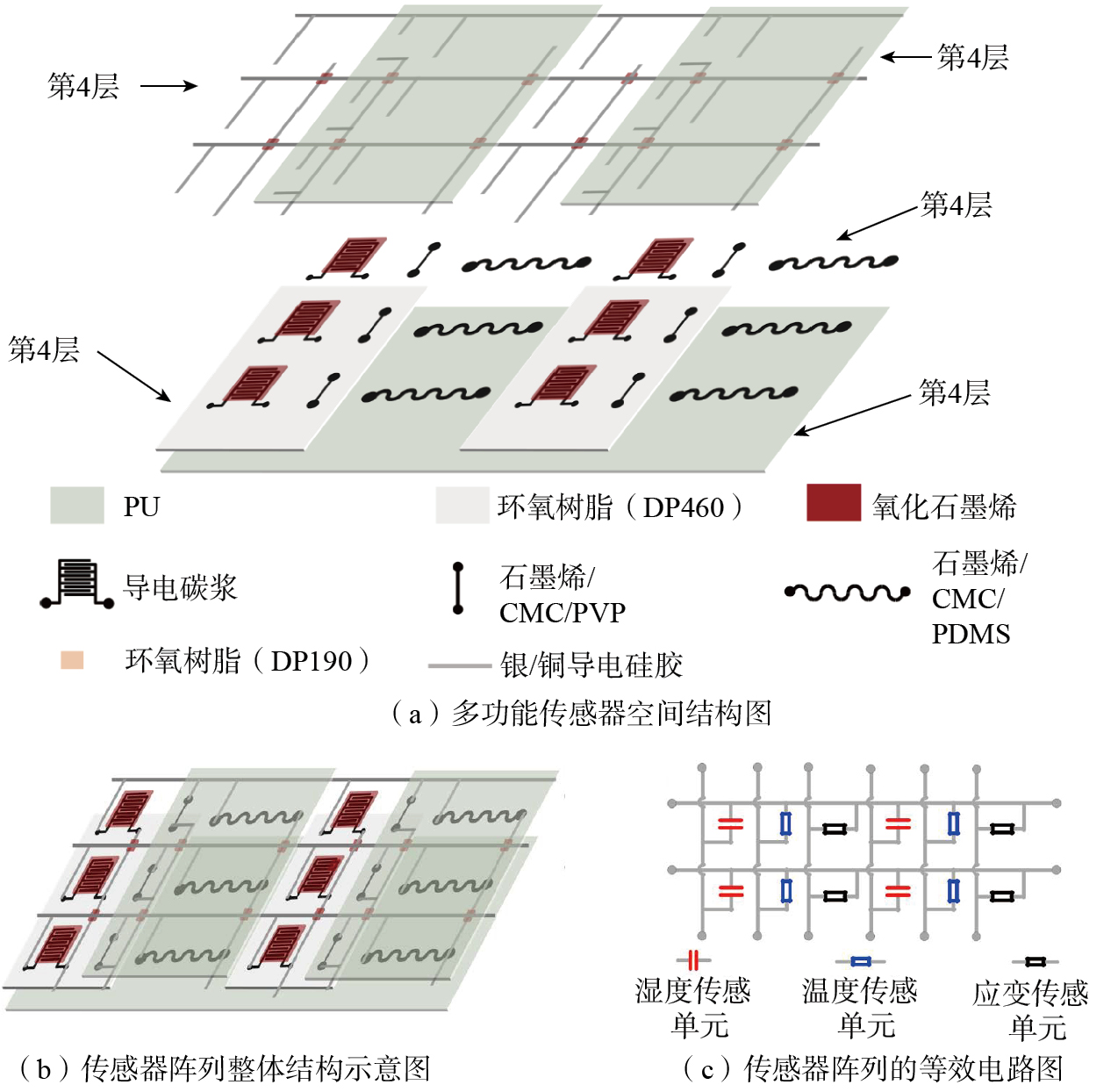
图5展示了基于DIW打印技术打印出能够实现同时检测应变、温度和湿度的多功能传感器阵列,该阵列解耦了包括应变、温度和湿度在内的不同信号,通过试验验证了其出色的性能[ YU P S, LIU H Z, WANG Z L, et al. Direct-ink-writing printed multifunctional sensor array for simultaneous detection of strain, temperature and humidity[J]. Nondestructive Testing and Evaluation, 2024: 2326889. 28]。该传感器基于DIW技术逐层制造,由基板、3个传感层及电路线、电极组成多层结构。第1层的聚氨酯(Polyurethane,PU)膜作为绝缘基板;第2层为环氧树脂屏蔽应变,第3层为含温度、湿度、应变的传感单元;第4层为银/铜导电硅胶印导线连接单元,线交叉处由环氧树脂绝缘;第5层为PU浆料封装温度和应变单元。
图5 DIW 3D打印多功能传感器阵列的设计[ YU P S, LIU H Z, WANG Z L, et al. Direct-ink-writing printed multifunctional sensor array for simultaneous detection of strain, temperature and humidity[J]. Nondestructive Testing and Evaluation, 2024: 2326889. 28]
Fig.5 Design of the DIW 3D printed multifunctional sensor array[ YU P S, LIU H Z, WANG Z L, et al. Direct-ink-writing printed multifunctional sensor array for simultaneous detection of strain, temperature and humidity[J]. Nondestructive Testing and Evaluation, 2024: 2326889. 28]
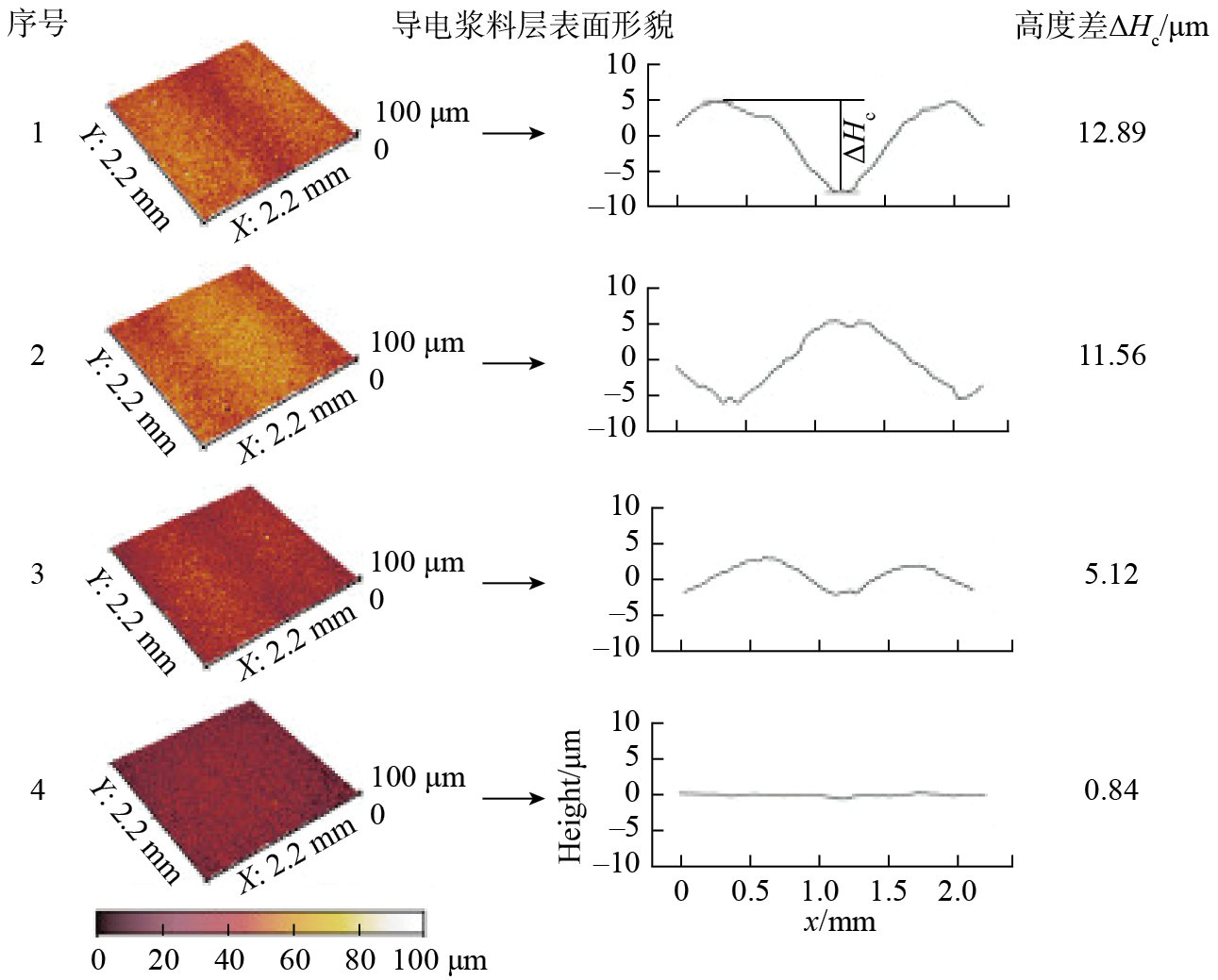
DIW打印技术因其材料兼容性和设计灵活性,已成为制备多层传感器的有效方法。然而,由于油墨复杂的流变特性,利用该技术打印的结构层表面容易出现波纹,使得结构层的平面度较低,这可能导致最终制备的传感器敏感层内应变分布不均匀,从而影响应变测量结果。另外,用于指导传感器结构设计的理论模型均基于各结构层界面平整、黏结完美的前提假设。如果所打印结构层平面度不足,可能导致模型误差增大,影响传感器设计精度。为此,亟须系统优化DIW制造参数,改善环氧树脂绝缘层与导电碳浆传感层的平面度,从而提升DIW传感器的性能。Guo等[ GUO Z Y, YU P S, LIU Y, et al. High-precision resistance strain sensors of multilayer composite structure via direct ink writing: Optimized layer flatness and interfacial strength[J]. Composites Science and Technology, 2021, 201: 108530. 22]研究表明,针头内径、打印线距、打印速度和驱动气压是影响平面度的核心参数。其中,由针头内径、速度和气压共同调控单位长度墨条的挤出体积,而线距决定了相邻墨条的融合效果。过大的线距会引发表面波纹,而过小则可能降低打印效率。为平衡效率与精度,首先固定打印速度为10 mm/s,随后通过形貌表征参数峰谷高度差ΔHe来量化参数组合的效果。如表2所示,对于环氧树脂层,最优参数组合为针头内径250 μm、打印线距150 μm、驱动气压25.5 psi,可实现ΔHe=2.43 μm的平面度。在碳浆传感层打印中,环氧树脂基底平面度对上方的碳浆层形貌具有显著影响。试验发现,碳浆因自流平特性可填充下方环氧树脂层的波纹,改善整体平面度。最终,通过优化碳浆参数,实现了环氧树脂层加碳浆层的ΔHc=0.84 μm超平整表面,如图6所示。这一结果证实,优先采用细针头、窄线距并结合气压调整,可高效优化薄层结构的平面度。
表2 具有不同表面平面度的环氧树脂层DIW制造参数[ GUO Z Y, YU P S, LIU Y, et al. High-precision resistance strain sensors of multilayer composite structure via direct ink writing: Optimized layer flatness and interfacial strength[J]. Composites Science and Technology, 2021, 201: 108530. 22]
Table 2 DIW manufacturing parameters for epoxy resin layers with different surface flatness[ GUO Z Y, YU P S, LIU Y, et al. High-precision resistance strain sensors of multilayer composite structure via direct ink writing: Optimized layer flatness and interfacial strength[J]. Composites Science and Technology, 2021, 201: 108530. 22]
序号
针头内径/μm
打印线距/μm
驱动气压/psi
高度差ΔHe/μm
1
700
950
15.5
16.89
2
700
800
10.5
14.46
3
700
650
10.5
7.78
4
250
150
25.5
2.43
图6表2对应的环氧树脂层上打印的导电碳浆层表面平面度[ GUO Z Y, YU P S, LIU Y, et al. High-precision resistance strain sensors of multilayer composite structure via direct ink writing: Optimized layer flatness and interfacial strength[J]. Composites Science and Technology, 2021, 201: 108530. 22]
Fig.6 Surface flatness of conductive carbon paste layer printed on the epoxy resin layer corresponding to Table 2[ GUO Z Y, YU P S, LIU Y, et al. High-precision resistance strain sensors of multilayer composite structure via direct ink writing: Optimized layer flatness and interfacial strength[J]. Composites Science and Technology, 2021, 201: 108530. 22]
Tu等[ TU Y Q, ARRIETA-ESCOBAR J A, HASSAN A, et al. Optimizing process parameters of direct ink writing for dimensional accuracy of printed layers[J]. 3D Printing and Additive Manufacturing, 2023, 10(4): 816–827. 29]进一步将DIW参数分为线成型与面成型两类,并进行系统优化。针对线成型阶段,通过正交试验,结合信噪比与方差分析发现参数校准比例对尺寸误差贡献率达27.78%(p<0.05)。打印参数的最优组合可降低单线宽度波动至SNR>30 dB。在面成型阶段,基于优化过的线宽(1.31 mm)确定线距比为0.9时的层内结构最均匀,该方法通过减小线距与线宽比值抑制材料堆积导致的波纹。相较于传统单因素试验,该框架通过参数交互效应分析提升了优化效率,且在纤维素基油墨(ΔHc<1 μm)和孔隙结构打印中均表现出适应性。Guo等[ GUO Z Y, YU P S, LIU Y, et al. High-precision resistance strain sensors of multilayer composite structure via direct ink writing: Optimized layer flatness and interfacial strength[J]. Composites Science and Technology, 2021, 201: 108530. 22]的研究聚焦于特定材料(即环氧树脂和碳浆)的平面度优化,通过参数组合试验获得局部最优解,而上述方法建立了通用性更强的两阶段优化框架。通过将参数分类为线成型和面成型,并与正交试验设计相结合,实现了多材料和复杂结构的多场景适用性。引入信噪比与方差分析为参数显著性评价提供了统计学依据,避免了传统试错法的经验依赖性。
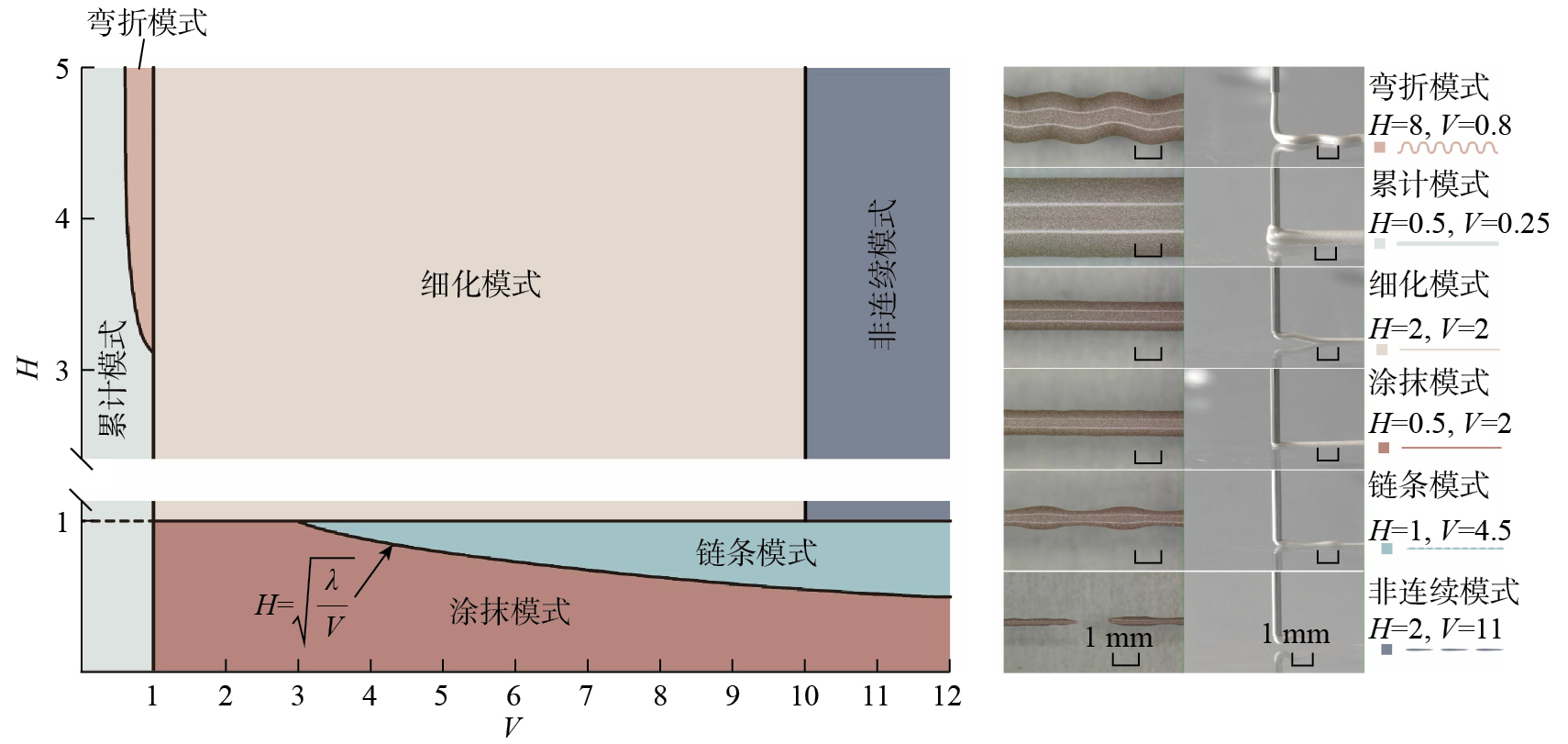
由于DIW技术在打印结构层时通常采用由线到面的成型方式,打印线条的形貌直接决定了最终结构层的质量。通过调控DIW工艺参数精确控制打印线条的形貌,是制造DIW传感器的关键基础。Li等[ LI M Y, YU P S, GUO Z Y, et al. High-resolution and programmable line-morphologies of material-extrusion 3D printed self-leveling inks[J]. Additive Manufacturing, 2023, 71: 103582. 30]通过分析不同打印工艺参数对油墨挤压形状及线条形貌的影响,甄选出了一系列的关键打印参数,并组合建立了两个归一化参数喷管速度V与无量纲喷管高度H。在此基础上,实现对卷曲、堆积、细化、涂抹、链状、不连续等6种线条形貌的有效调控。为了能够更好地反映各个打印模式的参数范围,基于油墨线条形貌形成的条件,构建了由两个无量纲参数V和H调控的油墨线条形貌相图,如图7所示。根据这一相图,可以选取合适的打印参数用于得到想要的线条形貌,或者规避不想要的线条形貌。
图7 打印油墨线条形貌的定量相图[ LI M Y, YU P S, GUO Z Y, et al. High-resolution and programmable line-morphologies of material-extrusion 3D printed self-leveling inks[J]. Additive Manufacturing, 2023, 71: 103582. 30]
Fig.7 Phase diagram for printing ink line morphology[ LI M Y, YU P S, GUO Z Y, et al. High-resolution and programmable line-morphologies of material-extrusion 3D printed self-leveling inks[J]. Additive Manufacturing, 2023, 71: 103582. 30]
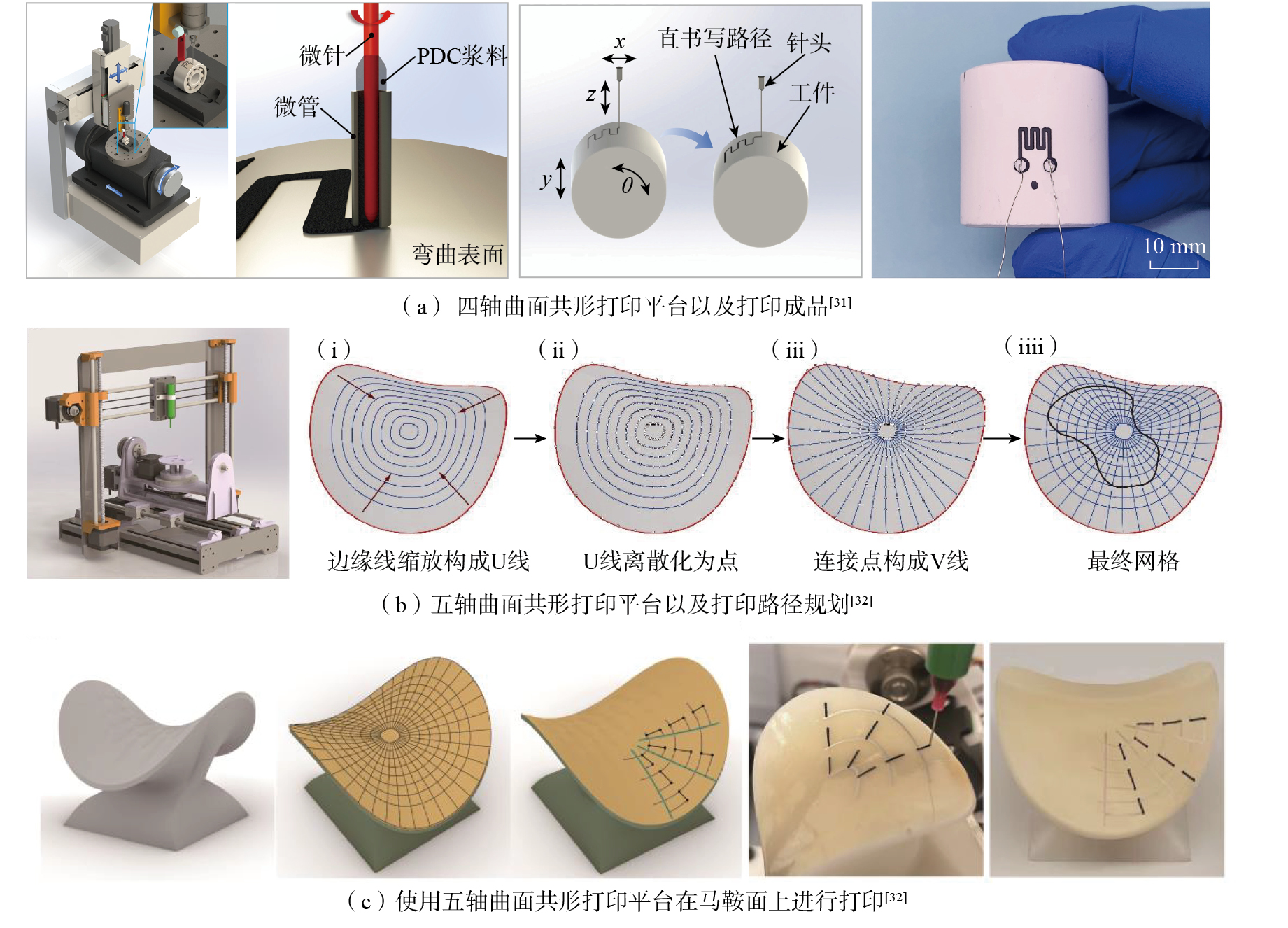
图8(a)展示了一种四轴曲面共形直写打印平台[ CHEN G C, ZHAO F X, SU Z X, et al. Conformal fabrication of polymer-derived ceramics thin-film heat flux sensor[J]. IEEE Sensors Journal, 2023, 23(22): 27046–27052. 31]。该平台具备X、Y、Z三轴平动自由度及绕Y轴的转动自由度。针头由多轴联动平台协同控制,确保其始终垂直于圆柱曲面(即沿曲面法向的反方向移动),并在运动过程中挤出浆料,实现复杂曲形表面的图案直写。这种集成旋转运动的联动控制机制,能够在圆柱曲面上维持恒定间隙距离,显著提升了曲面适应性打印的柔性与保形能力。
图8 DIW曲面共形打印装备开发的研究进展
Fig.8 Research progress on development of DIW surface conformal printing equipment
进一步地,姚钦[ 姚钦. 面向曲面共形传感器阵列的直书写打印控制方法与装备研究[D]. 无锡: 江南大学, 2024.YAO Qin. Research on control method and equipment of direct writing printing for curved conformal sensor array[D]. Wuxi: Jiangnan University, 2024. 32]制作了一种五轴曲面共形直写打印平台,如图8(b)左侧的图像所示。通过增加绕Z轴的转动自由度,拓展了其在复杂曲面进行高适应性直写打印的应用范围。其核心路径规划流程包含4个步骤:曲面参数化与U线生成,U线离散化,矩阵转置与V线生成,以及复杂路径规划。通过以上步骤,就能够将参数化网格(UV线)作为参考框架,在曲面上规划并执行复杂图案的直写路径,如图8(b)右侧的图像所示。图8(c)具体演示了五轴曲面共形打印平台在马鞍面上制造共形传感器阵列的全过程,涵盖了马鞍面模型设计、曲面离散网格生成、共形传感器阵列路径规划,最终实现不规则马鞍面实体的高保形打印。
3 DIW传感器的应用
为了实现对航空航天装备的结构健康监测,需要将陶瓷、高温合金等耐高温、高压、腐蚀的材料应用于高温传感器的制造当中,以提高传感器在极端环境中的耐久性能。而DIW技术能够良好地兼容这些材料,且在成本方面具有较好的经济适用性,故而成为了目前制造高温传感器的绝佳选择之一。相关领域的研究在近年来逐渐成为热门[ LIU X, ZHANG Z K, WANG J X, et al. Future development directions of high-temperature strain gauges: A comprehensive review of structure and performance characteristics[J]. Nanoscale Advances, 2025, 7(14): 4232–4251. 58],例如Xu等[ XU L D, ZHOU X, ZHAO F X, et al. Rapid laser fabrication of indium tin oxide and polymer-derived ceramic composite thin films for high-temperature sensors[J]. Journal of Colloid and Interface Science, 2024, 658: 913–922. 33]将DIW技术与激光扫描(Laser scanning,LS)技术相结合,用于快速制备最高可承受1250 ℃的高温测温传感器。将SiCN陶瓷前驱体(Preceramic polymer,PP)与氧化铟锡(Indium-tin-oxide,ITO)纳米颗粒混合制得ITO/PP复合墨水,利用DIW技术将其用于传感器敏感层的打印。然后使用LS技术对敏感层进行定向烧结,显著提高了制备效率,并且所制备的传感器具有良好的电学性能和高温稳定性。利用这一技术,能够在涡轮叶片表面制备薄膜热通量传感器,如图9(a)所示。但该传感器在800 ℃下会同时对温度、应变敏感,无法分离应变与温度效应进而导致信号漂移。用该方法制备的传感器响应时间为0.183 s,这虽优于传统方法,但仍然无法监测毫秒级瞬态热冲击。
图9 应用于航空航天领域的DIW高温传感器的研究展示
Fig.9 Research demonstration of DIW high-temperature sensors for aerospace applications
Wu等[ WU C, LIN F, FU Y Z, et al. Multilayer co-sintered Pt thin-film strain gauge for high-temperature applications[J]. Surface and Coatings Technology, 2023, 459: 129380. 34]利用DIW技术制备了一种高温Pt薄膜应变传感器,如图9(b)所示。通过创新的共烧结工艺,将玻璃绝缘层和Pt应变层同步烧结在Ni基高温合金基板上,显著简化逐层烧结的传统多步工艺。这种工艺不仅允许Pt应变层面内自由收缩化解界面应力,还能够通过绝缘层充填Pt应变层空隙使其致密度提升。这种传感器具备优异的高温稳定性,800 ℃下电阻漂移率仅为0.9%/h,应变系数GF从室温的2.55渐变至800 ℃的1.09,能够稳定检测1000 με的应变。这种DIW技术结合共烧结工艺所制备的高温应变传感器特别适用于航空发动机叶片等极端环境下的应变监测。通过进一步地研究,该研究团队通过调控TiB2/SiCN材料中的电子散射与隧穿效应,消除了温度波动对传感器的干扰,并利用DIW技术成功制备出了温度不敏感高温薄膜应变片[ WU C, HE Y P, LI L L, et al. Temperature-independent conductive ceramic for high-temperature strain-sensing applications[J]. Advanced Engineering Materials, 2023, 25(20): 2300516. 35]。这种温度不敏感性来源于具有正电阻温度系数的片内电阻与具有负电阻温度系数的片间电阻之间的动态平衡,使得传感器在300~700 ℃之间具有近乎恒定的电阻值,并且还展现出了稳定的压阻响应(应变因子4.28)。
Yu等[ YU J C, HU C X, WANG Z, et al. Printing three-dimensional refractory metal patterns in ambient air: Toward high temperature sensors[J]. Advanced Science, 2023, 10(31): 2302479. 36]研发了一种DIW技术与焦油介导激光烧结(Tar-mediated laser sintering,TMLS)相结合的3D难熔金属打印技术(DIW–TMLS),如图9(c)所示。该研究团队将焦油作为黏结剂,与Mo、Cu微米粉末混合,制得具有剪切稀化特性和增强光吸收能力的高黏度金属墨水。这种墨水能够使用低功率红外激光实现在空气环境下的无氧化烧结,形成多孔导电结构。这一技术通过DIW技术打印墨水并使用低功率激光同步烧结,实现了复杂三维金属结构的快速制造,能够应用于Cu应变传感器、半球形共形天线以及Mo无线温度传感器(最高工作温度350 ℃)的开发。DIW–TMLS技术突破了传统难熔金属加工对高功率激光、保护气氛的依赖,为制备应用于极端环境下的高柔性、低成本的三维结构传感器提供了一种可行的方案。但该方法存在激光控制要求高,生产速度较缓,产品高温上限不足等问题,需要进一步改进。
DIW打印传感器凭借设计灵活、高集成度等特性,不仅能够应用于航空航天领域的传感器制备,还能够在建筑结构监测、人体运动监测等多个领域得到运用。例如,Kim等[ KIM T H, MOEINNIA H, KIM W S. 3D printed vorticella-kirigami inspired sensors for structural health monitoring in Internet-of-Things[J]. Materials & Design, 2023, 234: 112332. 37]通过DIW打印技术制备了仿生草履虫–剪纸(Vorticella-kirigami,VK)结构的振动传感器。这种传感器能够实现从二维到三维的形态转变,并对特定频率表现出极高的灵敏度,能够有效应用于建筑结构的实时振动监测,如图10(a)所示。进一步,通过集成物联网(IoT)和MQTT通信协议,该传感器系统成功实现基础设施内多点振动信号的远程实时采集与分析,凸显了DIW技术在复杂环境中传感器部署的灵活性和适应性。然而,多种3D打印技术的使用增加了导电墨水打印、固化等后处理操作的复杂度,需要重新校准和熟练操作来确保多步骤制造的精度,这可能不利于传感器的大规模部署。另外,该研究主要针对室内基础设施,并未验证在风雨、极端温度等户外条件的可靠性。
图10 DIW传感器在不同领域的应用展示
Fig.10 Application demonstration of DIW sensors in different fields
此外,Zhou等[ ZHOU L Y, FU J Z, GAO Q, et al. All-printed flexible and stretchable electronics with pressing or freezing activatable liquid-metal–silicone inks[J]. Advanced Functional Materials, 2020, 30(3): 1906683. 38]开发了一种基于DIW技术的液态金属–硅胶复合墨水(LMS ink),成功制造出高性能、全打印的柔性与可拉伸电子器件。这种墨水初始为非导电状态,通过机械压制或冷冻处理后,液态金属微液滴发生融合并形成连续导电网络,从而表现出优异的导电性能。如图10(b)所示,基于该墨水制备的多层软电路、柔性应变传感器展现出良好的应变响应性与抗损伤能力,成功实现人体运动监测,且有望应用于工业场景中的实时结构健康监测。但由于材料的机械–电学耦合稳定性,在长期的运动监测中可能产生信号漂移,并且在拉伸应变下,复合墨水的氧化层破裂–重组机制可能导致响应的非线性。
在软结构部件的精密控制领域,Tao等[ TAO Y, YU P S, ZHANG X, et al. A unified mechanics model of direct-ink-writing printed flexible sensor benefits the accurate force control of soft manipulator[J]. Composites Part A: Applied Science and Manufacturing, 2025, 192: 108778. 23]基于DIW应变传感器设计与制造的一体化力学模型,利用混合增材制造技术实现了基于应变数据的闭环反馈控制,有效克服了软材料传递过程中因应变增强和剪滞效应所导致的精确性降低问题。如图10(c)所示,利用DIW打印技术能够直接将传感器打印于目标结构上以监测应变变化,数据显示结构表面至内部的应变测量误差显著降低(由37%减至7%),说明软体机械手在易碎物品抓取和控制中的精准度得到了有效提升。但由于软材料基体的黏弹性导致了传感器响应存在滞后时间,且随材料软化而增加。并且在软体机械手抓取时,接触力、应变、电阻的耦合关系非线性显著,需要编写额外算法进行解耦。
针对传统应变监测方法在大面积部署时存在的复杂布线、低灵敏度和动态适应性不足等问题,Zhang等[ ZHANG X, YU P S, TAO Y, et al. Wireless strain-field monitoring system for motion recognition via direct-ink-writing sensor-array[J]. International Journal of Mechanical Sciences, 2024, 275: 109298. 39]提出了基于DIW技术的新型解决方案,开发出高灵敏度、可扩展的多层传感器阵列,并集成无线数据采集系统(WDAQ),实现了实时、大面积的无线应变场监测,如图10(d)所示。通过无人载具模型跨越障碍物的动态试验,验证了该系统的实时性与高精度特性。此外,结合支持向量机(SVM)分类算法成功识别了运动车辆的不同运动状态,展示了DIW传感器阵列在实时动态监测与智能识别领域的重要潜力。然而传感器阵列的共享电极设计会导致阵列电路存在并联电阻耦合,需要设计算法进行解耦,降低信号传输的实时性。并且碳浆敏感层在循环载荷下会出现电阻波动,长期动态监测可能需要多次重新校准GF。
在实时智能化监测方面,Tao等[ TAO Y, YU P S, ZHANG X, et al. Displacement-reconstruction-realized components by structure-sensing integration via a hybrid 3D printing strategy[J]. Composites Part A: Applied Science and Manufacturing, 2024, 177: 107896. 27]提出了一种混合3D打印策略,将DIW打印的传感器阵列集成在板件结构上,制备出能够实现实时位移重构的组件。如图10(e)所示,将经过优化的传感器阵列打印在结构表面,通过在结构上施加不同大小的未知载荷使得结构呈现出不同的状态,根据结构受到的应变情况,重构了该结构的实时位移场。但由于使用DIW技术和FDM技术共同制造的嵌入式传感器,在长期循环载荷下,传感器与基体之间存在界面脱粘风险。
4 展望
得益于定制化结构、多材料兼容和直接基材打印的技术优势,DIW传感器已经在多个领域取得了较为成熟的研究成果。然而,随着研究的不断深入,不同领域之间的DIW传感器研究逐渐显现出了一些共性问题和挑战。在材料稳定性上,一方面,由于DIW技术的制造特性,所用材料需要具备良好的工艺稳定性,不仅要具有较好的流变性能,以保证材料的顺利挤出,还要根据后处理工艺的不同,在相应方面具备良好的适应性以保证器件的成功制备。例如,在Xu等 [ XU L D, ZHOU X, ZHAO F X, et al. Rapid laser fabrication of indium tin oxide and polymer-derived ceramic composite thin films for high-temperature sensors[J]. Journal of Colloid and Interface Science, 2024, 658: 913–922. 33]的研究中,所用复合墨水中的SiCN陶瓷前驱体与ITO纳米颗粒的混合比例既要保证材料能够顺利挤出而不堵塞喷管,又要保证在激光烧结时材料体积不会收缩严重,避免产生微裂纹,影响传感器性能;另一方面,由于DIW传感器工作的严苛环境条件,因此要求材料具备优异的机械–电学稳定性,以保证在长时间的监测当中,不会发生严重的信号漂移,使传感器失去监测能力。
在技术兼容性上,仅依靠DIW技术本身无法制备具有优秀性能或多功能集成的传感器,而是要与其他3D打印技术或后处理工艺相结合,才能最大限度地发挥DIW技术的优势。但由于不同的技术或工艺之间往往具备不同技术特性,而这些技术特性可能会相互冲突,为传感器的多步工艺制造造成阻碍。例如,在Tao等[ TAO Y, YU P S, ZHANG X, et al. Displacement-reconstruction-realized components by structure-sensing integration via a hybrid 3D printing strategy[J]. Composites Part A: Applied Science and Manufacturing, 2024, 177: 107896. 27]的工作中,使用了DIW和FDM两种打印技术。由于FDM需要在200 ℃下熔融材料才可以进行打印,可能破坏由DIW打印的嵌入式传感器,因此需要考虑加入隔热材料以提高传感器制备的成功率。
为了克服这些挑战,DIW传感器的发展在未来需要聚焦在材料、工艺、结构的协同创新上[ LIU H D, ZHANG H J, HAN W Q, et al. 3D printed flexible strain sensors: From printing to devices and signals[J]. Advanced Materials, 2021, 33(8): 2004782. 16, ZHAO Y X, YU P S, TAO Y, et al. Long-term stability and durability of direct-ink-writing 3D-printed sensors: Challenges, strategies and prospects[J]. Virtual and Physical Prototyping, 2025, 20(1): e2460211. 53]。在材料层面,开发具有自修复组分,能够利用动态键实现损伤修复,延长传感器寿命的多功能复合墨水,以抵御湿热、腐蚀、疲劳载荷导致的微裂纹。同时,优化墨水的流变特性,通过功能化纳米填料与聚合物基体的相互作用提高材料的工艺稳定性,确保挤出精度以及在后处理过程中的尺寸一致性。在工艺层面上,需要建立多技术融合制造标准,例如,整合FDM和DIW技术,设计混合打印系统,通过机器学习实时优化打印参数以协调材料兼容性矛盾,解决多工艺冲突。在结构层面,可以采用仿生拓扑优化策略,通过有限元模拟应力分布,设计梯度化封装层以及曲面过渡结构,分散机械载荷并抑制界面剥离,提升传感器在循环载荷下的耐久性。
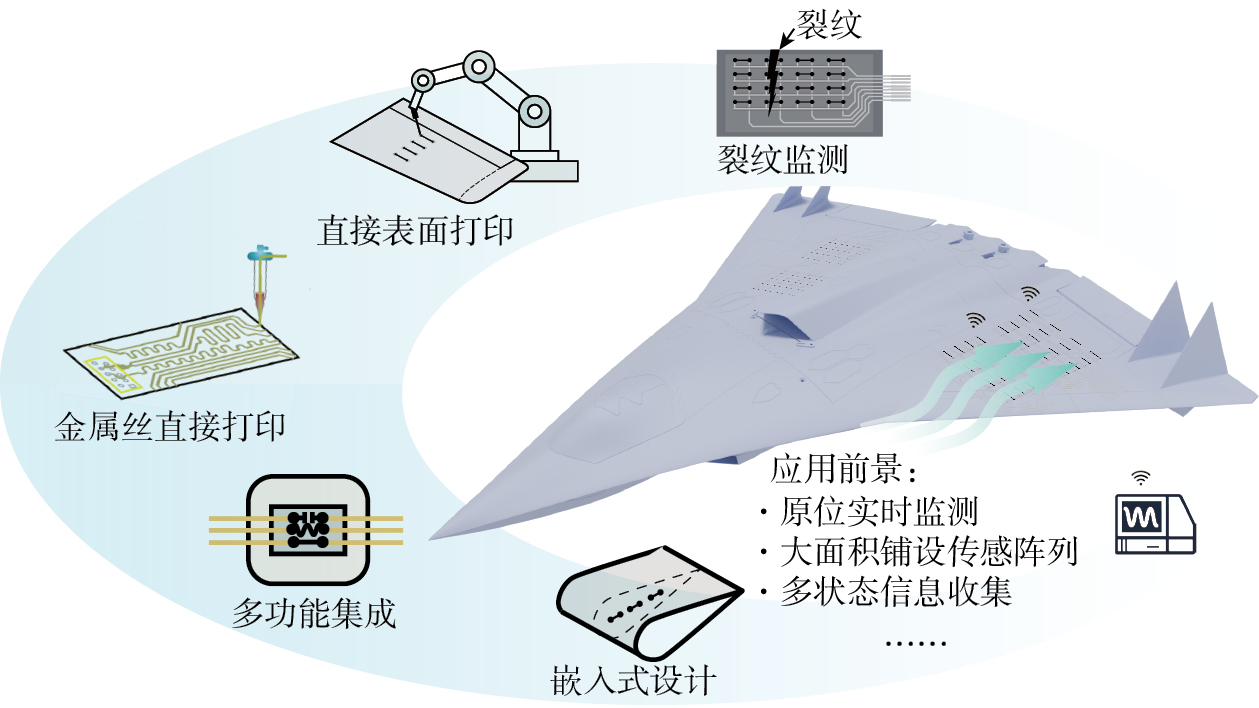
在航空航天结构健康监测领域,DIW传感器已展现出了初步的应用潜力,发展出各种用于高温环境下的DIW传感器。而DIW技术独特的设计灵活性、共形打印能力、嵌入式集成特性等优势将进一步拓展其在航空航天领域的应用深度,展现出巨大的应用价值。如图11所示,其设计灵活性和共形打印能力使其能够完美贴合飞机机翼、发动机叶片等复杂曲面结构,实现大面积、分布式传感阵列的铺设。这种复杂表面直接成型能力突破了传统传感器安装的几何限制,为复杂航空结构的全方位监测提供了更加先进的解决方案;嵌入式设计可进一步将传感器无缝集成到复合材料结构内部,实现原位、实时监测,且不影响结构完整性;多功能集成则有望同时监测关键部位的应变、温度、裂纹萌生等多种参数,提供更全面的结构状态信息[ 汪玉, 邱雷, 黄永安. 面向飞行器结构健康监测智能蒙皮的柔性传感器网络综述[J]. 航空制造技术, 2020, 63(15): 60–69, 80.WANG Yu, QIU Lei, HUANG Yongan. Review of flexible sensor networks for structural health monitoring of aircraft smart skin[J]. Aeronautical Manufacturing Technology, 2020, 63(15): 60–69, 80. XIONG W N, ZHU C, GUO D L, et al. Bio-inspired, intelligent flexible sensing skin for multifunctional flying perception[J]. Nano Energy, 2021, 90: 106550. 59-60],显著提升航空航天装备监测系统的检测精度和响应速度;另外,利用DIW打印技术将金属丝直接成型在复杂表面上的金属丝3D打印技术[ GUO Z Y, YU P S, LI B, et al. Direct wire writing technique benefitting the flexible electronics[J]. Virtual and Physical Prototyping, 2024, 19(1): e2286514. 48],作为一种潜力巨大的制造技术,其独特的复杂电路打印能力和复合材料集成特性同样有望在航空航天领域展现出独特优势,特别是在高温部件监测和智能蒙皮系统方面具有重要应用前景。
图11 DIW 3D打印传感器在航空航天结构健康监测领域的应用前景
Fig.11 Application prospects of DIW 3D printed sensors in structural health monitoring for aerospace
田童, 李建乐, 邓德双, 等. 飞行器结构健康监测技术研究进展[J]. 航空制造技术, 2024, 67(13): 41–67, 98. TIANTong, LIJianle, DENGDeshuang, et al. Research progress of structural health monitoring technology for aircraft[J]. Aeronautical Manufacturing Technology, 2024, 67(13): 41–67, 98.
[2]
蒋孝伟, 章文瑾, 刘玲. 复合材料结构健康监测中机器学习方法研究进展[J]. 航空制造技术, 2024, 67(13): 30–40. JIANGXiaowei, ZHANGWenjin, LIULing. Research progress on machine learning methods in structural health monitoring of composite materials[J]. Aeronautical Manufacturing Technology, 2024, 67(13): 30–40.
[3]
王彬文, 肖迎春, 白生宝, 等. 飞机结构健康监测与管理技术研究进展和展望[J]. 航空制造技术, 2022, 65(3): 30–41. WANGBinwen, XIAOYingchun, BAIShengbao, et al. Research progress and prospect of aircraft structural health monitoring and management technology[J]. Aeronautical Manufacturing Technology, 2022, 65(3): 30–41.
[4]
刘青旭, 陈海峰, ANTONB, 等. 航天复合材料结构健康监测技术应用进展[J]. 复合材料学报, 2024, 41(9): 4563–4588. LIUQingxu, CHENHaifeng, ANTONB, et al. Application progress of structural health monitoring technology for aerospace composite structures[J]. Acta Materiae Compositae Sinica, 2024, 41(9): 4563–4588.
[5]
KIMK H, JANGN S, HAS H, et al. Highly sensitive and stretchable resistive strain sensors based on microstructured metal nanowire/elastomer composite films[J]. Small, 2018, 14(14): 1704232.
[6]
SCOTT JACKSONP G. The early days of the Saunders-Roe foil strain gauge[J]. Strain, 1990, 26(2): 61–66.
[7]
CANALIC, MALVASID, MORTENB, et al. Strain sensitivity in thick-film resistors[J]. IEEE Transactions on Components, Hybrids, and Manufacturing Technology, 1980, 3(3): 421–423.
[8]
WHITEN, CRANNYA. Design and fabrication of thick film sensors[J]. Microelectronics International, 1987, 4(1): 32–35.
[9]
李小丽, 马剑雄, 李萍, 等. 3D打印技术及应用趋势[J]. 自动化仪表, 2014, 35(1): 1–5. LIXiaoli, MAJianxiong, LIPing, et al. 3D printing technology and its application trend[J]. Process Automation Instrumentation, 2014, 35(1): 1–5.
[10]
MAHMOODA, PERVEENF, CHENS G, et al. Polymer composites in 3D/4D printing: Materials, advances, and prospects[J]. Molecules, 2024, 29(2): 319.
[11]
胡家亮, 吴江鹏, 脱朝智, 等. 3D打印飞机颤振风洞试验模型设计与应用[J]. 航空科学技术, 2022, 33(9): 43–50. HUJialiang, WUJiangpeng, TUOChaozhi, et al. Design and application of 3D printed aircraft flutter wind tunnel test model[J]. Aeronautical Science & Technology, 2022, 33(9): 43–50.
[12]
MAZEEVAA, MASAYLOD, KONOVG, et al. Multi-metal additive manufacturing by extrusion-based 3D printing for structural applications: A review[J]. Metals, 2024, 14(11): 1296.
[13]
JIANGC, JIANGZ W, DAIS X, et al. The application of 3D printing technology in tumor radiotherapy in the era of precision medicine[J]. Applied Materials Today, 2024, 40: 102368.
[14]
NGOT D, KASHANIA, IMBALZANOG, et al. Additive manufacturing (3D printing): A review of materials, methods, applications and challenges[J]. Composites Part B: Engineering, 2018, 143: 172–196.
[15]
ZHOUL Y, FUJ Z, HEY. A review of 3D printing technologies for soft polymer materials[J]. Advanced Functional Materials, 2020, 30(28): 2000187.
[16]
LIUH D, ZHANGH J, HANW Q, et al. 3D printed flexible strain sensors: From printing to devices and signals[J]. Advanced Materials, 2021, 33(8): 2004782.
[17]
ZHOUL F, MILLERJ, VEZZAJ, et al. Additive manufacturing: A comprehensive review[J]. Sensors, 2024, 24(9): 2668.
[18]
SANANDIYAN D, PAIA R, SEYEDINS, et al. Chitosan-based electroconductive inks without chemical reaction for cost-effective and versatile 3D printing for electromagnetic interference (EMI) shielding and strain-sensing applications[J]. Carbohydrate Polymers, 2024, 337: 122161.
[19]
WANGY L, WILLENBACHERN. Phase-change-enabled, rapid, high-resolution direct ink writing of soft silicone[J]. Advanced Materials, 2022, 34(15): 2109240.
[20]
LIUH D, DUC F, LIAOL L, et al. Approaching intrinsic dynamics of MXenes hybrid hydrogel for 3D printed multimodal intelligent devices with ultrahigh superelasticity and temperature sensitivity[J]. Nature Communications, 2022, 13(1): 3420.
[21]
GUOZ Y, XUJ W, CHENY Q, et al. High-sensitive and stretchable resistive strain gauges: Parametric design and DIW fabrication[J]. Composite Structures, 2019, 223: 110955.
[22]
GUOZ Y, YUP S, LIUY, et al. High-precision resistance strain sensors of multilayer composite structure via direct ink writing: Optimized layer flatness and interfacial strength[J]. Composites Science and Technology, 2021, 201: 108530.
[23]
TAOY, YUP S, ZHANGX, et al. A unified mechanics model of direct-ink-writing printed flexible sensor benefits the accurate force control of soft manipulator[J]. Composites Part A: Applied Science and Manufacturing, 2025, 192: 108778.
[24]
WENX H, HANX L, DENGY L, et al. Stretchable snake electrodes and porous dielectric layers for advanced flexible pressure sensors[J]. Applied Physics A, 2025, 131(2): 156.
[25]
YUP S, QIL X, GUOZ Y, et al. Arbitrary-shape-adaptable strain sensor array with optimized circuit layout via direct-ink-writing: Scalable design and hierarchical printing[J]. Materials & Design, 2022, 214: 110388.
[26]
YUP S, QIL X, GUOZ Y, et al. Direct-ink-writing printed strain rosette sensor array with optimized circuit layout[J]. Chinese Journal of Mechanical Engineering, 2023, 36(1): 88.
[27]
TAOY, YUP S, ZHANGX, et al. Displacement-reconstruction-realized components by structure-sensing integration via a hybrid 3D printing strategy[J]. Composites Part A: Applied Science and Manufacturing, 2024, 177: 107896.
[28]
YUP S, LIUH Z, WANGZ L, et al. Direct-ink-writing printed multifunctional sensor array for simultaneous detection of strain, temperature and humidity[J]. Nondestructive Testing and Evaluation, 2024: 2326889.
[29]
TUY Q, ARRIETA-ESCOBARJ A, HASSANA, et al. Optimizing process parameters of direct ink writing for dimensional accuracy of printed layers[J]. 3D Printing and Additive Manufacturing, 2023, 10(4): 816–827.
[30]
LIM Y, YUP S, GUOZ Y, et al. High-resolution and programmable line-morphologies of material-extrusion 3D printed self-leveling inks[J]. Additive Manufacturing, 2023, 71: 103582.
姚钦. 面向曲面共形传感器阵列的直书写打印控制方法与装备研究[D]. 无锡: 江南大学, 2024. YAOQin. Research on control method and equipment of direct writing printing for curved conformal sensor array[D]. Wuxi: Jiangnan University, 2024.
[33]
XUL D, ZHOUX, ZHAOF X, et al. Rapid laser fabrication of indium tin oxide and polymer-derived ceramic composite thin films for high-temperature sensors[J]. Journal of Colloid and Interface Science, 2024, 658: 913–922.
[34]
WUC, LINF, FUY Z, et al. Multilayer co-sintered Pt thin-film strain gauge for high-temperature applications[J]. Surface and Coatings Technology, 2023, 459: 129380.
[35]
WUC, HEY P, LIL L, et al. Temperature-independent conductive ceramic for high-temperature strain-sensing applications[J]. Advanced Engineering Materials, 2023, 25(20): 2300516.
[36]
YUJ C, HUC X, WANGZ, et al. Printing three-dimensional refractory metal patterns in ambient air: Toward high temperature sensors[J]. Advanced Science, 2023, 10(31): 2302479.
[37]
KIMT H, MOEINNIAH, KIMW S. 3D printed vorticella-kirigami inspired sensors for structural health monitoring in Internet-of-Things[J]. Materials & Design, 2023, 234: 112332.
[38]
ZHOUL Y, FUJ Z, GAOQ, et al. All-printed flexible and stretchable electronics with pressing or freezing activatable liquid-metal–silicone inks[J]. Advanced Functional Materials, 2020, 30(3): 1906683.
[39]
ZHANGX, YUP S, TAOY, et al. Wireless strain-field monitoring system for motion recognition via direct-ink-writing sensor-array[J]. International Journal of Mechanical Sciences, 2024, 275: 109298.
[40]
LEEB M, NGUYENQ H, SHENW. Flexible multifunctional sensors using 3-D-printed PEDOT: PSS composites[J]. IEEE Sensors Journal, 2024, 24(6): 7584–7592.
[41]
YANF J, HUANGW Q, SANGX H, et al. Direct ink write printing of resistive-type humidity sensors[J]. Flexible and Printed Electronics, 2021, 6(4): 045007.
[42]
CHENC T, ZHOUJ H. Integrated design and manufacturing of wearable capacitive sensors embedded in a 3D-printed finger cot for hand gesture recognition[J]. Sensors and Actuators A: Physical, 2025, 391: 116664.
[43]
RUPOMR H, ISLAMM N, DEMCHUKZ, et al. Tailoring piezoelectricity of 3D printing PVDF-MoS2 nanocomposite via in situ induced shear stress[J]. ACS Applied Nano Materials, 2024, 7(19): 22714–22722.
[44]
KIMS, OHJ, JEONGD, et al. Consistent and reproducible direct ink writing of eutectic gallium-indium for high-quality soft sensors[J]. Soft Robotics, 2018, 5(5): 601–612.
[45]
ZIKES, MIKKELSENL P. Correction of gauge factor for strain gauges used in polymer composite testing[J]. Experimental Mechanics, 2014, 54(3): 393–403.
[46]
XUW, WEIY G. Influence of adhesive thickness on local interface fracture and overall strength of metallic adhesive bonding structures[J]. International Journal of Adhesion and Adhesives, 2013, 40: 158–167.
[47]
JIANGY J, ISLAMM N, HER, et al. Recent advances in 3D printed sensors: Materials, design, and manufacturing[J]. Advanced Materials Technologies, 2023, 8(2): 2200492.
[48]
GUOZ Y, YUP S, LIB, et al. Direct wire writing technique benefitting the flexible electronics[J]. Virtual and Physical Prototyping, 2024, 19(1): e2286514.
[49]
MUTHJ T, VOGTD M, TRUBYR L, et al. Embedded 3D printing of strain sensors within highly stretchable elastomers[J]. Advanced Materials, 2014, 26(36): 6307–6312.
[50]
YANGG Y, SUNY Y, LIMINQIN, et al. Direct-ink-writing (DIW) 3D printing functional composite materials based on supra-molecular interaction[J]. Composites Science and Technology, 2021, 215: 109013.
[51]
XUC, QUINNB, LEBELL L, et al. Multi-material direct ink writing (DIW) for complex 3D metallic structures with removable supports[J]. ACS Applied Materials & Interfaces, 2019, 11(8): 8499–8506.
[52]
TANDELR, GOZENB A. Direct-Ink-writing of liquid metal-graphene-based polymer composites: Composition-processing-property relationships[J]. Journal of Materials Processing Technology, 2022, 302: 117470.
[53]
ZHAOY X, YUP S, TAOY, et al. Long-term stability and durability of direct-ink-writing 3D-printed sensors: Challenges, strategies and prospects[J]. Virtual and Physical Prototyping, 2025, 20(1): e2460211.
[54]
YANGT T, XIED, LIZ H, et al. Recent advances in wearable tactile sensors: Materials, sensing mechanisms, and device performance[J]. Materials Science and Engineering: R: Reports, 2017, 115: 1–37.
[55]
TAYR Y, SONGY, YAOD R, et al. Direct-ink-writing 3D-printed bioelectronics[J]. Materials Today, 2023, 71: 135–151.
[56]
MAL J, XIAT C, YUR, et al. A 3D-printed, sensitive, stable, and flexible piezoresistive sensor for health monitoring[J]. Advanced Engineering Materials, 2021, 23(10): 2100379.
[57]
MENGF B, HUANGJ, PINGB, et al. Intelligent control system for 3D inkjet printing[J]. Journal of Intelligent Manufacturing, 2024, 35(2): 575–586.
[58]
LIUX, ZHANGZ K, WANGJ X, et al. Future development directions of high-temperature strain gauges: A comprehensive review of structure and performance characteristics[J]. Nanoscale Advances, 2025, 7(14): 4232–4251.
[59]
汪玉, 邱雷, 黄永安. 面向飞行器结构健康监测智能蒙皮的柔性传感器网络综述[J]. 航空制造技术, 2020, 63(15): 60–69, 80. WANGYu, QIULei, HUANGYongan. Review of flexible sensor networks for structural health monitoring of aircraft smart skin[J]. Aeronautical Manufacturing Technology, 2020, 63(15): 60–69, 80.
[60]
XIONGW N, ZHUC, GUOD L, et al. Bio-inspired, intelligent flexible sensing skin for multifunctional flying perception[J]. Nano Energy, 2021, 90: 106550.