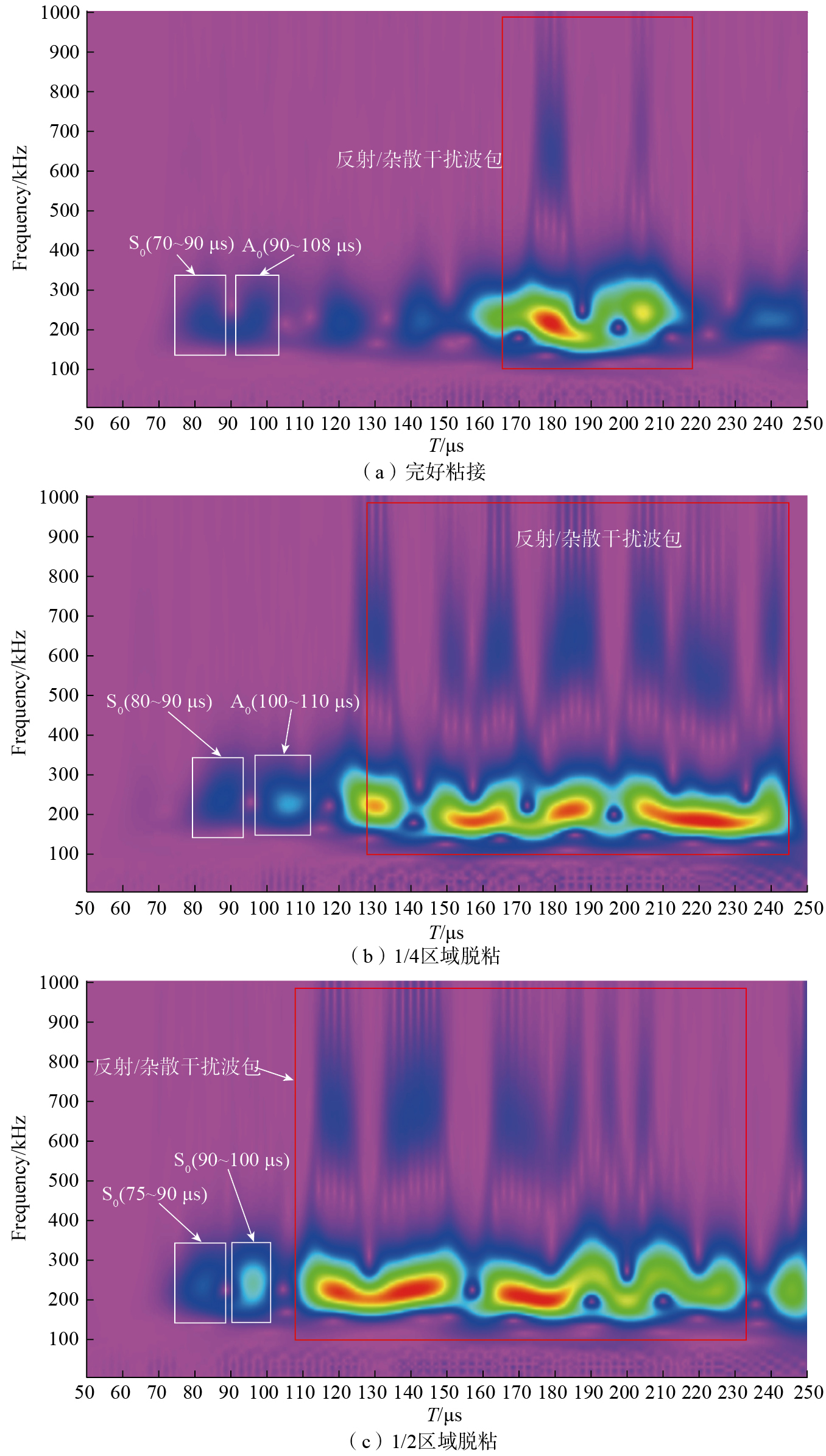
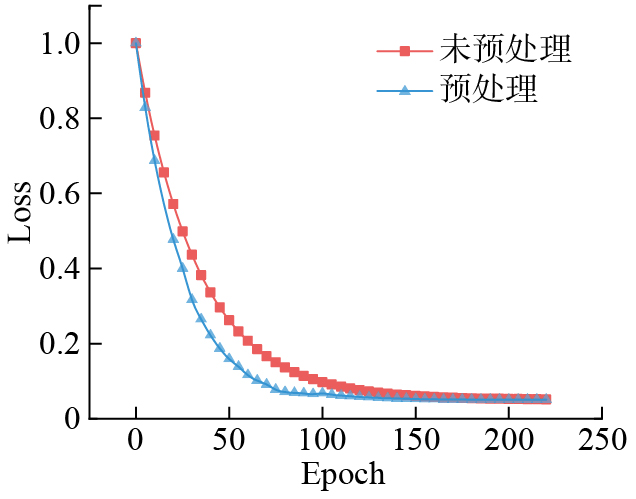
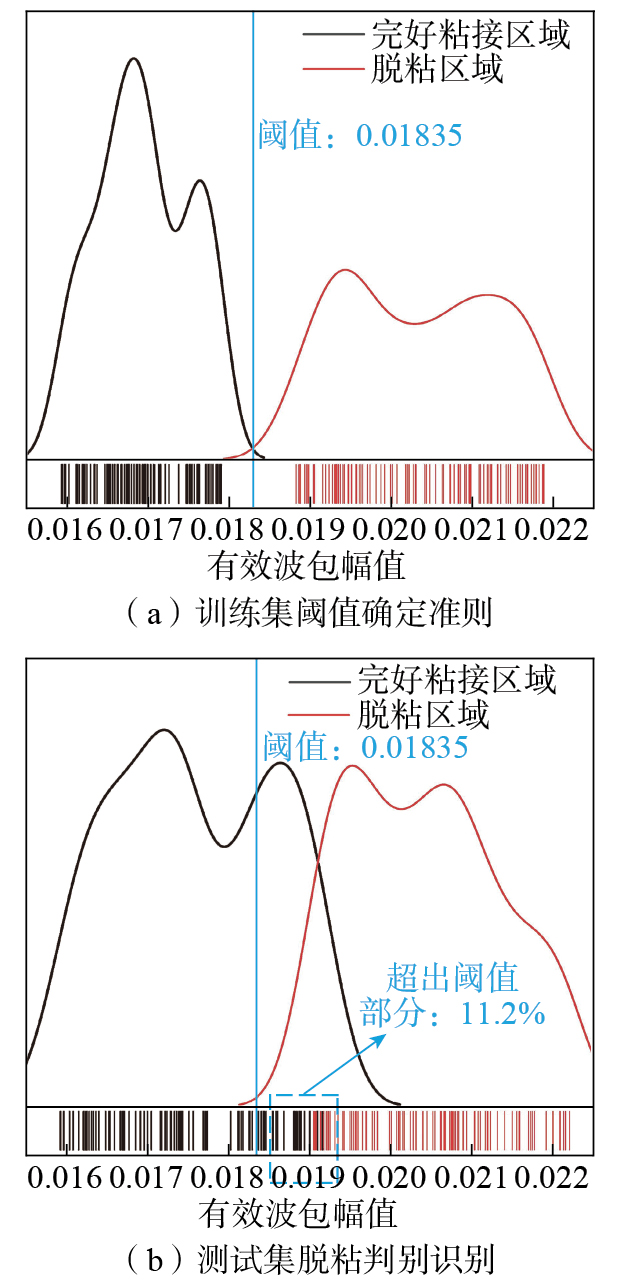
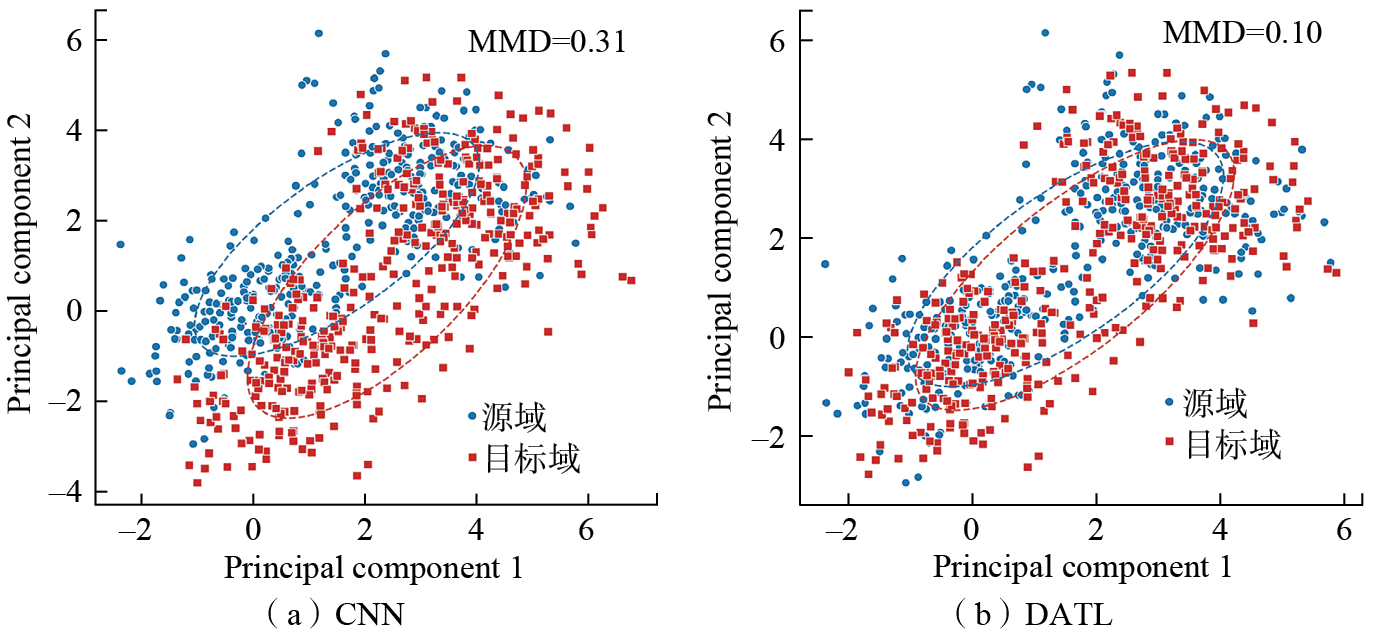
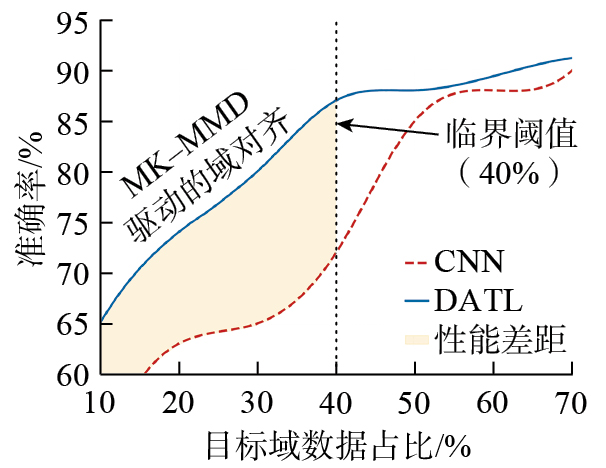
针对可重复使用飞行器热防护结构在复杂多场耦合环境下易产生层间脱粘损伤的关键问题,提出基于超声导波与域自适应迁移学习的无损检测方法。通过设计4类典型粘接缺陷的隔热瓦试件,结合双向正交扫描策略与超声激励–接收机制,实现粘接区域的高效覆盖检测。针对试件个体差异引起的信号漂移问题,采用基于峰值比例阈值的相位对齐方法,通过优化窗口长度同步保留损伤敏感特征并抑制噪声干扰。进一步构建域自适应迁移学习网络(Domain-adaptive transfer learning,DATL),实现跨试件损伤特征的分布对齐。试验表明,在跨试件测试场景下,DATL模型准确率仅下降3.9%,域间分布差异指数从0.31降至0.10;在目标域数据量不足40%时,其准确率仍达85%,较卷积神经网络(Convolutional neural network,CNN)提升19.4%。该方法缓解了对损伤类型和试件一致性的依赖,可降低在役热防护结构脱粘检测的误报率与漏检率,为可重复使用飞行器的快速无损检测与健康评估提供了一种可行的解决参考方案。
关键词
热防护结构;脱粘损伤;超声导波;双向正交扫描策略;域自适应迁移学习;
Domain-Adaptive Transfer Learning-Based Guided Wave Method for Debonding Detection in Thermal Protection System
2.China Science and Technology on Reliability and Environmental Engineering Laboratory, Beijing Institute of Structure and Environment Engineering, Beijing100076, China
Citations
HUANG Xin, QU Wenzhong, JIANG Qi, et al. Domain-adaptive transfer learning-based guided wave method for debonding detection in thermal protection system[J]. Aeronautical Manufacturing Technology, 2025, 68(21): 76–87.
Abstract
Aiming at the critical issue of interlayer debonding damage susceptibility in reusable launch vehicle thermal protection structures under complex multi-physics coupling environments, a non-destructive testing method integrating ultrasonic guided waves with domain-adaptive transfer learning was proposed. Four typical bonding types were designed in thermal protection tile specimens, enabling efficient full-coverage inspection of bonded areas through a bidirectional orthogonal scanning strategy coupled with an ultrasonic excitation-reception mechanism. To solve the problem of signal drift caused by individual differences of specimens, an adaptive phase alignment method based on peak proportion threshold is proposed, and an appropriate window length is selected to realize the retention of key features of debonding damage while suppressing the interference of redundant data. A Domain-Adaptive Transfer Learning (DATL) was further proposed to align cross-specimen damage feature distributions. Experimental results demonstrate that in cross-specimen testing scenarios, the DATL model exhibits only a 3.9% accuracy decline, with inter-domain distribution discrepancy reduced from 0.31 to 0.10. With target domain data below 40%, DATL achieves 85% accuracy, outperforming CNN by 19.4%. The methodology mitigates reliance on damage patterns and specimen consistency, effectively reducing false alarms and missed detections in debonding testing for in-service thermal protection systems, which provides a practical solution for rapid non-destructive evaluation and structural health monitoring of reusable launch vehicle.
可重复使用空天运载器作为未来航天任务的重要平台,兼具近地轨道载荷运输和空天作战武器平台的双重功能,能够完成精准打击、高点侦察、持久高空监视、实时远程侦查等多样化任务,已成为世界航天强国研究的热点[ 李俊宁, 胡子君, 孙陈诚, 等. 高超声速飞行器隔热材料技术研究进展[J]. 宇航材料工艺, 2011, 41(6): 10–13, 31.LI Junning, HU Zijun, SUN Chencheng, et al. Thermal insulation materials for hypersonic vehicles[J]. Aerospace Materials & Technology, 2011, 41(6): 10–13, 31. 周志勇, 马彬, 张萃, 等. X–37B轨道试验飞行器可重复使用热防护系统综述[J]. 航天器工程, 2016, 25(4): 95–101.ZHOU Zhiyong, MA Bin, ZHANG Cui, et al. Reusable thermal protection system for orbital test vehicle X–37B[J]. Spacecraft Engineering, 2016, 25(4): 95–101. 1-2]。随着航天技术的快速发展,热防护系统成为可重复使用飞行器发展的核心技术之一。飞行器在大气层再入和返回过程中会承受剧烈的温度载荷,其表面热防护性能直接影响结构安全与使用寿命。作为热防护系统中的关键组件,隔热瓦采用高性能耐高温材料,能够有效减少热量传递,保护飞行器机身免受高温损害[ UYANNA O, NAJAFI H. Thermal protection systems for space vehicles: A review on technology development, current challenges and future prospects[J]. Acta Astronautica, 2020, 176: 341–356. PAN B, YU L P, WU D F. Thermo-mechanical response of superalloy honeycomb sandwich panels subjected to non-steady thermal loading[J]. Materials & Design, 2015, 88: 528–536. 3-4]。在可重复使用环境条件下,隔热瓦的设计和性能成为影响飞行器安全性与可靠性的重要因素,因此已成为相关研究的重点方向。
热防护系统(Thermal protection system,TPS)的脱粘损伤主要由多种因素引起,其中最为关键的是热膨胀差异、气动载荷以及长时间高温和高频振动的共同作用[ 庞科技, 张运海, 杨旭堃. 空天飞行器热防护结构健康监测及维护技术综述[J]. 空间科学与试验学报, 2024, 24(4): 82–93.PANG Keji, ZHANG Yunhai, YANG Xukun. Review on health monitoring and maintenance technologies of thermal protection structures for reusable launch vehicles[J]. Journal of Space Science and Experiment, 2024, 24(4): 82–93. 5]。在飞行器的高速飞行过程中,飞行器表面会经历剧烈的温度变化和气动冲击[ SNAPP C, RODRIGUEZ A. Orbiter thermal protection system lessons learned[C]//AIAA SPACE 2011 Conference & Exposition. Long Beach: AIAA, 2011: 7308. SINGH M. In-Space Repair of reinforced carbon-carbon (RCC) thermal protection system structures[M]. 2005. 6-7],导致隔热瓦和承载结构之间的相对变形。由于不同材料之间的热膨胀系数差异,隔热瓦和承载结构可能会在温度变化过程中产生不均匀的应力分布,进而导致粘接层的局部脱落。此外,飞行器表面在飞行过程中会遭遇空气中的微小杂质或空间碎片撞击,也可能破坏隔热瓦与机体结构之间的粘接层,导致脱粘现象的发生[ 宋俊柏, 吴振强, 侯传涛, 等. 刚性隔热瓦热防护结构无损检测方法概述[J]. 强度与环境, 2022, 49(4): 48–57.SONG Junbai, WU Zhenqiang, HOU Chuantao, et al. Nondestructive testing on thermal protection systems of reusable aerospace craft[J]. Structure & Environment Engineering, 2022, 49(4): 48–57. 8]。由于隔热瓦脱粘通常发生在材料内部,且损伤位置较为隐蔽,传统的检测方法难以有效发现这些潜在问题。因此,开发一种高效无损的检测技术来及时发现隔热瓦的脱粘损伤,成为保障飞行器安全性和延长使用寿命的关键。
在热防护系统脱粘损伤检测问题诞生之初,诸多学者使用各种方法检测层间脱粘损伤。红外热成像技术发展较早,Davis等[ DAVIS C K. Shearographic and thermographic nondestructive evaluation of the space shuttle structure and thermal protection systems (TPS)[C]// Nondestructive Evaluation of Aging Aircraft, Airports, and Aerospace Hardware. Bellingham: SPIE, 1996. 9]于1996年使用该方法检测石墨环氧蜂窝隔热结构中的分层损伤;Taylor等[ TAYLOR J O, DUPONT H M. Inspection of metallic thermal protection systems for the X–33 launch vehicle using pulsed infrared thermography[C]// Conference on thermosense. Orlando: SPIE, 1998: 301–310. 10]的研究成果也表明红外热成像技术能检测金属蜂窝夹层热防护系统的内部缺陷.但该方法依赖表面温度场异常识别损伤[ 梅晨. 热障涂层结构缺陷脉冲红外热波无损检测技术研究[D]. 哈尔滨: 黑龙江科技大学, 2016.MEI Chen. Study on pulse infrared thermal wave nondestructive testing technology for structural defects of thermal barrier coatings[D]. Harbin: Heilongjiang University of Science and Technology, 2016. 11],多层隔热结构或表面涂层的存在会阻碍热波传递[ ZHOU G Y, ZHANG Z J, YIN W L, et al. Characterization and depth detection of internal delamination defects in CFRP based on line laser scanning infrared thermography[J]. Structural Health Monitoring, 2024, 23(5): 3195–3210. 12],导致深层脱粘缺陷漏检。研究学者们发现太赫兹脉冲成像技术在热防护结构损伤检测中也具有巨大潜力,Zhang[ ZHANG X C. Three-dimensional terahertz wave imaging[J]. Philosophical Transactions Series A, Mathematical, Physical, and Engineering Sciences, 2004, 362(1815): 283–298; discussion 298–299. 13]将太赫兹与层析成像结合,成功检测出隔热瓦内部缺陷。随着技术发展,研究人员发展出太赫兹扫描系统和损伤指标,在隔热瓦的脱粘损伤检测取得了进一步研究成果。但太赫兹波易被导电材料(如金属)吸收,导致信号衰减,且穿透能力较弱,对于多层复合材料,信号解析难度较高。柳敏静[ 柳敏静, 夏梓旭, 李建乐, 等. 基于分布式光纤传感的防热结构损伤识别研究[J]. 压电与声光, 2020, 42(6): 765–768.LIU Minjing, XIA Zixu, LI Jianle, et al. Research on damage detection of heat-insulating structure based on distributed optical fiber sensor[J]. Piezoelectrics & Acoustooptics, 2020, 42(6): 765–768. 14]、徐浩[ 徐浩, 王中枢, 马寅魏, 等. 基于分布式光纤的蜂窝夹层结构脱粘损伤监测[J]. 压电与声光, 2024, 46(3): 414–419.XU Hao, WANG Zhongshu, MA Yinwei, et al. Debonding damage monitoring of honeycomb sandwich structure based on distributed optical fiber[J]. Piezoelectrics & Acoustooptics, 2024, 46(3): 414–419. 15]等国内学者利用光纤传感技术,通过预埋光纤阵列实现分层结构的脱粘损伤监测,但其工程应用面临两大瓶颈:(1)传感器需在制造阶段嵌入热防护系统,导致现有装备改造成本增加且难以兼容在役检测需求;(2)极端热–力耦合环境(如气动加热、高频振动)易引发光纤断裂,影响长期监测可靠性[ XU Y, LEUNG C K Y, TONG P, et al. Interfacial debonding detection in bonded repair with a fiber optical interferometric sensor[J]. Composites Science and Technology, 2005, 65(9): 1428–1435. 16]。
相较而言,超声导波技术则展现出独特的综合优势。基于多模态波传播特性[ AN Y H, PANG C Z, CUI R T, et al. Debonding damage detection in CFRP–reinforced steel structures using scanning probabilistic imaging method improved by ultrasonic guided-wave transfer function[J]. Ultrasonics, 2025, 149: 107592. 17],可移动的多次激励即可实现大范围快速检测,显著提升效率。其界面耦合效应对粘接刚度变化高度敏感[ LI J R, LU Y, LEE Y F. Debonding detection in CFRP-reinforced steel structures using anti-symmetrical guided waves[J]. Composite Structures, 2020, 253: 112813. 18],可精准识别脱粘损伤。同时,导波在复杂几何结构中的自适应传播能力及抗表面粗糙干扰特性[ NIU X, DUAN W, CHEN H P, et al. Excitation and propagation of torsional T(0, 1) mode for guided wave testing of pipeline integrity[J]. Measurement, 2019, 131: 341–348. 19],使其能够穿透多层隔热结构并稳定表征深层缺陷[ ZHANG K S, LI S C, ZHOU Z G. Detection of disbonds in multi-layer bonded structures using the laser ultrasonic pulse-echo mode[J]. Ultrasonics, 2019, 94: 411–418. 20]。此外,无需预埋传感器、可拆卸式检测方案也大幅降低了工程应用成本。针对超声导波技术在隔热瓦脱粘损伤检测中的独特优势,其工程化应用仍面临复杂工况下信号特征提取与损伤量化等关键挑战。具体而言,热防护系统的实际服役环境会引入多重干扰因素[ 谢志强, 陈志彦, 姜勇刚, 等. 三明治结构防隔热一体化材料研究进展[J]. 南京工业大学学报(自然科学版), 2024, 46(6): 593–601.XIE Zhiqiang, CHEN Zhiyan, JIANG Yonggang, et al. Research progress on integrated thermal protection and insulation materials with sandwich structures[J]. Journal of Nanjing Tech University (Natural Science Edition), 2024, 46(6): 593–601. 21]:首先,气动噪声、机械振动及温度循环易导致导波信号基线漂移,传统阈值判别方法难以有效区分真实损伤与噪声扰动;其次,隔热瓦制造公差及材料老化引起的波速变化,会显著降低损伤敏感模态的识别鲁棒性。此外,脱粘损伤的几何尺寸、空间分布与界面退化程度之间呈现强非线性映射关系,使得基于物理模型的损伤量化准则难以适应多场景需求[ WANG C Y, ZHU G Y, LIU T Y, et al. A sub-domain adaptive transfer learning base on residual network for bearing fault diagnosis[J]. Journal of Vibration and Control, 2023, 29(1–2): 105–117. 22]。
近年来,迁移学习技术为解决跨场景、跨试件的结构健康监测问题提供了新思路。Li等[ LI J, LIU Y B, LI Q J. Generative adversarial network and transfer-learning-based fault detection for rotating machinery with imbalanced data condition[J]. Measurement Science and Technology, 2022, 33(4): 045103. 23]使用迁移学习技术实现了在不平衡数据条件下对滚动轴承的故障诊断。Zhang等[ ZHANG B, HONG X B, LIU Y. Distribution adaptation deep transfer learning method for cross-structure health monitoring using guided waves[J]. Structural Health Monitoring, 2022, 21(3): 853–871. 24]基于分布自适应深度迁移学习的跨结构超声导波结构健康监测方法,利用一个结构的单传感器监测数据实现另一个结构的多传感器损伤监测。Rai等[ RAI A, MITRA M. A transfer learning approach for damage diagnosis in composite laminated plate using Lamb waves[J]. Smart Materials and Structures, 2022, 31(6): 065002. 25]提出一种基于1D–CNN自动编码器和分类器的迁移学习框架,实现了2 mm碳纤维板的Lamb波信号人工缺陷损伤识别。Sawant等[ SAWANT S, SETHI A, BANERJEE S, et al. Unsupervised learning framework for temperature compensated damage identification and localization in ultrasonic guided wave SHM with transfer learning[J]. Ultrasonics, 2023, 130: 106931. 26]使用一种无监督的迁移学习方法,不使用损伤对应的导波信号实现更准确的损伤检测。然而,现有研究多基于理想化实验室环境构建模型,其单一模态信号特征提取机制难以适应飞行器实际工况中多物理场耦合引起的导波信号频散特性突变,且传统迁移学习框架往往忽略材料批次差异和服役老化导致的特征分布偏移,导致在跨试件应用时易产生脱粘损伤误判。
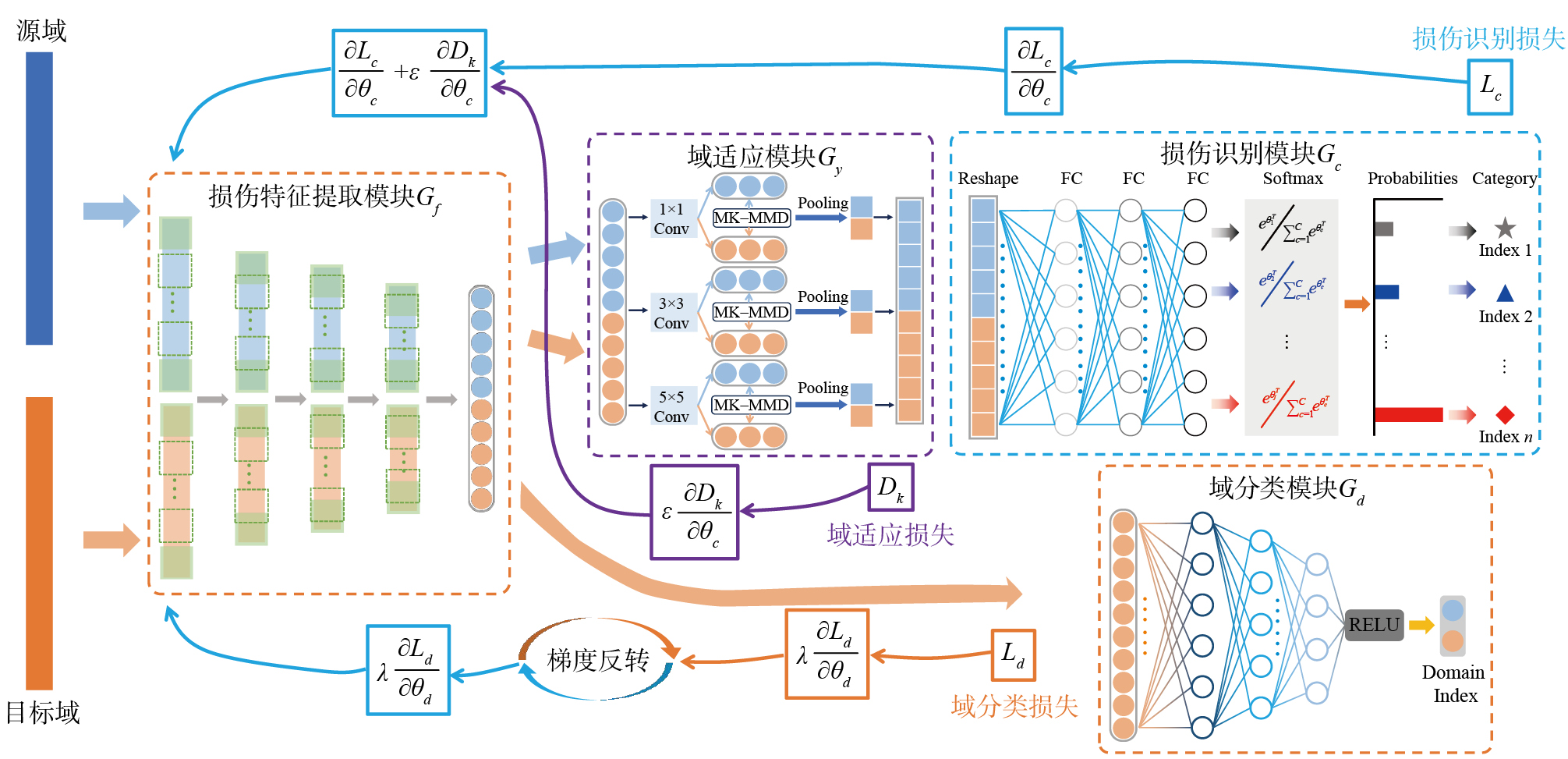
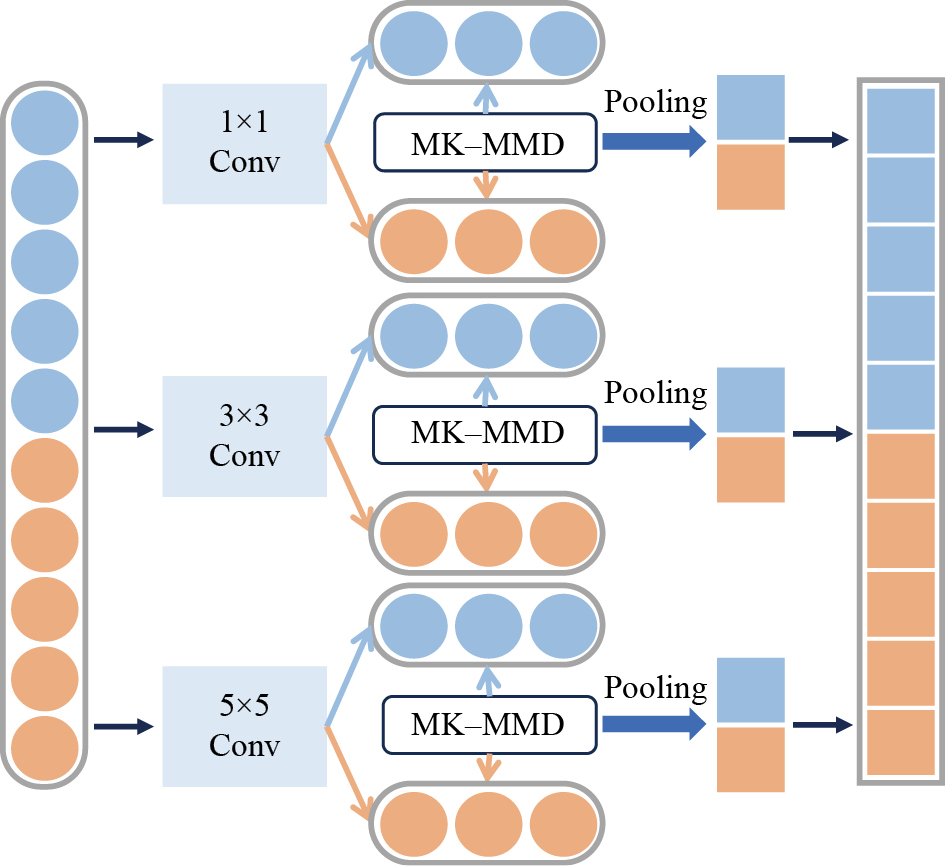
如图2所示,域适应模块采用了多尺度卷积操作,其中1×1卷积主要用于减少通道数的降维操作,减少计算量的同时提取信号的通道信息;3×3卷积用于提取局部特征和捕捉信号的细节;使用相对较大的5×5卷积核用于捕捉更大的局部信息或者长时间依赖。为了使Gt和Gs的概率分布更接近,在域适应模块使用多内核最大平均差异(Multi–kernel maximum mean discrepancy,MK–MMD)的域分布差异度量[ LIU C, XU X B, WU J, et al. Deep transfer learning-based damage detection of composite structures by fusing monitoring data with physical mechanism[J]. Engineering Applications of Artificial Intelligence, 2023, 123: 106245. 27],可表示为式(2)。
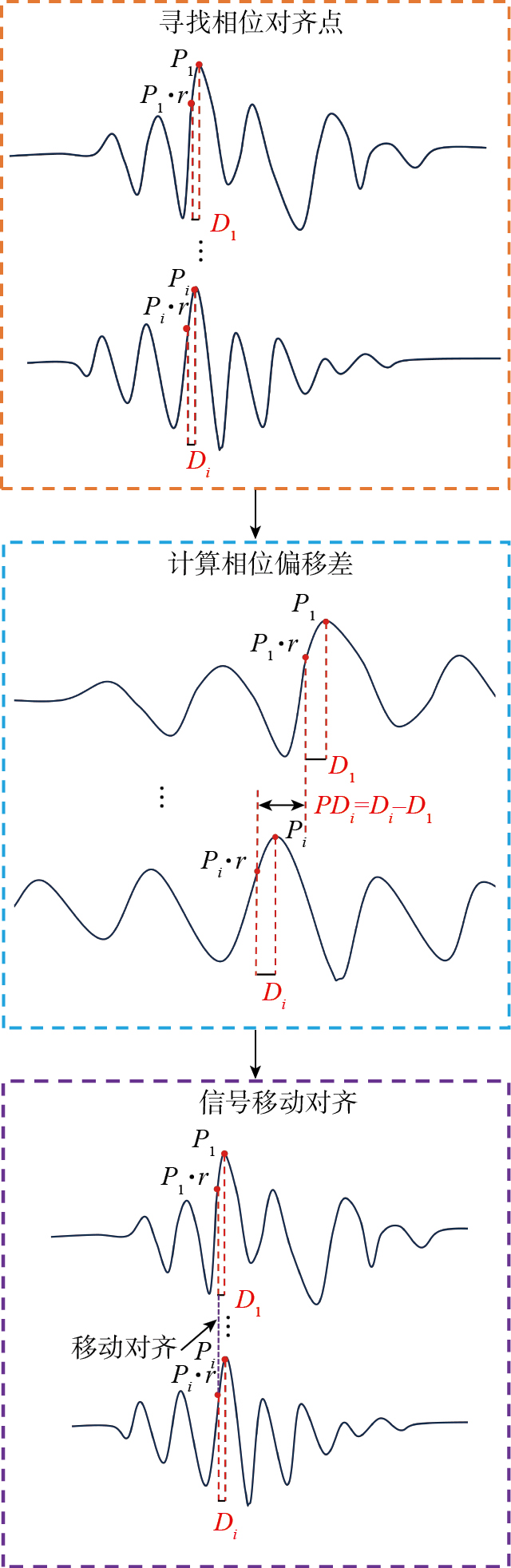
式中,Di为第i条信号的对齐时刻索引值;arg min(·)表示为满足条件的最小时间索引;Ai为第i条统一相位和维度的原始UGW信号;Pi为峰值;r为黄金分割比[ YANG D M, ZHANG B, CAI R M, et al. Multiple domain dynamic feature adaption transfer learning method for stranded wires health monitoring under variable vibration working conditions using laser-generated ultrasonic guided wave[J]. Engineering Structures, 2023, 297: 117013. 28],用于平衡噪声鲁棒性与对齐灵敏度。
图11 峰值比例阈值触发的相位对齐方法
Fig.11 Phase alignment method triggered by peak proportion threshold
周志勇, 马彬, 张萃, 等. X–37B轨道试验飞行器可重复使用热防护系统综述[J]. 航天器工程, 2016, 25(4): 95–101. ZHOUZhiyong, MABin, ZHANGCui, et al. Reusable thermal protection system for orbital test vehicle X–37B[J]. Spacecraft Engineering, 2016, 25(4): 95–101.
[3]
UYANNAO, NAJAFIH. Thermal protection systems for space vehicles: A review on technology development, current challenges and future prospects[J]. Acta Astronautica, 2020, 176: 341–356.
[4]
PANB, YUL P, WUD F. Thermo-mechanical response of superalloy honeycomb sandwich panels subjected to non-steady thermal loading[J]. Materials & Design, 2015, 88: 528–536.
[5]
庞科技, 张运海, 杨旭堃. 空天飞行器热防护结构健康监测及维护技术综述[J]. 空间科学与试验学报, 2024, 24(4): 82–93. PANGKeji, ZHANGYunhai, YANGXukun. Review on health monitoring and maintenance technologies of thermal protection structures for reusable launch vehicles[J]. Journal of Space Science and Experiment, 2024, 24(4): 82–93.
[6]
SNAPPC, RODRIGUEZA. Orbiter thermal protection system lessons learned[C]//AIAA SPACE 2011 Conference & Exposition. Long Beach: AIAA, 2011: 7308.
[7]
SINGHM. In-Space Repair of reinforced carbon-carbon (RCC) thermal protection system structures[M]. 2005.
[8]
宋俊柏, 吴振强, 侯传涛, 等. 刚性隔热瓦热防护结构无损检测方法概述[J]. 强度与环境, 2022, 49(4): 48–57. SONGJunbai, WUZhenqiang, HOUChuantao, et al. Nondestructive testing on thermal protection systems of reusable aerospace craft[J]. Structure & Environment Engineering, 2022, 49(4): 48–57.
[9]
DAVISC K. Shearographic and thermographic nondestructive evaluation of the space shuttle structure and thermal protection systems (TPS)[C]// Nondestructive Evaluation of Aging Aircraft, Airports, and Aerospace Hardware. Bellingham: SPIE, 1996.
[10]
TAYLORJ O, DUPONTH M. Inspection of metallic thermal protection systems for the X–33 launch vehicle using pulsed infrared thermography[C]// Conference on thermosense. Orlando: SPIE, 1998: 301–310.
[11]
梅晨. 热障涂层结构缺陷脉冲红外热波无损检测技术研究[D]. 哈尔滨: 黑龙江科技大学, 2016. MEIChen. Study on pulse infrared thermal wave nondestructive testing technology for structural defects of thermal barrier coatings[D]. Harbin: Heilongjiang University of Science and Technology, 2016.
[12]
ZHOUG Y, ZHANGZ J, YINW L, et al. Characterization and depth detection of internal delamination defects in CFRP based on line laser scanning infrared thermography[J]. Structural Health Monitoring, 2024, 23(5): 3195–3210.
[13]
ZHANGX C. Three-dimensional terahertz wave imaging[J]. Philosophical Transactions Series A, Mathematical, Physical, and Engineering Sciences, 2004, 362(1815): 283–298; discussion 298–299.
[14]
柳敏静, 夏梓旭, 李建乐, 等. 基于分布式光纤传感的防热结构损伤识别研究[J]. 压电与声光, 2020, 42(6): 765–768. LIUMinjing, XIAZixu, LIJianle, et al. Research on damage detection of heat-insulating structure based on distributed optical fiber sensor[J]. Piezoelectrics & Acoustooptics, 2020, 42(6): 765–768.
[15]
徐浩, 王中枢, 马寅魏, 等. 基于分布式光纤的蜂窝夹层结构脱粘损伤监测[J]. 压电与声光, 2024, 46(3): 414–419. XUHao, WANGZhongshu, MAYinwei, et al. Debonding damage monitoring of honeycomb sandwich structure based on distributed optical fiber[J]. Piezoelectrics & Acoustooptics, 2024, 46(3): 414–419.
[16]
XUY, LEUNGC K Y, TONGP, et al. Interfacial debonding detection in bonded repair with a fiber optical interferometric sensor[J]. Composites Science and Technology, 2005, 65(9): 1428–1435.
[17]
ANY H, PANGC Z, CUIR T, et al. Debonding damage detection in CFRP–reinforced steel structures using scanning probabilistic imaging method improved by ultrasonic guided-wave transfer function[J]. Ultrasonics, 2025, 149: 107592.
[18]
LIJ R, LUY, LEEY F. Debonding detection in CFRP-reinforced steel structures using anti-symmetrical guided waves[J]. Composite Structures, 2020, 253: 112813.
[19]
NIUX, DUANW, CHENH P, et al. Excitation and propagation of torsional T(0, 1) mode for guided wave testing of pipeline integrity[J]. Measurement, 2019, 131: 341–348.
[20]
ZHANGK S, LIS C, ZHOUZ G. Detection of disbonds in multi-layer bonded structures using the laser ultrasonic pulse-echo mode[J]. Ultrasonics, 2019, 94: 411–418.
[21]
谢志强, 陈志彦, 姜勇刚, 等. 三明治结构防隔热一体化材料研究进展[J]. 南京工业大学学报(自然科学版), 2024, 46(6): 593–601. XIEZhiqiang, CHENZhiyan, JIANGYonggang, et al. Research progress on integrated thermal protection and insulation materials with sandwich structures[J]. Journal of Nanjing Tech University (Natural Science Edition), 2024, 46(6): 593–601.
[22]
WANGC Y, ZHUG Y, LIUT Y, et al. A sub-domain adaptive transfer learning base on residual network for bearing fault diagnosis[J]. Journal of Vibration and Control, 2023, 29(1–2): 105–117.
[23]
LIJ, LIUY B, LIQ J. Generative adversarial network and transfer-learning-based fault detection for rotating machinery with imbalanced data condition[J]. Measurement Science and Technology, 2022, 33(4): 045103.
[24]
ZHANGB, HONGX B, LIUY. Distribution adaptation deep transfer learning method for cross-structure health monitoring using guided waves[J]. Structural Health Monitoring, 2022, 21(3): 853–871.
[25]
RAIA, MITRAM. A transfer learning approach for damage diagnosis in composite laminated plate using Lamb waves[J]. Smart Materials and Structures, 2022, 31(6): 065002.
[26]
SAWANTS, SETHIA, BANERJEES, et al. Unsupervised learning framework for temperature compensated damage identification and localization in ultrasonic guided wave SHM with transfer learning[J]. Ultrasonics, 2023, 130: 106931.
[27]
LIUC, XUX B, WUJ, et al. Deep transfer learning-based damage detection of composite structures by fusing monitoring data with physical mechanism[J]. Engineering Applications of Artificial Intelligence, 2023, 123: 106245.
[28]
YANGD M, ZHANGB, CAIR M, et al. Multiple domain dynamic feature adaption transfer learning method for stranded wires health monitoring under variable vibration working conditions using laser-generated ultrasonic guided wave[J]. Engineering Structures, 2023, 297: 117013.