Bolt Loosening Monitoring Based on Wide-Temperature High-Response Piezoresistive Sensing
Citations
LIU Qijian, QIN Haoxuan, YANG Yuanyuan, et al. Bolt loosening monitoring based on wide-temperature high-response piezoresistive sensing[J]. Aeronautical Manufacturing Technology, 2025, 68(21): 42–51.
1.School of Aerospace Engineering, Xiamen University, Xiamen361002, China
2.Sichuan Institute of Xiamen University, Chengdu610213, China
Citations
LIU Qijian, QIN Haoxuan, YANG Yuanyuan, et al. Bolt loosening monitoring based on wide-temperature high-response piezoresistive sensing[J]. Aeronautical Manufacturing Technology, 2025, 68(21): 42–51.
Abstract
In advanced engineering applications such as aerospace, petrochemical, and rail transportation, bolted joints often operate under complex service conditions involving high temperatures, high pressures, and multi-source coupled loads. Piezoresistive sensors exhibit strong potential for engineering applications owing to their mature fabrication process, low cost, and sensitive response characteristics. In this study, a piezoresistive sensor featuring high-temperature resistance, high integration, and a wide response range was developed. A conductive solution was prepared by mechanically stirring and ultrasonically dispersing carbon black (CB), aluminum oxide (Al2O3), and polyamic acid (PAA) solution. The sensor, with a thickness of 100 μm, was fabricated using blade coating followed by thermal imidization, and subsequently integrated with a flexible printed circuit (FPC). Experimental results show that the sensor can operate stably at 300 ℃ for extended periods. In monitoring tests of M20 large-size bolted joints looseness, the sensor demonstrated a torque measurement range of up to 100 N·m and a pressure range of 34.30 MPa. The experimental results verify its stable monitoring performance under high-temperature and high-load conditions, offering a robust technical solution for the identification of loosening states in large-scale bolted joint structures of critical engineering equipment and demonstrating significant potential for practical engineering applications.
Keywords
Bolt looseness; Structural health monitoring; Piezoresistive sensor; High temperature; Wide measurement range;
螺栓连接作为常用的机械连接形式,具有连接强度高、拆卸便捷、制造成本低、适应复杂工况等优点[ 王娟, 施建伟, 张书亭, 等. 复合材料螺栓连接接头渐进损伤分析研究进展[J]. 航空制造技术, 2016, 59(3): 85–89, 96.WANG Juan, SHI Jianwei, ZHANG Shuting, et al. Research progress of progressive damage analysis of composite bolted joint[J]. Aeronautical Manufacturing Technology, 2016, 59(3): 85–89, 96. CROCCOLO D, DE AGOSTINIS M, FINI S, et al. Failure of threaded connections: A literature review[J]. Machines, 2023, 11(2): 212. 1-2],广泛应用于航空航天、石油化工、轨道交通等领域的重大装备关键部件中。螺栓连接结构在长期服役过程中易在拉应力、剪切应力等多种载荷作用下发生松动,进而导致连接性能退化,诱发结构失效、材料疲劳与寿命缩短,严重时可能引起部件脱落,带来严重安全隐患。因此,螺栓松动监测显得尤为重要,其有助于保障工程安全,提高设备可靠性以及降低维护成本,是当前学者们研究的重点方向[ 宫涛, 杨建华, 庄絮竹, 等. 螺栓松动故障监测实验研究综述[J]. 机械设计与制造, 2024(2): 354–363.GONG Tao, YANG Jianhua, ZHUANG Xuzhu, et al. Review of experimental research on bolt looseness monitoring[J]. Machinery Design & Manufacture, 2024(2): 354–363. 龚裕, 唐国良, 王孝然, 等. 螺栓连接松动的监检测技术研究进展[J]. 北京工业大学学报, 2025, 51(2): 192–213.GONG Yu, TANG Guoliang, WANG Xiaoran, et al. Detection and monitoring technologies for bolt connection loosening: A review[J]. Journal of Beijing University of Technology, 2025, 51(2): 192–213. 3-4]。结构健康监测(Structural health monitoring,SHM)技术通过在结构关键部位布设传感器,实现结构响应数据的实时采集与分析,从而对结构状态进行动态评估,识别潜在损伤及性能退化趋势,此技术已在工程领域得到广泛应用[ VIJAYAN D S, SIVASURIYAN A, DEVARAJAN P, et al. Development of intelligent technologies in SHM on the innovative diagnosis in civil engineering—A comprehensive review[J]. Buildings, 2023, 13(8): 1903. 田童, 李建乐, 邓德双, 等. 飞行器结构健康监测技术研究进展[J]. 航空制造技术, 2024, 67(13): 41–67, 98.TIAN Tong, LI Jianle, DENG Deshuang, et al. Research progress of structural health monitoring technology for aircraft[J]. Aeronautical Manufacturing Technology, 2024, 67(13): 41–67, 98. 5-6]。针对螺栓松动问题,SHM技术可实现对状态变化的在线感知与预警,可逐步取代传统依赖人工巡检的方式,在提升检测效率的同时显著降低潜在安全风险,使其具有重要的工程应用价值。
现有研究主要基于声发射信号分析[ ZHOU Y, WANG S Y, ZHOU M, et al. Percussion-based bolt looseness identification using vibration-guided sound reconstruction[J]. Structural Control and Health Monitoring, 2022, 29(2): e2876. YUAN R, LV Y, XU S J, et al. ResNet–integrated very early bolt looseness monitoring based on intrinsic feature extraction of percussion sounds[J]. Smart Material Structures, 2023, 32(3): 034002. 7-8]、超声导波与信号处理算法融合技术[ CHEN D D, LI W, DONG Z Q, et al. Multi-bolt looseness monitoring using guided waves: A cross-correlation approach of the wavelet energy envelope[J]. Smart Material Structures, 2024, 33(12): 125019. SUI X D, ZHANG R, LUO Y Z, et al. Multiple bolt looseness detection using SH–typed guided waves: Integrating physical mechanism with monitoring data[J]. Ultrasonics, 2025, 150: 107601. 9-10]、光纤布拉格光栅应变感知方法[ CHEN D D, HUO L S, LI H N, et al. A fiber Bragg grating (FBG)-enabled smart washer for bolt pre-load measurement: Design, analysis, calibration, and experimental validation[J]. Sensors, 2018, 18(8): 2586. ZHANG W X, WANG T, YU W, et al. FBG-based loosening angle measurement sensor for bolt looseness monitoring[J]. IEEE Sensors Journal, 2025, 25(3): 4254–4260. 11-12],以及基于机器视觉的图像特征分析等方法[ DENG L, SA Y, LI X F, et al. A vision-based bolt looseness detection method for a multi-bolt connection[J]. Applied Sciences, 2024, 14(11): 4385. LUO J, LI K L, XIE C Q, et al. A novel anti-loosening bolt looseness diagnosis of bolt connections using a vision-based technique[J]. Scientific Reports, 2024, 14(1): 11441. 13-14],对螺栓松动状态进行监测。然而,现有传感技术在工程应用中仍面临诸多如器件构型复杂、制造成本高、灵敏度有限及环境适应性不足等问题。相比之下,压阻传感器因其结构简单、制造成本低、便于集成等优势,在螺栓松动监测领域展现出较大应用潜力[ ZHAO Y J, MIAO L W, XIAO Y, et al. Research progress of flexible piezoresistive pressure sensor: A review[J]. IEEE Sensors Journal, 2024, 24(20): 31624–31644. SANLI A, DEMIRKALE B, KANOUN O. Real-time detection of loosening torque in bolted joints using piezoresistive pressure-sensitive layer based on multi-walled carbon nanotubes reinforced epoxy nanocomposites[J]. Scientific Reports, 2025, 15(1): 4830. 15-16]。表1对上述各类方法在螺栓松动监测中的优势与不足进行了归纳与对比。
表1 现有螺栓松动监测方法优缺点对比
Table 1 Comparison of advantages and limitations of different bolt looseness monitoring methods
监测方法
优点
缺点
声发射法
可检测松动引起的摩擦、冲击、裂纹等突发事件
误报率高,无法持续监测渐进式松动
超声导波法
对结构完整性变化敏感,可进行多螺栓监测
对螺栓预紧力变化不够敏感
光纤光栅法
可嵌入螺栓内部,精准检测螺栓轴向应变变化
安装复杂,成本高,不易频繁拆装
机器视觉法
非接触式识别松动,易于自动识别和集成AI算法
只能监测可视表面,易受光照、遮挡等条件影响
压阻传感法
成本低、结构薄,可直接贴附于螺栓及垫片处监测压力变化
需与螺栓紧密集成,灵敏度与稳定性易受材料影响
Song等[ SONG P Q, LIU Q J, WANG K, et al. On-site monitoring of composite bolted joints looseness using CB/PVP nanocomposite piezoresistive sensor[J]. IEEE Sensors Journal, 2022, 22(21): 21179–21187. 17]基于炭黑(Carbon black,CB)和聚乙烯吡咯烷酮复合材料开发了一种高灵敏度压阻传感器,通过调控组分质量分数及优化电极布局,实现了对碳纤维增强复合材料螺栓连接结构松动状态的高效监测,为复合材料连接结构的健康监测提供了新的技术路径。Jiang等[ JIANG X W, MA K M, LU S W, et al. Structure bolt tightening force and loosening monitoring by conductive MXene/FPC pressure sensor with high sensitivity and wide sensing range[J]. Sensors and Actuators A: Physical, 2021, 331: 113005. 18]研制的一种基于MXene/柔性电路板(Flexible printed circuit board,FPC)的压阻传感器,具有优异的力学性能和环境适应性,在63000次压力循环加载后仍保持稳定响应,并可在振动环境下准确识别螺栓松动状态,展现出较高的可靠性与耐久性。上述研究表明,压阻传感器凭借结构简单、灵敏度高及易于集成等优势,已在螺栓连接结构松动监测中展现出良好的应用潜力。然而,针对高温服役工况下大尺寸螺栓连接结构的压阻传感监测技术的相关研究仍较为薄弱,且仍面临多项关键技术难题。
重大装备在运行过程中常处于高温环境,其连接部位通常采用具有耐热胀冷缩、抗氧化及抗应力松弛性能的螺栓连接结构。螺栓不仅需在常温下保持连接可靠性,更需在高温工况下长期稳定服役。因此,实现高温条件下的螺栓松动监测具有重要的工程应用价值。针对该需求,国内外学者持续开展高温环境下压阻传感器的相关研究。Zhang等[ ZHANG G D, ZHAO Y L, ZHAO Y, et al. Research of a novel ultra-high pressure sensor with high-temperature resistance[J]. Micromachines, 2017, 9(1): 5. 19]提出将截锥截面结构与绝缘硅基压阻元件相结合,有效隔离热源,使传感器在高达800 ℃的环境下实现了1.6 GPa的超高压力测量,然而,该方案因传感器整体尺寸较大,难以集成于螺栓连接结构中,限制了其在紧凑空间内的工程应用。Yang等[ YANG N, YIN X Y, LIU H L, et al. High-performance wearable piezoresistive sensor with a wide temperature range via a Ti3C2Tx MXene/Au dual-layer conductive network and microspike structure[J]. ACS Applied Nano Materials, 2024, 7(14): 16964–16974. 20]提出一种Ti3C2Tx MXene/Au双层导电网络和微球状结构的压阻传感器,其具备1000 kPa的压力监测范围和497 kPa–1的灵敏度,并可在400 ℃高温环境下保持稳定工作性能。该传感器虽通过结构设计显著提升了灵敏度,但其压力量程有限,从而制约其在大尺寸螺栓连接结构松动监测中的适用性。Kadkhodazadeh等[ KADKHODAZADEH M, POURMAHDIAN S, AFSHAR-TAREMI F. Piezoresistive polyurethane nanocomposites of MWCNT–graphene with high modulus and thermomechanical stability[J]. Polymer Composites, 2025, 46(10): 8892–8905. 21]采用高弹性模量聚氨酯基体,掺杂碳纳米管(Carbon nanotube,CNT)和石墨烯纳米片(Graphene nanoplatelets,GNP)导电填料,开发出一种具有优异热稳定性的压阻传感器,能够在150 ℃下实现10 MPa量程的压力监测。该传感器在中低温下具有良好性能,但其聚氨酯基体不耐高温,长期服役易发生性能退化,难以满足高温环境下螺栓状态监测的应用需求。现阶段,压阻传感器在耐高温、宽量程及薄型化等方面仍难以同时满足螺栓松动监测的工程应用需求,其在高温环境下的实际应用仍处于探索阶段。
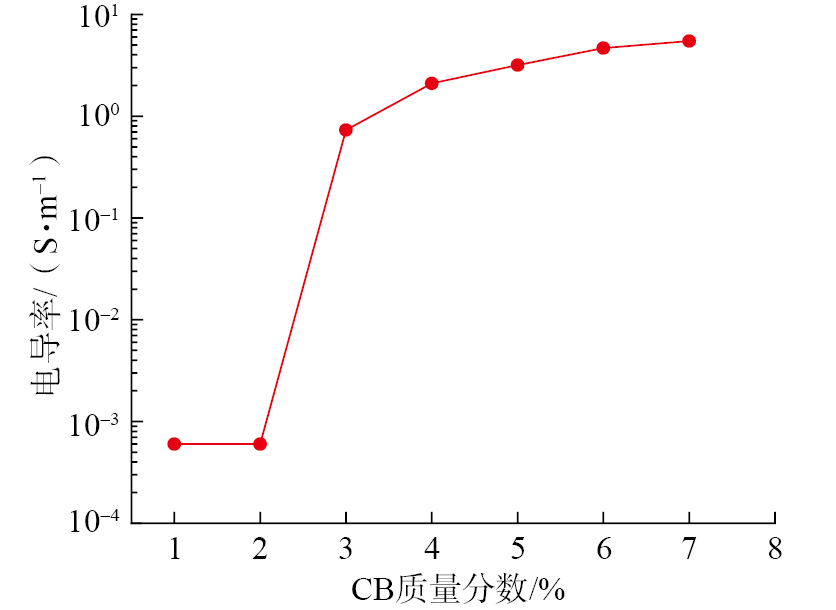
Table 3 Composition of sensing layers in piezoresistive sensors with varying CB mass fractions
传感器名称
传感层组成及其质量分数
CB质量/g
PAA质量/g
1CB/PI
1% CB+99% PI
0.036
3.564
2CB/PI
2% CB+98% PI
0.072
3.528
3CB/PI
3% CB+97% PI
0.108
3.492
4CB/PI
4% CB+96% PI
0.144
3.456
5CB/PI
5% CB+95% PI
0.18
3.42
6CB/PI
6% CB+94% PI
0.216
3.384
7CB/PI
7% CB+93% PI
0.252
3.348
图5 压阻传感器的电导率与CB质量分数关系
Fig.5 Relationship between electrical conductivity of piezoresistive sensors and CB mass fraction
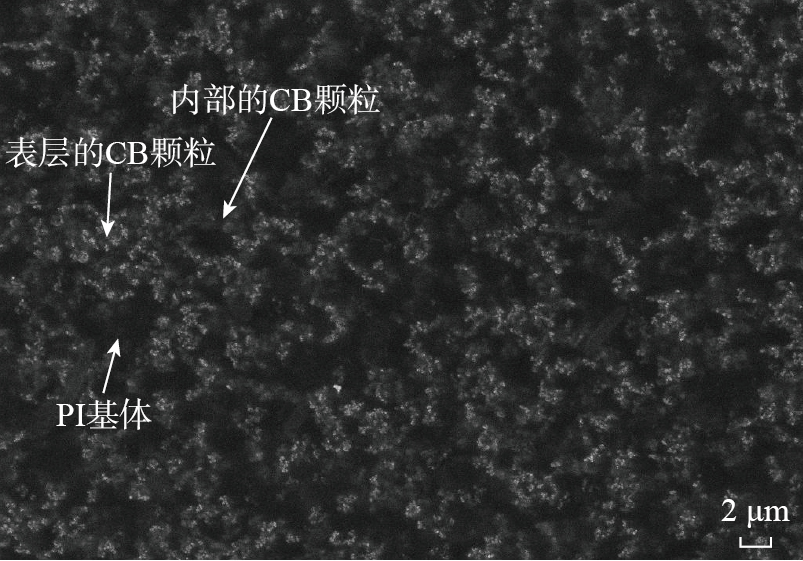
在确定导电填料为3% CB的基础上,本文通过扫描电子显微镜(Scanning electron microscope,SEM)对3CB/PI传感器的传感层微观形貌进行表征。SEM测试采用ZEISS SUPRA 55 SAPPHIRE电子显微镜,在加速电压15 kV、放大倍率2000倍的条件下获取图像,如图6所示。结果表明,CB颗粒在PI基体表面及内部均匀分布,有助于形成稳定、连续的导电网络,增强传感层的应变响应一致性与可靠性,从而提升传感器在高温及复杂载荷环境下的性能表现。
图6 3CB/PI压阻传感器传感层的SEM拍摄图
Fig.6 SEM images of sensing layer in 3CB/PI piezoresistive sensor
Table 7 Performance comparison of various piezoresistive sensing methods
传感器构成
最大监测压力
最高工作温度
厚度
来源
炭黑/聚乙烯吡咯烷酮
0.9 MPa
—
—
[ SONG P Q, LIU Q J, WANG K, et al. On-site monitoring of composite bolted joints looseness using CB/PVP nanocomposite piezoresistive sensor[J]. IEEE Sensors Journal, 2022, 22(21): 21179–21187. 17]
MXene
120 MPa
—
120 μm
[ JIANG X W, MA K M, LU S W, et al. Structure bolt tightening force and loosening monitoring by conductive MXene/FPC pressure sensor with high sensitivity and wide sensing range[J]. Sensors and Actuators A: Physical, 2021, 331: 113005. 18]
绝缘硅基压阻元件
1.6 GPa
800 ℃
180 mm
[ ZHANG G D, ZHAO Y L, ZHAO Y, et al. Research of a novel ultra-high pressure sensor with high-temperature resistance[J]. Micromachines, 2017, 9(1): 5. 19]
Ti3C2Tx MXene/Au
1000 kPa
400 ℃
0.66 mm
[ YANG N, YIN X Y, LIU H L, et al. High-performance wearable piezoresistive sensor with a wide temperature range via a Ti3C2Tx MXene/Au dual-layer conductive network and microspike structure[J]. ACS Applied Nano Materials, 2024, 7(14): 16964–16974. 20]
聚氨酯/碳纳米管/石墨烯纳米片
10 MPa
150 ℃
0.4~0.5 mm
[ KADKHODAZADEH M, POURMAHDIAN S, AFSHAR-TAREMI F. Piezoresistive polyurethane nanocomposites of MWCNT–graphene with high modulus and thermomechanical stability[J]. Polymer Composites, 2025, 46(10): 8892–8905. 21]
王娟, 施建伟, 张书亭, 等. 复合材料螺栓连接接头渐进损伤分析研究进展[J]. 航空制造技术, 2016, 59(3): 85–89, 96. WANGJuan, SHIJianwei, ZHANGShuting, et al. Research progress of progressive damage analysis of composite bolted joint[J]. Aeronautical Manufacturing Technology, 2016, 59(3): 85–89, 96.
[2]
CROCCOLOD, DE AGOSTINISM, FINIS, et al. Failure of threaded connections: A literature review[J]. Machines, 2023, 11(2): 212.
[3]
宫涛, 杨建华, 庄絮竹, 等. 螺栓松动故障监测实验研究综述[J]. 机械设计与制造, 2024(2): 354–363. GONGTao, YANGJianhua, ZHUANGXuzhu, et al. Review of experimental research on bolt looseness monitoring[J]. Machinery Design & Manufacture, 2024(2): 354–363.
[4]
龚裕, 唐国良, 王孝然, 等. 螺栓连接松动的监检测技术研究进展[J]. 北京工业大学学报, 2025, 51(2): 192–213. GONGYu, TANGGuoliang, WANGXiaoran, et al. Detection and monitoring technologies for bolt connection loosening: A review[J]. Journal of Beijing University of Technology, 2025, 51(2): 192–213.
[5]
VIJAYAND S, SIVASURIYANA, DEVARAJANP, et al. Development of intelligent technologies in SHM on the innovative diagnosis in civil engineering—A comprehensive review[J]. Buildings, 2023, 13(8): 1903.
[6]
田童, 李建乐, 邓德双, 等. 飞行器结构健康监测技术研究进展[J]. 航空制造技术, 2024, 67(13): 41–67, 98. TIANTong, LIJianle, DENGDeshuang, et al. Research progress of structural health monitoring technology for aircraft[J]. Aeronautical Manufacturing Technology, 2024, 67(13): 41–67, 98.
[7]
ZHOUY, WANGS Y, ZHOUM, et al. Percussion-based bolt looseness identification using vibration-guided sound reconstruction[J]. Structural Control and Health Monitoring, 2022, 29(2): e2876.
[8]
YUANR, LVY, XUS J, et al. ResNet–integrated very early bolt looseness monitoring based on intrinsic feature extraction of percussion sounds[J]. Smart Material Structures, 2023, 32(3): 034002.
[9]
CHEND D, LIW, DONGZ Q, et al. Multi-bolt looseness monitoring using guided waves: A cross-correlation approach of the wavelet energy envelope[J]. Smart Material Structures, 2024, 33(12): 125019.
[10]
SUIX D, ZHANGR, LUOY Z, et al. Multiple bolt looseness detection using SH–typed guided waves: Integrating physical mechanism with monitoring data[J]. Ultrasonics, 2025, 150: 107601.
[11]
CHEND D, HUOL S, LIH N, et al. A fiber Bragg grating (FBG)-enabled smart washer for bolt pre-load measurement: Design, analysis, calibration, and experimental validation[J]. Sensors, 2018, 18(8): 2586.
DENGL, SAY, LIX F, et al. A vision-based bolt looseness detection method for a multi-bolt connection[J]. Applied Sciences, 2024, 14(11): 4385.
[14]
LUOJ, LIK L, XIEC Q, et al. A novel anti-loosening bolt looseness diagnosis of bolt connections using a vision-based technique[J]. Scientific Reports, 2024, 14(1): 11441.
[15]
ZHAOY J, MIAOL W, XIAOY, et al. Research progress of flexible piezoresistive pressure sensor: A review[J]. IEEE Sensors Journal, 2024, 24(20): 31624–31644.
[16]
SANLIA, DEMIRKALEB, KANOUNO. Real-time detection of loosening torque in bolted joints using piezoresistive pressure-sensitive layer based on multi-walled carbon nanotubes reinforced epoxy nanocomposites[J]. Scientific Reports, 2025, 15(1): 4830.
[17]
SONGP Q, LIUQ J, WANGK, et al. On-site monitoring of composite bolted joints looseness using CB/PVP nanocomposite piezoresistive sensor[J]. IEEE Sensors Journal, 2022, 22(21): 21179–21187.
[18]
JIANGX W, MAK M, LUS W, et al. Structure bolt tightening force and loosening monitoring by conductive MXene/FPC pressure sensor with high sensitivity and wide sensing range[J]. Sensors and Actuators A: Physical, 2021, 331: 113005.
[19]
ZHANGG D, ZHAOY L, ZHAOY, et al. Research of a novel ultra-high pressure sensor with high-temperature resistance[J]. Micromachines, 2017, 9(1): 5.
[20]
YANGN, YINX Y, LIUH L, et al. High-performance wearable piezoresistive sensor with a wide temperature range via a Ti3C2Tx MXene/Au dual-layer conductive network and microspike structure[J]. ACS Applied Nano Materials, 2024, 7(14): 16964–16974.
[21]
KADKHODAZADEHM, POURMAHDIANS, AFSHAR-TAREMIF. Piezoresistive polyurethane nanocomposites of MWCNT–graphene with high modulus and thermomechanical stability[J]. Polymer Composites, 2025, 46(10): 8892–8905.