Review of Health Monitoring Technology for Thermal Protection System of Reusable Launch Vehicle
Citations
XU Chao, WU Yingxin, XU Suyu, et al. Review of health monitoring technology for thermal protection system of reusable launch vehicle[J]. Aeronautical Manufacturing Technology, 2025, 68(21): 24–39.
图1 航天飞机典型热防护系统结构[ LE V T, GOO N S. Design, fabrication, and testing of metallic thermal protection systems for spaceplane vehicles[J]. Journal of Spacecraft and Rockets, 2021, 58(4): 1043–1060. 15]
图2 星舰热防护系统
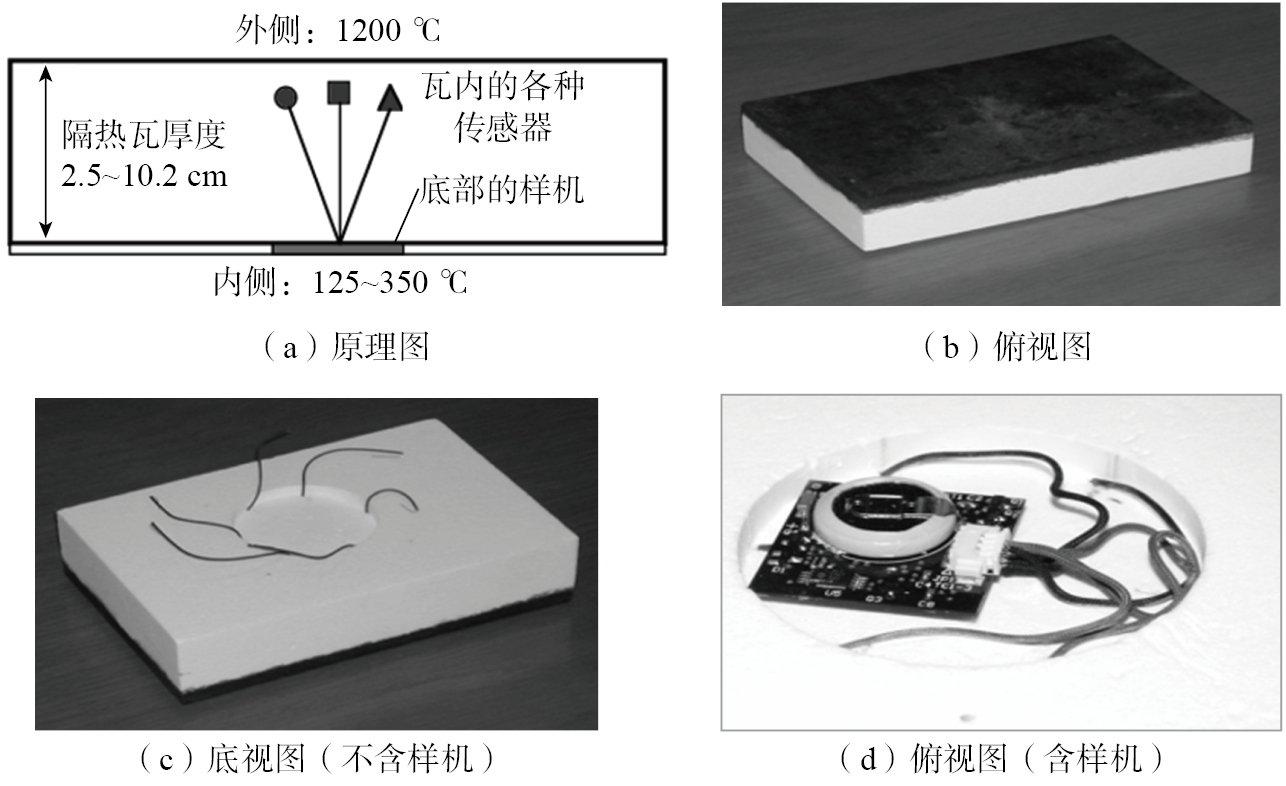
图3 被动式标识传感器[ MILOS F S, PALLIX J B. Wireless temperature sensors for health monitoring of aerospace thermal protection systems[C]//Proceedings of Smart Nondestructive Evaluation for Health Monitoring of Structural and Biological Systems. Bellingham: SPIE, 2002. 33]
图4 被动式标识传感器工作电路图[ MILOS F S, PALLIX J B. Wireless temperature sensors for health monitoring of aerospace thermal protection systems[C]//Proceedings of Smart Nondestructive Evaluation for Health Monitoring of Structural and Biological Systems. Bellingham: SPIE, 2002. 33]
图5 主动式标识传感器的安装[ MILOS F S, KARUNARATNE K S G. Active wireless temperature sensors for aerospace thermal protection systems[C]//Proceedings of Smart Nondestructive Evaluation and Health Monitoring of Structural and Biological Systems II. Bellingham: SPIE, 2003. 32]
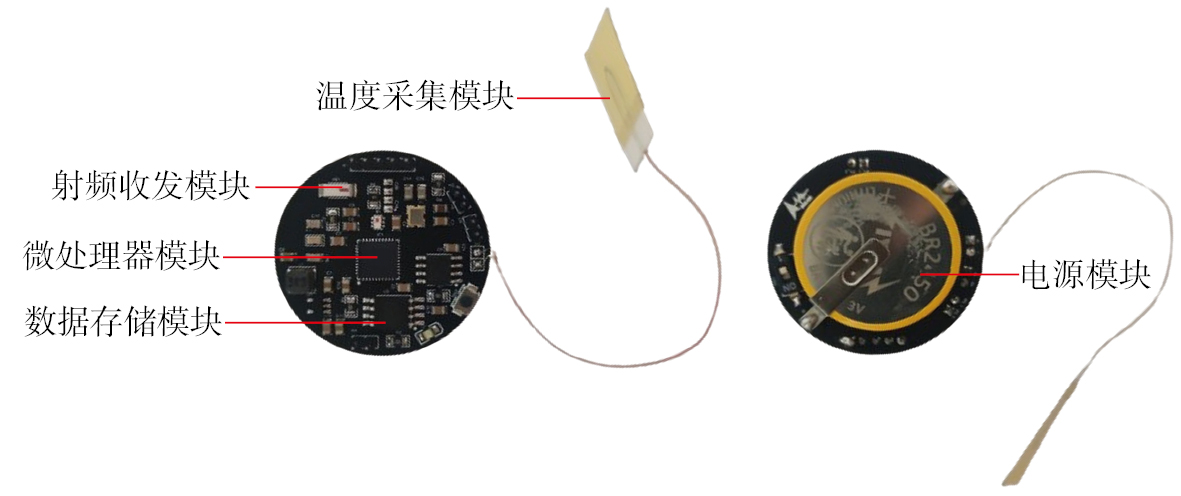
图6 温度监测节点[ 务颖欣, 许素宇, 徐大富, 等. 基于背壁温度测量的刚性热防护瓦健康监测原理样机设计[J]. 空天技术, 2024(6): 75–83.WU Yingxin, XU Suyu, XU Dafu, et al. Health monitoring prototype design for rigid thermal protection tile based on back-wall temperature detection[J]. Aerospace Technology, 2024(6): 75–83. 36]
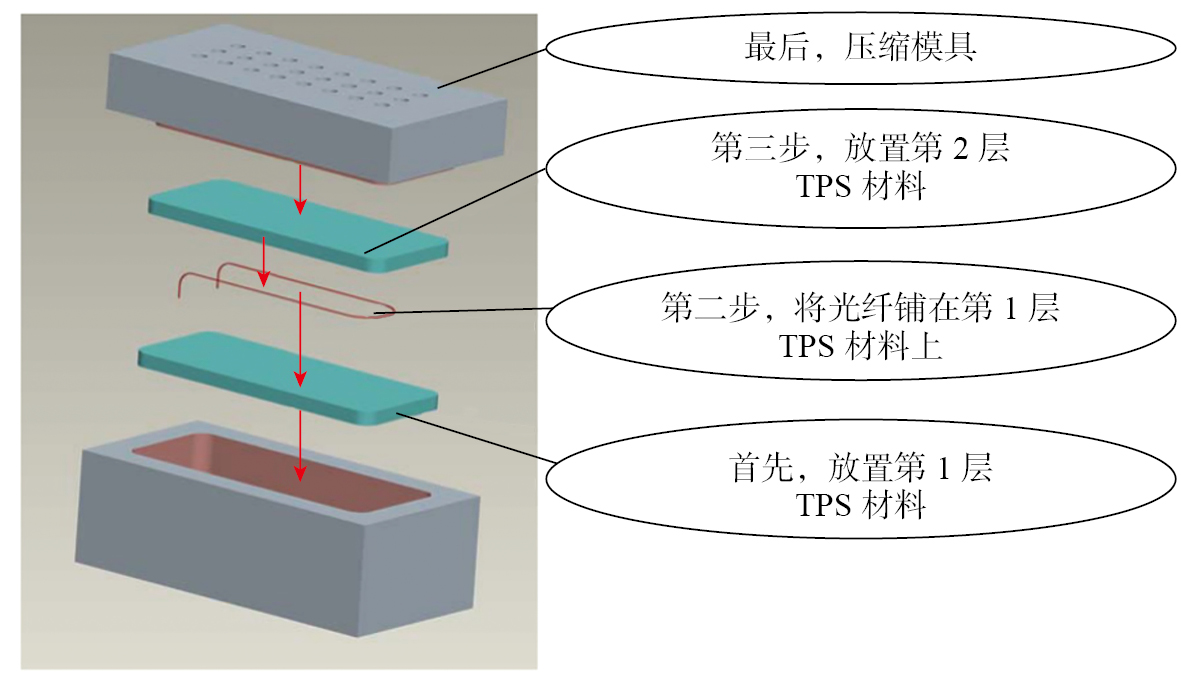
图7 光纤传感器嵌入防热瓦过程[ HANLON A B, DESHMUKH A, HYERS R W. Continuous health monitoring of the thermal protection system for future spacecraft[C]//Proceedings of Smart Structures and Materials 2006: Sensors and Smart Structures Technologies for Civil, Mechanical, and Aerospace Systems. Bellingham: SPIE, 2006. 40]
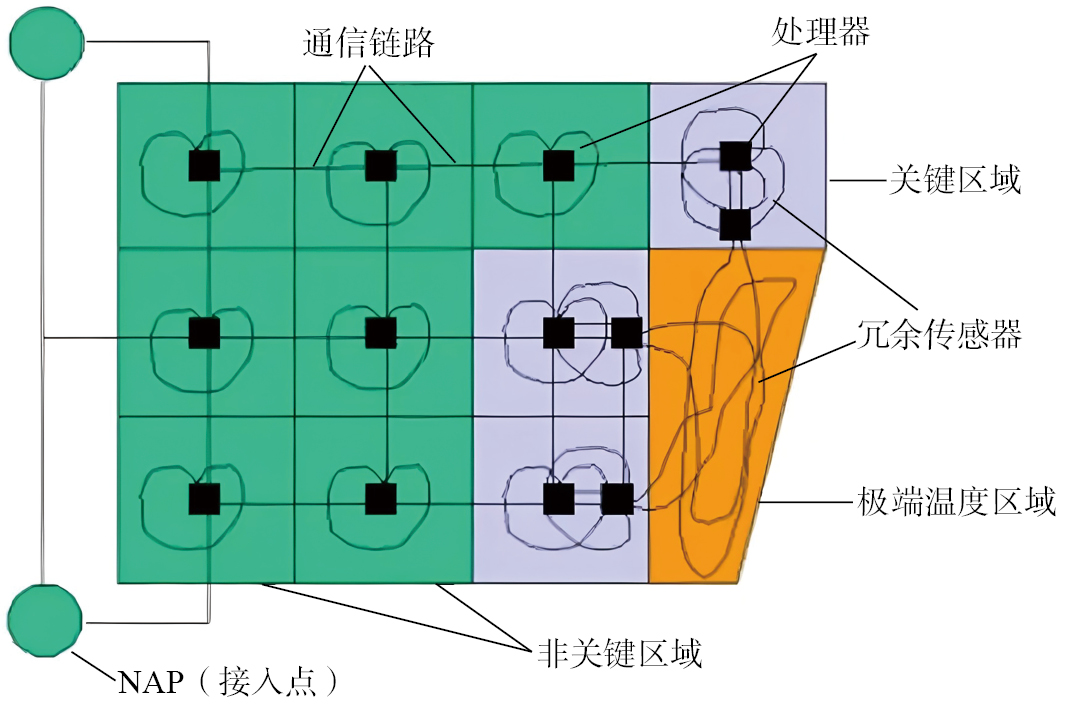
图8 健康监测系统网络布局[ DESHMUKH A, PEPYNE D, HANLON A B, et al. Distributed sensor network for thermal protection systems of future spacecraft[C]//Proceedings of ISHEM Forum 2005: First International Forum on Integrated System Health Engineering and Management in Aerospace. Washington: NASA, 2005. 41]
图9 螺栓与PZT的位置[ ZHANG Y K, HE Z P, ZHANG Z H, et al. Bolt loosening detection for aerospace thermal protection structures based on piezoelectric impedance method[J]. IEEE Transactions on Aerospace and Electronic Systems, 2017, 53(5): 2436–2452. 48]
图10 PZT嵌入式传感器垫圈[ YANG J, CHANG F K, DERRISO M M. Design of a hierarchical health monitoring system for detection of multilevel damage in bolted thermal protection panels: A preliminary study[J]. Structural Health Monitoring, 2003, 2(2): 115–122. 51]
图11 基于时反方法的螺栓松动检测原理示意图[ DU F, XU C, ZHANG J. A bolt preload monitoring method based on the refocusing capability of virtual time reversal[J]. Structural Control and Health Monitoring, 2019, 26(8): e2370. 54]
图12 TPS试件[ TOBE R J. Structural health monitoring of a thermal protection system for fastener failure with a validated model[D]. Dayton: Wright State University, 2010. 62]
图13 机电阻抗法检测防热瓦脱黏损伤[ GRISSO B L, INMAN D J. Impedance-based structural health monitoring of thermal protection systems[J]. Nondestructive Evaluation and Health Monitoring of Aerospace Materials, Composites, and Civil Infrastructure V, 2006, 6176: 61760M. 66]
图14 TPS模型的几何结构[ KUNDU T, DAS S, JATA K V. Health monitoring of a thermal protection system using lamb waves[J]. Structural Health Monitoring, 2009, 8(1): 29–45. 69]
图15 发射器、接收器和样本的方向[ KUNDU T, DAS S, JATA K V. Health monitoring of a thermal protection system using lamb waves[J]. Structural Health Monitoring, 2009, 8(1): 29–45. 69]
图16 TPS传感器布置示意图[ 郑辉, 邱雷, 袁慎芳, 等. C/C热防护结构高温气流损伤导波监测实验方法[J]. 航空学报, 2022, 43(8): 225659.ZHENG Hui, QIU Lei, YUAN Shenfang, et al. Experimental method of guided wave monitoring for high temperature airflow damage of C/C thermal protection structures[J]. Acta Aeronautica et Astronautica Sinica, 2022, 43(8): 225659. 71]
图17 试验件和试验加载装置[ 单一男, 武湛君, 徐新生, 等. 基于分布式光纤传感的隔热层脱粘识别研究[J]. 压电与声光, 2020, 42(1): 25–28.SHAN Yinan, WU Zhanjun, XU Xinsheng, et al. Research on de-bonding identification of thermal-protective coating based on distributed optical fiber sensing technology[J]. Piezoelectrics & Acoustooptics, 2020, 42(1): 25–28. 73]
图18 传感器位置和试验装置[ HUNDHAUSEN R J, ADAMS D E, DERRISO M. Impact loads identification in standoff metallic thermal protection system panels[J]. Journal of Intelligent Material Systems and Structures, 2007, 18(6): 531–541. 81]
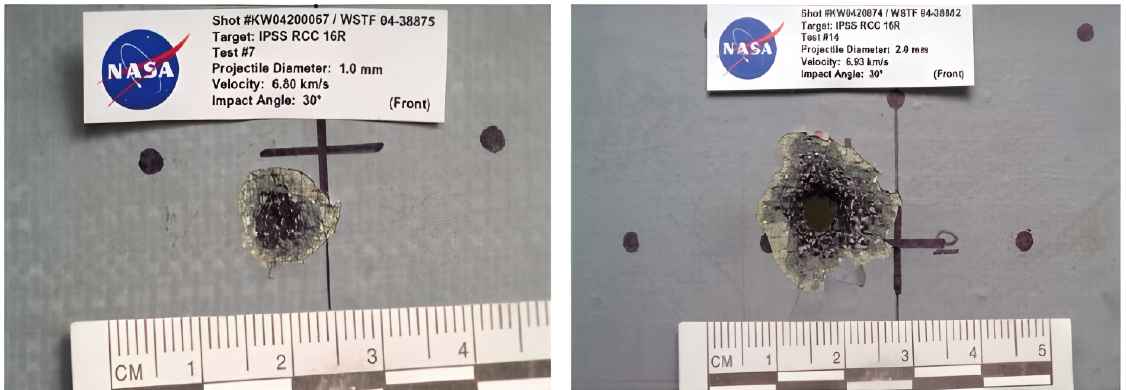
图19 WLEIDS组成[ YAP K, MACIAS J, KAOUK M, et al. Probabilistic structural health monitoring of the orbiter wing leading edge[C]//Proceedings of 52nd AIAA/ASME/ASCE/AHS/ASC Structures, Structural Dynamics and Materials Conference. Reston: AIAA, 2011. 82]
图20 机翼前缘碰撞试验品的示意图[ MADARAS E I. Structural health monitoring of the space shuttle’s wing leading edge[J]. AIP Conference Proceedings, 2006, 820(1): 1756–1763. 84]
图21 超高速撞击对增强碳–碳材料面板造成的损坏[ MADARAS E, WINFREE W, PROSSER W, et al. Nondestructive evaluation for the space shuttle’s wing leading edge[C]//proceedings of 41st AIAA/ASME/SAE/ASEE Joint Propulsion Conference & Exhibit. Reston: AIAA, 2005. 85]
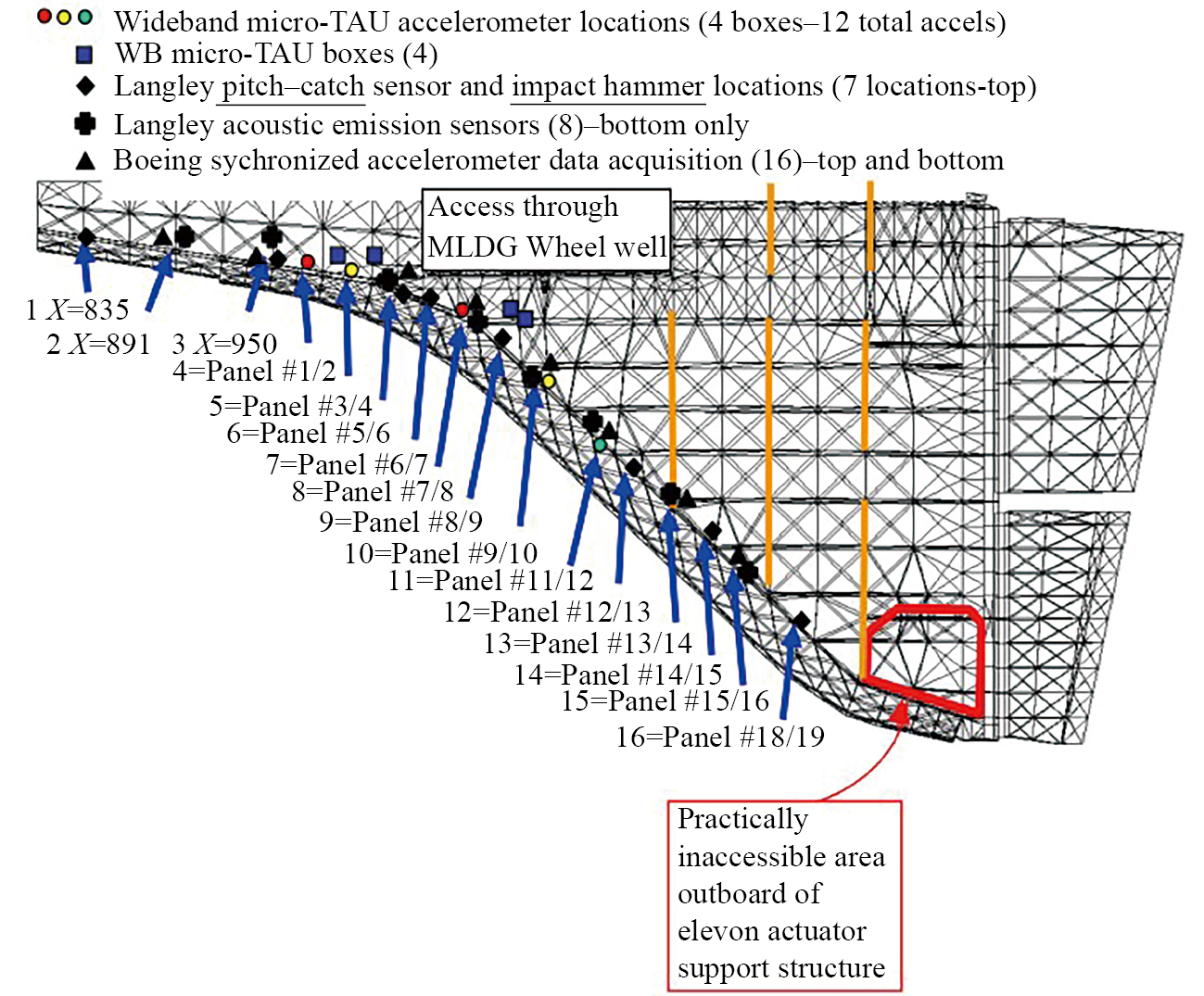
图22 航天飞机测试时传感器位置的布局[ MADARAS E, WINFREE W, PROSSER W, et al. Nondestructive evaluation for the space shuttle’s wing leading edge[C]//proceedings of 41st AIAA/ASME/SAE/ASEE Joint Propulsion Conference & Exhibit. Reston: AIAA, 2005. 85]
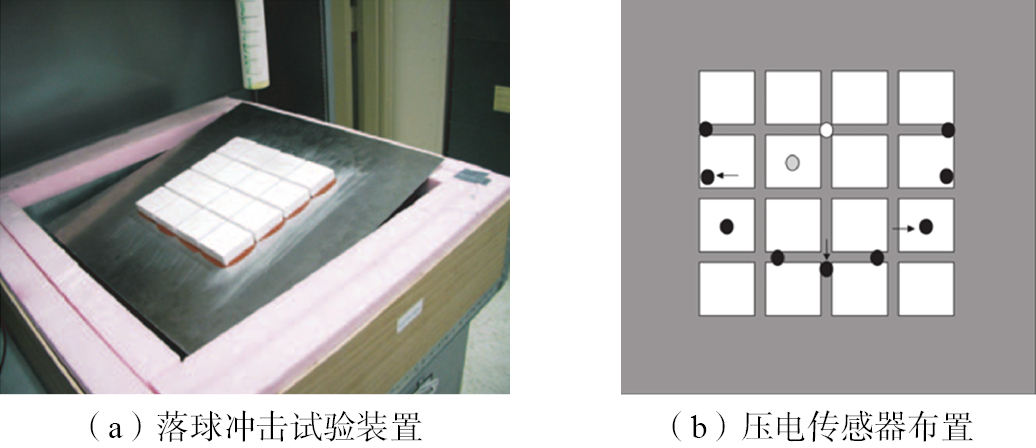
图23 落球试验装置和传感器布置[ KUNDU T, DAS S, JATA K V. Health monitoring of a thermal protection system using lamb waves[J]. Structural Health Monitoring, 2009, 8(1): 29–45. 69]
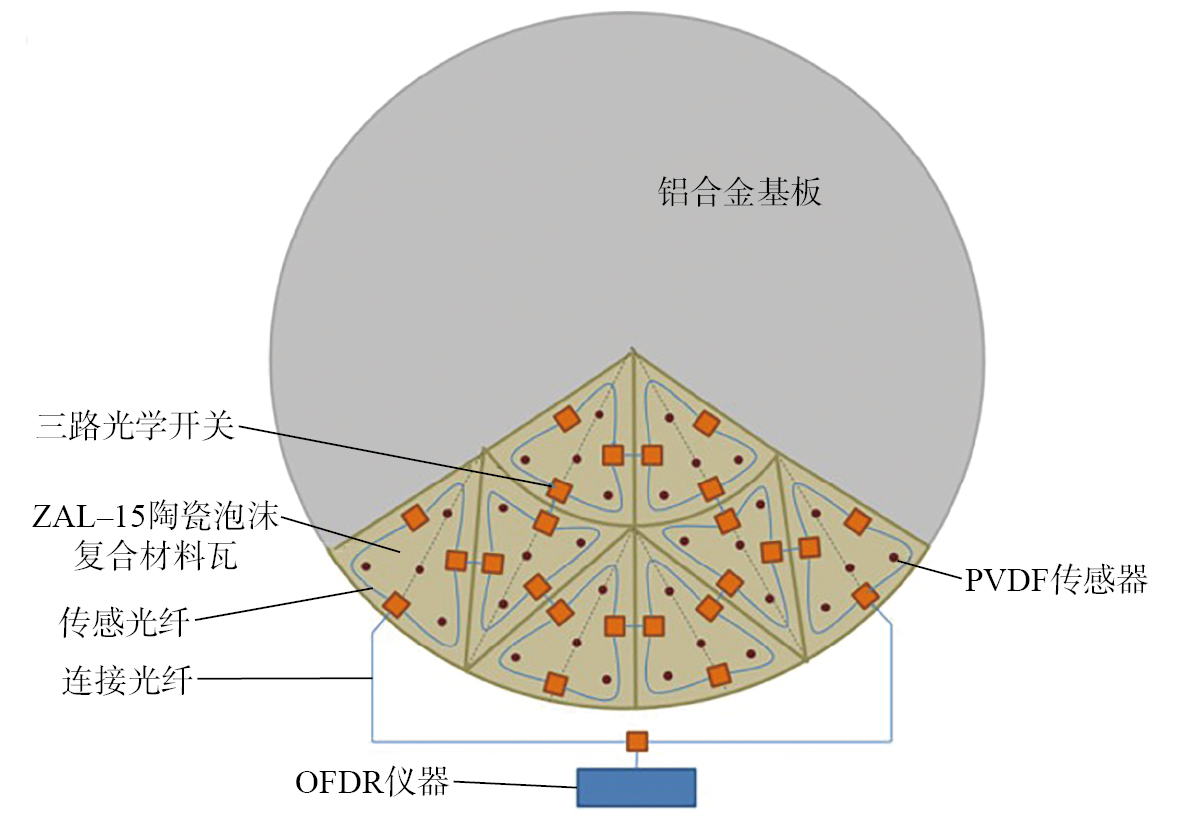
图24 智能网络传感器布局[ HOSCHKE N, PRICE D C, SCOTT D A, et al. Structural health monitoring of space vehicle thermal protection systems[J]. Key Engineering Materials, 2013, 558: 268–280. 79]
图25 曲面热防护试验件[ 唐伍强. 基于混合核极限学习机的热防护结构冲击定位方法研究[D]. 南京: 南京航空航天大学, 2023.TANG Wuqiang. Research on impact location method of thermal protection structure based on hybrid kernel extreme learning machine[D]. Nanjing: Nanjing University of Aeronautics and Astronautics, 2023. 87]
图26 冲击点与压电传感器位置分布[ 唐伍强. 基于混合核极限学习机的热防护结构冲击定位方法研究[D]. 南京: 南京航空航天大学, 2023.TANG Wuqiang. Research on impact location method of thermal protection structure based on hybrid kernel extreme learning machine[D]. Nanjing: Nanjing University of Aeronautics and Astronautics, 2023. 87]
Review of Health Monitoring Technology for Thermal Protection System of Reusable Launch Vehicle
XU Chao1
WU Yingxin1
XU Suyu1,2
WANG Jianyue1,3
1.School of Astronautics, Northwestern Polytechnical University, Xi’an710072, China
2.Beijing Institute of Mechanical and Electrical Engineering, Beijing100074, China
3.Institute of Aerospace Materials and Technology, Beijing100076, China
Citations
XU Chao, WU Yingxin, XU Suyu, et al. Review of health monitoring technology for thermal protection system of reusable launch vehicle[J]. Aeronautical Manufacturing Technology, 2025, 68(21): 24–39.
Abstract
Reusable launch vehicles are critical assets for achieving round-trip space transportation in the world. As a key subsystem, the thermal protection system serves the main function of protecting vehicle from burning and overheating in the aerodynamic heating environment during atmospheric re-entry. Its health condition is directly related to the reliability and cost-effectiveness of the flight mission. In response to failures that thermal protection systems are prone to during flight, this article first analyzes typical damage modes of thermal protection systems in space shuttles and Starships, such as bolt loosening, structural debonding, and damage caused by impacts from micrometeoroids or space debris. Then, it provides a detailed overview of structural health monitoring technologies related to thermal protection systems, including the thermal protection system temperature monitoring, connection bolt loose monitoring, structural debonding monitoring, structural impact monitoring and implementation methods of other key technologies and their practicality. Finally, the future development trends and prospects of structural health monitoring technology for reusable launch vehicle thermal protection system are discussed.
目前,世界航天已进入以互联网星座建设、空间资源开发和载人月球探测为代表的新阶段,频繁出入空间的需求正在快速增长,这对航天运输系统提出了更进一步发展的要求。为实现自由便捷出入空间和高效利用空间的目标,世界主要航天大国都相继提出了天地往返运输系统的发展战略,其核心是要研制可重复使用运载器(Reusable launch vehicle,RLV)[ 包为民. 可重复使用运载火箭技术发展综述[J]. 航空学报, 2023, 44(23): 629555.BAO Weimin. A review of reusable launch vehicle technology development[J]. Acta Aeronautica et Astronautica Sinica, 2023, 44(23): 629555. 1]。可重复使用运载器是指能从地面起飞完成预定发射任务,随后全部或部分返回并安全着陆,经过检修维护与燃料加注后,可快速再次执行发射任务的运载器。不同于一次性运载火箭发射后完全废弃,可重复使用运载器能大幅降低单位有效载荷发射成本,具有极高的军事和民用价值[ 宋月娥, 吴东涛, 姜硕. 组合动力运载器结构与热防护系统概述[J]. 中国航天, 2022(1): 29–36.SONG Yue’e, WU Dongtao, JIANG Shuo. Introduction to structure and thermal protection system of aerospace vehicle with combined cycle engine[J]. Aerospace China, 2022(1): 29–36. 2]。
可重复使用运载器在再入大气层时会出现严重的气动加热现象,为保证运载器机体结构及其内部仪器设备工作在许可的温度范围内,一般须在其表面安装热防护系统(Thermal protection system,TPS)[ 孟松鹤, 杨强, 霍施宇, 等. 一体化热防护技术现状和发展趋势[J]. 宇航学报, 2013, 34(10): 1295–1302.MENG Songhe, YANG Qiang, HUO Shiyu, et al. State-of-arts and trend of integrated thermal protection systems[J]. Journal of Astronautics, 2013, 34(10): 1295–1302. 3]。相较于一次性运载器多采用烧蚀型热防护方式,可重复使用运载器须采用非烧蚀式热防护方式,其组件在工作过程中不允许发生显著损耗或变形,部分结构还应具有一定的承载能力。此外,可重复使用热防护系统应具备良好的重复使用性和易于维护的特性,以确保重复使用的任务可靠性和降低使用成本。因此,发展有效的热防护系统结构健康监测技术就具有十分重要的现实意义[ 周印佳, 张志贤. 航天器可重复使用热防护技术研究进展与应用[J]. 航天返回与遥感, 2019, 40(5): 27–40.ZHOU Yinjia, ZHANG Zhixian. Research progress and applications of reusable thermal protection technology for spacecraft[J]. Spacecraft Recovery & Remote Sensing, 2019, 40(5): 27–40. UYANNA O, NAJAFI H. Thermal protection systems for space vehicles: A review on technology development, current challenges and future prospects[J]. Acta Astronautica, 2020, 176: 341–356. 闻悦, 马婷婷, 郑平军, 等. 重复使用航天运输系统设计与评估[J]. 科学通报, 2020, 65(9): 764–770.WEN Yue, MA Tingting, ZHENG Pingjun, et al. Design and assessment of reusable space transportation system[J]. Chinese Science Bulletin, 2020, 65(9): 764–770. 4-6]。
当前,以美国航天飞机服役时期的维护技术为代表,对运载器热防护系统的检测工作仍主要依赖于地面无损检测手段[ TRIVEDI A, MITRA K, SUBRAMANIAN C. Numerical and experimental study of non-destructive detection of thermal tile system debonding using short-pulse laser[C]//Proceedings of 37th AIAA Thermophysics Conference. Arlington: AIAA, 2004. KACMAR C J. Thermal characterization of TPS tiles[J]. AIP Conference Proceedings, 2006, 820(1): 1740–1747. THOMAS B P, RAJENDRAN K V, ANNAMALA PILLAI S. Whole-field NDT of thermal protection system using digital holography[J]. Insight-Non-Destructive Testing and Condition Monitoring, 2007, 49(5): 279–282. IVASHOV S I, VASILIEV I A, BECHTEL T D, et al. Comparison between impulse and holographic subsurface radar for NDT of space vehicle structural materials[J]. PIERS Online, 2007, 3(5): 658–661. 7-10]。虽然无损检测技术可以在地面很好地检测出热防护结构的各种损伤,但使用的仪器设备体积大、检测周期长和部分要求拆解等,难以满足可重复使用运载器的快速周转维护要求。
近年来,快速发展的结构健康监测技术(Structural health monitoring,SHM)为热防护系统的维护提供了新思路。结构健康监测是一种结合了传感器、智能结构和数据分析的原位实时在线监测技术[ 王彬文, 肖迎春, 白生宝, 等. 飞机结构健康监测与管理技术研究进展和展望[J]. 航空制造技术, 2022, 65(3): 30–41.WANG Binwen, XIAO Yingchun, BAI Shengbao, et al. Research progress and prospect of aircraft structural health monitoring and management technology[J]. Aeronautical Manufacturing Technology, 2022, 65(3): 30–41. 11]。通过将传感器阵列与热防护结构一体化永久集成形成监测网络,可在运载器地面和飞行中采集多种参数,能快速、准确地识别出热防护系统中的损伤。因此,应用SHM技术能显著提高运载器的安全性和可靠性、减少检修成本和停机时间,从而实现在轨服务和快速周转维护。
陶瓷防热瓦结构作为典型的可重复使用被动热防护结构,在航天飞机、星舰等可重复使用运载器中被大量使用。美国航天飞机每架覆盖超过20000块防热瓦,在长达30年、共135次飞行任务中,其热防护系统曾多次发生故障,甚至出现过因热防护系统破坏而引发的机毁人亡惨剧[ 吴国庭. 哥伦比亚号防热系统概貌[J]. 国际太空, 2003(6): 26–28.WU Guoting. General situation of Columbia thermal protection system[J]. Space International, 2003(6): 26–28. 张宗美. 航天故障手册[M]. 北京: 中国宇航出版社, 1994.ZHANG Zongmei. Handbook of failures of launch vehicles, spacecrafts and missiles[M]. Beijing: China Astronautics Press, 1994. SNAPP C, RODRIGUEZ A. Orbiter thermal protection system lessons learned[C]//Proceedings of AIAA SPACE 2011 Conference & Exposition. Arlington: AIAA, 2011. 12-14]。星舰九次飞行试验中(截至2025年5月31日),热防护系统也多次出现了脱落、烧蚀等故障。本节根据现有相关公开资料,对热防护系统典型损伤模式进行总结,为热防护系统健康监测研究工作奠定基础。
1.1 航天飞机热防护系统典型损伤模式
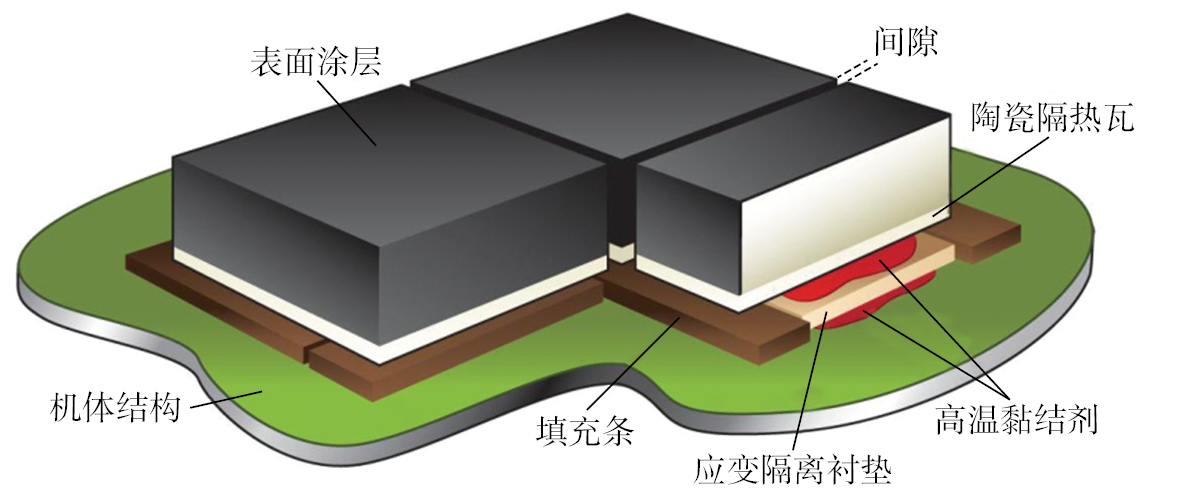
航天飞机热防护系统的主要连接方式为黏结式,系统结构包括陶瓷防热瓦、高温黏结剂、应变隔离衬垫(Strain isolation pad,SIP)及间隙填充条,如图1所示[ LE V T, GOO N S. Design, fabrication, and testing of metallic thermal protection systems for spaceplane vehicles[J]. Journal of Spacecraft and Rockets, 2021, 58(4): 1043–1060. 15]。防热瓦表面覆盖高辐射率的黑色涂层,以增强辐射换热能力;内部采用低导热率的LI–900硅质陶瓷材料,最高耐温可达1200 ℃,用以实现隔热目的。防热瓦底部通过室温硫化硅橡胶(Room-temperature vulcanizing,RTV)黏结剂与SIP粘接。SIP作为热柔性缓冲层,能够有效降低热应力集中带来的结构失效风险。此外,为抑制高温气体从瓦块间隙侵入,相邻防热瓦之间设置了间隙填充条,从而增强热防护系统密封能力,保障系统整体热防护完整性[ 黄杰. 高超声速飞行器热防护系统综合研究[D]. 南京: 南京航空航天大学, 2019.HUANG Jie. Comprehensive investigations on thermal protection system of hypersonic vehicles[D]. Nanjing: Nanjing University of Aeronautics and Astronautics, 2019. 张茂. 重复使用跨大气层飞行器防热系统健康监控技术研究[D]. 西安: 西北工业大学, 2006.ZHANG Mao. Research on health monitoring technology for thermal protection systems of reusable transatmospheric vehicles[D]. Xi’an: Northwestern Polytechnical University, 2006. 16-17]。
图1 航天飞机典型热防护系统结构[ LE V T, GOO N S. Design, fabrication, and testing of metallic thermal protection systems for spaceplane vehicles[J]. Journal of Spacecraft and Rockets, 2021, 58(4): 1043–1060. 15]
Fig.1 Typical thermal protection system structure of space shuttle[ LE V T, GOO N S. Design, fabrication, and testing of metallic thermal protection systems for spaceplane vehicles[J]. Journal of Spacecraft and Rockets, 2021, 58(4): 1043–1060. 15]
美国研究人员曾经跟踪研究了10年的航天飞机防热瓦结构的损伤情况,最终发现每次任务后防热瓦都会出现多处损伤,平均损伤数量达25块[ SMITH K, SOARES C, MIKATARIAN R, et al. Space shuttle thermal protection system repair flight experiment induced contamination impacts[C]//Proceedings of 44th AIAA Aerospace Sciences Meeting and Exhibit. Arlington: AIAA, 2006. 18]。针对1992—1996年间的20余次飞行任务,美国的Morris等[ MORRIS W, WHITE N, EBELING C. Analysis of Shuttle Orbiter reliability and maintainability data for conceptual studies[C]//Proceedings of Space Programs and Technologies Conference. Arlington: AIAA, 1996. 19]对其飞行后的维护数据进行了详细分析,结果发现,机身热防护系统每次任务结束后平均更换17.2%的结构部件,机翼热防护系统每次任务后平均更换28%的零部件。据此,对航天飞机飞行过程中的损伤模式进行总结,表1给出了具有代表性的航天飞机防热瓦的故障模式[ SNAPP C, RODRIGUEZ A. Orbiter thermal protection system lessons learned[C]//Proceedings of AIAA SPACE 2011 Conference & Exposition. Arlington: AIAA, 2011. 14, SMITH K, SOARES C, MIKATARIAN R, et al. Space shuttle thermal protection system repair flight experiment induced contamination impacts[C]//Proceedings of 44th AIAA Aerospace Sciences Meeting and Exhibit. Arlington: AIAA, 2006. MORRIS W, WHITE N, EBELING C. Analysis of Shuttle Orbiter reliability and maintainability data for conceptual studies[C]//Proceedings of Space Programs and Technologies Conference. Arlington: AIAA, 1996. 18-19]。
表1 航天飞机热防护损伤模式
Table 1 Space shuttle thermal protection damage mode
飞行日期及航天飞机任务编号
热防护系统损伤模式
损伤原因
1981–04–12,哥伦比亚号STS–1[ SMITH K, SOARES C, MIKATARIAN R, et al. Space shuttle thermal protection system repair flight experiment induced contamination impacts[C]//Proceedings of 44th AIAA Aerospace Sciences Meeting and Exhibit. Arlington: AIAA, 2006. 18]
1988–12–02,亚特兰蒂斯号STS–27[ SMITH K, SOARES C, MIKATARIAN R, et al. Space shuttle thermal protection system repair flight experiment induced contamination impacts[C]//Proceedings of 44th AIAA Aerospace Sciences Meeting and Exhibit. Arlington: AIAA, 2006. 18]
下表面出现大量碎片撞击的凿痕,共有644块防热瓦受损,其中272块防热瓦损坏尺寸大于1/2
推测是上升过程中外部燃料储箱的绝缘材料等碎片撞击导致的
1996–06–08,发现者号STS–103[ MORRIS W, WHITE N, EBELING C. Analysis of Shuttle Orbiter reliability and maintainability data for conceptual studies[C]//Proceedings of Space Programs and Technologies Conference. Arlington: AIAA, 1996. 19]
丢失了1块升降舵内侧防热瓦
安装时填充条不正确
2005–07–26,发现者号STS–114[ SNAPP C, RODRIGUEZ A. Orbiter thermal protection system lessons learned[C]//Proceedings of AIAA SPACE 2011 Conference & Exposition. Arlington: AIAA, 2011. 14]
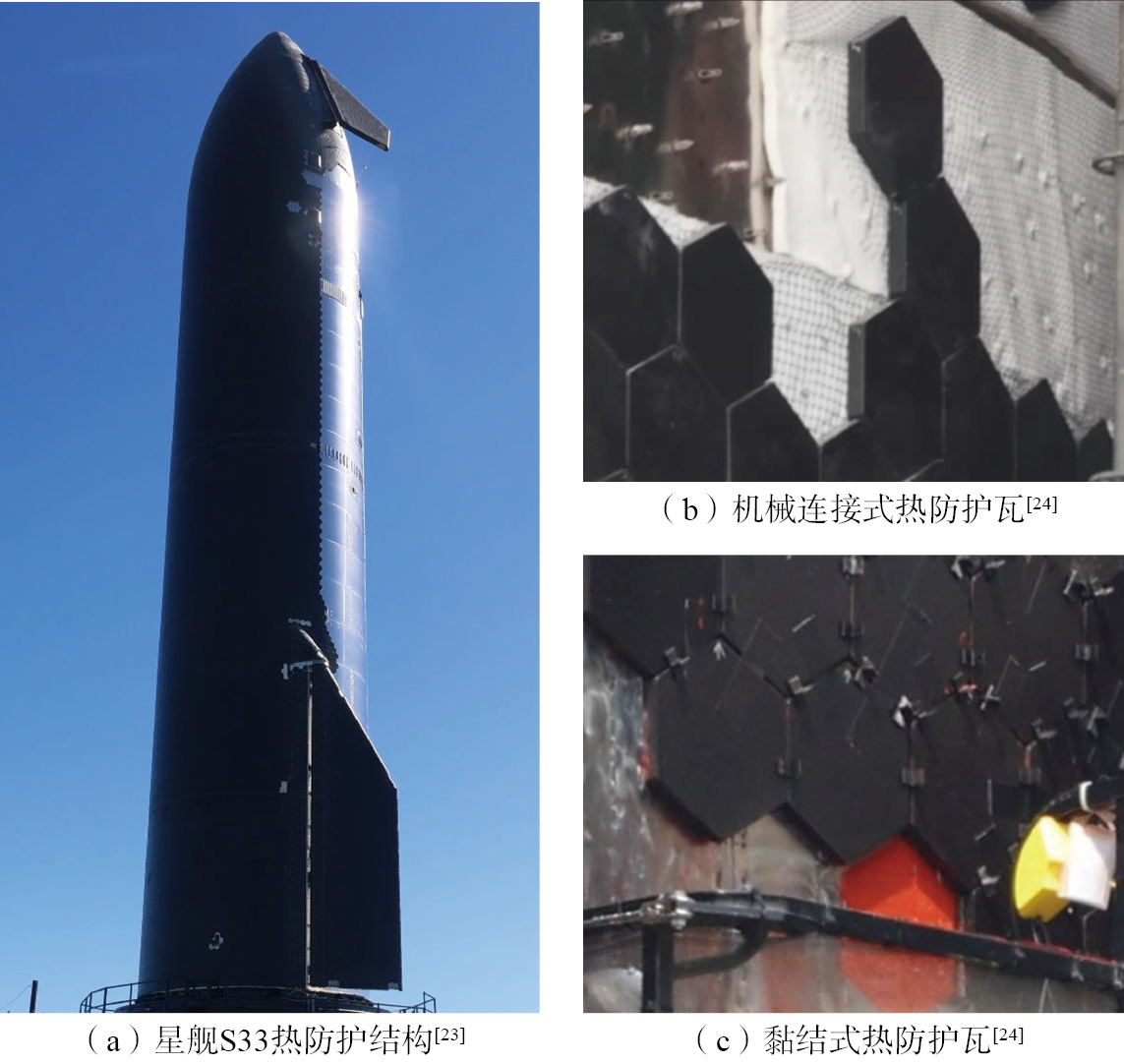
SpaceX星舰作为有代表性的先进可重复使用运载器,对其热防护系统的损伤模式进行分析具有重要的理论和工程意义[ ZHANG X M. Optimal launch capacity trajectory design for SpaceX’s super heavy starship launch vehicle[C]//Proceedings of Third International Computing Imaging Conference (CITA 2023). Sydney: SPIE, 2023. 孟光, 刘昶, 杨冬春, 等. 美国SpaceX超重–星舰首飞分析及对中国航天产业的启示[J]. 航空学报, 2023, 44(10): 028914.MENG Guang, LIU Chang, YANG Dongchun, et al. First flight of SpaceX heavy-lift Starship: Enlightenment for aerospace industry in China[J]. Acta Aeronautica et Astronautica Sinica, 2023, 44(10): 028914. 龙雪丹, 杨开, 王林, 等. “超重–星舰” 首次入轨飞行测试及经验教训分析[J]. 中国航天, 2023(5): 59–66.LONG Xuedan, YANG Kai, WANG Lin, et al. Experience learned from first fully-integrated test flight of super heavy Starship[J]. Aerospace China, 2023(5): 59–66. 20-22]。根据连接方式不同,星舰的热防护系统主要分为机械连接式和黏结式两类,图2(a)[ RingWatchers. The Bestagons: Starship’s upgraded heat shield[EB/OL]. (2025–01–14)[2025–07–28]. https://ringwatchers.com/article/s33-tps. 23]为星舰S33总体热防护系统结构图。其机械连接式热防护系统如图2(b)所示[ RingWatchers. Just don’t melt: Flight 5’s upgraded heat shield[EB/OL]. (2024–12–23)[2025–07–28]. https://ringwatchers.com/article/s30-tps. 24],采用销钉固定,覆盖约18000块防热瓦;而黏结式热防护系统如图2(c)所示[ RingWatchers. Just don’t melt: Flight 5’s upgraded heat shield[EB/OL]. (2024–12–23)[2025–07–28]. https://ringwatchers.com/article/s30-tps. 24],主要采用RTV胶粘接,防热瓦数量约为100余块,主要分布于曲面蒙皮、舱段连接处及少数不规则区域。
图2 星舰热防护系统
Fig.2 Starship thermal protection system
具体来看,星舰S24~S29的机械连接式热防护结构从下至上为白色隔热毡、网格和防热瓦[ RingWatchers. The Bestagons: Starship’s upgraded heat shield[EB/OL]. (2025–01–14)[2025–07–28]. https://ringwatchers.com/article/s33-tps. 23];星舰S30~S34则在原有热防护结构上进行改进,在底部新增了一层黑色烧蚀层作为防护[ RingWatchers. Just don’t melt: Flight 5’s upgraded heat shield[EB/OL]. (2024–12–23)[2025–07–28]. https://ringwatchers.com/article/s30-tps. 李明华. 超重–星舰演变历程及未来发展方向分析[J]. 导弹与航天运载技术(中英文), 2024(4): 1–7.LI Minghua. Analysis on the evolution course and future development of superheavy Starship[J]. Missiles and Space Vehicles, 2024(4): 1–7. 24-25],构成由下至上的4层结构:黑色烧蚀层、白色隔热毡、网格和防热瓦。相比之下,黏结式热防护系统相较于机械连接式更为简单,包括高温黏结剂、防热瓦和间隙填充条,但其防护效果在一些飞行试验过程中的表现不及机械连接式。
在星舰的9次试飞过程中,共有4次成功实现再入大气层,对这4次试飞过程热防护系统损伤模式进行总结,能够为热防护系统健康监测技术提供重要参考[ 苏浩涵, 陈亮, 于新宇, 等. SpaceX公司星舰第二次飞行异常情况初步分析[J]. 宇航学报, 2023, 44(11): 1785–1791.SU Haohan, CHEN Liang, YU Xinyu, et al. Initial analysis of anomalies in the second flight of SpaceX’s Starship[J]. Journal of Astronautics, 2023, 44(11): 1785–1791. 张毅博, 吴会强, 张宏剑, 等. 太空探索技术公司运载火箭机构技术发展路线分析及启示[J]. 宇航学报, 2025, 46(3): 631–640.ZHANG Yibo, WU Huiqiang, ZHANG Hongjian, et al. Analysis of the technological development path of SpaceX’s launch vehicle mechanisms and its implications[J]. Journal of Astronautics, 2025, 46(3): 631–640. 26-27]。表2[ RingWatchers. The Bestagons: Starship’s upgraded heat shield[EB/OL]. (2025–01–14)[2025–07–28]. https://ringwatchers.com/article/s33-tps. RingWatchers. Just don’t melt: Flight 5’s upgraded heat shield[EB/OL]. (2024–12–23)[2025–07–28]. https://ringwatchers.com/article/s30-tps. 23-24, 张毅博, 吴会强, 张宏剑, 等. 太空探索技术公司运载火箭机构技术发展路线分析及启示[J]. 宇航学报, 2025, 46(3): 631–640.ZHANG Yibo, WU Huiqiang, ZHANG Hongjian, et al. Analysis of the technological development path of SpaceX’s launch vehicle mechanisms and its implications[J]. Journal of Astronautics, 2025, 46(3): 631–640. 27]总结了这4次任务中热防护系统的典型损伤模式及损伤原因。
表2 星舰热防护损伤模式
Table 2 Starship thermal protection damage mode
飞行日期及星舰编号
热防护系统损伤模式
损伤原因
2023–04–20,星舰S28[ RingWatchers. Just don’t melt: Flight 5’s upgraded heat shield[EB/OL]. (2024–12–23)[2025–07–28]. https://ringwatchers.com/article/s30-tps. 24, 张毅博, 吴会强, 张宏剑, 等. 太空探索技术公司运载火箭机构技术发展路线分析及启示[J]. 宇航学报, 2025, 46(3): 631–640.ZHANG Yibo, WU Huiqiang, ZHANG Hongjian, et al. Analysis of the technological development path of SpaceX’s launch vehicle mechanisms and its implications[J]. Journal of Astronautics, 2025, 46(3): 631–640. 27]
粘贴式防热瓦出现明显脱落现象
胶粘不牢,同时由于提前进入大气层导致再入速度过高,防热瓦承受更大的热流
2024–06–06,星舰S29[ RingWatchers. Just don’t melt: Flight 5’s upgraded heat shield[EB/OL]. (2024–12–23)[2025–07–28]. https://ringwatchers.com/article/s30-tps. 24, 张毅博, 吴会强, 张宏剑, 等. 太空探索技术公司运载火箭机构技术发展路线分析及启示[J]. 宇航学报, 2025, 46(3): 631–640.ZHANG Yibo, WU Huiqiang, ZHANG Hongjian, et al. Analysis of the technological development path of SpaceX’s launch vehicle mechanisms and its implications[J]. Journal of Astronautics, 2025, 46(3): 631–640. 27]
安装热防护系统的目的是将运载器内部环境的温度限制在一定范围内,从而避免极端热环境对运载器结构和内部仪器设备造成破坏性影响。在运载器再入期间,热防护系统发生结构或连接损伤后,高温气体有可能渗透到防热结构中,从而改变热防护系统正常的温度特性。因此,可以通过监测防热瓦温度变化来实现对热防护系统的功能完整性或健康状态的监测[ 宣建林, 冯蕴雯, 张茂, 等. 航天飞机考虑意外损伤时防热系统的健康管理研究[J]. 机械强度, 2007, 29(5): 843–847.XUAN Jianlin, FENG Yunwen, ZHANG Mao, et al. Considered accident damage the health management for thermal protection system of space shuttle[J]. Journal of Mechanical Strength, 2007, 29(5): 843–847. 29]。另一方面,通过对防热瓦使用过程中的温度监测,结合辨识技术,还能实现对再入过程中热环境的感知。目前,在热防护系统温度在线监测方面,主要有无线射频和光纤传感两类技术。
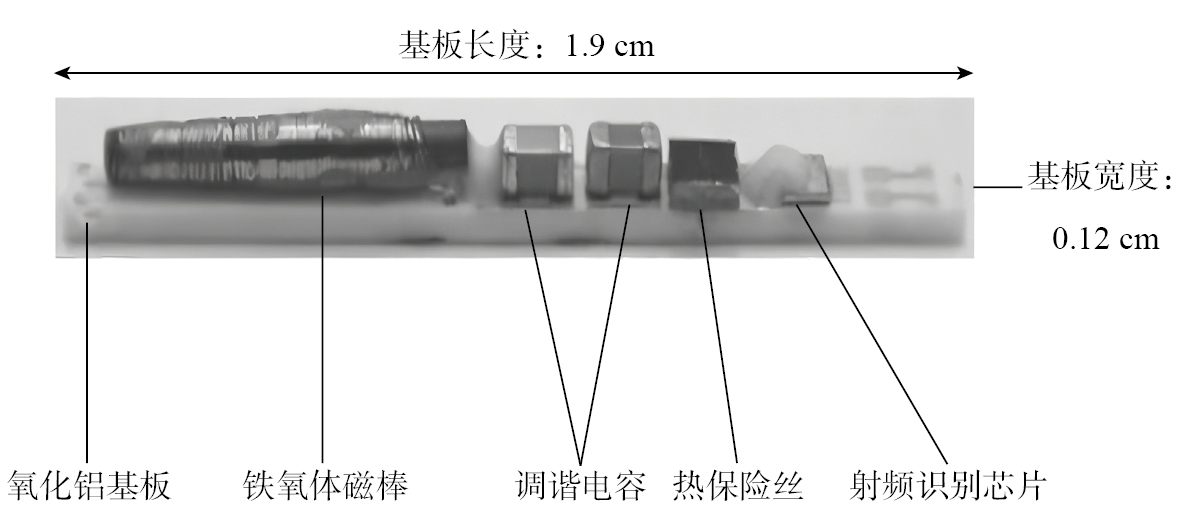
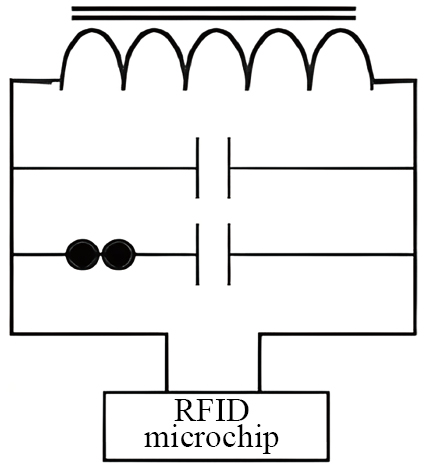
针对热防护系统温度原位监测的需求,要求部署的传感器必须小、轻、耐高温且不能反向影响系统的热力性能,考虑到大量布线会降低系统的可靠性,无线射频技术受到了关注[ 田贵云, 张俊, 孟召宗. 无源无线射频识别传感器及其在结构健康监测中的应用[J]. 南京航空航天大学学报, 2017, 49(4): 453–460.TIAN Guiyun, ZHANG Jun, MENG Zhaozong. Passive wireless RFID sensors and their applications in structural health monitoring[J]. Journal of Nanjing University of Aeronautics & Astronautics, 2017, 49(4): 453–460. XU F J, SU S J, ZHANG L L, et al. Design and research of wireless passive high-temperature sensor based on SIW resonance[J]. Micromachines, 2022, 13(7): 1035. 30-31]。NASA Ames的Milos和Watters等[ MILOS F S, KARUNARATNE K S G. Active wireless temperature sensors for aerospace thermal protection systems[C]//Proceedings of Smart Nondestructive Evaluation and Health Monitoring of Structural and Biological Systems II. Bellingham: SPIE, 2003. MILOS F S, PALLIX J B. Wireless temperature sensors for health monitoring of aerospace thermal protection systems[C]//Proceedings of Smart Nondestructive Evaluation for Health Monitoring of Structural and Biological Systems. Bellingham: SPIE, 2002. WATTERS D G. Design and performance of wireless sensors for structural health monitoring[J]. AIP Conference Proceedings, 2002, 615(1): 969–976. 32-34]研发了多代被动式和主动式SensorTag微传感器,每个传感器都包含着一个射频调节芯片,采用不同的识别号来区分,因此也被称为“标识传感器[ 解维华, 杜善义, 张博明, 等. 热防护系统的无线温度监测技术发展[J]. 传感器与微系统, 2007, 26(10): 5–8.XIE Weihua, DU Shanyi, ZHANG Boming, et al. Development of wireless temperature sensor technology for thermal protection systems[J]. Transducer and Microsystem Technologies, 2007, 26(10): 5–8. 35]”。被动式标识传感器主要由铁氧体磁棒、调谐电容、热保险丝和射频识别芯片组成。它们被安装在一块氧化铝基板上,如图3所示[ MILOS F S, PALLIX J B. Wireless temperature sensors for health monitoring of aerospace thermal protection systems[C]//Proceedings of Smart Nondestructive Evaluation for Health Monitoring of Structural and Biological Systems. Bellingham: SPIE, 2002. 33]。图4给出了其工作电路图[ 解维华, 杜善义, 张博明, 等. 热防护系统的无线温度监测技术发展[J]. 传感器与微系统, 2007, 26(10): 5–8.XIE Weihua, DU Shanyi, ZHANG Boming, et al. Development of wireless temperature sensor technology for thermal protection systems[J]. Transducer and Microsystem Technologies, 2007, 26(10): 5–8. 35],当缝隙温度超过熔断温度时,热保险丝熔断,串联电容被移除,导致传感器谐振频率改变。通过外部读取器读取不同谐振频率,可以判断缝隙温度是否超过阈值。
图3 被动式标识传感器[ MILOS F S, PALLIX J B. Wireless temperature sensors for health monitoring of aerospace thermal protection systems[C]//Proceedings of Smart Nondestructive Evaluation for Health Monitoring of Structural and Biological Systems. Bellingham: SPIE, 2002. 33]
Fig.3 Passive SensorTag[ MILOS F S, PALLIX J B. Wireless temperature sensors for health monitoring of aerospace thermal protection systems[C]//Proceedings of Smart Nondestructive Evaluation for Health Monitoring of Structural and Biological Systems. Bellingham: SPIE, 2002. 33]
图4 被动式标识传感器工作电路图[ MILOS F S, PALLIX J B. Wireless temperature sensors for health monitoring of aerospace thermal protection systems[C]//Proceedings of Smart Nondestructive Evaluation for Health Monitoring of Structural and Biological Systems. Bellingham: SPIE, 2002. 33]
Fig.4 Passive SensorTag working circuit diagram[ MILOS F S, PALLIX J B. Wireless temperature sensors for health monitoring of aerospace thermal protection systems[C]//Proceedings of Smart Nondestructive Evaluation for Health Monitoring of Structural and Biological Systems. Bellingham: SPIE, 2002. 33]
图5 主动式标识传感器的安装[ MILOS F S, KARUNARATNE K S G. Active wireless temperature sensors for aerospace thermal protection systems[C]//Proceedings of Smart Nondestructive Evaluation and Health Monitoring of Structural and Biological Systems II. Bellingham: SPIE, 2003. 32]
Fig.5 Installation of active SensorTag[ MILOS F S, KARUNARATNE K S G. Active wireless temperature sensors for aerospace thermal protection systems[C]//Proceedings of Smart Nondestructive Evaluation and Health Monitoring of Structural and Biological Systems II. Bellingham: SPIE, 2003. 32]
基于监测热防护瓦背壁温度能够反映其损伤状态的原理,西北工业大学徐超团队[ 务颖欣, 许素宇, 徐大富, 等. 基于背壁温度测量的刚性热防护瓦健康监测原理样机设计[J]. 空天技术, 2024(6): 75–83.WU Yingxin, XU Suyu, XU Dafu, et al. Health monitoring prototype design for rigid thermal protection tile based on back-wall temperature detection[J]. Aerospace Technology, 2024(6): 75–83. 36]提出通过构建温度监测节点、区域节点与热防护系统的一体化无线温度监测网络,来实现对热防护瓦系统结构健康状态的实时监测;温度监测节点部署于在热防护瓦底部,用于监测底部实时温度数据,具有小型化、低功耗、无线传输的特点,如图6所示。
图6 温度监测节点[ 务颖欣, 许素宇, 徐大富, 等. 基于背壁温度测量的刚性热防护瓦健康监测原理样机设计[J]. 空天技术, 2024(6): 75–83.WU Yingxin, XU Suyu, XU Dafu, et al. Health monitoring prototype design for rigid thermal protection tile based on back-wall temperature detection[J]. Aerospace Technology, 2024(6): 75–83. 36]
Fig.6 Temperature monitoring node[ 务颖欣, 许素宇, 徐大富, 等. 基于背壁温度测量的刚性热防护瓦健康监测原理样机设计[J]. 空天技术, 2024(6): 75–83.WU Yingxin, XU Suyu, XU Dafu, et al. Health monitoring prototype design for rigid thermal protection tile based on back-wall temperature detection[J]. Aerospace Technology, 2024(6): 75–83. 36]
当光纤传感器所处位置的应变或温度发生变化时,经过该区域的光纤会发生拉伸或收缩,进而影响内部散射光的特性。通过测量这些变化,可以获取光纤的物理状态,从而判断监测对象的健康状态[ BOS J, KLEIN J, FROGGATT M, et al. Fiber optic strain, temperature and shape sensing via OFDR for ground, air and space applications[C]//Proceedings of Nanophotonics and Macrophotonics for Space Environments VII. Bellingham: SPIE, 2013. 李卫斌. 用于铁路基础设施综合监测的分布式光纤传感器[J]. 中国市政工程, 2022(1): 81–84, 88, 127.LI Weibin. Distributed fiber optic sensors for comprehensive monitoring of railway infrastructure[J]. China Municipal Engineering, 2022(1): 81–84, 88, 127. 何宇栋. 光纤高温应变传感器及应变传递规律研究[D]. 西安: 西北大学, 2020.HE Yudong. Research on optic fiber high temperature strain sensor and strain transfer law[D]. Xi’an: Northwest University, 2020. 37-39]。2006年,Hanlon等[ HANLON A B, DESHMUKH A, HYERS R W. Continuous health monitoring of the thermal protection system for future spacecraft[C]//Proceedings of Smart Structures and Materials 2006: Sensors and Smart Structures Technologies for Civil, Mechanical, and Aerospace Systems. Bellingham: SPIE, 2006. 40]通过在热防护材料中嵌入光纤传感器,开发了一种用于持续采集热防护材料内部温度的监测系统;首先制作了无光纤和嵌入光纤传感器的热防护材料,图7展示了光纤的嵌入过程;随后进行了初步力学测试,以检查光纤传感器与TPS材料之间的黏结强度;最终,利用该光纤传感器技术成功测量了TPS材料样品的温度升高,验证了光纤传感器在温度监测中的可行性。
图7 光纤传感器嵌入防热瓦过程[ HANLON A B, DESHMUKH A, HYERS R W. Continuous health monitoring of the thermal protection system for future spacecraft[C]//Proceedings of Smart Structures and Materials 2006: Sensors and Smart Structures Technologies for Civil, Mechanical, and Aerospace Systems. Bellingham: SPIE, 2006. 40]
Fig.7 Procedure for integrating the fiber optic sensor into the tile[ HANLON A B, DESHMUKH A, HYERS R W. Continuous health monitoring of the thermal protection system for future spacecraft[C]//Proceedings of Smart Structures and Materials 2006: Sensors and Smart Structures Technologies for Civil, Mechanical, and Aerospace Systems. Bellingham: SPIE, 2006. 40]
基于上述工作,研究人员还提出了一种面向热防护系统损伤检测的连续实时健康监测系统,其网络布局如图8所示[ DESHMUKH A, PEPYNE D, HANLON A B, et al. Distributed sensor network for thermal protection systems of future spacecraft[C]//Proceedings of ISHEM Forum 2005: First International Forum on Integrated System Health Engineering and Management in Aerospace. Washington: NASA, 2005. 41];该系统将热防护系统划分为极端温度区域、关键区域和非关键区域,其中面积较小的极端温度区域和关键区域采用增强碳纤维板,而面积较大的非关键区域则铺设了嵌入光纤的防热瓦;每个区域被进一步划分为多个小区,每个小区配备相应的微控制器、光纤传感器和电源,能够检测小区内的破裂损伤,并测量不同深度位置的温度;为增强极端区域和关键区域的损伤检测可靠性,该系统还增加了冗余传感器。
图8 健康监测系统网络布局[ DESHMUKH A, PEPYNE D, HANLON A B, et al. Distributed sensor network for thermal protection systems of future spacecraft[C]//Proceedings of ISHEM Forum 2005: First International Forum on Integrated System Health Engineering and Management in Aerospace. Washington: NASA, 2005. 41]
Fig.8 Health monitoring system network layout[ DESHMUKH A, PEPYNE D, HANLON A B, et al. Distributed sensor network for thermal protection systems of future spacecraft[C]//Proceedings of ISHEM Forum 2005: First International Forum on Integrated System Health Engineering and Management in Aerospace. Washington: NASA, 2005. 41]
2019年,Xuan等[ XUAN J L, ZHOU W H, SONG Y. Optimal sensor placement of health management for thermal protection system on RLV[J]. IOP Conference Series: Materials Science and Engineering, 2019, 686(1): 012020. 42]以传感器布置为重点,以温度为主要监测对象,对TPS传感器网络进行了优化设计;该研究以光纤传感器为研究对象,在高、中、低温度分别放置多个传感器,构成一个广泛的健康监测传感器网络,并对传感器的布局进行了优化。
目前,基于无线射频传感的温度监测技术主要处于地面验证阶段,实际应用中仍须综合优化传感器的尺寸、功耗、环境适应性及电池能量等性能[ 田贵云, 张俊, 孟召宗. 无源无线射频识别传感器及其在结构健康监测中的应用[J]. 南京航空航天大学学报, 2017, 49(4): 453–460.TIAN Guiyun, ZHANG Jun, MENG Zhaozong. Passive wireless RFID sensors and their applications in structural health monitoring[J]. Journal of Nanjing University of Aeronautics & Astronautics, 2017, 49(4): 453–460. 30]。光纤传感器因其重量轻、功耗低且抗电磁干扰能力强[ 周之. 基于光纤光栅传感器的高超声速飞行器结构损伤诊断技术研究[D]. 长沙: 国防科学技术大学, 2013.ZHOU Zhi. Research on structural damage diagnosis technology for hypersonic vehicles based on fiber Bragg grating sensors[D]. Changsha: National University of Defense Technology, 2013. 43],已成功应用于温度监测,且更易于在热防护结构制造过程中或后期集成,实现对TPS材料不同深度的状态参数监测。然而,光纤的耐高温性能及适应曲面几何形状的能力仍须进一步提升,以满足实际应用需求[ 任亮. 光纤光栅传感技术在结构健康监测中的应用[D]. 大连: 大连理工大学, 2008.REN Liang. Application of fiber Bragg grating sensing technology in structural health monitoring[D]. Dalian: Dalian University of Technology, 2008. 44]。
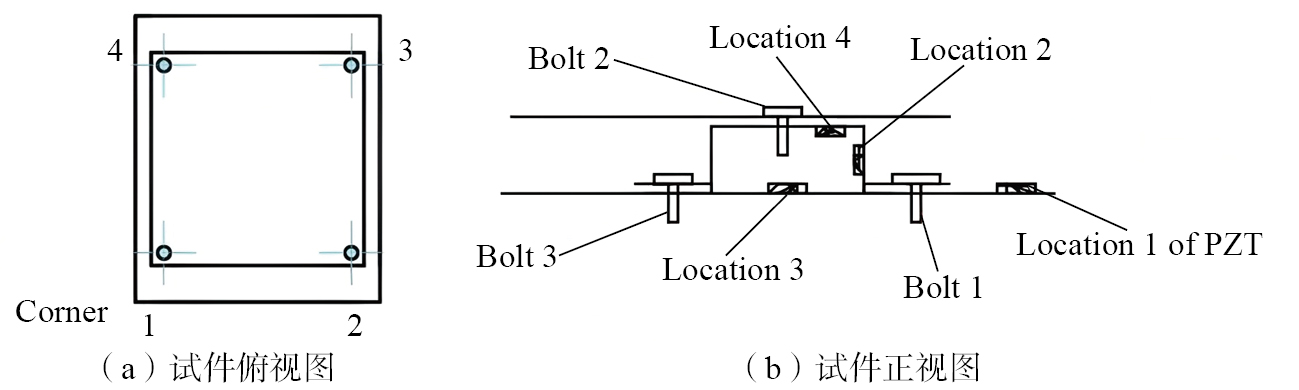
由于螺栓松动会导致结构机械阻抗发生变化,通过机电耦合效应会使贴于结构表面的压电陶瓷的电阻抗发生变化[ 任凯, 张子涵, 杜飞, 等. 基于阻抗法的多螺栓连接预紧扭矩检测试验研究[J]. 动力学与控制学报, 2018, 16(5): 467–472.REN Kai, ZHANG Zihan, DU Fei, et al. Experimental study on multi-bolt connection pre-tightening torque testing based on impedance method[J]. Journal of Dynamics and Control, 2018, 16(5): 467–472. 45],可利用损伤指标来度量无损和有损状态下电阻抗的变化,从而识别螺栓松动情况。因此,机电阻抗法成为一种有效的检测RLV热防护系统螺栓松动的方法[ MANCINI S, TUMINO G, GAUDENZI P. Structural health monitoring for future space vehicles[J]. Journal of Intelligent Material Systems and Structures, 2006, 17(7): 577–585. AN Y K, SOHN H. Integrated impedance and guided wave based damage detection[J]. Mechanical Systems and Signal Processing, 2012, 28: 50–62. 46-47]。2017年,Zhang等[ ZHANG Y K, HE Z P, ZHANG Z H, et al. Bolt loosening detection for aerospace thermal protection structures based on piezoelectric impedance method[J]. IEEE Transactions on Aerospace and Electronic Systems, 2017, 53(5): 2436–2452. 48]提出了一种基于机电阻抗原理检测热防护系统中螺栓松动的方法,以两块钢板为试件,每块钢板由4块∏型钢相连而成,使用锆钛酸铅(PZT)作为传感器和执行器,如图9所示;利用阻抗分析仪测得不同螺栓状态下的阻抗信号,并将信号实部的均方根偏差(Root mean square deviation,RMSD)用作损伤特征;试验结果表明,RMSD值与螺栓拧紧力矩之间存在相关性,从而可以计算特定频率下螺栓的RMSD值,以判断螺栓状态,验证了机电阻抗法对热防护结构中螺栓松动检测的有效性。
图9 螺栓与PZT的位置[ ZHANG Y K, HE Z P, ZHANG Z H, et al. Bolt loosening detection for aerospace thermal protection structures based on piezoelectric impedance method[J]. IEEE Transactions on Aerospace and Electronic Systems, 2017, 53(5): 2436–2452. 48]
Fig.9 Position of bolts and PZT[ ZHANG Y K, HE Z P, ZHANG Z H, et al. Bolt loosening detection for aerospace thermal protection structures based on piezoelectric impedance method[J]. IEEE Transactions on Aerospace and Electronic Systems, 2017, 53(5): 2436–2452. 48]
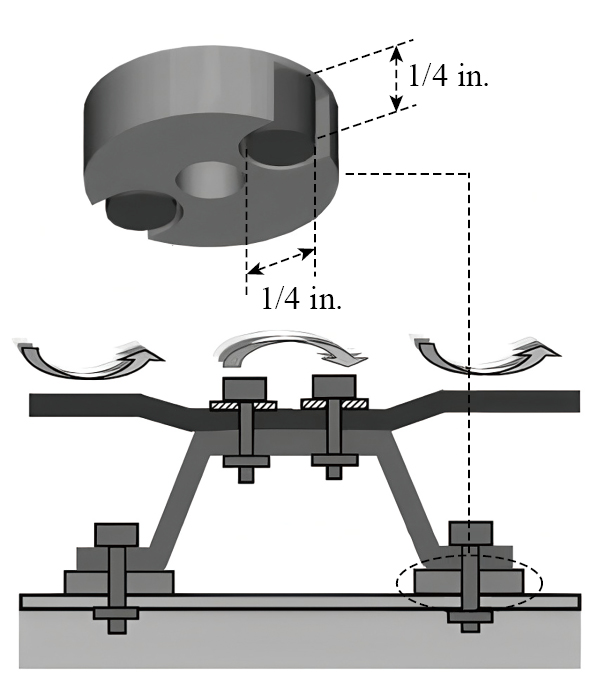
随着螺栓预紧力的增加,界面处的接触压力相应增强,实际接触面积也随之扩大。当超声波通过搭接面时,只有部分入射波能量能够透射通过搭接区域,而剩余能量则被反射或耗散[ 杜飞, 徐超. 螺栓连接松动的导波监测技术综述[J]. 宇航总体技术, 2018, 2(4): 13–23.DU Fei, XU Chao. A review on bolt preload monitoring using guided waves[J]. Astronautical Systems Engineering Technology, 2018, 2(4): 13–23. 28]。因此,超声导波的透射能量常被用作衡量螺栓紧固状态的指标,广泛应用于螺栓松动检测[ 王刚, 肖黎, 屈文忠. Lamb波高斯混合模型螺栓松动损伤检测[J]. 机械科学与技术, 2020, 39(4): 493–500.WANG Gang, XIAO Li, QU Wenzhong. Bolt looseness damage detection using lamb wave Gaussian mixture model[J]. Mechanical Science and Technology for Aerospace Engineering, 2020, 39(4): 493–500. XIE W H, ZHANG B M, DU S Y, et al. An improved diagnostic method for detection of bolt loosening in thermal protection panels[C]//Proceedings of Earth & Space 2008: Engineering, Science, Construction, and Operations in Challenging Environments. New York: ASCE, 2008. 49-50]。斯坦福大学的Yang等[ YANG J, CHANG F K, DERRISO M M. Design of a hierarchical health monitoring system for detection of multilevel damage in bolted thermal protection panels: A preliminary study[J]. Structural Health Monitoring, 2003, 2(2): 115–122. YANG J, CHANG F K. Detection of bolt loosening in C–C composite thermal protection panels: II. Experimental[J]. Smart Materials and Structures, 2006, 15(2): 591. 51-52]提出了一种多级损伤的分层健康监测系统,用于检测TPS板中的螺栓连接损伤;他们设计了一种嵌入式PZT传感器垫圈,以实现包括螺栓松动、外部冲击和面板损坏在内的多层次监测;图10[ YANG J, CHANG F K, DERRISO M M. Design of a hierarchical health monitoring system for detection of multilevel damage in bolted thermal protection panels: A preliminary study[J]. Structural Health Monitoring, 2003, 2(2): 115–122. 51]展示了TPS系统中PZT嵌入式传感器垫圈的几何结构和安装位置,该智能垫圈可以激励和接收超声导波,通过分析透过螺栓连接部超声导波的衰减特性实现了对热防护板上、下两处连接螺栓的松动检测。
图10 PZT嵌入式传感器垫圈[ YANG J, CHANG F K, DERRISO M M. Design of a hierarchical health monitoring system for detection of multilevel damage in bolted thermal protection panels: A preliminary study[J]. Structural Health Monitoring, 2003, 2(2): 115–122. 51]
Fig.10 PZT–embedded sensor washer[ YANG J, CHANG F K, DERRISO M M. Design of a hierarchical health monitoring system for detection of multilevel damage in bolted thermal protection panels: A preliminary study[J]. Structural Health Monitoring, 2003, 2(2): 115–122. 51]
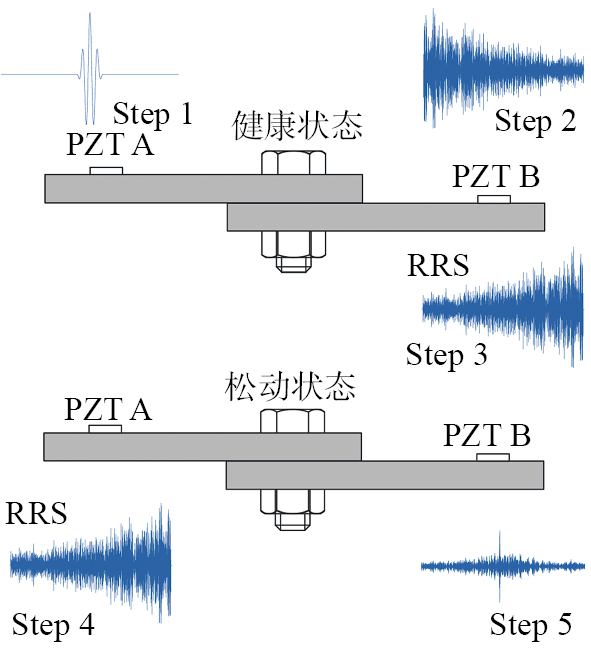
当螺栓预紧力达到一定值后,透过的导波能量不再变化,此时其检测灵敏度会显著降低[ 杜飞, 徐超, 鱼则行. 可重复使用运载器结构健康监测技术研究进展[J]. 宇航学报, 2019, 40(10): 1177–1186.DU Fei, XU Chao, YU Zexing. Research progress on structural health monitoring technology for reusable launch vehicles[J]. Journal of Astronautics, 2019, 40(10): 1177–1186. 53]。为解决这一这个问题,Du等[ DU F, XU C, ZHANG J. A bolt preload monitoring method based on the refocusing capability of virtual time reversal[J]. Structural Control and Health Monitoring, 2019, 26(8): e2370. DU F, XU C, WU G N, et al. Preload monitoring of bolted L–shaped lap joints using virtual time reversal method[J]. Sensors, 2018, 18(6): 1928. 54-55]在2018年提出一种虚拟时间反转方法,其原理如图11所示,可大幅提高螺栓预紧力监测灵敏度。2024年,Du等[ DU F, TIAN Z X, NAN Y, et al. A modified virtual time reversal method for enhancing monitoring sensitivity of bolt preloads based on ultrasonic guided waves[J]. Journal of Sound and Vibration, 2024, 585: 118475. 56]进一步改进了该方法,通过具有代表性的单螺栓和多螺栓的螺栓搭接结构进行试验验证;结果表明,与目前常用的线性或非线性导波特征的主流方法相比,改进的虚拟时间反转方法在监测灵敏度上有了显著提高。此外,为了研究复杂多螺栓连接结构的松动螺栓定位,Wu等[ WU G N, XU C, DU F, et al. A modified time reversal method for guided wave detection of bolt loosening in simulated thermal protection system panels[J]. Complexity, 2018, 2018(1): 8210817. 57]提出了一种基于主成分分析法的松动检测方法,并在一个模拟的双层螺栓连接热防护系统面板上进行了试验验证,表明该方法能够有效识别和定位复杂多螺栓连接结构中的螺栓松动问题,实现多螺栓松动位置的检测与识别。
图11 基于时反方法的螺栓松动检测原理示意图[ DU F, XU C, ZHANG J. A bolt preload monitoring method based on the refocusing capability of virtual time reversal[J]. Structural Control and Health Monitoring, 2019, 26(8): e2370. 54]
Fig.11 Schematic diagram of bolt loosening detection technology based on time reversal method[ DU F, XU C, ZHANG J. A bolt preload monitoring method based on the refocusing capability of virtual time reversal[J]. Structural Control and Health Monitoring, 2019, 26(8): e2370. 54]
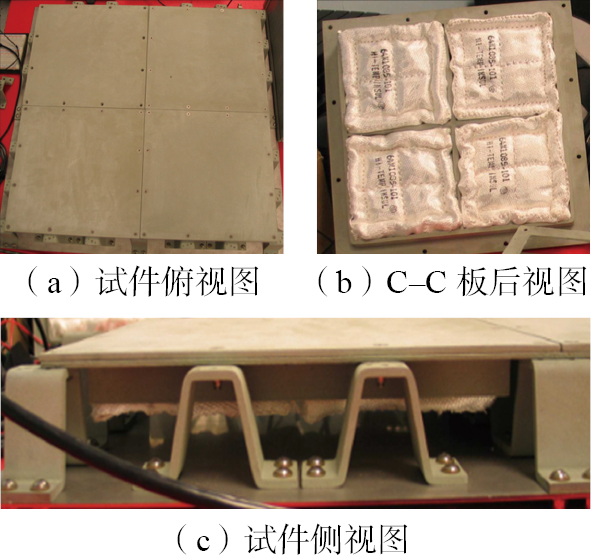
振动响应法检测螺栓连接松动的原理在于,螺栓连接的刚度减小会导致结构松动损伤后振动信息的变化。因此,可以通过分析结构动态参数或振动响应特征的变化来判断螺栓是否松动[ 伍济钢, 邵俊, 周根, 等. 利用平均振动响应能量的螺栓松动检测方法[J]. 机械科学与技术, 2022, 41(7): 992–997.WU Jigang, SHAO Jun, ZHOU Gen, et al. Detecting method for bolt looseness with average vibration response energy[J]. Mechanical Science and Technology for Aerospace Engineering, 2022, 41(7): 992–997. 58]。已有研究表明,测量结构的固有频率、模态和频率响应函数等参数可在一定条件下判断螺栓的紧固状态[ YANG J, CHANG F K. Detection of bolt loosening in C–C composite thermal protection panels: I. Diagnostic principle[J]. Smart Materials and Structures, 2006, 15(2): 581–590. HE K, ZHU W D. Detecting loosening of bolted connections in a pipeline using changes in natural frequencies[J]. Journal of Vibration and Acoustics-Transactions of the ASME, 2014, 136(3). 59-60]。2003年,DeSimio等[ DESIMIO M, MILLER I, DERRISO M, et al. Structural health monitoring experiments with a canonical element of an aerospace vehicle[C]//2003 IEEE Aerospace Conference Proceedings. Piscataway: IEEE, 2003. 61]以一个用螺栓和支架连接在钢背衬结构上的碳纤维板为试验对象,记录了16种不同结构状态下扫频正弦激励下的振动响应,通过特征提取与识别判断结构螺栓的状态,对螺栓缺失的检测准确率为97.6%,对缺失螺栓定位的准确率为80.1%。2010年,Tobe[ TOBE R J. Structural health monitoring of a thermal protection system for fastener failure with a validated model[D]. Dayton: Wright State University, 2010. 62]研究了基于紧固件损伤引起固有频率变化的损伤检测;该研究的TPS试件由4个C–C承载板组成,每个承载板通过12个螺栓固定的连接支架连接到金属支撑结构上,背面都有可拆卸的绝缘毯,如图12所示;通过试验研究了系统因损伤而产生的低阶模态变化,实现了对连接承载板和支撑结构中损伤螺栓的定位;试验结果表明,可以根据前10阶固有频率及其相应振型的变化来确定TPS试件中包含损伤螺栓的承载板。
图12 TPS试件[ TOBE R J. Structural health monitoring of a thermal protection system for fastener failure with a validated model[D]. Dayton: Wright State University, 2010. 62]
Fig.12 TPS specimen[ TOBE R J. Structural health monitoring of a thermal protection system for fastener failure with a validated model[D]. Dayton: Wright State University, 2010. 62]
机电阻抗法、超声导波法和振动响应法在螺栓松动监测方面各有优势,但当前也存在明显局限。机电阻抗法的测量范围较小,对远场损伤的检测敏感性不足[ 王涛, 杨志武, 邵俊华, 等. 基于压电阻抗技术的螺栓松动检测试验研究[J]. 传感技术学报, 2014, 27(10): 1321–1325.WANG Tao, YANG Zhiwu, SHAO Junhua, et al. Research on bolt loosen detection based on piezoelectric impedance technology[J]. Chinese Journal of Sensors and Actuators, 2014, 27(10): 1321–1325. 63],系统部署代价较大,限制了它在热防护系统健康监测中的应用。现有关于超声导波法的研究多基于实验室环境,在热防护结构中导波传播机理、高温等实际服役环境对导波监测性能的影响、系统的轻量化等方面还存在不少难题。基于结构振动的损伤监测方法受制于监测的灵敏度,在识别早期损伤方面还存在瓶颈[ TODD M D, NICHOLS J M, NICHOLS C J, et al. An assessment of modal property effectiveness in detecting bolted joint degradation: Theory and experiment[J]. Journal of Sound and Vibration, 2004, 275(3–5): 1113–1126. 64]。综上所述,尽管这些方法在理论上可行,但在实际应用中仍须克服诸多挑战,以提高监测的有效性和可靠性。
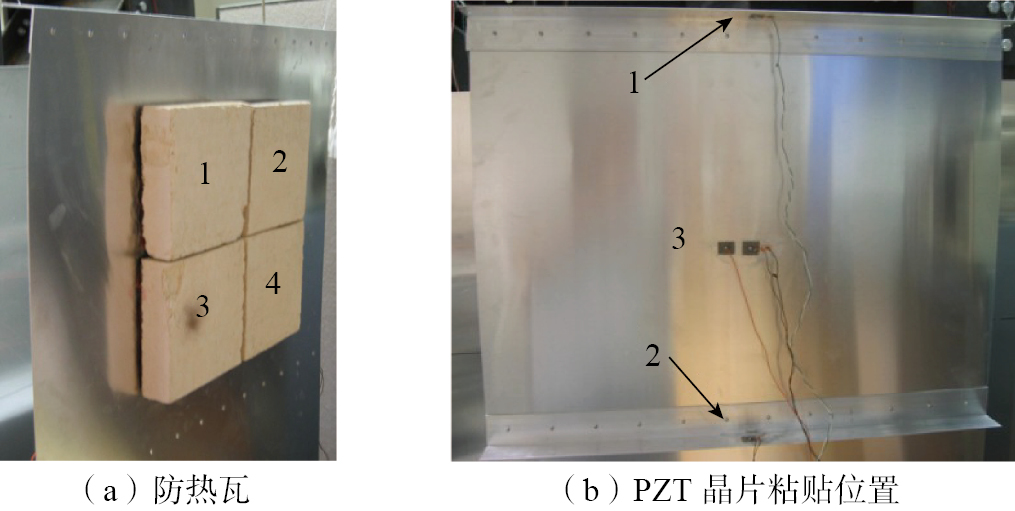
基于机电阻抗的脱黏监测技术的原理是,首先对防热瓦施加激励信号,激励信号会引发试件材料内部的受激振动;随后,采集并分析振动响应所反馈的阻抗信号,并将之与无缺陷试件的阻抗信号进行比较,从而确定试件内部是否存在脱黏缺陷[ 陈志强. 基于机械阻抗法的多层复合结构的脱粘缺陷检测[D]. 成都: 电子科技大学, 2020.CHEN Zhiqiang. Debonding defect detection of multilayer composite structures based on mechanical impedance method[D]. Chengdu: University of Electronic Science and Technology of China, 2020. 65]。美国弗吉尼亚理工学院和州立大学的Grisso等[ GRISSO B L, INMAN D J. Impedance-based structural health monitoring of thermal protection systems[J]. Nondestructive Evaluation and Health Monitoring of Aerospace Materials, Composites, and Civil Infrastructure V, 2006, 6176: 61760M. GRISSO B L. Advancing autonomous structural health monitoring[D]. Blacksburg: Virginia Polytechnic Institute and State University, 2007. 66-67]开展了基于机电阻抗的航天飞机防热瓦脱黏损伤检测试验,以期从机身内部监测防热瓦的健康状态;试验装置如图13[ GRISSO B L, INMAN D J. Impedance-based structural health monitoring of thermal protection systems[J]. Nondestructive Evaluation and Health Monitoring of Aerospace Materials, Composites, and Civil Infrastructure V, 2006, 6176: 61760M. 66]所示,4块防热瓦通过硅树脂胶粘剂粘贴在一块薄板上,薄板模拟机身结构,防热瓦与薄板之间夹有一层Nomex芳纶毛毡,薄板的另一面则粘贴了压电传感器PZT;试验发现,损伤主要来源于毛毡与薄板之间黏结层的分层,研究者逐步加重损伤,并使用阻抗分析仪获取PZT晶片的实频曲线,通过计算均方根偏差来量化脱黏的严重程度。
图13 机电阻抗法检测防热瓦脱黏损伤[ GRISSO B L, INMAN D J. Impedance-based structural health monitoring of thermal protection systems[J]. Nondestructive Evaluation and Health Monitoring of Aerospace Materials, Composites, and Civil Infrastructure V, 2006, 6176: 61760M. 66]
Fig.13 Electromechanical impedance method to detect the debonding damage of heat-proof tile[ GRISSO B L, INMAN D J. Impedance-based structural health monitoring of thermal protection systems[J]. Nondestructive Evaluation and Health Monitoring of Aerospace Materials, Composites, and Civil Infrastructure V, 2006, 6176: 61760M. 66]
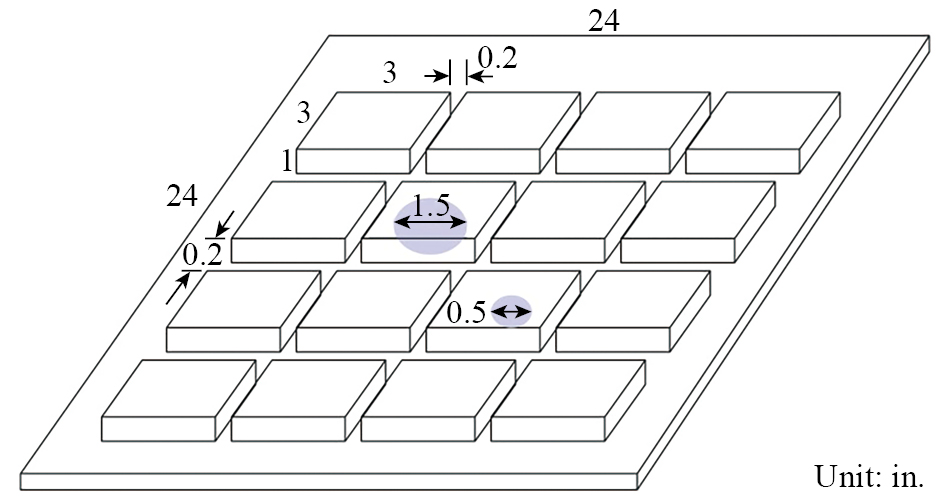
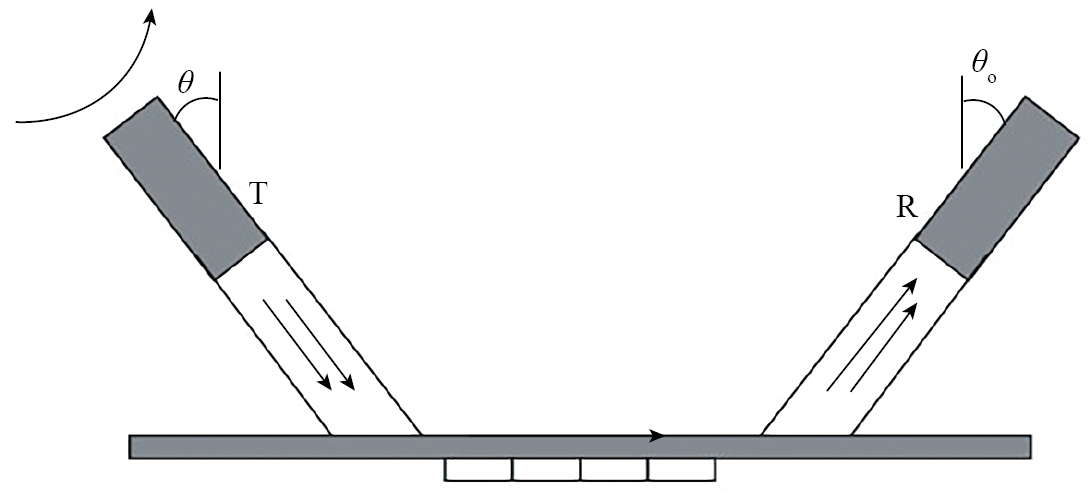
导波在传播过程中会受到脱黏的影响,使其时域信号发生变化,因此可以通过对比导波信号来判断是否经过脱黏区域[ 高飞, 姬鼎丞, 王军伟, 等. 航天器蜂窝夹层结构脱粘损伤的导波检测与成像方法[J]. 航天器工程, 2021, 30(1): 57–63.GAO Fei, JI Dingcheng, WANG Junwei, et al. Disbond detection and imaging using lamb waves for spacecraft honeycomb sandwich panel[J]. Spacecraft Engineering, 2021, 30(1): 57–63. 68]。2009年,Kundu等[ KUNDU T, DAS S, JATA K V. Health monitoring of a thermal protection system using lamb waves[J]. Structural Health Monitoring, 2009, 8(1): 29–45. 69]研究了Lamb波作为结构健康监测工具在热防护系统中预测冲击点和检测分层的适用性;研究者设计了一种TPS试件,该试件由陶瓷多孔砖与2.2 mm厚的铝合金板粘合而成,如图14所示[ KUNDU T, DAS S, JATA K V. Health monitoring of a thermal protection system using lamb waves[J]. Structural Health Monitoring, 2009, 8(1): 29–45. 69];为了在试件中产生导波,研究者将1个发射器和1个接收器放置在不含任何瓷砖的铝板一侧,如图15所示[ KUNDU T, DAS S, JATA K V. Health monitoring of a thermal protection system using lamb waves[J]. Structural Health Monitoring, 2009, 8(1): 29–45. 69];通过在试样制造过程中去除所选界面区域的粘合剂,模拟瓷砖与铝板之间的分层;通过分析传播导波所产生的声学特征,可以有效区分脱黏区域与未脱黏区域,从而实现对脱黏分层缺陷的检测。2021年,南京航空航天大学的Liu等[ LIU Y H, ZHANG C, JI H L, et al. Guided wave propagation in thermal protection structures with debonding damage[C]//Proceedings of 2020 15th Symposium on Piezoelectrcity, Acoustic Waves and Device Applications (SPAWDA). Piscataway: IEEE, 2021. 70]采用局域波数法对脱黏TPS中导波的波数变化进行了数值研究,结果表明,TPS脱黏区的导波波数小于TPS黏结区的导波波数;为验证通过导波波数变化特征识别不同尺寸脱黏的可行性,研究者进行了有限元仿真;仿真结果显示,所有脱黏点均可被成功识别,进一步证明了局部波数法在识别TPS脱黏点方面的有效性。
图14 TPS模型的几何结构[ KUNDU T, DAS S, JATA K V. Health monitoring of a thermal protection system using lamb waves[J]. Structural Health Monitoring, 2009, 8(1): 29–45. 69]
Fig.14 Geometry of the TPS model[ KUNDU T, DAS S, JATA K V. Health monitoring of a thermal protection system using lamb waves[J]. Structural Health Monitoring, 2009, 8(1): 29–45. 69]
图15 发射器、接收器和样本的方向[ KUNDU T, DAS S, JATA K V. Health monitoring of a thermal protection system using lamb waves[J]. Structural Health Monitoring, 2009, 8(1): 29–45. 69]
Fig.15 Orientations of the transmitter, receiver and the specimen[ KUNDU T, DAS S, JATA K V. Health monitoring of a thermal protection system using lamb waves[J]. Structural Health Monitoring, 2009, 8(1): 29–45. 69]
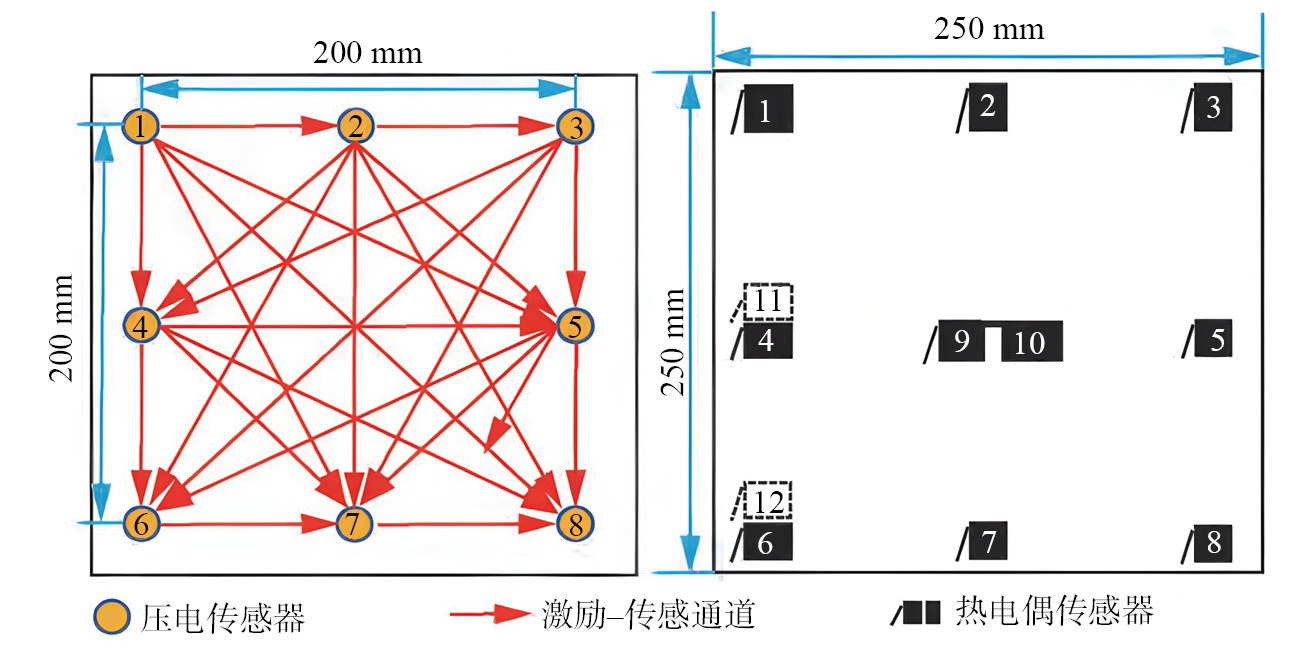
此外,郑辉等[ 郑辉, 邱雷, 袁慎芳, 等. C/C热防护结构高温气流损伤导波监测实验方法[J]. 航空学报, 2022, 43(8): 225659.ZHENG Hui, QIU Lei, YUAN Shenfang, et al. Experimental method of guided wave monitoring for high temperature airflow damage of C/C thermal protection structures[J]. Acta Aeronautica et Astronautica Sinica, 2022, 43(8): 225659. 71]提出了一种基于导波的C/C热防护系统损伤监测的试验方法,传感器布置如图16所示;通过设计氧–乙炔火焰喷流装置模拟再入环境下的高温气流(温度约1800 ℃),对C/C热防护结构施加热流激励以产生损伤,同时利用热电偶采集TPS典型位置的温度情况;随后,通过粘贴在结构表面的PZT压电传感器阵列激励并采集导波信号,分析损伤对导波的影响;试验结果表明,损伤产生后TPS上导波幅值和波速发生明显变化,通过对导波信号在损伤前后的变化程度进行量化,可以反映TPS损伤程度,验证了导波技术在高温环境下对TPS热损伤的识别与定位能力。
图16 TPS传感器布置示意图[ 郑辉, 邱雷, 袁慎芳, 等. C/C热防护结构高温气流损伤导波监测实验方法[J]. 航空学报, 2022, 43(8): 225659.ZHENG Hui, QIU Lei, YUAN Shenfang, et al. Experimental method of guided wave monitoring for high temperature airflow damage of C/C thermal protection structures[J]. Acta Aeronautica et Astronautica Sinica, 2022, 43(8): 225659. 71]
Fig.16 Schematic diagram of TPS sensor layout[ 郑辉, 邱雷, 袁慎芳, 等. C/C热防护结构高温气流损伤导波监测实验方法[J]. 航空学报, 2022, 43(8): 225659.ZHENG Hui, QIU Lei, YUAN Shenfang, et al. Experimental method of guided wave monitoring for high temperature airflow damage of C/C thermal protection structures[J]. Acta Aeronautica et Astronautica Sinica, 2022, 43(8): 225659. 71]
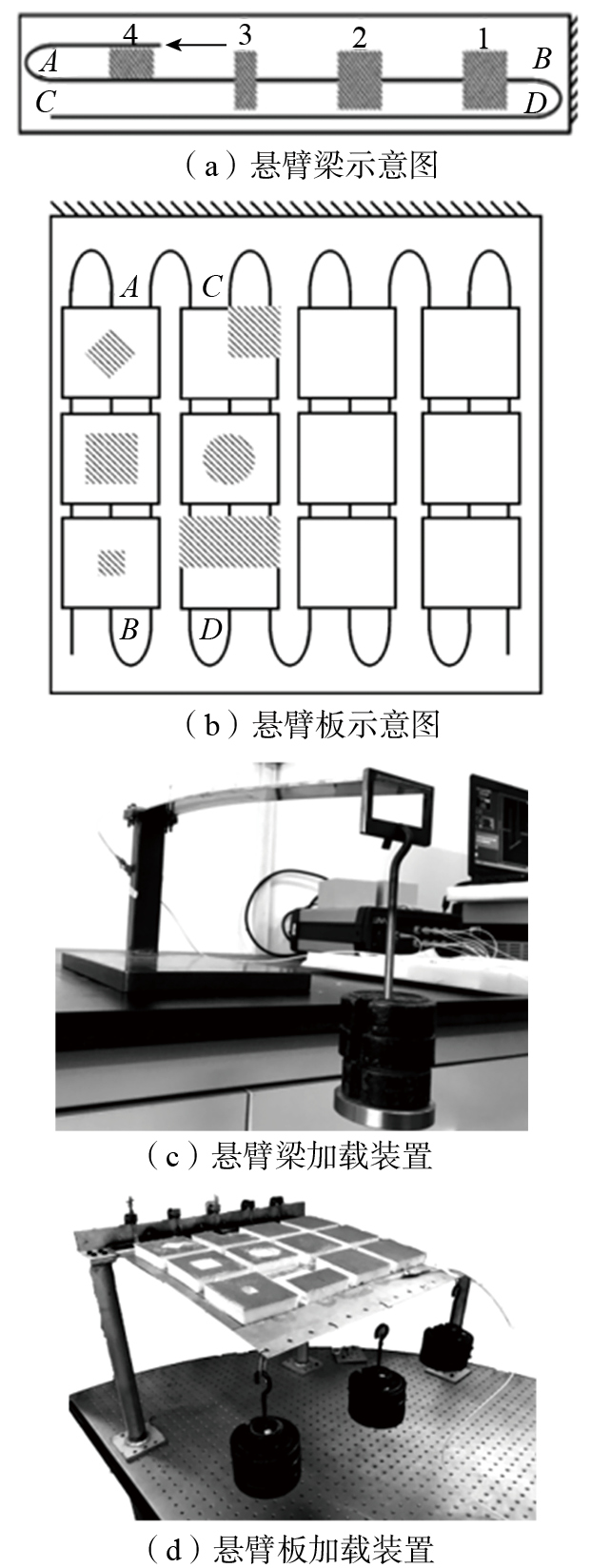
基于光纤的脱黏检测技术通常采用弯曲试验进行研究与验证。当结构发生弯曲时,依据平面假设,未脱黏区域的应变应呈现连续、线性的变化。然而,脱黏后,结构的刚度和弹性模量会发生变化,导致应变的重新分布。通过光纤测量这种应变的差异,可以判断结构的脱黏情况[ 柳敏静, 夏梓旭, 李建乐, 等. 基于分布式光纤传感的防热结构损伤识别研究[J]. 压电与声光, 2020, 42(6): 765–768.LIU Minjing, XIA Zixu, LI Jianle, et al. Research on damage detection of heat-insulating structure based on distributed optical fiber sensor[J]. Piezoelectrics & Acoustooptics, 2020, 42(6): 765–768. 72]。2020年,单一男等[ 单一男, 武湛君, 徐新生, 等. 基于分布式光纤传感的隔热层脱粘识别研究[J]. 压电与声光, 2020, 42(1): 25–28.SHAN Yinan, WU Zhanjun, XU Xinsheng, et al. Research on de-bonding identification of thermal-protective coating based on distributed optical fiber sensing technology[J]. Piezoelectrics & Acoustooptics, 2020, 42(1): 25–28. 单一男. 基于分布式光纤传感的典型结构状态监测研究[D]. 大连: 大连理工大学, 2020.SHAN Yinan. State monitoring study of typical structures based on distributed fiber optic sensing[D]. Dalian: Dalian University of Technology, 2020. 73-74]针对一种隔热泡沫胶结铝合金结构,利用铺设的光纤传感器网络研究了对脱黏损伤的识别效果;研究者分别进行了悬臂梁弯曲试验和悬臂板弯曲试验,试验件和加载装置如图17所示;为了模拟脱黏损伤,研究者去除了泡沫试片,并利用光纤解调仪对光纤传感器进行解调;结果显示,在脱黏区域附近,光纤的应变差值幅值较大,因此可以通过确定差值曲线的波峰位置来有效识别脱黏损伤的位置。
图17 试验件和试验加载装置[ 单一男, 武湛君, 徐新生, 等. 基于分布式光纤传感的隔热层脱粘识别研究[J]. 压电与声光, 2020, 42(1): 25–28.SHAN Yinan, WU Zhanjun, XU Xinsheng, et al. Research on de-bonding identification of thermal-protective coating based on distributed optical fiber sensing technology[J]. Piezoelectrics & Acoustooptics, 2020, 42(1): 25–28. 73]
Fig.17 Test piece and test loading device[ 单一男, 武湛君, 徐新生, 等. 基于分布式光纤传感的隔热层脱粘识别研究[J]. 压电与声光, 2020, 42(1): 25–28.SHAN Yinan, WU Zhanjun, XU Xinsheng, et al. Research on de-bonding identification of thermal-protective coating based on distributed optical fiber sensing technology[J]. Piezoelectrics & Acoustooptics, 2020, 42(1): 25–28. 73]
在多层防热结构脱黏监测领域,机电阻抗法、超声导波法和光纤传感器技术均展现出一定的损伤识别能力,并在多项地面试验中得以验证。机电阻抗法具有灵敏度高和响应快速的优势,能够通过分析局部振动阻抗特征有效识别脱黏缺陷,适合对关键部位进行实时监测;然而,该方法对温度变化较为敏感[ PARK G, INMAN D J. Impedance-based structural health monitoring[M]//Damage Prognosis: For Aerospace, Civil and Mechanical Systems. Hoboken: John Wiley & Sons, Ltd., 2005. 75],实际应用中需要复杂的温度补偿算法以确保准确性。超声导波法依靠导波在结构中的传播特性进行监测,能够覆盖较大范围并实现远距离无损检测,适合大面积防热结构的在线监测;但导波信号易受结构几何形状和温度变化的影响,使得其信号解读和缺陷定位相对复杂[ ROSE J L. Ultrasonic guided waves in structural health monitoring[J]. Key Engineering Materials, 2004, 270–273: 14–21. 76]。光纤传感器技术具有高灵敏度和抗电磁干扰能力,可实现对结构应变和温度的高精度测量,适合长距离布设和分布式监测;然而,光纤对未直接经过路径的脱黏缺陷难以检测,且在高温环境中如何区分机械应变和热应变仍存在技术瓶颈[ 王成亮, 杨庆胜, 李军, 等. 基于神经网络的光纤温度和应变快速解调方法[J]. 激光技术, 2022, 46(2): 254–259.WANG Chengliang, YANG Qingsheng, LI Jun, et al. Fast demodulation method of optical fiber temperature and strain based on neural network[J]. Laser Technology, 2022, 46(2): 254–259. 张开银, 崔树森, 李松, 等. 结构应变测试中温度应变补偿研究[J]. 武汉理工大学学报, 2021, 43(10): 63–67.ZHANG Kaiyin, CUI Shusen, LI Song, et al. Research on temperature strain compensation in structural strain testing[J]. Journal of Wuhan University of Technology, 2021, 43(10): 63–67. 77-78]。
可重复使用运载器在执行运载任务时需要频繁进出空间,面临微流星体或轨道碎片等外来物体撞击的潜在损伤风险[ HOSCHKE N, PRICE D C, SCOTT D A, et al. Structural health monitoring of space vehicle thermal protection systems[J]. Key Engineering Materials, 2013, 558: 268–280. 79]。此外,发射过程中结构脱落导致的撞击损伤同样不可忽视。例如,哥伦比亚号航天飞机在发射时,外部燃料箱表面脱落的泡沫材料击中了左翼前缘的增强碳–碳隔热板,最终引发了严重事故[ FAHRENTHOLD E P, PARK Y K. Simulation of foam-impact effects on the space shuttle thermal protection system[J]. Journal of Spacecraft and Rockets, 2005, 42(2): 201–207. 80]。因此,热防护系统的结构健康监测任务之一便是监测外部结构的冲击。目前,冲击监测技术主要依赖于加速度传感器、声发射传感器等,这些传感器能够实时捕捉冲击事件,提供重要数据以评估结构的完整性和安全性,从而为运载器的安全运行提供保障。
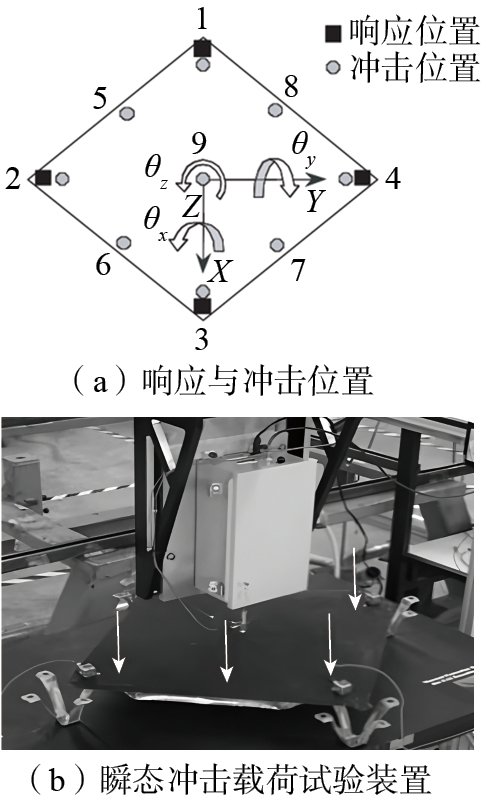
2007年,Hundhausen等[ HUNDHAUSEN R J, ADAMS D E, DERRISO M. Impact loads identification in standoff metallic thermal protection system panels[J]. Journal of Intelligent Material Systems and Structures, 2007, 18(6): 531–541. 81]研究了用于识别金属复合材料热防护系统面板瞬态冲击载荷的试验方法;参考X–33的TPS设计,针对一种通过金属支架连接到机身的TPS金属面板,使用电动冲击锤在面板上9个点进行冲击,同时使用三轴加速计在面板上的4个位置(点1、2、3和4)测量响应(x、y和z方向),如图18所示;通过数据采集系统获取每个加速度计的响应和相应的输入,从而确定频率响应函数(Frequency response function,FRF)矩阵;收集的时域响应数据与FRF矩阵结合使用,以识别作用在系统上的载荷;最终成功定位了9个冲击位置,冲击力大小的最大误差为4.02%,验证了该方法能够高精度检测、定位和量化瞬态冲击载荷。
图18 传感器位置和试验装置[ HUNDHAUSEN R J, ADAMS D E, DERRISO M. Impact loads identification in standoff metallic thermal protection system panels[J]. Journal of Intelligent Material Systems and Structures, 2007, 18(6): 531–541. 81]
Fig.18 Sensor location and experimental setup[ HUNDHAUSEN R J, ADAMS D E, DERRISO M. Impact loads identification in standoff metallic thermal protection system panels[J]. Journal of Intelligent Material Systems and Structures, 2007, 18(6): 531–541. 81]
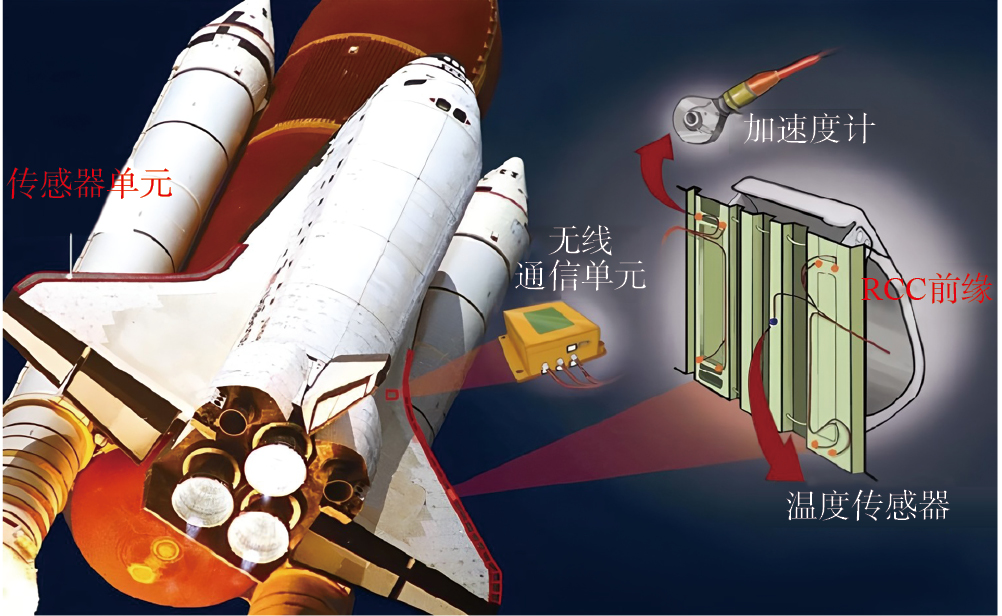
在哥伦比亚航天飞机事件后,NASA开发了一种机翼前缘撞击检测系统[ YAP K, MACIAS J, KAOUK M, et al. Probabilistic structural health monitoring of the orbiter wing leading edge[C]//Proceedings of 52nd AIAA/ASME/ASCE/AHS/ASC Structures, Structural Dynamics and Materials Conference. Reston: AIAA, 2011. GROSCH D, BERTRAND F. Thermal protection system (TPS) impact experiments[C]//Proceedings of 47th AIAA/ASME/ASCE/AHS/ASC Structures, Structural Dynamics, and Materials Conference. Reston: AIAA, 2006. 82-83](Wing leading-edge impact-detection system,WLEIDS),如图19所示。该系统机载设备包含132个加速度计和44个电阻式温度传感器,安装在增强碳纤维面板后面的翼梁中。每3个加速度计和1个温度传感器构成一组传感器单元,与无线通信单元相连。无线通信单元由电池供电,通过射频与航天飞机内部的计算机进行通信。该设备被布置在发现号轨道飞行器上,并在STS–114任务的飞行中监测到少量的冲击碰撞事件,为后来的热防护系统健康监测提供了参考。
图19 WLEIDS组成[ YAP K, MACIAS J, KAOUK M, et al. Probabilistic structural health monitoring of the orbiter wing leading edge[C]//Proceedings of 52nd AIAA/ASME/ASCE/AHS/ASC Structures, Structural Dynamics and Materials Conference. Reston: AIAA, 2011. 82]
Fig.19 Components of WLEIDS[ YAP K, MACIAS J, KAOUK M, et al. Probabilistic structural health monitoring of the orbiter wing leading edge[C]//Proceedings of 52nd AIAA/ASME/ASCE/AHS/ASC Structures, Structural Dynamics and Materials Conference. Reston: AIAA, 2011. 82]
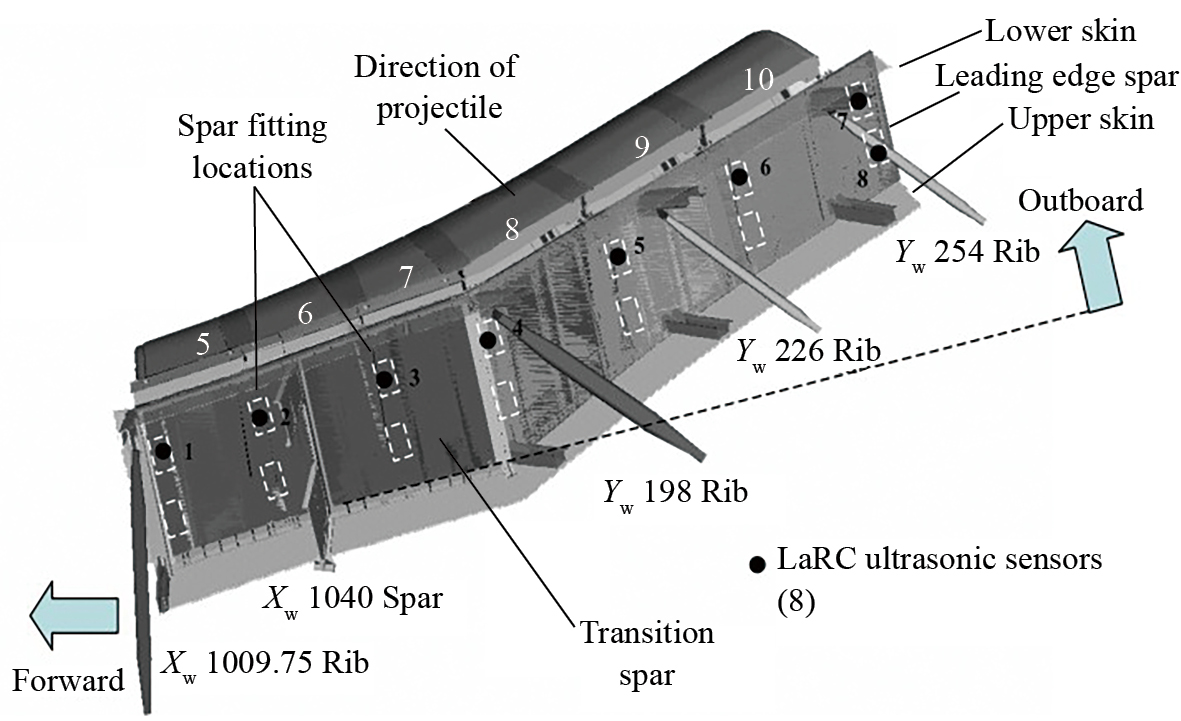
当防热结构的外部受到瞬态冲击时,内部会产生应力重分布并形成瞬态弹性波。通过声发射传感器采集这些冲击信号,并对之进行分析处理,可以获取冲击源的相关信息,实现对冲击事件的有效监测。自哥伦比亚号航天飞机事件以来,针对机翼前缘热防护结构的冲击监测技术,在多年来开发的声发射测试方法的基础上,NASA对增强碳纤维前缘材料及典型铝机翼结构上的梭形瓦材料进行了大量冲击试验[ MADARAS E I. Structural health monitoring of the space shuttle’s wing leading edge[J]. AIP Conference Proceedings, 2006, 820(1): 1756–1763. MADARAS E, WINFREE W, PROSSER W, et al. Nondestructive evaluation for the space shuttle’s wing leading edge[C]//proceedings of 41st AIAA/ASME/SAE/ASEE Joint Propulsion Conference & Exhibit. Reston: AIAA, 2005. 84-85]。这些试验评估了多种撞击材料和条件的影响,包括低速泡沫冲击试验(图20)[ MADARAS E I. Structural health monitoring of the space shuttle’s wing leading edge[J]. AIP Conference Proceedings, 2006, 820(1): 1756–1763. 84]、超高速冲击试验(图21)[ MADARAS E, WINFREE W, PROSSER W, et al. Nondestructive evaluation for the space shuttle’s wing leading edge[C]//proceedings of 41st AIAA/ASME/SAE/ASEE Joint Propulsion Conference & Exhibit. Reston: AIAA, 2005. 85]和翼梁结构差异对波传播的影响(图22)[ MADARAS E, WINFREE W, PROSSER W, et al. Nondestructive evaluation for the space shuttle’s wing leading edge[C]//proceedings of 41st AIAA/ASME/SAE/ASEE Joint Propulsion Conference & Exhibit. Reston: AIAA, 2005. 85]。测试结果成功验证了基于声发射技术监测和定位航天飞机机翼结构冲击事件的可行性,显示了它在航天器安全性评估中的重要应用潜力。
图20 机翼前缘碰撞试验品的示意图[ MADARAS E I. Structural health monitoring of the space shuttle’s wing leading edge[J]. AIP Conference Proceedings, 2006, 820(1): 1756–1763. 84]
Fig.20 A drawing of the wing leading edge impact test article[ MADARAS E I. Structural health monitoring of the space shuttle’s wing leading edge[J]. AIP Conference Proceedings, 2006, 820(1): 1756–1763. 84]
图21 超高速撞击对增强碳–碳材料面板造成的损坏[ MADARAS E, WINFREE W, PROSSER W, et al. Nondestructive evaluation for the space shuttle’s wing leading edge[C]//proceedings of 41st AIAA/ASME/SAE/ASEE Joint Propulsion Conference & Exhibit. Reston: AIAA, 2005. 85]
Fig.21 Damage to RCC (reinforced carbin–carbon) panels from hypervelocity impacts[ MADARAS E, WINFREE W, PROSSER W, et al. Nondestructive evaluation for the space shuttle’s wing leading edge[C]//proceedings of 41st AIAA/ASME/SAE/ASEE Joint Propulsion Conference & Exhibit. Reston: AIAA, 2005. 85]
图22 航天飞机测试时传感器位置的布局[ MADARAS E, WINFREE W, PROSSER W, et al. Nondestructive evaluation for the space shuttle’s wing leading edge[C]//proceedings of 41st AIAA/ASME/SAE/ASEE Joint Propulsion Conference & Exhibit. Reston: AIAA, 2005. 85]
Fig.22 Layout of transducer locations during the shuttle tests[ MADARAS E, WINFREE W, PROSSER W, et al. Nondestructive evaluation for the space shuttle’s wing leading edge[C]//proceedings of 41st AIAA/ASME/SAE/ASEE Joint Propulsion Conference & Exhibit. Reston: AIAA, 2005. 85]
针对黏结式多层防热结构的冲击监测,目前也进行了深入探索。2009年,Kundu等[ KUNDU T, DAS S, JATA K V. Health monitoring of a thermal protection system using lamb waves[J]. Structural Health Monitoring, 2009, 8(1): 29–45. 69]基于声发射技术设计了落球试验,进行冲击检测;将弹性球投掷到瓷砖板上以模拟冲击事件,为避免球在板上多次反弹,瓷砖板被放置在略微倾斜的位置,如图23(a)所示[ KUNDU T, DAS S, JATA K V. Health monitoring of a thermal protection system using lamb waves[J]. Structural Health Monitoring, 2009, 8(1): 29–45. 69];压电传感器放置在瓷砖板另一侧的金属表面上,具体的放置位置如图23(b)所示[ KUNDU T, DAS S, JATA K V. Health monitoring of a thermal protection system using lamb waves[J]. Structural Health Monitoring, 2009, 8(1): 29–45. 69];黑色圆圈表示放置在圆弧上的9个接收传感器,而白色和灰色圆圈则表示落球的位置;由于各向异性陶瓷瓦显著影响板中的导波速度,首先让球落在白色圆圈上,以测量不同方向的导波速度,然后再让球落在灰色圆圈上,接收传感器记录信号以检测冲击点;通过最小化目标函数,研究者获得了良好的检测结果,验证了声发射技术在监测热防护结构冲击事件中的可行性。
图23 落球试验装置和传感器布置[ KUNDU T, DAS S, JATA K V. Health monitoring of a thermal protection system using lamb waves[J]. Structural Health Monitoring, 2009, 8(1): 29–45. 69]
Fig.23 Drop test apparatus and sensor arrangement[ KUNDU T, DAS S, JATA K V. Health monitoring of a thermal protection system using lamb waves[J]. Structural Health Monitoring, 2009, 8(1): 29–45. 69]
2013年,Hoschke等[ HOSCHKE N, PRICE D C, SCOTT D A, et al. Structural health monitoring of space vehicle thermal protection systems[J]. Key Engineering Materials, 2013, 558: 268–280. 79, HOSCHKE N, PRICE D C, SCOTT D A. Self-organizing sensing of structures: Monitoring a space vehicle thermal protection system[M]//Advances in Applied Self-Organizing Systems. London: Springer, 2013. 86]提出一种智能传感器网络,如图24所示[ HOSCHKE N, PRICE D C, SCOTT D A, et al. Structural health monitoring of space vehicle thermal protection systems[J]. Key Engineering Materials, 2013, 558: 268–280. 79];其中,每个伪三角区域代表一片防热瓦,在每片瓦中,圆形元件代表压电声发射传感器,方形元件代表光路开关,连接光路开关的是光学传感器;研究者利用该智能网络进行了防热瓦冲击损伤探测和评估试验,首先利用压电声发射传感器网络对冲击进行检测和近似定位,接着利用嵌入在防热瓦中的光学传感纤维测量防热瓦的温度,通过热成像技术评估碰撞损伤的影响。
图24 智能网络传感器布局[ HOSCHKE N, PRICE D C, SCOTT D A, et al. Structural health monitoring of space vehicle thermal protection systems[J]. Key Engineering Materials, 2013, 558: 268–280. 79]
Fig.24 Intelligent network sensor layout[ HOSCHKE N, PRICE D C, SCOTT D A, et al. Structural health monitoring of space vehicle thermal protection systems[J]. Key Engineering Materials, 2013, 558: 268–280. 79]
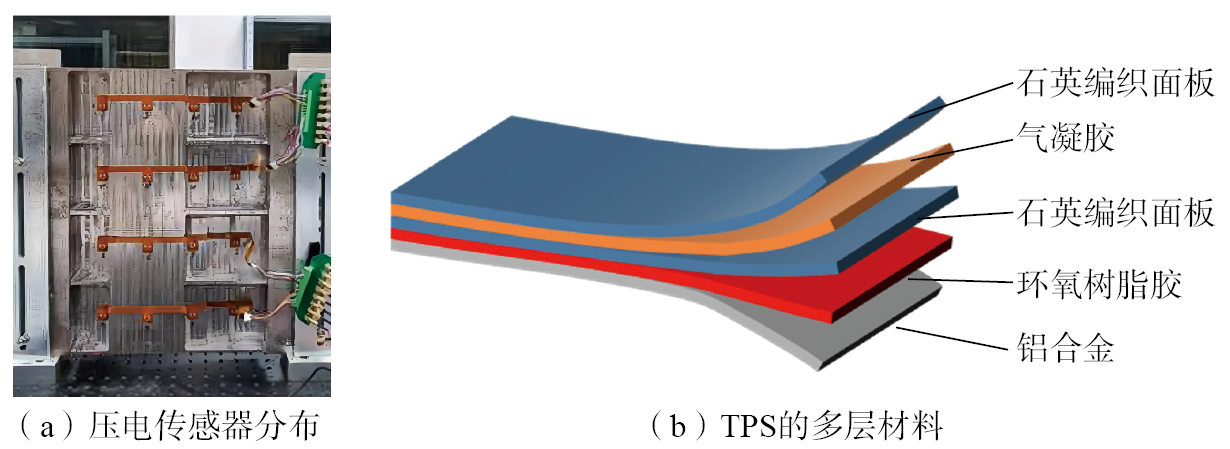
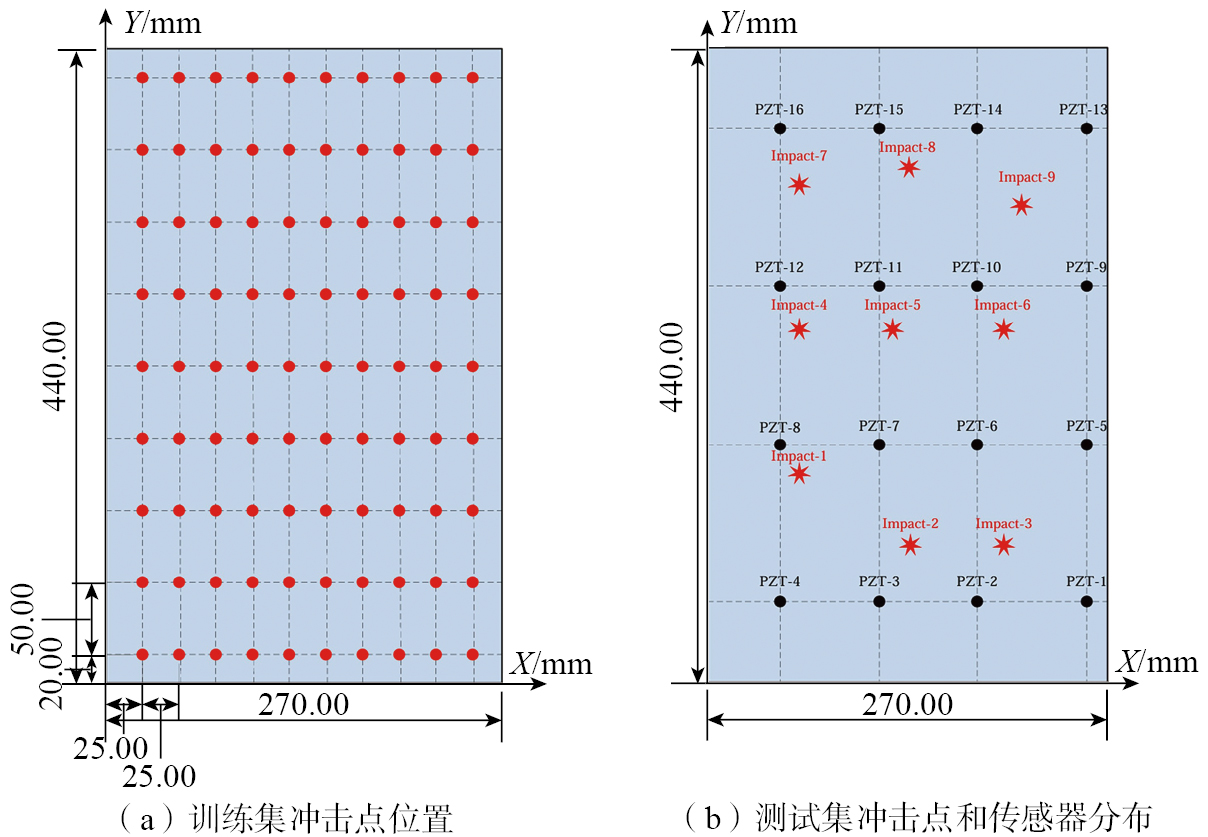
2023年,唐伍强[ 唐伍强. 基于混合核极限学习机的热防护结构冲击定位方法研究[D]. 南京: 南京航空航天大学, 2023.TANG Wuqiang. Research on impact location method of thermal protection structure based on hybrid kernel extreme learning machine[D]. Nanjing: Nanjing University of Aeronautics and Astronautics, 2023. 87]针对热防护结构在复杂飞行条件下可能遭遇的瞬态冲击问题,提出一种结合混合核极限学习机(Hybrid kernel extreme learning machine,HKELM)的冲击定位方法;以曲面热防护结构为对象,其上布设16个压电传感器,用于采集不同冲击位置激发下的响应信号;冲击加载采用自制自由落体冲击装置在多个预设位置进行,具体布置和试验所用热防护结构如图25所示;该试验提取了各通道传感器信号的特征向量,构建数据集,并将之输入到HKELM分类模型进行位置识别,如图26所示;结果表明,该方法可准确定位常温下9个冲击点,最大定位误差小于5 mm;对于高温及热振耦合振动环境下的冲击测试数据,冲击位置的预测误差会有所增加,但由于网络模型具有良好的泛化性能,冲击位置的平均预测误差约为40 mm。
图25 曲面热防护试验件[ 唐伍强. 基于混合核极限学习机的热防护结构冲击定位方法研究[D]. 南京: 南京航空航天大学, 2023.TANG Wuqiang. Research on impact location method of thermal protection structure based on hybrid kernel extreme learning machine[D]. Nanjing: Nanjing University of Aeronautics and Astronautics, 2023. 87]
Fig.25 Curved surface thermal protection test piece[ 唐伍强. 基于混合核极限学习机的热防护结构冲击定位方法研究[D]. 南京: 南京航空航天大学, 2023.TANG Wuqiang. Research on impact location method of thermal protection structure based on hybrid kernel extreme learning machine[D]. Nanjing: Nanjing University of Aeronautics and Astronautics, 2023. 87]
图26 冲击点与压电传感器位置分布[ 唐伍强. 基于混合核极限学习机的热防护结构冲击定位方法研究[D]. 南京: 南京航空航天大学, 2023.TANG Wuqiang. Research on impact location method of thermal protection structure based on hybrid kernel extreme learning machine[D]. Nanjing: Nanjing University of Aeronautics and Astronautics, 2023. 87]
Fig.26 Impact point and piezoelectric sensor position distribution[ 唐伍强. 基于混合核极限学习机的热防护结构冲击定位方法研究[D]. 南京: 南京航空航天大学, 2023.TANG Wuqiang. Research on impact location method of thermal protection structure based on hybrid kernel extreme learning machine[D]. Nanjing: Nanjing University of Aeronautics and Astronautics, 2023. 87]
加速度传感器通常只能测量低频段的振动信息,而可重复使用运载器在频繁进出复杂空间环境时所承受的冲击类型多样且复杂,这使得单纯依赖加速度计的监测存在明显局限性。而声发射传感器与压电传感器虽然能够捕捉高频瞬态弹性波信号,但易受环境噪声干扰,对数据的准确解析依赖于丰富的数据库支持和现场检测经验。此外,声发射传感器通常侧重于冲击源的定位,难以直接量化损伤的程度和性质[ HOSCHKE N, PRICE D C, SCOTT D A, et al. Structural health monitoring of space vehicle thermal protection systems[J]. Key Engineering Materials, 2013, 558: 268–280. 79, HOSCHKE N, PRICE D C, SCOTT D A. Self-organizing sensing of structures: Monitoring a space vehicle thermal protection system[M]//Advances in Applied Self-Organizing Systems. London: Springer, 2013. 86]。
包为民. 可重复使用运载火箭技术发展综述[J]. 航空学报, 2023, 44(23): 629555. BAOWeimin. A review of reusable launch vehicle technology development[J]. Acta Aeronautica et Astronautica Sinica, 2023, 44(23): 629555.
[2]
宋月娥, 吴东涛, 姜硕. 组合动力运载器结构与热防护系统概述[J]. 中国航天, 2022(1): 29–36. SONGYue’e, WUDongtao, JIANGShuo. Introduction to structure and thermal protection system of aerospace vehicle with combined cycle engine[J]. Aerospace China, 2022(1): 29–36.
[3]
孟松鹤, 杨强, 霍施宇, 等. 一体化热防护技术现状和发展趋势[J]. 宇航学报, 2013, 34(10): 1295–1302. MENGSonghe, YANGQiang, HUOShiyu, et al. State-of-arts and trend of integrated thermal protection systems[J]. Journal of Astronautics, 2013, 34(10): 1295–1302.
[4]
周印佳, 张志贤. 航天器可重复使用热防护技术研究进展与应用[J]. 航天返回与遥感, 2019, 40(5): 27–40. ZHOUYinjia, ZHANGZhixian. Research progress and applications of reusable thermal protection technology for spacecraft[J]. Spacecraft Recovery & Remote Sensing, 2019, 40(5): 27–40.
[5]
UYANNAO, NAJAFIH. Thermal protection systems for space vehicles: A review on technology development, current challenges and future prospects[J]. Acta Astronautica, 2020, 176: 341–356.
[6]
闻悦, 马婷婷, 郑平军, 等. 重复使用航天运输系统设计与评估[J]. 科学通报, 2020, 65(9): 764–770. WENYue, MATingting, ZHENGPingjun, et al. Design and assessment of reusable space transportation system[J]. Chinese Science Bulletin, 2020, 65(9): 764–770.
[7]
TRIVEDIA, MITRAK, SUBRAMANIANC. Numerical and experimental study of non-destructive detection of thermal tile system debonding using short-pulse laser[C]//Proceedings of 37th AIAA Thermophysics Conference. Arlington: AIAA, 2004.
[8]
KACMARC J. Thermal characterization of TPS tiles[J]. AIP Conference Proceedings, 2006, 820(1): 1740–1747.
[9]
THOMASB P, RAJENDRANK V, ANNAMALA PILLAIS. Whole-field NDT of thermal protection system using digital holography[J]. Insight-Non-Destructive Testing and Condition Monitoring, 2007, 49(5): 279–282.
[10]
IVASHOVS I, VASILIEVI A, BECHTELT D, et al. Comparison between impulse and holographic subsurface radar for NDT of space vehicle structural materials[J]. PIERS Online, 2007, 3(5): 658–661.
[11]
王彬文, 肖迎春, 白生宝, 等. 飞机结构健康监测与管理技术研究进展和展望[J]. 航空制造技术, 2022, 65(3): 30–41. WANGBinwen, XIAOYingchun, BAIShengbao, et al. Research progress and prospect of aircraft structural health monitoring and management technology[J]. Aeronautical Manufacturing Technology, 2022, 65(3): 30–41.
[12]
吴国庭. 哥伦比亚号防热系统概貌[J]. 国际太空, 2003(6): 26–28. WUGuoting. General situation of Columbia thermal protection system[J]. Space International, 2003(6): 26–28.
[13]
张宗美. 航天故障手册[M]. 北京: 中国宇航出版社, 1994. ZHANGZongmei. Handbook of failures of launch vehicles, spacecrafts and missiles[M]. Beijing: China Astronautics Press, 1994.
[14]
SNAPPC, RODRIGUEZA. Orbiter thermal protection system lessons learned[C]//Proceedings of AIAA SPACE 2011 Conference & Exposition. Arlington: AIAA, 2011.
[15]
LEV T, GOON S. Design, fabrication, and testing of metallic thermal protection systems for spaceplane vehicles[J]. Journal of Spacecraft and Rockets, 2021, 58(4): 1043–1060.
[16]
黄杰. 高超声速飞行器热防护系统综合研究[D]. 南京: 南京航空航天大学, 2019. HUANGJie. Comprehensive investigations on thermal protection system of hypersonic vehicles[D]. Nanjing: Nanjing University of Aeronautics and Astronautics, 2019.
[17]
张茂. 重复使用跨大气层飞行器防热系统健康监控技术研究[D]. 西安: 西北工业大学, 2006. ZHANGMao. Research on health monitoring technology for thermal protection systems of reusable transatmospheric vehicles[D]. Xi’an: Northwestern Polytechnical University, 2006.
[18]
SMITHK, SOARESC, MIKATARIANR, et al. Space shuttle thermal protection system repair flight experiment induced contamination impacts[C]//Proceedings of 44th AIAA Aerospace Sciences Meeting and Exhibit. Arlington: AIAA, 2006.
[19]
MORRISW, WHITEN, EBELINGC. Analysis of Shuttle Orbiter reliability and maintainability data for conceptual studies[C]//Proceedings of Space Programs and Technologies Conference. Arlington: AIAA, 1996.
[20]
ZHANGX M. Optimal launch capacity trajectory design for SpaceX’s super heavy starship launch vehicle[C]//Proceedings of Third International Computing Imaging Conference (CITA 2023). Sydney: SPIE, 2023.
[21]
孟光, 刘昶, 杨冬春, 等. 美国SpaceX超重–星舰首飞分析及对中国航天产业的启示[J]. 航空学报, 2023, 44(10): 028914. MENGGuang, LIUChang, YANGDongchun, et al. First flight of SpaceX heavy-lift Starship: Enlightenment for aerospace industry in China[J]. Acta Aeronautica et Astronautica Sinica, 2023, 44(10): 028914.
[22]
龙雪丹, 杨开, 王林, 等. “超重–星舰” 首次入轨飞行测试及经验教训分析[J]. 中国航天, 2023(5): 59–66. LONGXuedan, YANGKai, WANGLin, et al. Experience learned from first fully-integrated test flight of super heavy Starship[J]. Aerospace China, 2023(5): 59–66.
[23]
RingWatchers. The Bestagons: Starship’s upgraded heat shield[EB/OL]. (2025–01–14)[2025–07–28]. https://ringwatchers.com/article/s33-tps.
李明华. 超重–星舰演变历程及未来发展方向分析[J]. 导弹与航天运载技术(中英文), 2024(4): 1–7. LIMinghua. Analysis on the evolution course and future development of superheavy Starship[J]. Missiles and Space Vehicles, 2024(4): 1–7.
[26]
苏浩涵, 陈亮, 于新宇, 等. SpaceX公司星舰第二次飞行异常情况初步分析[J]. 宇航学报, 2023, 44(11): 1785–1791. SUHaohan, CHENLiang, YUXinyu, et al. Initial analysis of anomalies in the second flight of SpaceX’s Starship[J]. Journal of Astronautics, 2023, 44(11): 1785–1791.
[27]
张毅博, 吴会强, 张宏剑, 等. 太空探索技术公司运载火箭机构技术发展路线分析及启示[J]. 宇航学报, 2025, 46(3): 631–640. ZHANGYibo, WUHuiqiang, ZHANGHongjian, et al. Analysis of the technological development path of SpaceX’s launch vehicle mechanisms and its implications[J]. Journal of Astronautics, 2025, 46(3): 631–640.
[28]
杜飞, 徐超. 螺栓连接松动的导波监测技术综述[J]. 宇航总体技术, 2018, 2(4): 13–23. DUFei, XUChao. A review on bolt preload monitoring using guided waves[J]. Astronautical Systems Engineering Technology, 2018, 2(4): 13–23.
[29]
宣建林, 冯蕴雯, 张茂, 等. 航天飞机考虑意外损伤时防热系统的健康管理研究[J]. 机械强度, 2007, 29(5): 843–847. XUANJianlin, FENGYunwen, ZHANGMao, et al. Considered accident damage the health management for thermal protection system of space shuttle[J]. Journal of Mechanical Strength, 2007, 29(5): 843–847.
[30]
田贵云, 张俊, 孟召宗. 无源无线射频识别传感器及其在结构健康监测中的应用[J]. 南京航空航天大学学报, 2017, 49(4): 453–460. TIANGuiyun, ZHANGJun, MENGZhaozong. Passive wireless RFID sensors and their applications in structural health monitoring[J]. Journal of Nanjing University of Aeronautics & Astronautics, 2017, 49(4): 453–460.
[31]
XUF J, SUS J, ZHANGL L, et al. Design and research of wireless passive high-temperature sensor based on SIW resonance[J]. Micromachines, 2022, 13(7): 1035.
[32]
MILOSF S, KARUNARATNEK S G. Active wireless temperature sensors for aerospace thermal protection systems[C]//Proceedings of Smart Nondestructive Evaluation and Health Monitoring of Structural and Biological Systems II. Bellingham: SPIE, 2003.
[33]
MILOSF S, PALLIXJ B. Wireless temperature sensors for health monitoring of aerospace thermal protection systems[C]//Proceedings of Smart Nondestructive Evaluation for Health Monitoring of Structural and Biological Systems. Bellingham: SPIE, 2002.
[34]
WATTERSD G. Design and performance of wireless sensors for structural health monitoring[J]. AIP Conference Proceedings, 2002, 615(1): 969–976.
[35]
解维华, 杜善义, 张博明, 等. 热防护系统的无线温度监测技术发展[J]. 传感器与微系统, 2007, 26(10): 5–8. XIEWeihua, DUShanyi, ZHANGBoming, et al. Development of wireless temperature sensor technology for thermal protection systems[J]. Transducer and Microsystem Technologies, 2007, 26(10): 5–8.
[36]
务颖欣, 许素宇, 徐大富, 等. 基于背壁温度测量的刚性热防护瓦健康监测原理样机设计[J]. 空天技术, 2024(6): 75–83. WUYingxin, XUSuyu, XUDafu, et al. Health monitoring prototype design for rigid thermal protection tile based on back-wall temperature detection[J]. Aerospace Technology, 2024(6): 75–83.
[37]
BOSJ, KLEINJ, FROGGATTM, et al. Fiber optic strain, temperature and shape sensing via OFDR for ground, air and space applications[C]//Proceedings of Nanophotonics and Macrophotonics for Space Environments VII. Bellingham: SPIE, 2013.
[38]
李卫斌. 用于铁路基础设施综合监测的分布式光纤传感器[J]. 中国市政工程, 2022(1): 81–84, 88, 127. LIWeibin. Distributed fiber optic sensors for comprehensive monitoring of railway infrastructure[J]. China Municipal Engineering, 2022(1): 81–84, 88, 127.
[39]
何宇栋. 光纤高温应变传感器及应变传递规律研究[D]. 西安: 西北大学, 2020. HEYudong. Research on optic fiber high temperature strain sensor and strain transfer law[D]. Xi’an: Northwest University, 2020.
[40]
HANLONA B, DESHMUKHA, HYERSR W. Continuous health monitoring of the thermal protection system for future spacecraft[C]//Proceedings of Smart Structures and Materials 2006: Sensors and Smart Structures Technologies for Civil, Mechanical, and Aerospace Systems. Bellingham: SPIE, 2006.
[41]
DESHMUKHA, PEPYNED, HANLONA B, et al. Distributed sensor network for thermal protection systems of future spacecraft[C]//Proceedings of ISHEM Forum 2005: First International Forum on Integrated System Health Engineering and Management in Aerospace. Washington: NASA, 2005.
[42]
XUANJ L, ZHOUW H, SONGY. Optimal sensor placement of health management for thermal protection system on RLV[J]. IOP Conference Series: Materials Science and Engineering, 2019, 686(1): 012020.
[43]
周之. 基于光纤光栅传感器的高超声速飞行器结构损伤诊断技术研究[D]. 长沙: 国防科学技术大学, 2013. ZHOUZhi. Research on structural damage diagnosis technology for hypersonic vehicles based on fiber Bragg grating sensors[D]. Changsha: National University of Defense Technology, 2013.
[44]
任亮. 光纤光栅传感技术在结构健康监测中的应用[D]. 大连: 大连理工大学, 2008. RENLiang. Application of fiber Bragg grating sensing technology in structural health monitoring[D]. Dalian: Dalian University of Technology, 2008.
[45]
任凯, 张子涵, 杜飞, 等. 基于阻抗法的多螺栓连接预紧扭矩检测试验研究[J]. 动力学与控制学报, 2018, 16(5): 467–472. RENKai, ZHANGZihan, DUFei, et al. Experimental study on multi-bolt connection pre-tightening torque testing based on impedance method[J]. Journal of Dynamics and Control, 2018, 16(5): 467–472.
[46]
MANCINIS, TUMINOG, GAUDENZIP. Structural health monitoring for future space vehicles[J]. Journal of Intelligent Material Systems and Structures, 2006, 17(7): 577–585.
[47]
ANY K, SOHNH. Integrated impedance and guided wave based damage detection[J]. Mechanical Systems and Signal Processing, 2012, 28: 50–62.
[48]
ZHANGY K, HEZ P, ZHANGZ H, et al. Bolt loosening detection for aerospace thermal protection structures based on piezoelectric impedance method[J]. IEEE Transactions on Aerospace and Electronic Systems, 2017, 53(5): 2436–2452.
XIEW H, ZHANGB M, DUS Y, et al. An improved diagnostic method for detection of bolt loosening in thermal protection panels[C]//Proceedings of Earth & Space 2008: Engineering, Science, Construction, and Operations in Challenging Environments. New York: ASCE, 2008.
[51]
YANGJ, CHANGF K, DERRISOM M. Design of a hierarchical health monitoring system for detection of multilevel damage in bolted thermal protection panels: A preliminary study[J]. Structural Health Monitoring, 2003, 2(2): 115–122.
[52]
YANGJ, CHANGF K. Detection of bolt loosening in C–C composite thermal protection panels: II. Experimental[J]. Smart Materials and Structures, 2006, 15(2): 591.
[53]
杜飞, 徐超, 鱼则行. 可重复使用运载器结构健康监测技术研究进展[J]. 宇航学报, 2019, 40(10): 1177–1186. DUFei, XUChao, YUZexing. Research progress on structural health monitoring technology for reusable launch vehicles[J]. Journal of Astronautics, 2019, 40(10): 1177–1186.
[54]
DUF, XUC, ZHANGJ. A bolt preload monitoring method based on the refocusing capability of virtual time reversal[J]. Structural Control and Health Monitoring, 2019, 26(8): e2370.
[55]
DUF, XUC, WUG N, et al. Preload monitoring of bolted L–shaped lap joints using virtual time reversal method[J]. Sensors, 2018, 18(6): 1928.
[56]
DUF, TIANZ X, NANY, et al. A modified virtual time reversal method for enhancing monitoring sensitivity of bolt preloads based on ultrasonic guided waves[J]. Journal of Sound and Vibration, 2024, 585: 118475.
[57]
WUG N, XUC, DUF, et al. A modified time reversal method for guided wave detection of bolt loosening in simulated thermal protection system panels[J]. Complexity, 2018, 2018(1): 8210817.
[58]
伍济钢, 邵俊, 周根, 等. 利用平均振动响应能量的螺栓松动检测方法[J]. 机械科学与技术, 2022, 41(7): 992–997. WUJigang, SHAOJun, ZHOUGen, et al. Detecting method for bolt looseness with average vibration response energy[J]. Mechanical Science and Technology for Aerospace Engineering, 2022, 41(7): 992–997.
[59]
YANGJ, CHANGF K. Detection of bolt loosening in C–C composite thermal protection panels: I. Diagnostic principle[J]. Smart Materials and Structures, 2006, 15(2): 581–590.
[60]
HEK, ZHUW D. Detecting loosening of bolted connections in a pipeline using changes in natural frequencies[J]. Journal of Vibration and Acoustics-Transactions of the ASME, 2014, 136(3).
[61]
DESIMIOM, MILLERI, DERRISOM, et al. Structural health monitoring experiments with a canonical element of an aerospace vehicle[C]//2003 IEEE Aerospace Conference Proceedings. Piscataway: IEEE, 2003.
[62]
TOBER J. Structural health monitoring of a thermal protection system for fastener failure with a validated model[D]. Dayton: Wright State University, 2010.
[63]
王涛, 杨志武, 邵俊华, 等. 基于压电阻抗技术的螺栓松动检测试验研究[J]. 传感技术学报, 2014, 27(10): 1321–1325. WANGTao, YANGZhiwu, SHAOJunhua, et al. Research on bolt loosen detection based on piezoelectric impedance technology[J]. Chinese Journal of Sensors and Actuators, 2014, 27(10): 1321–1325.
[64]
TODDM D, NICHOLSJ M, NICHOLSC J, et al. An assessment of modal property effectiveness in detecting bolted joint degradation: Theory and experiment[J]. Journal of Sound and Vibration, 2004, 275(3–5): 1113–1126.
[65]
陈志强. 基于机械阻抗法的多层复合结构的脱粘缺陷检测[D]. 成都: 电子科技大学, 2020. CHENZhiqiang. Debonding defect detection of multilayer composite structures based on mechanical impedance method[D]. Chengdu: University of Electronic Science and Technology of China, 2020.
[66]
GRISSOB L, INMAND J. Impedance-based structural health monitoring of thermal protection systems[J]. Nondestructive Evaluation and Health Monitoring of Aerospace Materials, Composites, and Civil Infrastructure V, 2006, 6176: 61760M.
[67]
GRISSOB L. Advancing autonomous structural health monitoring[D]. Blacksburg: Virginia Polytechnic Institute and State University, 2007.
[68]
高飞, 姬鼎丞, 王军伟, 等. 航天器蜂窝夹层结构脱粘损伤的导波检测与成像方法[J]. 航天器工程, 2021, 30(1): 57–63. GAOFei, JIDingcheng, WANGJunwei, et al. Disbond detection and imaging using lamb waves for spacecraft honeycomb sandwich panel[J]. Spacecraft Engineering, 2021, 30(1): 57–63.
[69]
KUNDUT, DASS, JATAK V. Health monitoring of a thermal protection system using lamb waves[J]. Structural Health Monitoring, 2009, 8(1): 29–45.
[70]
LIUY H, ZHANGC, JIH L, et al. Guided wave propagation in thermal protection structures with debonding damage[C]//Proceedings of 2020 15th Symposium on Piezoelectrcity, Acoustic Waves and Device Applications (SPAWDA). Piscataway: IEEE, 2021.
[71]
郑辉, 邱雷, 袁慎芳, 等. C/C热防护结构高温气流损伤导波监测实验方法[J]. 航空学报, 2022, 43(8): 225659. ZHENGHui, QIULei, YUANShenfang, et al. Experimental method of guided wave monitoring for high temperature airflow damage of C/C thermal protection structures[J]. Acta Aeronautica et Astronautica Sinica, 2022, 43(8): 225659.
[72]
柳敏静, 夏梓旭, 李建乐, 等. 基于分布式光纤传感的防热结构损伤识别研究[J]. 压电与声光, 2020, 42(6): 765–768. LIUMinjing, XIAZixu, LIJianle, et al. Research on damage detection of heat-insulating structure based on distributed optical fiber sensor[J]. Piezoelectrics & Acoustooptics, 2020, 42(6): 765–768.
[73]
单一男, 武湛君, 徐新生, 等. 基于分布式光纤传感的隔热层脱粘识别研究[J]. 压电与声光, 2020, 42(1): 25–28. SHANYinan, WUZhanjun, XUXinsheng, et al. Research on de-bonding identification of thermal-protective coating based on distributed optical fiber sensing technology[J]. Piezoelectrics & Acoustooptics, 2020, 42(1): 25–28.
[74]
单一男. 基于分布式光纤传感的典型结构状态监测研究[D]. 大连: 大连理工大学, 2020. SHANYinan. State monitoring study of typical structures based on distributed fiber optic sensing[D]. Dalian: Dalian University of Technology, 2020.
[75]
PARKG, INMAND J. Impedance-based structural health monitoring[M]//Damage Prognosis: For Aerospace, Civil and Mechanical Systems. Hoboken: John Wiley & Sons, Ltd., 2005.
[76]
ROSEJ L. Ultrasonic guided waves in structural health monitoring[J]. Key Engineering Materials, 2004, 270–273: 14–21.
[77]
王成亮, 杨庆胜, 李军, 等. 基于神经网络的光纤温度和应变快速解调方法[J]. 激光技术, 2022, 46(2): 254–259. WANGChengliang, YANGQingsheng, LIJun, et al. Fast demodulation method of optical fiber temperature and strain based on neural network[J]. Laser Technology, 2022, 46(2): 254–259.
[78]
张开银, 崔树森, 李松, 等. 结构应变测试中温度应变补偿研究[J]. 武汉理工大学学报, 2021, 43(10): 63–67. ZHANGKaiyin, CUIShusen, LISong, et al. Research on temperature strain compensation in structural strain testing[J]. Journal of Wuhan University of Technology, 2021, 43(10): 63–67.
[79]
HOSCHKEN, PRICED C, SCOTTD A, et al. Structural health monitoring of space vehicle thermal protection systems[J]. Key Engineering Materials, 2013, 558: 268–280.
[80]
FAHRENTHOLDE P, PARKY K. Simulation of foam-impact effects on the space shuttle thermal protection system[J]. Journal of Spacecraft and Rockets, 2005, 42(2): 201–207.
[81]
HUNDHAUSENR J, ADAMSD E, DERRISOM. Impact loads identification in standoff metallic thermal protection system panels[J]. Journal of Intelligent Material Systems and Structures, 2007, 18(6): 531–541.
[82]
YAPK, MACIASJ, KAOUKM, et al. Probabilistic structural health monitoring of the orbiter wing leading edge[C]//Proceedings of 52nd AIAA/ASME/ASCE/AHS/ASC Structures, Structural Dynamics and Materials Conference. Reston: AIAA, 2011.
[83]
GROSCHD, BERTRANDF. Thermal protection system (TPS) impact experiments[C]//Proceedings of 47th AIAA/ASME/ASCE/AHS/ASC Structures, Structural Dynamics, and Materials Conference. Reston: AIAA, 2006.
[84]
MADARASE I. Structural health monitoring of the space shuttle’s wing leading edge[J]. AIP Conference Proceedings, 2006, 820(1): 1756–1763.
[85]
MADARASE, WINFREEW, PROSSERW, et al. Nondestructive evaluation for the space shuttle’s wing leading edge[C]//proceedings of 41st AIAA/ASME/SAE/ASEE Joint Propulsion Conference & Exhibit. Reston: AIAA, 2005.
[86]
HOSCHKEN, PRICED C, SCOTTD A. Self-organizing sensing of structures: Monitoring a space vehicle thermal protection system[M]//Advances in Applied Self-Organizing Systems. London: Springer, 2013.
[87]
唐伍强. 基于混合核极限学习机的热防护结构冲击定位方法研究[D]. 南京: 南京航空航天大学, 2023. TANGWuqiang. Research on impact location method of thermal protection structure based on hybrid kernel extreme learning machine[D]. Nanjing: Nanjing University of Aeronautics and Astronautics, 2023.